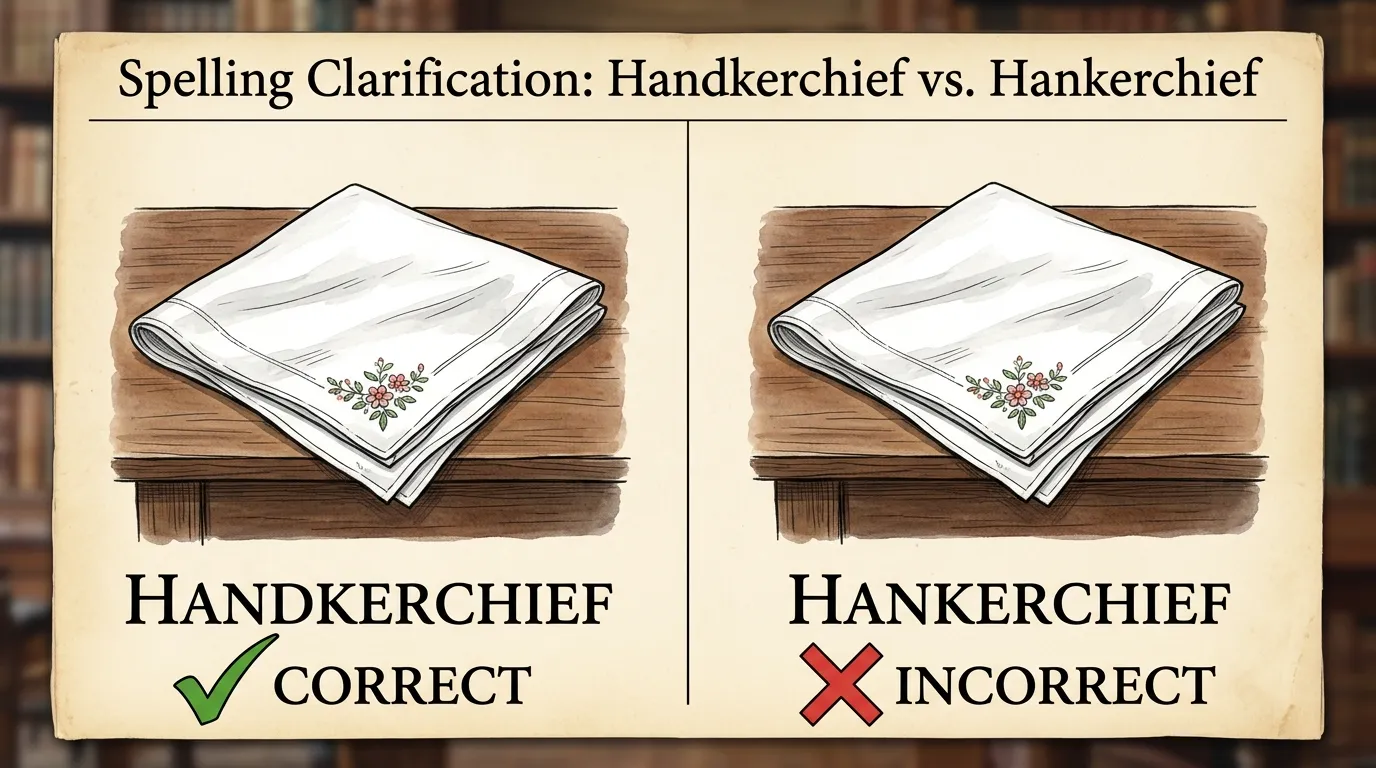
Have you ever wondered whether you should write handkerchief or hankerchief? You are not alone. Many people type or say Handkerchief or Hankerchief because the words sound very similar. The confusion happens in schools, workplaces, emails, social media posts, and even professional documents.
The simple answer is that handkerchief is the correct English spelling, while hankerchief is a common misspelling. Whether you use American English or British English, dictionaries recognize handkerchief as the standard word. The spelling hankerchief does not appear as a correct dictionary entry.
In this guide, you’ll learn the Handkerchief or Hankerchief meaning, correct spelling, grammar rules, pronunciation, examples, common mistakes, memory tricks, UK vs US English differences, and much more. By the end, you’ll know exactly which word to use and why.
Quick Answer
| ✅ Correct | ❌ Incorrect |
|---|---|
| Handkerchief | Hankerchief |
Correct: ✔ Handkerchief
Incorrect: ✘ Hankerchief
What Does “Handkerchief” Mean?
A handkerchief is a small square piece of cloth that people carry for personal hygiene or practical purposes. It is commonly used to wipe the face, nose, hands, or tears.
Part of Speech
Noun
Definition
A small cloth carried in a pocket or handbag for wiping the nose, face, or hands.
When Should You Use “Handkerchief”?
Use handkerchief whenever you are referring to the cloth itself.
Examples include:
- wiping your nose
- drying tears
- cleaning glasses
- folding into a pocket square (sometimes)
- carrying during weddings
- personal hygiene
Handkerchief Examples in American English
- I always carry a handkerchief in my jacket pocket.
- Grandpa offered me a clean handkerchief.
- She embroidered her initials on the handkerchief.
- The magician pulled a rabbit from a handkerchief.
- My father keeps a white handkerchief for church.
- Please wash the handkerchief with the towels.
- He used a cotton handkerchief during allergy season.
- I packed two handkerchiefs for the trip.
- The gift included a silk handkerchief.
- She folded the handkerchief neatly.
Handkerchief Examples in British English
- He keeps a handkerchief in his trouser pocket.
- Mum handed me a clean handkerchief.
- The gentleman carried a linen handkerchief.
- She dabbed her eyes with a handkerchief.
- His handkerchief matched his suit.
- The child forgot his handkerchief at school.
- Please iron my white handkerchief.
- The bride carried a lace handkerchief.
- He bought several cotton handkerchiefs.
- The old handkerchief belonged to his grandfather.
Why Is “Hankerchief” Incorrect?
The spelling hankerchief is simply a misspelling.
People often write it because:
- it sounds similar
- pronunciation hides the “d”
- people type quickly
- they have never seen the correct spelling
No major English dictionary recognizes hankerchief as the standard spelling.
Incorrect vs Correct Examples
| ❌ Incorrect | ✅ Correct |
|---|---|
| I bought a hankerchief. | I bought a handkerchief. |
| She lost her hankerchief. | She lost her handkerchief. |
| Please wash my hankerchief. | Please wash my handkerchief. |
| He folded the hankerchief. | He folded the handkerchief. |
| My hankerchief is white. | My handkerchief is white. |
Handkerchief vs Hankerchief Comparison Table
| Feature | Handkerchief | Hankerchief |
|---|---|---|
| Correct spelling | ✅ Yes | ❌ No |
| Dictionary word | Yes | No |
| Part of speech | Noun | None |
| Meaning | Small cloth | Misspelling |
| Used in UK English | Yes | No |
| Used in US English | Yes | No |
| Formal writing | Yes | Never |
| Everyday use | Yes | No |
Pronunciation Guide
Handkerchief
IPA (UK): /ˈhæŋ.kə.tʃɪf/
IPA (US): /ˈhæŋ.kɚ.tʃɪf/
Common pronunciation:
HANG-kuh-chif
Hankerchief
There is no official pronunciation because it is not a correct English word.
People usually pronounce it exactly like handkerchief, which explains the confusion.
Why Are These Words Commonly Confused?
Several reasons explain the mistake:
- Silent or softened “d” sound
- Fast pronunciation
- Typing errors
- Childhood spelling mistakes
- Hearing instead of reading the word
- Lack of exposure to the correct spelling
When spoken quickly,
handkerchief
often sounds like
hankerchief
even though the spelling never changes.
Word Origin and Etymology
The word handkerchief has an interesting history.
It comes from two words:
- hand
- kerchief
The word kerchief comes from Old French couvrechief, meaning “cover the head.”
Originally, a kerchief was cloth worn over the head.
Later, English speakers combined hand and kerchief, creating handkerchief, meaning a cloth carried in the hand.
The spelling has remained the same for hundreds of years.
The word hankerchief never developed as a separate English word. It appeared only because people misspelled handkerchief.
Synonyms of Handkerchief
| Synonym | American English | British English | Notes |
|---|---|---|---|
| Handkerchief | ✔ Preferred | ✔ Preferred | Standard word |
| Hanky | Common | Common | Informal |
| Hankie | Common | Common | Informal spelling |
| Tissue | Very common | Very common | Disposable alternative |
| Pocket square | Common | Common | Fashion accessory |
Which Synonym Should You Use?
- Handkerchief → formal and standard
- Hanky/Hankie → casual conversation
- Tissue → disposable paper
- Pocket square → decorative clothing accessory
Grammar Rule Behind the Correct Usage
Handkerchief is a countable noun.
Singular:
- a handkerchief
Plural:
- handkerchiefs
Examples:
- I bought a handkerchief.
- She owns five handkerchiefs.
Can It Be an Adjective?
Not normally.
However, it may appear in noun phrases like:
- handkerchief pocket
- handkerchief fabric
Handkerchief in Real-Life Situations
Please remember to pack a clean handkerchief for tomorrow’s meeting.
Office
John keeps a white handkerchief in his desk drawer.
Banking
A customer accidentally left a handkerchief at the bank counter.
Invoice
The order included twelve cotton handkerchiefs.
School
The teacher reminded students to bring a clean handkerchief.
Social Media
“My grandmother still carries a beautiful embroidered handkerchief.”
Rent Payment
The landlord found a forgotten handkerchief after the tenant moved out.
Everyday Conversation
“Do you have a spare handkerchief?”
10 More American English Sentences
- My dad never leaves home without a handkerchief.
- The store sells cotton handkerchiefs.
- She bought a silk handkerchief.
- He wiped his glasses with a handkerchief.
- Grandma collects vintage handkerchiefs.
- The gift box contained a handkerchief.
- I found a blue handkerchief.
- His handkerchief was folded perfectly.
- The actor carried a handkerchief.
- My uncle prefers cloth handkerchiefs.
10 More British English Sentences
- My grandfather always carries a handkerchief.
- She keeps a handkerchief in her handbag.
- His handkerchief was freshly washed.
- I borrowed a clean handkerchief.
- The gentleman unfolded his handkerchief.
- She stitched flowers onto the handkerchief.
- We bought linen handkerchiefs.
- He pressed the handkerchief with an iron.
- The handkerchief was beautifully embroidered.
- Everyone admired the vintage handkerchief.
Handkerchief Compared with Related Words
| Word | Purpose |
|---|---|
| Handkerchief | Reusable cloth |
| Tissue | Disposable paper |
| Napkin | Used during meals |
| Pocket square | Decorative accessory |
| Towel | Larger cloth for drying |
Common Mistakes and Corrections
1. Writing “Hankerchief”
❌ Wrong
✅ Handkerchief
2. Forgetting the “d”
Always remember:
Hand + kerchief
3. Using Tissue as a Synonym Everywhere
A tissue is disposable.
A handkerchief is reusable.
4. Confusing Pocket Square with Handkerchief
Pocket squares are decorative.
Handkerchiefs are practical.
5. Misspelling the Plural
❌ handkerchieves
✅ handkerchiefs
6. Capitalizing Unnecessarily
❌ Handkerchief
✅ handkerchief (unless beginning a sentence)
7. Thinking UK Uses “Hankerchief”
No.
Both British and American English use handkerchief.
Five Memory Tricks
1. Think “Hand”
You hold it in your hand.
2. Split the Word
Hand + kerchief
3. Remember the Letter “D”
Never drop the d.
4. Visualize Holding It
Picture holding a cloth in your hand.
5. Practice Writing It
Write:
handkerchief
five times.
Your brain will remember the spelling.
Frequently Asked Questions (FAQs)
Is handkerchief or hankerchief correct?
Handkerchief is correct. Hankerchief is a misspelling.
What does handkerchief mean?
It is a small reusable cloth used to wipe the nose, face, or hands.
Is hankerchief in the dictionary?
No. Standard English dictionaries list handkerchief, not hankerchief.
How do you pronounce handkerchief?
UK: /ˈhæŋ.kə.tʃɪf/
US: /ˈhæŋ.kɚ.tʃɪf/
Is there a UK vs US spelling difference?
No.
Both countries use handkerchief.
What is a synonym for handkerchief?
Common synonyms include:
- hanky
- hankie
- tissue (not identical)
- pocket square (decorative only)
Is handkerchief formal?
Yes.
It is appropriate in both formal and informal writing.
Is hanky acceptable?
Yes.
It is an informal nickname for handkerchief.
What is the plural of handkerchief?
Handkerchiefs.
People Also Ask
Why do people spell handkerchief as hankerchief?
Because the “d” is often not clearly heard when the word is spoken quickly. This leads many people to write the word the way it sounds instead of the way it is spelled.
Is “handkerchief” an old-fashioned word?
Not entirely. While disposable tissues are more common today, handkerchief is still widely used, especially for reusable cloths, fashion accessories, weddings, and cultural traditions.
Is “hanky” the same as “handkerchief”?
Yes, hanky (or hankie) is an informal, shortened form of handkerchief. It is common in everyday speech but less common in formal writing.
Do American and British dictionaries agree on the spelling?
Yes. Both American and British dictionaries recognize handkerchief as the correct spelling.
Can I use “handkerchief” in formal writing?
Absolutely. It is the standard and correct term for professional, academic, and everyday writing.
Conclusion
Choosing between Handkerchief or Hankerchief is actually very simple once you know the rule. Handkerchief is the only correct spelling recognized in both American English and British English, while hankerchief is simply a common spelling mistake caused by pronunciation. Remember that the word comes from hand + kerchief, making it easier to recall the correct form.
Whether you’re writing an email, completing schoolwork, preparing business documents, or chatting online, using handkerchief shows accurate spelling and strong language skills. By understanding its meaning, pronunciation, grammar, history, and common mistakes, you can use the word with confidence in any situation. Whenever you’re unsure, think of the phrase “a cloth for your hand”—and you’ll always remember to spell it handkerchief correctly.


