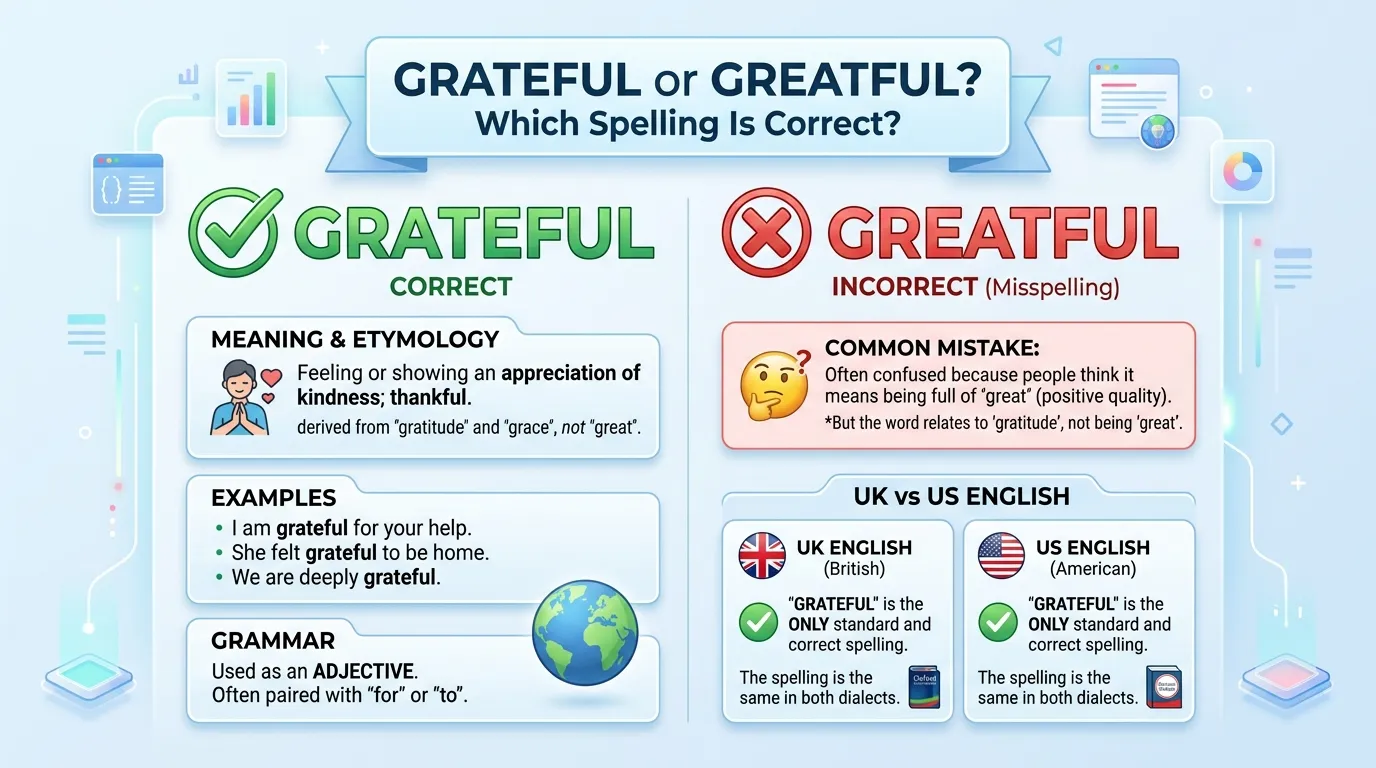
Have you ever stopped while writing grateful and wondered whether it should be spelled greatful instead? You are not alone. Many English learners, students, and even native speakers search for grateful or greatful because the pronunciation makes both spellings seem possible.
The quick truth is simple: grateful is the only correct spelling in both American and British English. Greatful is a common spelling mistake and is not recognized as a standard English word. People often confuse the two because grateful sounds like it is connected to the word great, but its history comes from a different source.
Whether you’re writing an email, school assignment, social media post, business letter, or thank-you message, using the correct spelling helps you appear more professional and confident. In this guide, you’ll learn the meaning of grateful, its pronunciation, grammar, origin, examples, common mistakes, and helpful memory tricks. You’ll also discover whether there is any difference between UK vs US English when using this word.
Quick Answer
| ✅ Correct | ❌ Incorrect |
|---|---|
| Grateful | Greatful |
Correct: Grateful means feeling thankful or appreciative.
Incorrect: Greatful is not a correct English spelling.
Example:
✅ I am grateful for your support.
❌ I am greatful for your support.
What Does “Grateful” Mean?
Grateful is an adjective that describes someone who feels thankful for kindness, help, or good fortune.
Definition
Grateful (adjective): Feeling or showing appreciation and thanks.
It is commonly used to express appreciation toward people, opportunities, gifts, or positive experiences.
Common Uses
- Feeling thankful
- Expressing appreciation
- Writing thank-you notes
- Professional emails
- Personal conversations
Examples:
- I’m grateful for your kindness.
- We are grateful for your donation.
- She felt grateful after receiving help.
Grammatical Role of “Grateful”
Part of Speech:
- Adjective
It describes a person’s feelings.
Examples:
- I am grateful.
- They were grateful.
- She feels grateful.
Common Structures
- grateful for something
- grateful to someone
- grateful that…
Examples:
- I’m grateful for your advice.
- We’re grateful to our teachers.
- I’m grateful that everyone arrived safely.
American English Examples
Here are ten examples commonly used in American English.
- I’m grateful for your help.
- She was grateful for the opportunity.
- We are grateful to our customers.
- Thank you—I truly feel grateful.
- Our family is grateful for your support.
- He remained grateful throughout his career.
- The company is grateful for employee dedication.
- I’m grateful that you called.
- She sent a grateful thank-you email.
- Everyone was grateful after the storm passed.
British English Examples
These sentences sound natural in British English.
- I’m grateful for your assistance.
- We are grateful to everyone involved.
- She felt grateful after the doctor’s advice.
- He was extremely grateful for the opportunity.
- The school is grateful for parents’ support.
- I’m grateful that everything worked out.
- They were grateful for the warm welcome.
- We’re grateful to our neighbours.
- She expressed her grateful appreciation.
- The charity remains grateful for every donation.
Why Is “Greatful” Incorrect?
Although great is a real English word, greatful is not.
Many people mistakenly assume that feeling thankful means feeling “full of great things.” However, English spelling does not work that way.
Standard dictionaries only recognize:
- grateful ✅
- gratefully ✅
- gratefulness ✅
They do not recognize:
- greatful ❌
- greatfully ❌
- greatfulness ❌
Incorrect vs Correct Examples
| ❌ Incorrect | ✅ Correct |
|---|---|
| I am greatful. | I am grateful. |
| We are greatful for your help. | We are grateful for your help. |
| She felt greatful today. | She felt grateful today. |
| I’m very greatful. | I’m very grateful. |
| Greatfully yours | Gratefully yours |
Grateful vs Greatful Comparison Table
| Feature | Grateful | Greatful |
|---|---|---|
| Correct spelling | ✅ Yes | ❌ No |
| Dictionary word | Yes | No |
| Part of speech | Adjective | None |
| Meaning | Thankful | No meaning |
| Used in writing | Yes | Never |
| UK English | Correct | Incorrect |
| US English | Correct | Incorrect |
| Formal writing | Yes | No |
Pronunciation Guide
| Word | IPA (US) | IPA (UK) |
|---|---|---|
| Grateful | /ˈɡreɪtfəl/ | /ˈɡreɪtfəl/ |
| Greatful | Not recognized | Not recognized |
Notice that grateful sounds very similar to great, which explains why many people accidentally add the extra e.
Why Are They Commonly Confused?
Several reasons explain this common mistake.
- The pronunciation sounds similar to “great.”
- People associate gratitude with greatness.
- Spell check may not always catch typed mistakes in every application.
- Children often learn the word by hearing it before seeing it written.
- English spelling has many irregular patterns.
Word Origin and Etymology
The word grateful comes from the Latin word gratus, meaning:
- pleasing
- thankful
- welcome
It entered English through Old French and Middle English.
The root grat- also appears in words like:
- gratitude
- congratulate
- ingratiate
- gratuitous
Notice that none of these words use great.
The spelling greatful developed simply as a spelling error because people connected it with the word great.
Synonyms of Grateful
| Synonym | American English | British English | Best Use |
|---|---|---|---|
| Thankful | Very common | Very common | Everyday speech |
| Appreciative | Common | Common | Professional writing |
| Obliged | Less common | More common | Formal British English |
| Indebted | Common | Common | Formal situations |
| Thanking | Rare | Rare | Literary use |
| Acknowledging | Moderate | Moderate | Business writing |
Which Synonym Should You Choose?
- Thankful is the simplest alternative.
- Appreciative sounds professional.
- Obliged appears more often in British English.
- Indebted suggests a stronger feeling of gratitude.
Grammar Rule Behind the Correct Usage
Since grateful is an adjective, it describes feelings.
Examples:
- She is grateful.
- They became grateful.
- We remain grateful.
Verb Form
The feeling comes from the verb thank.
Example:
- I thank you.
- I am grateful.
Noun Form
The related noun is:
gratitude
Example:
- She expressed her gratitude.
Adverb Form
gratefully
Example:
- He gratefully accepted the gift.
Grateful Compared with Related Words
| Word | Meaning |
|---|---|
| Grateful | Feeling thankful |
| Thankful | Feeling thanks |
| Gratitude | The feeling of thankfulness |
| Appreciate | To recognize value |
| Appreciative | Showing appreciation |
Example:
“I appreciate your help, and I am grateful for it.”
Common Mistakes and Corrections
1. Writing “greatful”
❌ greatful
✅ grateful
2. Confusing grateful with gratitude
❌ I feel gratitude.
✅ I feel grateful.
3. Using grateful as a verb
❌ I grateful you.
✅ I thank you.
4. Saying grateful to help
❌ I’m grateful to your help.
✅ I’m grateful for your help.
5. Wrong preposition
❌ grateful about
✅ grateful for
6. Wrong adverb
❌ greatfully
✅ gratefully
7. Forgetting the adjective
❌ I gratitude you.
✅ I appreciate you.
Real-Life Examples
Dear Sarah,
I’m grateful for your quick response.
Office
Our team is grateful for everyone’s hard work.
Banking
The bank is grateful for your continued trust.
Invoice
Thank you for your payment. We are grateful for your business.
School
Students were grateful to their teachers.
Social Media
Feeling grateful for another beautiful day.
Rent Payment
The landlord was grateful that the rent arrived early.
Everyday Conversation
“I’m really grateful you came.”
Ten More American English Sentences
- I’m grateful for your patience.
- She’ll always be grateful.
- We’re grateful to our community.
- He felt grateful after recovering.
- I’m grateful for every chance.
- The hospital is grateful for donations.
- Everyone seemed grateful.
- I remain grateful today.
- We’re grateful for your loyalty.
- They were grateful beyond words.
Ten More British English Sentences
- We’re grateful for your understanding.
- She was grateful to the volunteers.
- I’m grateful for your kindness.
- The village was grateful for the support.
- He felt grateful after the meeting.
- We’re grateful that you attended.
- The organisation remains grateful.
- Everyone felt grateful afterwards.
- She expressed grateful thanks.
- We are forever grateful.
Five Memory Tricks
1. Think of “gratitude”
Both begin with grat-.
2. Remember the phrase
Gratitude makes you grateful.
3. Never add “great”
Although it sounds similar, great is unrelated.
4. Learn the family
- gratitude
- grateful
- gratefully
All begin with grat-.
5. Dictionary Check
If you’re unsure, remember that every major dictionary lists grateful, never greatful.
Frequently Asked Questions
Is grateful or greatful correct?
Grateful is correct. Greatful is incorrect.
What does grateful mean?
It means feeling thankful or appreciative.
Is greatful a real word?
No. Standard English dictionaries do not recognize it.
How do you pronounce grateful?
US and UK IPA:
/ˈɡreɪtfəl/
Is there a UK vs US difference?
No. Both British and American English use grateful.
What is a synonym for grateful?
Common synonyms include:
- thankful
- appreciative
- obliged
- indebted
Is grateful formal?
It works in both formal and informal writing.
Can I use grateful in business emails?
Yes. It is common in professional communication.
What is the noun form of grateful?
The noun is gratitude.
People Also Ask
Why do people spell grateful as greatful?
Because the pronunciation sounds similar to the word great, many writers mistakenly insert an extra e. However, the correct spelling comes from the Latin root gratus, not from great.
Is grateful an adjective?
Yes. It describes the feeling of being thankful or appreciative.
Which dictionaries include “greatful”?
Major dictionaries such as the Oxford English Dictionary, Cambridge Dictionary, Merriam-Webster, and Collins list grateful as the correct spelling. Greatful is treated as a misspelling.
Is “grateful” appropriate in formal writing?
Absolutely. It is widely used in business emails, academic writing, speeches, reports, and professional correspondence.
How can I remember the correct spelling?
Think of the word family: gratitude → grateful → gratefully. All three begin with grat-, making them easier to remember.
Conclusion
The debate over grateful or greatful has one clear answer: grateful is the only correct spelling in both American and British English. Although greatful may seem logical because it resembles the word great, it is simply a common spelling mistake and should never be used in formal or informal writing.
Understanding the grateful meaning, pronunciation, grammar, and origin makes it much easier to remember the correct form. Whether you’re writing a thank-you email, a school assignment, a business message, or a social media post, choosing grateful shows strong language skills and attention to detail. Keep the simple memory trick in mind—gratitude leads to grateful—and you’ll avoid this mistake every time. With regular practice and the examples in this guide, using grateful correctly will soon become second nature.


