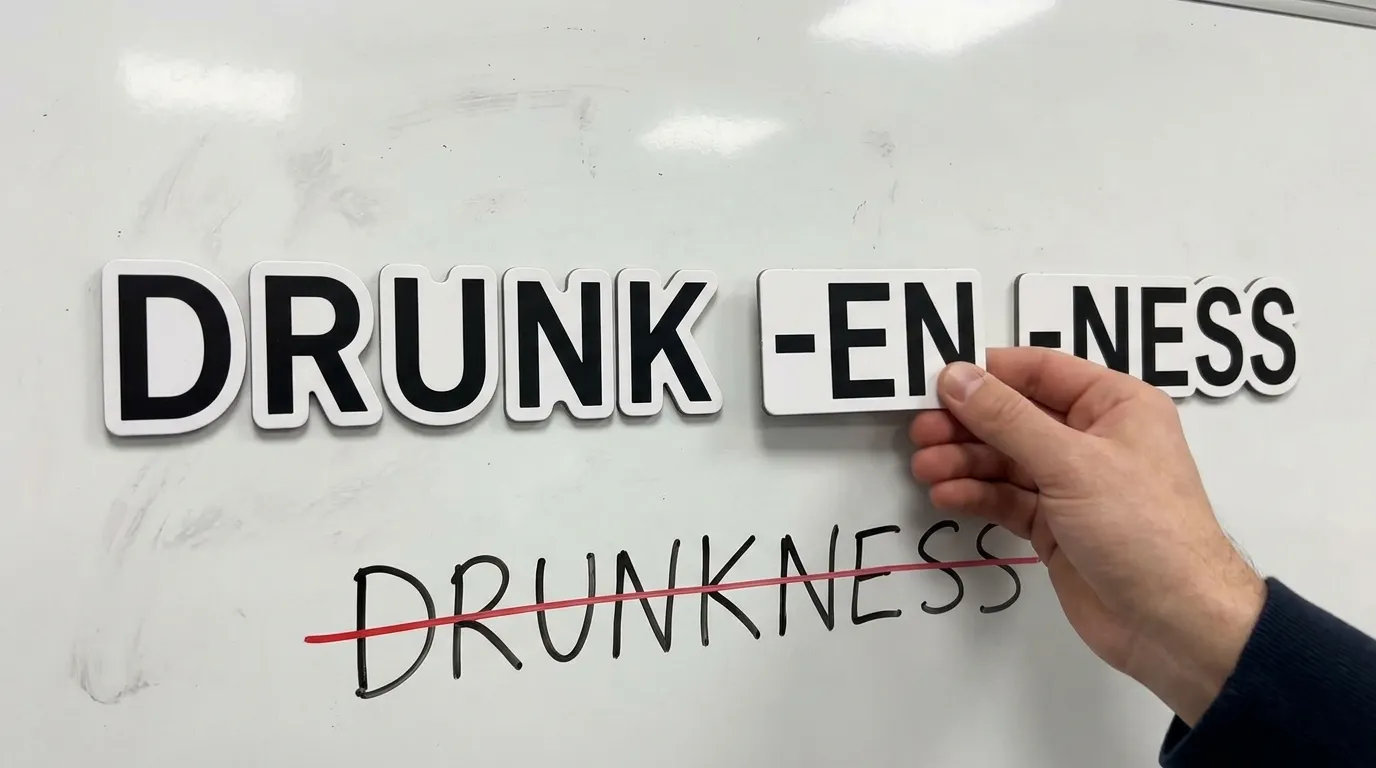
Have you ever wondered whether you should write drunkenness or drunkness? You’re not alone. Many English learners, students, writers, and even native speakers search for the difference between drunkenness or drunkness because both words seem logical. Since they both come from the adjective drunk, it’s easy to assume they are equally correct.
The short answer is simple: drunkenness is the standard and widely accepted English word. While drunkness does appear occasionally in informal speech or older writings, it is considered nonstandard and is rarely used in modern English. Most dictionaries, grammar guides, and style manuals recommend drunkenness.
This difference is the same in both American English and British English. Whether you’re writing an essay, email, business report, or social media post, drunkenness is almost always the correct choice. In this guide, you’ll learn the meaning of drunkenness, its grammar, pronunciation, history, examples, common mistakes, and practical tips so you’ll never confuse these two words again.
Quick Answer
| ✅ Correct | ❌ Incorrect |
|---|---|
| Drunkenness | Drunkness (nonstandard and rarely used) |
Correct Word: ✅ Drunkenness
Meaning: The state of being drunk or intoxicated by alcohol.
Incorrect Word: ❌ Drunkness
Although it occasionally appears in informal writing or historical texts, drunkness is not the standard English noun and should generally be avoided.
What Does “Drunkenness” Mean?
Drunkenness is a noun that describes the condition or state of being drunk after drinking too much alcohol.
Grammatical Role
- Part of speech: Noun
- Root word: Drunken (adjective) + -ness (noun suffix)
It refers to:
- Alcohol intoxication
- Impaired judgment caused by drinking
- A legal or medical condition involving excessive alcohol use
When Should You Use It?
Use drunkenness whenever you talk about:
- Legal matters
- Health discussions
- Academic writing
- News reports
- Everyday conversations
- Religious or historical texts
American English Examples
- Drunkenness can lead to serious accidents.
- The officer arrested him for public drunkenness.
- The company has a strict policy against workplace drunkenness.
- Drunkenness affects decision-making.
- They discussed the dangers of teenage drunkenness.
British English Examples
- Drunkenness remains a public health concern.
- The police dealt with several cases of drunkenness after the match.
- The council launched a campaign against street drunkenness.
- Drunkenness often leads to antisocial behaviour.
- The report examined alcohol-related drunkenness.
Why Is “Drunkness” Wrong?
Drunkness isn’t technically impossible from a word-formation standpoint, but modern English strongly prefers drunkenness.
Native speakers almost always use:
- drunkenness
- intoxication
- inebriation
instead of drunkness.
Incorrect vs Correct
❌ His drunkness caused problems.
✅ His drunkenness caused problems.
❌ Public drunkness is illegal.
✅ Public drunkenness is illegal.
❌ Her drunkness worried everyone.
✅ Her drunkenness worried everyone.
Drunkenness vs Drunkness Comparison Table
| Feature | Drunkenness | Drunkness |
|---|---|---|
| Standard English | ✅ Yes | ❌ No |
| Dictionary Acceptance | Yes | Rarely |
| Grammar | Correct noun | Nonstandard noun |
| Formal Writing | Yes | No |
| Academic Writing | Yes | Avoid |
| Legal Documents | Yes | No |
| US English | Common | Rare |
| UK English | Common | Rare |
| Everyday Speech | Common | Uncommon |
Pronunciation Guide
| Word | IPA (US) | IPA (UK) |
|---|---|---|
| Drunkenness | /ˈdrʌŋ.kən.nəs/ | /ˈdrʌŋ.kən.nəs/ |
| Drunkness | /ˈdrʌŋk.nəs/ | /ˈdrʌŋk.nəs/ |
Why Are They Confused?
People become confused because:
- Both come from drunk
- Both end in -ness
- English often forms nouns by adding -ness
- Learners assume every adjective follows the same rule
However, English keeps the older adjective drunken, making drunkenness the accepted noun.
Word Origin and Etymology
Drunkenness
The word comes from:
- Old English druncen, meaning “intoxicated”
- Middle English drunken
- The suffix -ness, meaning “state or condition”
For hundreds of years, English speakers have used drunkenness to describe intoxication.
Drunkness
Although it can be formed by combining drunk + -ness, it never became the preferred standard noun.
Modern dictionaries either omit it or label it as rare or nonstandard.
Grammar Rule Behind the Correct Usage
Many English nouns are created by adding -ness to adjectives.
Examples:
- Happy → Happiness
- Kind → Kindness
- Dark → Darkness
However, English has historical exceptions.
Instead of:
Drunk → Drunkness
English traditionally uses:
Drunken → Drunkenness
This is an example of a historical word surviving while a simpler form never became standard.
Parts of Speech
| Word | Part of Speech |
|---|---|
| Drink | Verb |
| Drunk | Adjective |
| Drunken | Adjective |
| Drunkenness | Noun |
| Intoxicate | Verb |
| Intoxication | Noun |
Drunkenness Meaning: Synonyms
| Synonym | US English | UK English | Formality |
|---|---|---|---|
| Intoxication | Very common | Very common | Formal |
| Inebriation | Common | Common | Formal |
| Alcohol intoxication | Common | Common | Medical |
| Impairment | Common | Common | Formal |
| Tipsiness | Common | Common | Informal |
| Being drunk | Very common | Very common | Informal |
| Alcohol abuse* | Common | Common | Different meaning |
*Alcohol abuse refers to a pattern of harmful drinking, not simply being drunk.
Which Synonyms Are Preferred?
American English
Most common:
- Intoxication
- Being drunk
- Drunkenness
British English
Most common:
- Drunkenness
- Intoxication
- Being drunk
Drunkenness Examples in Real Life
Office
Employee handbook:
Drunkenness at work may result in disciplinary action.
The manager wrote:
We have a zero-tolerance policy toward workplace drunkenness.
Banking
The bank denied liability because the customer acted while under severe drunkenness.
Invoice
Alcohol-related damages caused by drunkenness are not covered.
School
The lesson discussed the dangers of teenage drunkenness.
Social Media
Public drunkenness can ruin your reputation online.
Rent Agreement
The lease prohibits disorderly conduct resulting from drunkenness.
Everyday Conversation
His drunkenness embarrassed everyone at the wedding.
Ten American English Example Sentences
- Drunkenness caused the accident.
- Public drunkenness is against the law.
- His drunkenness worried his family.
- They studied alcohol-related drunkenness.
- Drunkenness affects judgment.
- Police responded to reports of drunkenness.
- Workplace drunkenness is unacceptable.
- Excessive drunkenness can damage health.
- The campaign reduced teenage drunkenness.
- Courts treat repeated drunkenness seriously.
Ten British English Example Sentences
- Drunkenness remains a serious concern.
- The police arrested him for drunkenness.
- The council addressed public drunkenness.
- Drunkenness often leads to violence.
- Hospital staff treated alcohol-related drunkenness.
- The report highlighted weekend drunkenness.
- Excessive drunkenness harms communities.
- Drunkenness affected his employment.
- Local authorities discouraged drunkenness.
- Parents discussed teenage drunkenness.
Common Mistakes and How to Fix Them
1. Using “drunkness”
❌ His drunkness
✅ His drunkenness
2. Confusing “drunk” with “drunken”
❌ Drunk behavior
✅ Drunken behavior (more formal)
3. Using “drunkenness” as an adjective
❌ Drunkenness driver
✅ Drunken driver
4. Saying “very drunkenness”
❌ Very drunkenness
✅ Extreme drunkenness
5. Mixing noun and adjective forms
❌ He showed drunk.
✅ He was drunk.
6. Using it for non-alcohol situations
❌ Drunkenness from medicine
Better:
✅ Intoxication from medication
7. Using it where “alcoholism” is intended
Drunkenness means temporary intoxication.
Alcoholism refers to a long-term medical condition.
Drunkenness vs Related Words
| Word | Meaning |
|---|---|
| Drunk | Intoxicated person or adjective |
| Drunken | Adjective describing intoxicated behavior |
| Drunkenness | State of being drunk |
| Intoxication | Medical or formal term |
| Alcoholism | Long-term alcohol dependence |
| Tipsiness | Mild intoxication |
Five Memory Tricks
1. Remember the hidden word
Drunken + ness = Drunkenness
2. Think of dictionaries
Every major dictionary lists drunkenness.
3. Think of newspapers
News reports always use public drunkenness, not public drunkness.
4. Remember the phrase
“Public drunkenness” is a fixed legal expression.
5. Think historically
English kept the older adjective drunken, so the noun became drunkenness.
Frequently Asked Questions (FAQs)
Is drunkenness or drunkness correct?
Drunkenness is the correct and standard word.
What does drunkenness mean?
It means the condition of being intoxicated by alcohol.
Is drunkness a real word?
It exists occasionally but is considered nonstandard and should generally be avoided.
Do Americans say drunkenness?
Yes. It is common in American English.
Do British people use drunkenness?
Yes. British English also prefers drunkenness.
Which dictionaries include drunkenness?
Major dictionaries such as Merriam-Webster, Cambridge, Oxford, and Collins include drunkenness as the standard form.
Is drunkenness formal?
Yes. It works in both formal and informal contexts.
What is another word for drunkenness?
Common alternatives include:
- Intoxication
- Inebriation
- Being drunk
- Alcohol intoxication
How do you pronounce drunkenness?
IPA:
/ˈdrʌŋ.kən.nəs/
Can I use drunkness in academic writing?
No. Academic writing should use drunkenness.
People Also Ask
Why isn’t drunkness commonly used?
English inherited the adjective drunken from earlier forms of the language, and the noun drunkenness became established over centuries. As a result, drunkness never became the standard form.
Is public drunkenness a legal term?
Yes. In many English-speaking countries, public drunkenness is a recognized legal expression used in laws, police reports, and court documents.
Is drunkenness always related to alcohol?
Usually, yes. If intoxication is caused by drugs or medication, terms like intoxication or impairment are often more accurate.
Can I say “his drunkenness affected his work”?
Yes. This is a grammatically correct and natural sentence in both American and British English.
Is “drunken” still used today?
Yes. Although drunk is more common in everyday conversation, drunken is still widely used in formal writing and set phrases such as drunken driving, drunken behavior, and drunkenness.
Conclusion
If you’ve been wondering whether to use drunkenness or drunkness, the answer is clear: drunkenness is the correct, standard, and widely accepted noun in both American and British English. It refers to the state of being intoxicated by alcohol and appears in dictionaries, legal documents, news reports, academic writing, and everyday speech. While drunkness may occasionally appear in informal or historical contexts, it is considered nonstandard and should generally be avoided.
By understanding the grammar, pronunciation, history, and correct usage of drunkenness, you can write and speak with greater confidence. Whenever you’re unsure, remember the common legal phrase public drunkenness—it’s a reliable reminder of the standard form. With the examples, comparison tables, memory tricks, and practical tips in this guide, you’ll be able to use drunkenness accurately in any situation.


