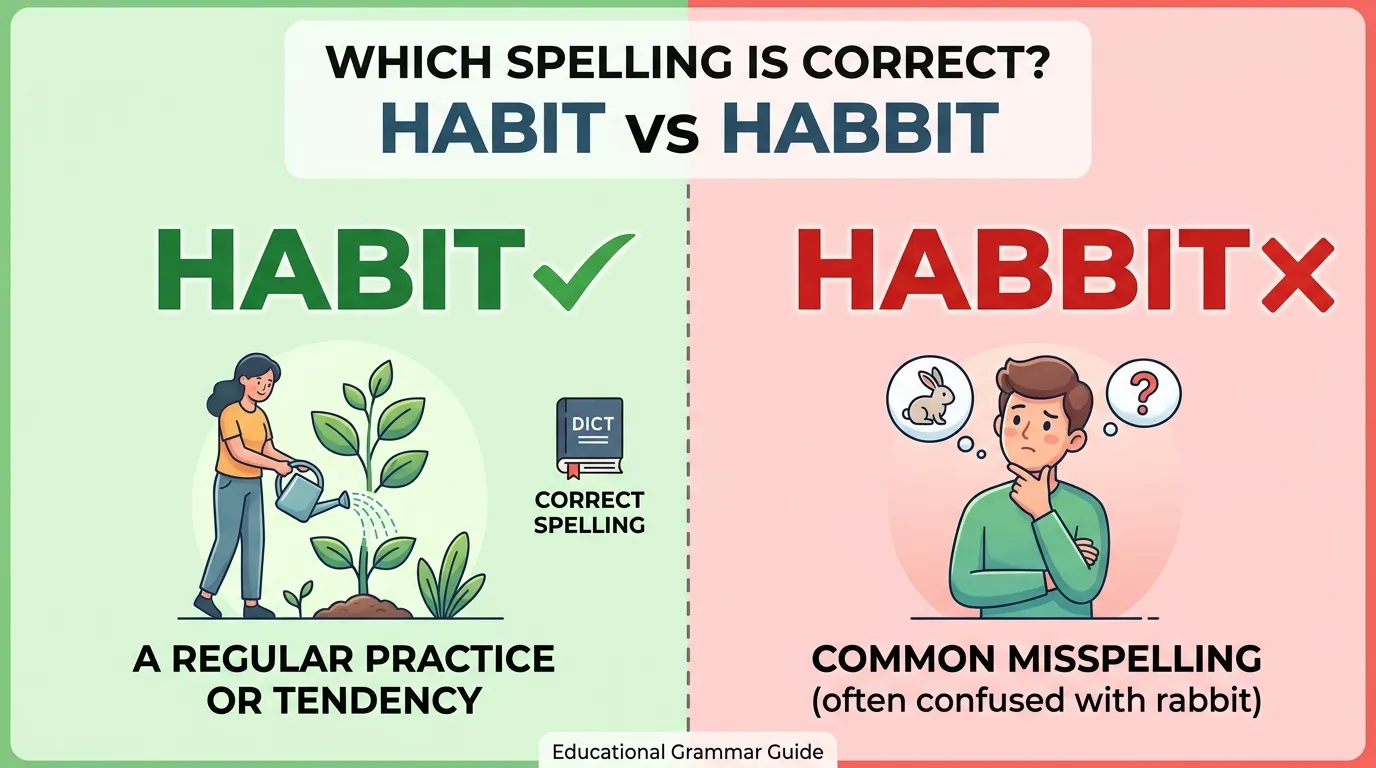
If you are wondering about habit vs habbit, the correct spelling is habit. Habbit is a common spelling mistake and is not a standard English word. The confusion happens because English has many words with double consonants, such as rabbit, hobby, and letter. It can feel natural to write habbit, especially when you hear the word pronounced quickly.
The correct word, habit, means something you do regularly or repeatedly. It can describe a daily routine, a personal behavior, or a repeated action. For example, you might say, “Reading before bed is a good habit.”
There is no UK vs US English spelling difference here. American English and British English both use habit. The spelling habbit is incorrect in both varieties.
Understanding the habit vs habbit difference is useful for students, ESL learners, office workers, and anyone who wants to write accurate English. Once you learn the spelling rule and a few simple memory tricks, this common mistake becomes easy to avoid.
Quick Answer
- ✅ Correct: habit
- ❌ Incorrect: habbit
- 🇺🇸 American English: habit
- 🇬🇧 British English: habit
- Meaning: a regular or repeated behavior or action
- Pronunciation: /ˈhæbɪt/
So, whenever you need this word, use habit, with only one b.
What Does Habit Mean?
The word habit is a noun. It describes something a person does regularly, often without thinking much about it.
For example:
- She has a habit of drinking coffee in the morning.
- Checking your phone constantly can become a habit.
- Going for a walk after dinner is a healthy habit.
- He has a bad habit of being late.
- Reading every night is a useful habit.
The habit meaning is therefore closely connected to repetition, routine, and behavior.
A habit can be good, bad, healthy, unhealthy, useful, or annoying.
Good habits
- Exercising regularly
- Saving money
- Reading books
- Getting enough sleep
- Keeping your workspace organized
Bad habits
- Smoking
- Procrastinating
- Spending too much money
- Staying up too late
- Interrupting people
The word can also refer to a regular pattern of behavior rather than a single action.
Habit as a Part of Speech
Habit is mainly used as a countable noun.
You can say:
- a habit
- one habit
- several habits
- good habits
- bad habits
The plural form is habits.
Common grammar patterns
have + a habit + of + -ing verb
I have a habit of checking my email early.
develop + a habit + of + -ing verb
She developed a habit of walking every evening.
break + a habit
He is trying to break his habit of eating late.
form + a habit
Children can form good study habits.
The word does not normally function as a verb in everyday modern English. Instead, English uses related verbs such as practice, repeat, develop, or get used to.
Habit Examples in American English
Here are natural habit examples commonly used in American English:
- I have a habit of checking my phone before breakfast.
- She developed a habit of exercising every morning.
- Saving money is a good habit.
- He is trying to break his bad habit of procrastinating.
- My dog has a habit of barking at the mail carrier.
There is nothing unusual about these sentences. The spelling remains habit in every example.
Habit Examples in British English
British English also uses habit in exactly the same way:
- I have a habit of drinking tea in the afternoon.
- She has developed a good habit of walking to work.
- He needs to break his habit of staying up late.
- Reading before bed is a useful habit.
- My brother has a habit of leaving his shoes by the door.
Notice that the spelling does not change between American and British English.
Habit vs Habbit: Comparison Table
| Feature | Habit | Habbit |
|---|---|---|
| Correct spelling | ✅ Yes | ❌ No |
| Meaning | A repeated behavior or routine | No standard English meaning |
| Part of speech | Noun | Not a standard English word |
| Singular | habit | habbit |
| Plural | habits | Not applicable |
| Pronunciation | /ˈhæbɪt/ | Not standard |
| American English | Correct | Incorrect |
| British English | Correct | Incorrect |
| Formal writing | Correct | Incorrect |
| Informal writing | Correct | Incorrect |
| Example | She has a good habit. | ❌ She has a good habbit. |
The key grammar difference is simple: habit is a real English noun, while habbit is simply a misspelling.
Why Is Habbit Wrong?
The spelling habbit contains an unnecessary second b.
The correct spelling is:
H-A-B-I-T
Not:
H-A-B-B-I-T
There is no spelling rule that adds a second b to habit.
For example:
❌ I have a habbit of waking up early.
✅ I have a habit of waking up early.
Another example:
❌ Exercise is a healthy habbit.
✅ Exercise is a healthy habit.
The incorrect version may look familiar because English contains many words with double consonants. However, spelling must be learned word by word when there is no general rule supporting the extra letter.
Incorrect and Correct Examples
| Incorrect | Correct |
|---|---|
| He has a bad habbit. | He has a bad habit. |
| Reading is a good habbit. | Reading is a good habit. |
| I want to change this habbit. | I want to change this habit. |
| She has several useful habbits. | She has several useful habits. |
| This habbit is difficult to break. | This habit is difficult to break. |
The plural form also uses only one b:
✅ habits
❌ habbits
Pronunciation Guide
The correct pronunciation of habit is:
IPA: /ˈhæbɪt/
It sounds roughly like:
HAB-it
The first syllable is stressed.
Why do people confuse the spelling?
The pronunciation can contribute to the confusion. The word contains a clear b sound, and learners may associate that sound with words that use double letters.
However, spelling and pronunciation do not always match perfectly in English.
For example:
- rabbit → double b
- hobby → double b
- habit → single b
This is why it is better to memorize the written form rather than guess the spelling from pronunciation.
There is no standard pronunciation for habbit because it is not a standard English word.
Word Origin and Etymology
The history of habit helps explain why the word looks the way it does.
Habit comes from Latin habitus, meaning a condition, appearance, character, or manner of being. It is related to the Latin verb habere, meaning “to have” or “to hold.”
The word passed through French before becoming part of English.
Over time, habit developed meanings connected with a person’s regular behavior, manner, or routine. It also gained an older meaning related to clothing or dress, although that use is much less common in everyday modern English.
Importantly, the historical development of the word does not involve a double b in its standard English spelling.
Habbit does not have a separate historical origin. It is simply a modern spelling error.
Habit Synonyms
If you are looking for a habit synonym, several words may work depending on the context.
| Synonym | Meaning | Common Use |
|---|---|---|
| routine | A regular pattern of activity | Everyday and professional English |
| practice | A repeated way of doing something | Formal and professional English |
| custom | A traditional or usual behavior | Social and cultural contexts |
| pattern | A repeated behavior or action | Formal and analytical contexts |
| tendency | A person’s usual inclination | Formal English |
| behavior | The way someone acts | General and academic English |
| ritual | A repeated action, often meaningful | Personal and social contexts |
For example:
Reading before bed is my habit.
You could also say:
Reading before bed is part of my routine.
The two words are similar, but they are not always interchangeable.
Habit usually focuses on a repeated behavior. Routine often describes an organized sequence of regular activities.
UK vs US English and synonyms
There is little difference in the use of habit between American and British English. Words such as routine, practice, custom, and behavior are also widely understood in both varieties.
British English often spells the related noun behaviour, while American English uses behavior. However, both varieties spell the target word as habit.
Seven Common Mistakes
Writing habbit instead of habit
❌ She has a bad habbit.
✅ She has a bad habit.
The second b is unnecessary.
Writing habbits for the plural
❌ Good habbits are important.
✅ Good habits are important.
Simply add s to habit.
Using habit as a regular verb
❌ I habit checking my email.
✅ I have a habit of checking my email.
English does not normally use habit as a verb in this way.
Confusing habit with routine
A habit is a repeated behavior. A routine is often a planned pattern of activities.
Brushing my teeth is a habit.
My morning routine includes breakfast, exercise, and reading.
Forgetting the article
❌ Reading is good habit.
✅ Reading is a good habit.
A singular countable noun normally needs a determiner such as a, an, the, my, or this.
Using the wrong verb form
❌ I have a habit to check my phone.
✅ I have a habit of checking my phone.
The common pattern is habit of + -ing.
Assuming UK and US spelling are different
❌ British English: habbit
❌ American English: habit
This is incorrect.
Both varieties use:
✅ habit
Habit in Real-Life Situations
The word appears in many everyday settings.
Emails
It is a good habit to review your email before sending it.
Offices
Taking short breaks during long work sessions can become a healthy habit.
Banking
Checking your bank balance regularly is a useful financial habit.
Invoices
Paying invoices on time is an important business habit.
Schools
Good study habits can help students perform better.
Social media
Checking social media every few minutes can become a difficult habit to break.
Rent payments
Paying your rent on time is an important financial habit.
Everyday conversations
I have a habit of forgetting where I put my keys.
These examples show how flexible the word habit is in real communication.
Habit in a Sentence: American English
Here are ten additional examples:
- My morning habit is to drink water before coffee.
- She has a habit of taking notes during meetings.
- I am trying to develop better study habits.
- His habit of interrupting people can be annoying.
- Walking after dinner is becoming a habit.
- Saving a small amount each week is a smart financial habit.
- She broke her habit of checking her phone at night.
- Good habits often make daily life easier.
- He developed the habit of reading every evening.
- Exercise has become a regular habit for me.
Habit in a Sentence: British English
Here are ten examples:
- Drinking tea in the afternoon is a common habit.
- She has a habit of arriving early.
- He is trying to develop better work habits.
- Reading newspapers was once a daily habit for many people.
- I need to break my habit of staying up late.
- Paying bills on time is a useful habit.
- She formed the habit of walking to the station.
- Good study habits can help pupils succeed.
- He has a habit of leaving his coat downstairs.
- Going for a walk after dinner has become a family habit.
Habit Compared With Related Expressions
Habit vs routine: A habit is a repeated behavior. A routine is a regular sequence of activities.
Habit vs custom: A habit is often personal. A custom is usually shared by a group or culture.
Habit vs practice: A practice can be a repeated method or activity, especially in professional settings.
Habit vs tendency: A tendency describes what someone is likely to do, but it does not always mean the behavior is repeated enough to be a habit.
For example:
She has a habit of checking her messages.
But:
She has a tendency to worry about small problems.
Grammar Rule for Beginners
The easiest rule is:
Habit is a countable noun, so use a determiner with a singular form.
Examples:
- a habit
- my habit
- this habit
- that habit
- several habits
A very useful sentence pattern is:
subject + have/has + a habit + of + verb-ing
Examples:
I have a habit of checking my phone.
She has a habit of arriving early.
They have a habit of eating dinner together.
Remember that the verb after of usually takes the -ing form.
Five Memory Tricks
Think of HABIT as HAB + IT
Break the word into:
HAB + IT
There is only one B.
Remember the short spelling
Think:
Habit is a short word with one B.
Connect it with routine
A habit is something you repeat. Both ideas are short and simple.
Watch out for rabbit
Remember:
rabbit = bb
habit = b
They may look similar, but their spellings are different.
Say it slowly
Pronounce it as:
HAB + it
When you picture the spelling while saying it, the single b becomes easier to remember.
Frequently Asked Questions
Is habit or habbit correct?
Habit is correct. Habbit is a spelling mistake.
What is the meaning of habit?
A habit is a behavior or action that a person does regularly or repeatedly.
Is habit spelled differently in British English?
No. Habit is the correct spelling in both British and American English.
How do you pronounce habit?
The IPA pronunciation is /ˈhæbɪt/. It sounds approximately like HAB-it.
What is a synonym for habit?
Common synonyms include routine, practice, custom, pattern, tendency, and ritual, depending on context.
Is habit formal or informal?
Habit is suitable for both formal and informal English. It can be used in academic writing, business communication, schoolwork, and everyday conversation.
Can habit be used as a verb?
In ordinary modern English, habit is mainly used as a noun. Common expressions include have a habit, develop a habit, and break a habit.
What is the plural of habit?
The plural is habits, with only one b.
Do dictionaries list habbit as correct?
Standard English dictionaries recognize habit. Habbit is not the standard spelling of the word.
People Also Ask
Why do people spell habit as habbit?
People often add a second b because English has many familiar words with double consonants. Words such as rabbit and hobby can make habbit look plausible, but the standard spelling is habit.
Is habit a noun or adjective?
Habit is primarily a noun. Related words include habitual, which is an adjective.
For example:
Checking his phone is a habit.
His habitual phone checking became distracting.
What is the correct usage of habit?
Common correct patterns include have a habit, develop a habit, form a habit, and break a habit.
She has a habit of reading before bed.
Is there a UK vs US English difference?
No. The spelling habit is standard in both British and American English. The word has the same basic meaning and pronunciation.
Is habbit ever correct?
Not when you mean the ordinary English word for a repeated behavior. In standard English writing, use habit.
Conclusion
The habit vs habbit question has a very simple answer: habit is correct, and habbit is incorrect. The correct word means a repeated behavior, action, or routine. It is a common noun used in everyday conversations, schools, workplaces, emails, banking, financial discussions, and many other settings.
The spelling is the same in American and British English, so there is no UK vs US spelling difference to remember. Just keep one b in habit.
Remember the useful pattern have a habit of + -ing: “I have a habit of checking my email.” If you see habbit in your writing, remove the extra b. With the pronunciation guide, etymology, examples, synonyms, and memory tricks above, you can now use habit confidently and avoid this common spelling mistake.


