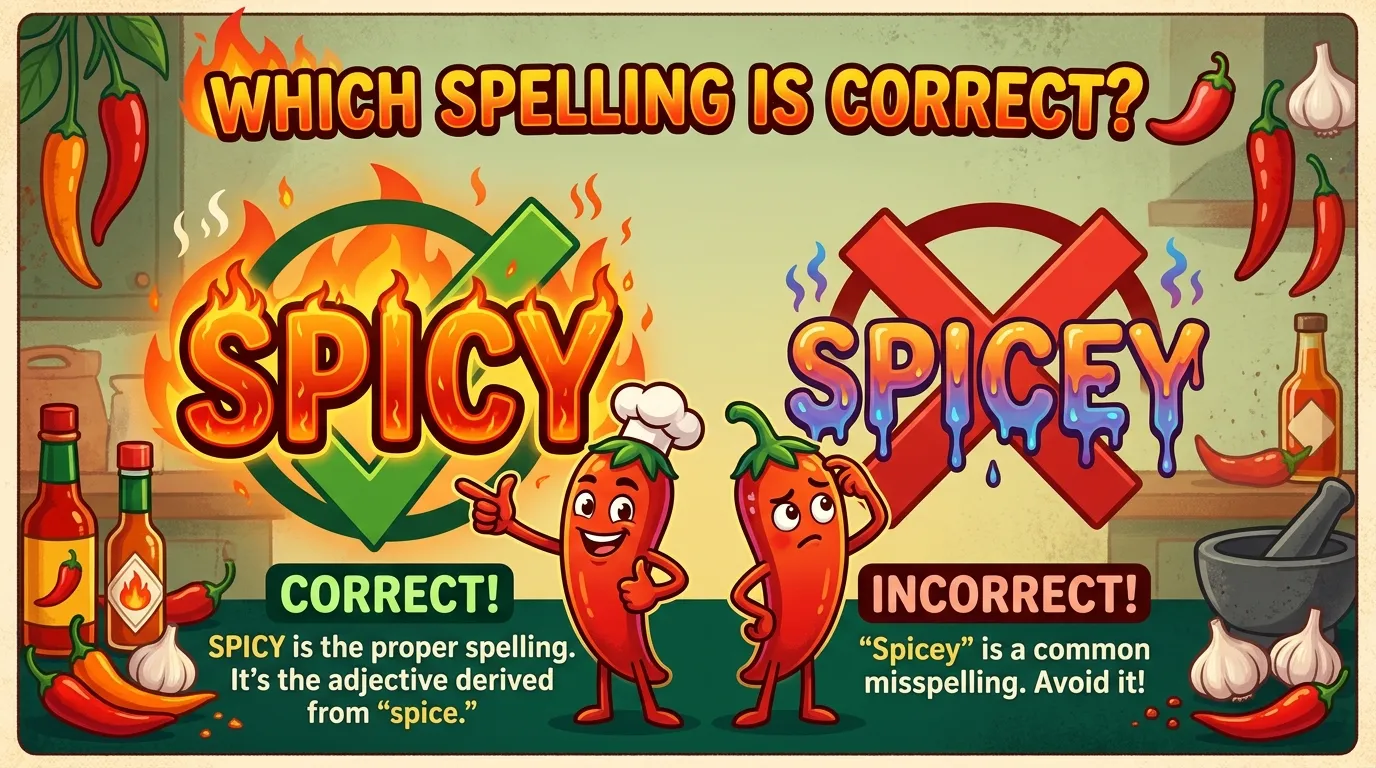
If you are wondering about spicy vs spicey, the correct spelling is spicy. The spelling spicey is generally considered incorrect in standard English. You should write spicy food, spicy sauce, and a spicy conversation, not spicey food, spicey sauce, or a spicey conversation.
People often confuse spicy vs spicey because the word comes from spice, and it feels natural to keep the final e when adding -y. However, English spelling has a common pattern in which a final silent e is dropped before a suffix beginning with a vowel. That gives us spice + y = spicy.
There is also no meaningful UK vs US English difference here. American and British English both use spicy as the standard spelling. Major dictionaries such as Cambridge and Oxford list spicy, with the pronunciation /ˈspaɪsi/.
So, if you are writing an email, school assignment, menu, invoice, social media post, or professional document, choose spicy.
Quick Answer: Spicy vs Spicey
| Form | Correct? | Explanation |
|---|---|---|
| spicy | ✅ Correct | Standard English spelling |
| spicey | ❌ Incorrect | Common spelling mistake |
| spicier | ✅ Correct | Comparative form |
| spiciest | ✅ Correct | Superlative form |
| spiciness | ✅ Correct | Noun form |
| spicily | ✅ Correct | Adverb form |
Correct: This curry is very spicy.
Incorrect: This curry is very spicey.
The key rule is simple: spice + y becomes spicy.
What Does Spicy Mean?
Spicy is an adjective. It describes something that contains or has the strong taste, flavor, or aroma of spices.
For example:
- I ordered a spicy curry.
- This sauce is too spicy for me.
- She loves spicy food.
- The restaurant serves spicy noodles.
Cambridge defines spicy as containing strong flavors from spices. Oxford gives a similar definition and also notes an informal meaning connected with something exciting or slightly shocking.
The word can also describe things that are not food. For example, a spicy story can mean an exciting or slightly shocking story. In informal modern English, spicy may also describe an argument, debate, or situation that becomes intense.
Merriam-Webster lists meanings including having the flavor or quality of spice, being lively, and being engagingly provocative.
Grammar Role of Spicy
Spicy is mainly an adjective.
Its common forms are:
- spicy — positive form
- spicier — comparative form
- spiciest — superlative form
- spiciness — noun
- spicily — adverb
Examples:
The soup is spicy.
This soup is spicier than yesterday’s soup.
That was the spiciest curry I have ever eaten.
I could not handle the spiciness.
The sauce was spicily seasoned.
Spicy vs Spicey: The Grammar Difference
The main difference between spicy and spicey is not meaning. It is spelling and standard usage.
Spicy is the accepted standard form. Spicey is normally a misspelling.
The reason is connected to the spelling of the base word spice.
When -y is added to create an adjective, the final silent e is removed:
spice + y → spicy
Compare:
- spice → spicy
- ice → icy
- noise → noisy
- shine → shiny
- taste → tasty
This pattern helps explain why spicey looks reasonable but is not the normal standard spelling.
Comparison Table
| Feature | Spicy | Spicey |
|---|---|---|
| Meaning | Having the flavor or quality of spices | Intended to mean the same thing |
| Standard spelling | ✅ Yes | ❌ No |
| Part of speech | Adjective | Nonstandard spelling |
| US English | spicy | spicey is a mistake |
| UK English | spicy | spicey is a mistake |
| Pronunciation | /ˈspaɪsi/ | Usually intended as /ˈspaɪsi/ |
| Comparative | spicier | spiceier is incorrect |
| Superlative | spiciest | spiceiest is incorrect |
| Noun | spiciness | spiceyness is incorrect |
| Formal writing | Use spicy | Avoid |
| Social media | Use spicy | May appear as an error or deliberate style |
Spicy vs Spicey Pronunciation
One reason this pair causes confusion is that spicy and the misspelled spicey are normally intended to sound alike.
Correct pronunciation
Spicy: /ˈspaɪsi/
It sounds like:
SPY-see
Cambridge gives /ˈspaɪ.si/ for both UK and US English, while Oxford gives /ˈspaɪsi/.
The spelling does not create a separate standard pronunciation for spicey because spicey is not the standard word.
Why Are They So Easy to Confuse?
The confusion comes from the word spice.
A learner may think:
spice + y = spicey
That seems logical at first glance.
But standard spelling gives us:
spice + y = spicy
The silent e disappears.
Spicy in American English: Examples
Here are natural examples of spicy in American English:
- I love spicy chicken wings.
- This salsa is too spicy for me.
- Can you make the tacos less spicy?
- She ordered a spicy noodle bowl.
- The restaurant has a very spicy curry.
- He added hot sauce to make the meal more spicy.
- My brother enjoys spicy Mexican food.
- The soup is flavorful but not too spicy.
- We bought a spicy barbecue sauce.
- That was the spiciest dish on the menu.
Spicy in British English: Examples
British English uses the same spelling:
- I quite enjoy spicy food.
- This curry is extremely spicy.
- Could you make the sauce less spicy?
- We had a spicy meal last night.
- She ordered a spicy chicken dish.
- The soup was rather spicy.
- He prefers mild food to spicy food.
- That was the spiciest curry I’ve ever tasted.
- The restaurant is famous for its spicy dishes.
- Would you like your curry spicy or mild?
There is no spelling change between British and American English. Both use spicy.
Why Is “Spicey” Wrong?
The incorrect spelling spicey usually happens because writers keep the final e from spice.
But the standard adjective is formed as:
spice → spicy
Not:
spice → spicey
This is a spelling issue, not a difference in meaning.
Incorrect and Correct Examples
❌ The curry is very spicey.
✅ The curry is very spicy.
❌ I don’t like spicey food.
✅ I don’t like spicy food.
❌ She ordered a spicey chicken sandwich.
✅ She ordered a spicy chicken sandwich.
❌ This sauce is too spicey.
✅ This sauce is too spicy.
❌ The meal became spicey after I added peppers.
✅ The meal became spicy after I added peppers.
The Word Origin and Etymology of Spicy
The story begins with spice.
Merriam-Webster traces spice to Middle English forms such as espece and espis, through Anglo-French, and ultimately to Late Latin species. The noun entered English centuries ago, and the verb developed later.
The adjective spicy developed from spice by adding the adjective-forming suffix -y. Merriam-Webster records the first known use of spicy in 1543.
So the spelling is not a recent American invention. Spicy has a long history in English.
The word’s meaning has also expanded. At first, it was closely connected to spices, flavor, fragrance, and seasoning. Today, it can also describe something lively, exciting, provocative, or intense.
Spicy Synonyms
The best spicy synonym depends on what you mean.
| Synonym | Best for | Example |
|---|---|---|
| hot | Food with strong heat | This curry is hot. |
| peppery | Pepper-like taste | The sauce tastes peppery. |
| fiery | Very hot or intense | It was a fiery chili. |
| pungent | Strong smell or taste | The cheese has a pungent smell. |
| piquant | Pleasantly sharp flavor | The dressing has a piquant taste. |
| seasoned | Food with added seasoning | The vegetables are well seasoned. |
| zesty | Fresh, sharp flavor | The sauce has a zesty taste. |
| flavorful | Strong or rich flavor generally | The dish is flavorful. |
In both American and British English, hot is especially common when talking about chili heat.
For example:
- US: “This sauce is really hot.”
- UK: “This sauce is really hot.”
However, hot can be ambiguous. It may mean high temperature rather than spicy flavor. Spicy is clearer when you mean seasoning or chili heat.
Seven Common Mistakes With Spicy
1. Writing “spicey”
❌ spicey food
✅ spicy food
2. Writing “spiceier”
❌ This curry is spiceier.
✅ This curry is spicier.
The correct comparative is spicier.
3. Writing “spiceiest”
❌ That was the spiceiest meal.
✅ That was the spiciest meal.
4. Writing “spiceyness”
❌ I could not handle its spiceyness.
✅ I could not handle its spiciness.
5. Assuming UK English uses “spicey”
It does not.
❌ British: spicey
✅ British: spicy
6. Assuming US English uses “spicey”
It does not.
❌ American: spicey
✅ American: spicy
7. Using “spicy” when “spiced” is better
These words are related but not identical.
Spicy means having a strong spice flavor or character.
Spiced means that something has had spices added to it.
For example:
- spicy curry = curry with a strong spicy flavor
- spiced cake = cake made with spices
Spicy in Real-Life Writing
Correct spelling matters in everyday communication.
Could you confirm whether the restaurant can prepare a spicy meal?
Office
The team discussion became a little spicy after the new proposal was announced.
Here, spicy is informal and means intense or heated.
Banking
Please confirm whether the bank charges are spicy.
This would sound humorous rather than professional. In banking, use high, large, or expensive instead.
Invoice
The invoice includes a charge for the spicy catering package.
School
Write a sentence using the adjective spicy.
Social Media
This new taco challenge is seriously spicy! 🌶️
Rent Payment
My rent went up, but the new restaurant downstairs has some spicy food.
Everyday Conversation
Do you like spicy food?
Yes, but not extremely spicy.
These examples show an important lesson: correct spelling and correct word choice are both important.
Spicy in a Sentence
If you are searching for spicy in a sentence, here are useful examples:
- The curry is spicy.
- I ordered a spicy burger.
- She made a spicy tomato sauce.
- These noodles are too spicy for my children.
- He prefers spicy food.
- We tried the spiciest dish.
- The salsa became spicier after I added chili peppers.
- The restaurant serves spicy Indian dishes.
- That was a surprisingly spicy conversation.
- The article contains some spicy details.
Spicy vs Related Words
It helps to separate spicy from nearby words.
Spicy vs Spiced
Spicy describes the character or taste.
Spiced describes something that has been prepared with spices.
This curry is spicy.
The cake is spiced with cinnamon.
Spicy vs Hot
Hot can mean spicy, especially in American English, but it can also mean high in temperature.
The soup is hot.
This could mean temperature.
The soup is spicy.
This clearly refers to flavor or heat from seasoning.
Spicy vs Seasoned
Seasoned means flavored with seasoning. It does not necessarily mean hot or chili-heavy.
A dish can be well seasoned but not spicy.
Five Easy Memory Tricks for Spicy
1. Drop the E
Remember:
SPICE − E + Y = SPICY
2. Think of “icy”
The word icy also loses the final e:
ice → icy
Do the same with:
spice → spicy
3. Remember “SPY-see”
The pronunciation sounds like SPY-see.
That can remind you that the spelling is spicy, not spicey.
4. Use “spicy, spicier, spiciest”
Learn the complete family:
spicy → spicier → spiciest
If you remember this pattern, spiceier and spiceiest will look wrong.
5. Picture a Chili Pepper
Imagine a chili pepper saying:
“Drop the E!”
SPICE → SPICY 🌶️
It is simple, but visual memory can make spelling easier.
Is “Spicy” Formal or Informal?
Spicy itself is a normal standard English adjective, so there is nothing informal about using it to describe food.
For example:
The restaurant serves spicy food.
That is perfectly suitable for formal writing.
However, newer figurative uses can be informal.
The meeting got spicy.
This means the meeting became heated or intense. It is conversational rather than formal.
Similarly:
She posted some spicy details online.
This may suggest shocking, provocative, or slightly risqué information.
Oxford marks this broader story-related use as informal.
UK vs US English: Is There Any Difference?
No spelling difference exists.
| Language variety | Correct spelling | Pronunciation |
|---|---|---|
| American English | spicy | /ˈspaɪsi/ |
| British English | spicy | /ˈspaɪsi/ |
| Canadian English | spicy | Similar |
| Australian English | spicy | Similar |
The important point is that UK vs US English does not explain the difference between spicy and spicey.
Both major varieties use spicy.
FAQs About Spicy vs Spicey
Is “spicy” or “spicey” correct?
Spicy is correct. Spicey is normally a misspelling.
What is the meaning of spicy?
Spicy means having a strong flavor or quality from spices. It can also describe something exciting, provocative, or intense in informal contexts.
Is “spicey” accepted in English?
It may appear in informal writing, names, usernames, or deliberate creative spelling, but it is not the standard spelling for the adjective.
How do you pronounce spicy?
Spicy is pronounced /ˈspaɪsi/, approximately SPY-see. Cambridge gives the same basic pronunciation for UK and US English.
What is the plural or comparative form of spicy?
The comparative is spicier, and the superlative is spiciest.
What is a synonym for spicy?
Depending on context, useful synonyms include hot, peppery, fiery, pungent, piquant, zesty, and flavorful.
Do British people spell it “spicey”?
No. British English uses spicy, just like American English.
Which dictionaries use “spicy”?
Major dictionaries including Cambridge, Oxford, and Merriam-Webster list spicy as the standard word.
Is spicy a formal word?
Yes. Spicy is a standard adjective and works well in formal writing when the meaning is appropriate. Figurative uses such as “a spicy argument” can be more informal.
People Also Ask
Is “spicey” a word?
Spicey can be found in informal or nonstandard writing, but it is not the standard spelling of the adjective. Use spicy in normal English.
Why is spicy not spelled spicey?
Because the final silent e in spice is dropped before the suffix -y. Therefore, spice + y = spicy.
Is spicy American or British?
It is used in both American and British English. There is no meaningful regional spelling difference.
Is spicy the same as hot?
Not always. Hot can refer to temperature, while spicy specifically points to flavor or seasoning. In food contexts, hot can also mean strongly chili-flavored.
What is the noun form of spicy?
The noun is spiciness.
I cannot handle the spiciness of this sauce.
What is the adjective form of spice?
The adjective is spicy.
This is a spicy dish.
What is the comparative form of spicy?
The comparative is spicier.
This curry is spicier than the other one.
What is the superlative form of spicy?
The superlative is spiciest.
This is the spiciest dish on the menu.
Final Takeaway
When choosing between spicy vs spicey, there is a clear winner: spicy. It is the standard English spelling in both American and British English. Major dictionaries use spicy, not spicey, and give it meanings connected with strong flavors, spices, and, in some contexts, exciting or provocative ideas.
The easiest way to remember the spelling is spice + y = spicy. Drop the silent e before adding -y. The same pattern appears in words such as ice → icy and noise → noisy.
So whether you are writing a school paper, professional email, menu, invoice, social media caption, or everyday message, use spicy.
Spicy = correct ✅
Spicey = incorrect in standard English ❌
Once you remember that simple spelling rule, the spicy vs spicey confusion becomes easy to avoid.


