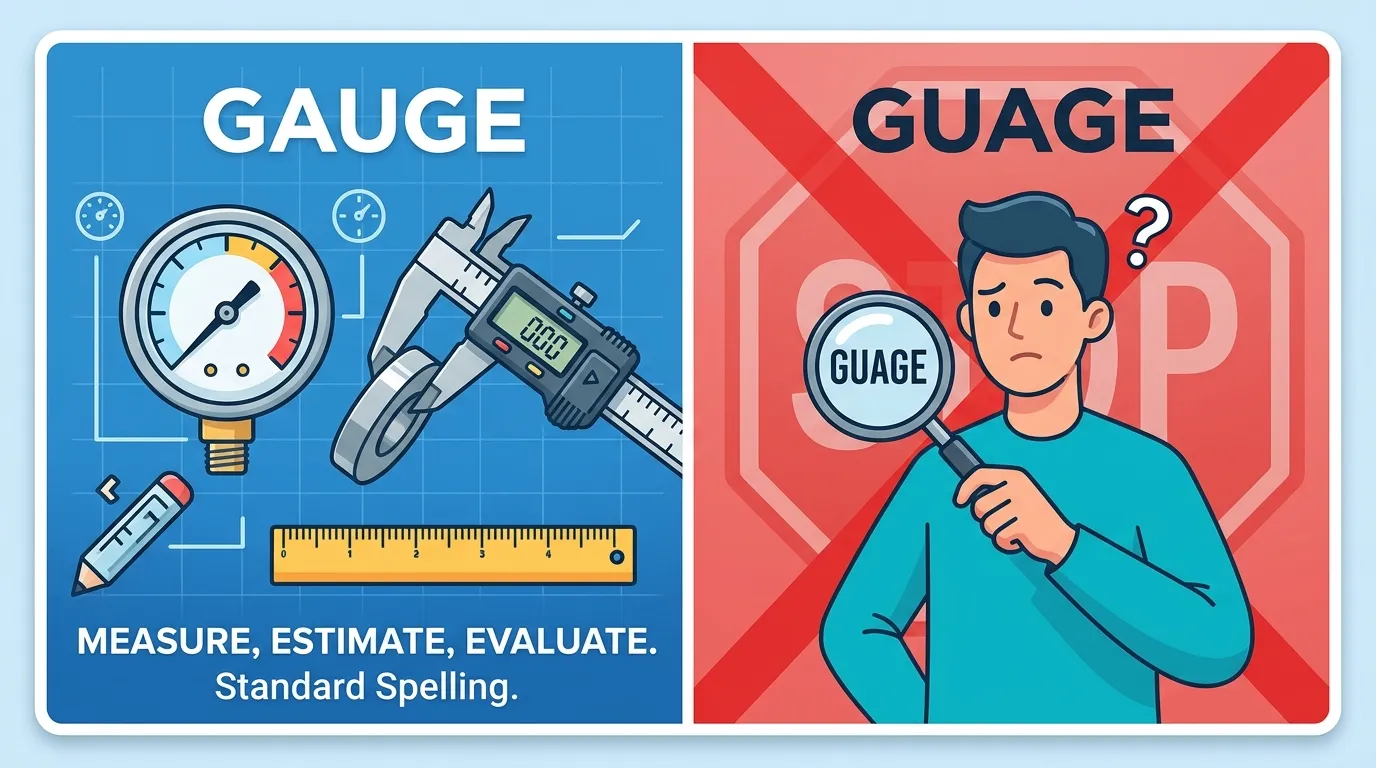
Have you ever typed “guage” and wondered if your spell checker was right to change it to “gauge”? You’re not alone. Many English learners, students, and even native speakers confuse Gauge or Guage because the correct spelling doesn’t match how the word sounds. The letters “au” and “ua” are easy to mix up, making this one of the most commonly misspelled English words.
The quick answer is simple: “gauge” is the correct spelling, while “guage” is a spelling mistake. This rule is the same in both American English and British English. Unlike words such as color/colour or center/centre, there is no UK vs US spelling difference for this word. Every major dictionary—including Merriam-Webster, Oxford, and Cambridge—recognizes gauge as the standard spelling.
In this guide, you’ll learn the Gauge meaning, Gauge examples, pronunciation, grammar rules, history, synonyms, memory tricks, common mistakes, and real-life examples so you’ll never confuse Gauge or Guage again.
Quick Answer
| ✔ Correct | ✘ Incorrect |
|---|---|
| Gauge | Guage |
Correct: ✅ Gauge
Incorrect: ❌ Guage
Remember: The correct spelling is always gauge in both American and British English.
What Does “Gauge” Mean?
The word gauge has several meanings depending on the context.
As a verb, it means:
- to measure
- to estimate
- to judge
- to evaluate
As a noun, it refers to:
- a measuring instrument
- a standard measurement
- the thickness, size, or capacity of something
Grammatical Role
| Part of Speech | Example |
|---|---|
| Noun | The fuel gauge is broken. |
| Verb | We need to gauge customer interest. |
When Should You Use “Gauge”?
Use gauge whenever you’re talking about:
- measuring something
- estimating a situation
- judging performance
- reading an instrument
- describing thickness or size
Examples include:
- pressure gauge
- rain gauge
- fuel gauge
- wire gauge
- gauge public opinion
American English Examples
- The fuel gauge shows the tank is full.
- We need to gauge customer satisfaction.
- The engineer checked the pressure gauge.
- The company uses a standard wire gauge.
- She couldn’t gauge his reaction.
- The manager gauged employee performance carefully.
- This gauge measures temperature.
- Investors gauged market risk before buying stocks.
- The doctor used a needle gauge suitable for children.
- It’s difficult to gauge demand during the holidays.
British English Examples
- The petrol gauge needs repairing.
- We should gauge public opinion first.
- The railway gauge varies in some regions.
- He checked the pressure gauge before starting.
- The electrician measured the wire gauge.
- Teachers gauge pupils’ progress regularly.
- The rain gauge recorded heavy rainfall.
- It is difficult to gauge the cost accurately.
- The mechanic replaced the faulty fuel gauge.
- The committee gauged community support carefully.
Why Is “Guage” Incorrect?
Guage is simply a misspelling.
It appears because people spell the word based on pronunciation instead of remembering its correct letter order.
No major English dictionary accepts guage as a standard English word.
Incorrect vs Correct Examples
| ❌ Incorrect | ✔ Correct |
|---|---|
| Please guage the results. | Please gauge the results. |
| The fuel guage is empty. | The fuel gauge is empty. |
| Can you guage his mood? | Can you gauge his mood? |
| Check the pressure guage. | Check the pressure gauge. |
| We need to guage demand. | We need to gauge demand. |
Gauge or Guage Comparison Table
| Feature | Gauge | Guage |
|---|---|---|
| Correct spelling | ✔ Yes | ✘ No |
| Dictionary word | Yes | No |
| Part of speech | Noun & Verb | None |
| Meaning | Measure or estimate | Misspelling |
| Formal writing | Yes | Never |
| Business writing | Yes | No |
| Academic writing | Yes | No |
| American English | Gauge | Not used |
| British English | Gauge | Not used |
Pronunciation Guide
| Word | IPA (US) | IPA (UK) |
|---|---|---|
| Gauge | /ɡeɪdʒ/ | /ɡeɪdʒ/ |
| Guage | Not recognized | Not recognized |
Why Are They Confused?
People hear the sound “gayj” and often assume the letters should be arranged as gua instead of gau.
Since English spelling isn’t always phonetic, many learners naturally write guage by mistake.
Word Origin and Etymology
The word gauge comes from Old French jauge, meaning measure or measuring rod.
Later, Middle English adopted the spelling as gauge, which became the accepted standard in modern English.
The spelling guage never developed as an official English word. It appeared only as a common spelling error.
Grammar Rule Behind Correct Usage
Gauge as a Verb
The verb follows normal English verb rules.
| Form | Example |
|---|---|
| Base | gauge |
| Present | gauge |
| Past | gauged |
| Past Participle | gauged |
| Present Participle | gauging |
Examples:
- I gauge.
- She gauges.
- They gauged.
- We are gauging demand.
Gauge as a Noun
Examples:
- pressure gauge
- rain gauge
- fuel gauge
- tire gauge
There is no adjective form commonly used as gauge. Instead, English uses phrases like:
- gauge measurement
- gauge reading
- gauged estimate
Synonyms of Gauge
| Synonym | American English | British English | Best Use |
|---|---|---|---|
| Measure | ✔ | ✔ | Physical measurement |
| Estimate | ✔ | ✔ | Guessing values |
| Assess | ✔ | ✔ | Formal evaluation |
| Evaluate | ✔ | ✔ | Business and education |
| Judge | ✔ | ✔ | Opinion or decision |
| Determine | ✔ | ✔ | Research |
| Calculate | ✔ | ✔ | Numbers |
| Check | ✔ | ✔ | Everyday English |
Which Synonyms Are Preferred?
In both American and British English:
- Measure is best for physical objects.
- Estimate is common when guessing.
- Assess is popular in business and education.
- Evaluate is preferred in formal writing.
Common Mistakes (and How to Fix Them)
1. Writing “guage”
❌ Please guage the results.
✔ Please gauge the results.
2. Using gauge when you mean estimate
Sometimes estimate sounds more natural.
Example:
✔ We estimated the project cost.
3. Confusing gauge with gage
Some technical industries use gage, but general English prefers gauge.
4. Forgetting verb endings
❌ He gauge the situation.
✔ He gauged the situation.
5. Wrong pronunciation spelling
People spell the word exactly how they hear it.
Always remember:
GAU + GE
6. Using guage in professional emails
Spell check before sending business documents.
7. Assuming UK and US spell differently
They don’t.
Both countries use gauge.
Real-Life Examples
Office
“We need to gauge employee satisfaction before making changes.”
“Please gauge customer feedback before tomorrow’s meeting.”
Banking
“The bank tries to gauge financial risk before approving loans.”
Invoice
“The accountant gauged the total project cost carefully.”
School
“The teacher gauged students’ understanding with a short quiz.”
Social Media
“It’s difficult to gauge public opinion from one viral post.”
Rent Payment
“The landlord gauged the market before increasing the rent.”
Everyday Conversation
“I can’t gauge whether she’s joking.”
Gauge in Sentences
American English
- I checked the fuel gauge.
- The manager gauged customer needs.
- We gauge success using data.
- The pressure gauge failed.
- Engineers inspect every gauge.
- She gauged the audience’s reaction.
- We gauged the distance quickly.
- The company gauges employee morale.
- This gauge measures air pressure.
- They gauged market demand.
British English
- The petrol gauge is accurate.
- We gauged local support.
- The rain gauge collected water overnight.
- Engineers checked the gauge.
- She gauged the team’s confidence.
- It is hard to gauge the outcome.
- They gauged customer expectations.
- The railway gauge differs across countries.
- The pressure gauge needs replacing.
- The inspector gauged the equipment.
Gauge Compared with Related Words
| Word | Meaning |
|---|---|
| Gauge | Measure or estimate |
| Measure | Find exact size or amount |
| Assess | Judge quality |
| Estimate | Approximate value |
| Evaluate | Examine carefully |
| Calculate | Compute mathematically |
When to Use Each
- Gauge → estimate or measure generally.
- Measure → exact physical measurement.
- Estimate → rough guess.
- Assess → formal evaluation.
- Calculate → mathematical answer.
Memory Tricks
1. Think of “GAU”
The correct word always starts with GAU.
2. Remember “Gauge the Gauge”
The instrument itself is called a gauge.
3. Dictionary Trick
Oxford, Cambridge, and Merriam-Webster all spell it gauge.
4. Visual Trick
Picture the word:
GAU + GE
Never switch the middle letters.
5. Spell Check Reminder
If your computer changes guage to gauge, trust it.
Frequently Asked Questions
1. Is it gauge or guage?
The correct spelling is gauge.
2. Is guage a real word?
No. It is a common misspelling.
3. What does gauge mean?
It means to measure, estimate, judge, or a measuring instrument.
4. How do you pronounce gauge?
It is pronounced /ɡeɪdʒ/.
5. Is gauge used in American English?
Yes.
6. Is gauge used in British English?
Yes. The spelling is identical.
7. What is a synonym for gauge?
Common synonyms include:
- measure
- estimate
- assess
- evaluate
- judge
8. Is gauge formal?
Yes. It is suitable for formal, academic, and professional writing.
9. Can gauge be both a noun and a verb?
Yes. It functions as both.
10. Which dictionaries recognize gauge?
Oxford, Cambridge, Collins, Merriam-Webster, and Dictionary.com all list gauge as the correct spelling.
People Also Ask
Why do people spell gauge as guage?
Because the pronunciation does not clearly show the correct letter order. Many people write the word the way it sounds rather than memorizing its spelling.
Is “guage” accepted anywhere?
No. It is considered a spelling error in both American and British English.
Is there a UK vs US difference for gauge?
No. Both varieties of English use gauge with the same spelling and meaning.
What part of speech is gauge?
It can be a noun (a measuring instrument or standard) or a verb (to measure, estimate, or judge).
Can I use gauge in formal writing?
Yes. It is widely used in business reports, academic papers, technical manuals, engineering, finance, and everyday professional communication.
Conclusion
If you’ve ever wondered whether to write Gauge or Guage, the answer is clear: gauge is the only correct spelling. It is accepted in both American and British English, appears in every major dictionary, and can be used as both a noun and a verb. Whether you’re talking about a fuel gauge, gauging customer satisfaction, or gauging public opinion, the spelling never changes.
Guage is simply a common typo caused by the word’s unusual letter order. By remembering the spelling pattern GAU + GE, practicing with real-world examples, and using the memory tricks in this guide, you’ll avoid this mistake with confidence. Whenever you write emails, reports, school assignments, or social media posts, choose gauge to ensure your English is accurate, professional, and clear.


