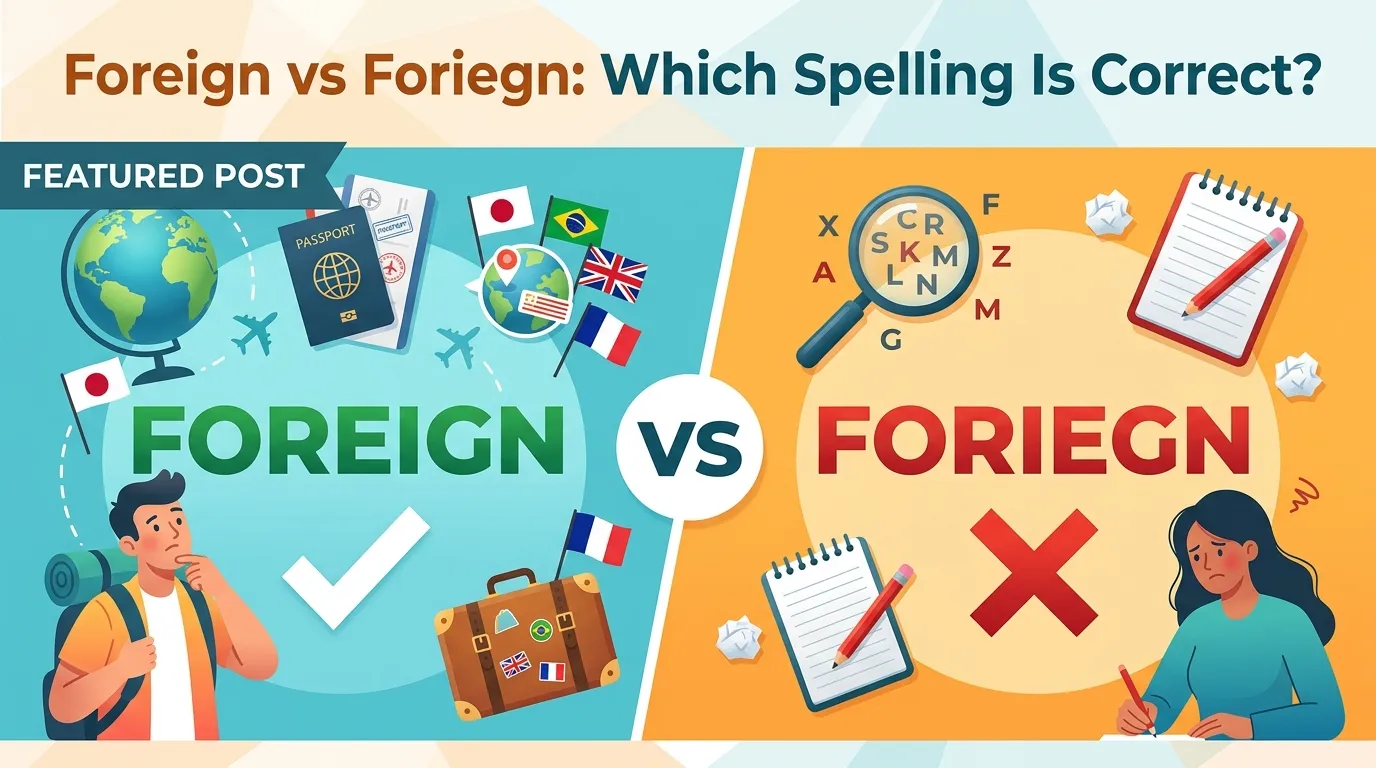
If you have ever typed “foriegn” instead of “foreign,” you are not alone. These two spellings look remarkably similar, and the unusual placement of the letters e and i makes this word a common spelling trap for English learners and native speakers alike.
The correct spelling is foreign. The spelling foriegn is incorrect in standard English.
The word foreign is an adjective that generally describes something or someone connected with another country or unfamiliar with one’s own country. For example, you might talk about foreign languages, foreign travel, foreign policy, foreign students, or foreign products.
In this guide, you will learn the difference between foreign and foriegn, how to pronounce foreign, what the word means, why its spelling causes confusion, how it is used in American and British English, and how to remember the correct spelling permanently.
Quick Answer: Foreign or Foriegn?
Foreign is the correct spelling.
Foriegn is a misspelling.
| Spelling | Correct? | Meaning | Example |
|---|---|---|---|
| Foreign | ✅ Yes | Related to another country or something unfamiliar | She speaks three foreign languages. |
| Foriegn | ❌ No | No standard English meaning; spelling error | ❌ She speaks three foriegn languages. |
Correct:
The company imports foreign products.
Incorrect:
The company imports foriegn products.
A simple way to remember the spelling is:
foreign = foreign
Notice that the letters are -e-i-, not -i-e-.
What Does “Foreign” Mean?
Foreign is primarily an adjective. It has several closely related meanings depending on context.
1. Related to another country
The most common meaning is something connected with a country other than one’s own.
Examples:
- She enjoys watching foreign movies.
- He is learning a foreign language.
- The company sells foreign cars.
- We exchanged money before our foreign trip.
- The government changed its foreign policy.
Here, foreign means from, belonging to, or connected with another country.
2. Coming from another country
The word can describe people, products, ideas, foods, or customs that originate somewhere else.
For example:
- foreign students
- foreign tourists
- foreign goods
- foreign investment
- foreign food
- foreign technology
- foreign currency
3. Unfamiliar or strange
Foreign can also mean unfamiliar, strange, or outside one’s normal experience.
For example:
The technical terminology was completely foreign to me.
In this sentence, foreign does not mean that the terminology came from another country. It means the terminology was unfamiliar.
Another example:
The idea of working at night was foreign to him.
This means the idea was unfamiliar or unusual to him.
What Does “Foriegn” Mean?
Foriegn is not the correct spelling of the English word.
It is simply a common spelling mistake for foreign.
You may see foriegn in:
- Social media posts
- Online comments
- Student writing
- Emails
- Search queries
- Informal messages
- Draft documents
However, it should not be used in polished writing.
Incorrect:
I want to study a foriegn language.
Correct:
I want to study a foreign language.
The incorrect spelling does not create a different word. It is simply a misspelling.
Why Do People Confuse Foreign and Foriegn?
The spelling of foreign is confusing because it does not follow the spelling pattern many English learners expect.
People often remember the word as:
for + eign
But when writing quickly, they may reverse the e and i and produce:
for + iegn
This creates foriegn.
The main spelling problem
The confusing sequence is:
foreign → e-i
not:
foriegn → i-e
This is similar to other English spelling words that contain unexpected letter combinations.
The pronunciation also contributes to the confusion because the written letters eign do not sound exactly as a learner might expect.
Foreign vs Foriegn: The Key Difference
There is only one meaningful difference between these two forms:
Foreign is correct; foriegn is incorrect.
This is not a case like affect vs effect, where both words have separate meanings.
It is also not like stationary vs stationery, where both spellings are legitimate words.
Instead, foreign is the standard English word, while foriegn is a spelling error.
Compare:
- foreign → correct
- foriegn → incorrect
- foreign language → correct
- foriegn language → incorrect
- foreign country → correct
- foriegn country → incorrect
- foreign policy → correct
- foriegn policy → incorrect
How Do You Pronounce “Foreign”?
In American English, foreign is generally pronounced approximately like:
FOR-in
The final letters -eign do not create a separate syllable.
Pronunciation
Foreign: /ˈfɔːrən/ or /ˈfɔrən/, depending on pronunciation system and accent.
A simple pronunciation guide is:
FOR-in
The word normally has two syllables.
Example
Foreign languages can open new career opportunities.
You would pronounce foreign approximately as:
FOR-in languages
The spelling and pronunciation are therefore somewhat different, which can make the word harder to spell correctly.
Is “Foreign” an Adjective or Noun?
Foreign is most commonly used as an adjective.
It modifies a noun.
Examples:
- foreign country
- foreign language
- foreign student
- foreign company
- foreign policy
- foreign market
- foreign currency
- foreign investment
For example:
She works for a foreign company.
Here, foreign describes the company.
Can “foreign” be a noun?
Historically and in some contexts, foreign can appear in noun-like expressions, especially in older or specialized usage. However, modern standard English overwhelmingly uses foreign as an adjective.
For everyday writing, learners should treat foreign primarily as an adjective.
Common Meanings of Foreign in Everyday English
The meaning of foreign depends heavily on the noun or phrase that follows it.
Foreign country
A country other than one’s own.
They moved to a foreign country for work.
Foreign language
A language that is not one’s native or usual language.
Spanish was my first foreign language.
Foreign student
A student from another country, although terms such as international student may be more natural and inclusive in many modern contexts.
The university welcomes international students from around the world.
Foreign food
Food associated with another country’s cuisine.
The restaurant serves foreign and local dishes.
Foreign currency
Money issued by another country.
You may need foreign currency when traveling abroad.
Foreign policy
A government’s strategy and relationships concerning other countries.
The president discussed the nation’s foreign policy.
Foreign investment
Money invested by individuals, businesses, or institutions from another country.
Foreign investment can contribute to economic development.
Foreign vs International: Are They the Same?
Not always.
Foreign and international can overlap, but they often carry slightly different meanings.
Foreign usually emphasizes something coming from or relating to another country.
International often emphasizes interaction, activity, or relationships involving multiple countries.
Compare:
The company sells foreign products.
This emphasizes products originating outside the country.
The company has international operations.
This emphasizes business activity across multiple countries.
Another example
She is a foreign student.
This is grammatically possible, but international student is often the more natural expression in modern educational contexts.
She is an international student.
This sounds more neutral and is widely used by universities.
Foreign vs Overseas
These words can also overlap, but they are not always interchangeable.
Foreign generally means related to another country.
Overseas traditionally refers to another country or region across the sea, although modern usage can be broader.
Examples:
The company has foreign investors.
The company has overseas offices.
The first focuses on the investors’ connection to another country. The second focuses on offices located abroad.
Foreign vs Abroad
Foreign and abroad have different grammatical functions.
Foreign is usually an adjective.
Abroad is usually an adverb.
Correct:
She works abroad.
Correct:
She works for a foreign company.
Incorrect:
She works foreign.
Incorrect:
She works for an abroad company.
A useful distinction is:
- foreign + noun
- abroad usually describes an action or situation
Common Collocations With “Foreign”
A collocation is a combination of words that naturally occur together.
Learning common collocations can help you use foreign correctly.
Common examples
- foreign language
- foreign country
- foreign national
- foreign student
- foreign visitor
- foreign tourist
- foreign company
- foreign business
- foreign market
- foreign investment
- foreign currency
- foreign exchange
- foreign policy
- foreign affairs
- foreign relations
- foreign trade
- foreign aid
- foreign minister
- foreign government
- foreign government official
- foreign media
- foreign technology
- foreign film
- foreign literature
Example sentences
I studied a foreign language in college.
The company entered a new foreign market.
Foreign investment increased during the year.
She enjoys reading foreign literature.
The minister discussed foreign affairs.
Foreign in Business and Professional Writing
The word foreign is common in business English, economics, finance, government, and international relations.
Examples:
- foreign investment
- foreign exchange
- foreign markets
- foreign trade
- foreign ownership
- foreign suppliers
- foreign customers
- foreign competitors
For example:
The business is expanding into foreign markets.
This is appropriate for professional writing.
However, writers should be precise about what they mean. In some contexts, international, overseas, global, or cross-border may communicate the idea more accurately.
Compare:
Foreign market
A market located outside the speaker’s or company’s home country.
International market
A market involving multiple countries.
Global market
A worldwide market or broad international marketplace.
Cross-border trade
Trade that specifically crosses national borders.
Choosing the right term makes professional writing more precise.
Foreign in Academic Writing
Academic writing frequently uses foreign in areas such as:
- Language studies
- International relations
- Political science
- Economics
- History
- Sociology
- Business
- Anthropology
Examples:
Foreign language education has changed significantly over the past decade.
The study examines foreign investment patterns.
Researchers analyzed foreign policy decisions.
However, academic writers should avoid using foreign when a more precise term is available.
For example, international students may be preferable to foreign students in many university contexts.
Foreign in Journalism
Journalists often use terms such as:
- foreign policy
- foreign affairs
- foreign minister
- foreign government
- foreign correspondent
- foreign markets
- foreign media
Example:
The foreign minister met with international leaders on Tuesday.
In journalism, accuracy and neutrality matter. The writer should choose language that clearly identifies the relevant country, region, or international relationship when necessary.
Foreign in Politics
One of the most common political expressions is:
foreign policy
Foreign policy refers to a government’s approach to its relationships with other nations.
Examples:
The administration announced changes to its foreign policy.
Foreign policy remains an important election issue.
Another common expression is:
foreign affairs
This refers broadly to matters involving relationships between a country and other countries.
She has extensive experience in foreign affairs.
Foreign in Technology and Science
The word can also appear in technical and scientific contexts.
For example:
- foreign key
- foreign material
- foreign object
- foreign body
- foreign data
- foreign language processing
Foreign key
In database terminology, a foreign key is a field or group of fields that links one table to another table.
This is a specialized technical meaning.
Foreign body
In medicine and biology, foreign body can refer to an object or substance that is present where it does not normally belong.
For example:
The scan revealed a foreign body.
Thus, the word foreign does not always refer to nationality or geography.
Foreign in Sports
Sports writing can use foreign to describe athletes, players, teams, competitions, or participants from another country.
Examples:
The club signed several foreign players.
Foreign athletes competed in the tournament.
However, modern sports organizations may prefer more precise terms such as international players, overseas players, or the specific nationality.
The best choice depends on context and the style of the organization.
Foreign in Casual Conversation
In everyday speech, foreign is completely normal in many expressions.
Examples:
I love foreign films.
Have you ever studied a foreign language?
We tried some foreign food.
That idea is completely foreign to me.
The last example uses foreign in its figurative sense.
Quantum physics is foreign to me.
This means:
I do not understand or know much about quantum physics.
Literal vs Figurative Meaning of Foreign
The word foreign can have both literal and figurative meanings.
Literal meaning
Something is connected to another country.
They imported foreign cars.
Figurative meaning
Something is unfamiliar or strange.
The concept was foreign to her.
Compare
Literal:
He works for a foreign company.
Figurative:
The idea of public speaking was foreign to him.
This distinction is useful because foreign does not always indicate nationality.
Formal vs Informal Alternatives to Foreign
The best alternative depends on the context.
| Meaning | Possible alternative |
|---|---|
| From another country | international |
| From another country | overseas |
| From another country | international-origin |
| In another country | abroad |
| Worldwide | global |
| Between countries | cross-border |
| Unfamiliar | strange |
| Unfamiliar | unfamiliar |
| Not previously known | new |
| Outside one’s experience | unfamiliar |
Not every synonym can replace foreign in every sentence.
For example:
Foreign policy
cannot normally be replaced with:
❌ Global policy
without changing the meaning.
Similarly:
Foreign language
and
International language
do not necessarily mean the same thing.
Synonyms for Foreign
Depending on context, possible synonyms include:
- international
- overseas
- external
- alien
- unfamiliar
- strange
- imported
- nonnative
- external to
- from another country
Be careful with alien. Although it can mean foreign or unfamiliar in some contexts, it can sound formal, literary, technical, or insensitive when referring to people. Modern writing often favors more specific terms such as foreign national, immigrant, international visitor, or noncitizen, depending on the exact meaning.
Antonyms of Foreign
Possible opposites include:
- domestic
- local
- native
- national
- familiar
- indigenous
- homegrown
Again, context matters.
Example:
foreign products ↔ domestic products
foreign market ↔ domestic market
foreign language ↔ native language
foreign customs ↔ local customs
foreign company ↔ domestic company
Word History and Etymology of “Foreign”
The spelling of foreign makes more sense when you look at its history.
The word ultimately comes through French from Latin roots associated with the idea of something being outside or from elsewhere.
Over centuries, its spelling and pronunciation changed as English developed.
This historical development helps explain why the modern spelling does not perfectly match its pronunciation.
English contains many words whose spelling reflects historical forms rather than modern pronunciation. Foreign is one of them.
That is also why trying to spell the word purely from its pronunciation can lead to mistakes.
A Simple Memory Trick for Foreign
The easiest memory trick is:
Foreign has “e” before “i.”
Write:
FOREIGN
Break it visually into:
FOR + EIGN
Do not write:
FOR + IEGN
Another useful sentence is:
Foreign starts with “fore,” just like “foreigner.”
Remember:
foreign → foreigner
The same spelling pattern appears in both.
Common Spelling Mistakes With Foreign
Here are some common errors and their corrections.
| Incorrect | Correct |
|---|---|
| foriegn | foreign |
| foregin | foreign |
| forein | foreign |
| forign | foreign |
| foreigne | foreign |
| foriegn language | foreign language |
| foriegn country | foreign country |
| foriegn policy | foreign policy |
Incorrect:
I want to learn a foriegn language.
Correct:
I want to learn a foreign language.
Incorrect:
He has experience in foriegn affairs.
Correct:
He has experience in foreign affairs.
Incorrect:
The company attracts foriegn investors.
Correct:
The company attracts foreign investors.
Awkward vs Natural Examples
Correct spelling is only the first step. Word choice also matters.
Example 1
Awkward:
She is a foreign student at the university.
More natural in many educational contexts:
She is an international student at the university.
Both can be grammatically understandable, but international student is often the preferred modern term.
Example 2
Awkward:
He went to a foreign country abroad.
Natural:
He went abroad.
Or:
He traveled to a foreign country.
The original combines overlapping ideas unnecessarily.
Example 3
Awkward:
This subject is foreign for me.
Natural:
This subject is foreign to me.
The common expression is foreign to someone.
“Foreign to Me” vs “Foreign for Me”
When you mean unfamiliar, the standard expression is:
foreign to me
Correct:
The process is completely foreign to me.
Less natural:
The process is completely foreign for me.
The phrase foreign to is a common collocation when describing something unfamiliar.
Other examples include:
The idea was foreign to her.
Advanced mathematics is foreign to many beginners.
This style of cooking is foreign to me.
Foreign vs Foreigner
These words are related but have different grammatical roles.
Foreign
Usually an adjective.
She speaks a foreign language.
Foreigner
A noun referring to a person from another country.
The city attracts many foreigners.
However, in modern English, foreigner can sometimes sound less neutral than more specific alternatives such as:
- international visitor
- international student
- immigrant
- expatriate
- noncitizen
- visitor from another country
The correct choice depends on the person and situation.
Is “Foreign” Used in American English?
Yes. Foreign is standard and widely used in American English.
Common American expressions include:
- foreign language
- foreign country
- foreign policy
- foreign aid
- foreign investment
- foreign exchange
- foreign company
- foreign film
- foreign travel
There is no American spelling in which foriegn becomes correct.
Important point
American English:
foreign ✅
British English:
foreign ✅
International English:
foreign ✅
Foriegn is not the standard spelling in any major variety of English.
American vs British English: Foreign
There is essentially no spelling difference between American and British English for this word.
Both use:
foreign
The pronunciation can vary slightly because of regional accents, but the spelling remains the same.
Therefore, whether you are writing:
- an American essay,
- a British article,
- an international business email,
- an academic paper,
- a news report, or
- a casual social media post,
use foreign, not foriegn.
Foreign in Digital Communication and Social Media
People frequently make spelling errors online because they type quickly.
You may encounter:
“I love watching foriegn movies.”
The intended meaning is obvious, but the spelling is still incorrect.
For casual texting, minor spelling mistakes may not matter. However, if you are writing:
- a LinkedIn post,
- a business email,
- a school assignment,
- a website,
- a blog,
- a resume,
- a report,
- an application,
you should always use foreign.
Search engines may understand a misspelling, but professional writing should still use the standard form.
Foreign in SEO and Blogging
If you are writing content targeting a phrase such as foreign language, foreign travel, or foreign policy, spelling accuracy is important.
Use:
foreign language learning
foreign language courses
foreign travel tips
foreign exchange rates
Avoid:
foriegn language learning
foriegn travel tips
foriegn exchange rates
A misspelled keyword can make content look less trustworthy and less professional.
Writers should prioritize natural language rather than deliberately repeating common misspellings.
How to Remember Foreign Forever
Try these three methods.
Method 1: Remember “E before I”
Write:
FOREIGN
Focus on:
E-I
Method 2: Connect it to “foreigner”
If you know how to spell:
foreigner
you already know the spelling of:
foreign
Method 3: Use it in a sentence
Write:
Foreign languages are useful.
Repeat the sentence a few times.
Seeing the correct spelling in context is often more effective than memorizing an isolated word.
Practice: Choose the Correct Spelling
Test yourself.
1. She speaks three ______ languages.
A. foriegn
B. foreign
Answer: B. foreign
2. The company has ______ investors.
A. foreign
B. foriegn
Answer: A. foreign
3. His foreign policy is controversial.
Correct or incorrect?
Answer: Correct.
4. I am not familiar with this system; it is ______ to me.
A. foreign
B. foriegn
Answer: A. foreign
5. They sell ______ products.
A. foriegn
B. foreign
Answer: B. foreign
Foreign: Common Phrases and Expressions
Several phrases containing foreign appear frequently in modern English.
Foreign language
Learning a foreign language can improve communication skills.
Foreign country
She plans to visit a foreign country next year.
Foreign policy
The government announced a new foreign policy.
Foreign affairs
He studied international relations and foreign affairs.
Foreign investment
Foreign investment increased in the technology sector.
Foreign exchange
The bank provides foreign exchange services.
Foreign market
The company hopes to enter a foreign market.
Foreign national
The law applies to foreign nationals as well as residents.
Foreign to someone
The concept was completely foreign to him.
These expressions are useful because they show how native speakers naturally use the word.
When Should You Use “Foreign”?
Use foreign when you need to describe something that is:
- Connected with another country
- From another country
- Outside one’s own national context
- Unfamiliar or strange
- Outside normal experience
Examples:
The company imports foreign goods.
She studies foreign languages.
Foreign policy affects international relations.
The custom was foreign to me.
In more sensitive contexts, choose a more precise or neutral term if one better describes the situation.
When Should You Avoid “Foreign”?
The word itself is not grammatically wrong or inherently inappropriate. However, context matters.
Instead of using a broad phrase like foreign people, consider what you actually mean.
You may mean:
- international visitors
- immigrants
- tourists
- international students
- noncitizens
- expatriates
- people from another country
Specific language is usually clearer.
For example:
The university has many international students.
is often more informative than:
The university has many foreign people.
Precision improves both clarity and tone.
Foreign vs Foriegn: Final Comparison
| Feature | Foreign | Foriegn |
|---|---|---|
| Standard spelling | ✅ Yes | ❌ No |
| Dictionary word | ✅ Yes | ❌ No |
| Meaning | Another country; unfamiliar | None as a standard word |
| Pronunciation | Approximately “FOR-in” | Intended as “foreign” |
| American English | Correct | Incorrect |
| British English | Correct | Incorrect |
| Academic writing | Recommended | Avoid |
| Business writing | Recommended | Avoid |
| Casual texting | Correct | Common typo |
| Formal writing | Correct | Incorrect |
| SEO content | Correct | Avoid as a deliberate spelling |
Frequently Asked Questions About Foreign vs Foriegn
1. Is it foreign or foriegn?
Foreign is the correct spelling. Foriegn is a common misspelling. Always write the word as foreign, with e before i in the final letter sequence.
2. What does foreign mean?
Foreign generally means related to, originating from, or belonging to another country. It can also mean unfamiliar or strange, as in “That concept is foreign to me.”
3. Why do people spell foreign as foriegn?
People often reverse the e and i because the spelling of foreign does not closely match its pronunciation. Fast typing and unfamiliarity with the word can also cause the mistake.
4. Is foriegn a word?
No. Foriegn is not the standard spelling of an English word. It is a misspelling of foreign.
5. How do you spell foreign correctly?
Spell it:
F-O-R-E-I-G-N
The important sequence to remember is E-I, not I-E.
6. How is foreign pronounced?
In common American English pronunciation, foreign is approximately pronounced “FOR-in.” It is generally pronounced with two syllables.
7. Is foreign American or British English?
Foreign is used in both American and British English. The spelling is the same in both varieties.
8. What is the opposite of foreign?
Depending on context, possible opposites include domestic, local, native, national, and familiar. For example, foreign products can contrast with domestic products.
9. Is “international student” better than “foreign student”?
Often, yes. International student is widely used in modern educational contexts and can sound more neutral and specific. However, whether it is the best choice depends on exactly what the writer means.
10. What is an easy trick to remember foreign?
Remember:
FOREIGN = E before I
You can also connect it with foreigner, which contains the same spelling pattern.
Conclusion: Foreign vs Foriegn
The difference between foreign and foriegn is straightforward: foreign is the correct spelling, while foriegn is a misspelling.
The word foreign is commonly used to describe something associated with another country, such as a foreign language, foreign company, foreign market, foreign policy, or foreign product. It can also describe something unfamiliar, as in “The subject was foreign to me.”
Although the spelling may look unusual, the most important detail to remember is the E-I sequence:
F-O-R-E-I-G-N
Do not write foriegn in formal, academic, professional, journalistic, or published content. American and British English both use foreign, so there is no regional spelling variation that makes foriegn correct.
When choosing related words such as international, overseas, global, domestic, or abroad, consider the exact meaning and grammatical role you need. And when referring to people, choose precise and context-appropriate terms such as international student, tourist, immigrant, visitor, or noncitizen when those terms more accurately describe the situation.
If you remember just one rule, remember this:
Foreign is correct. Foriegn is a spelling mistake.


