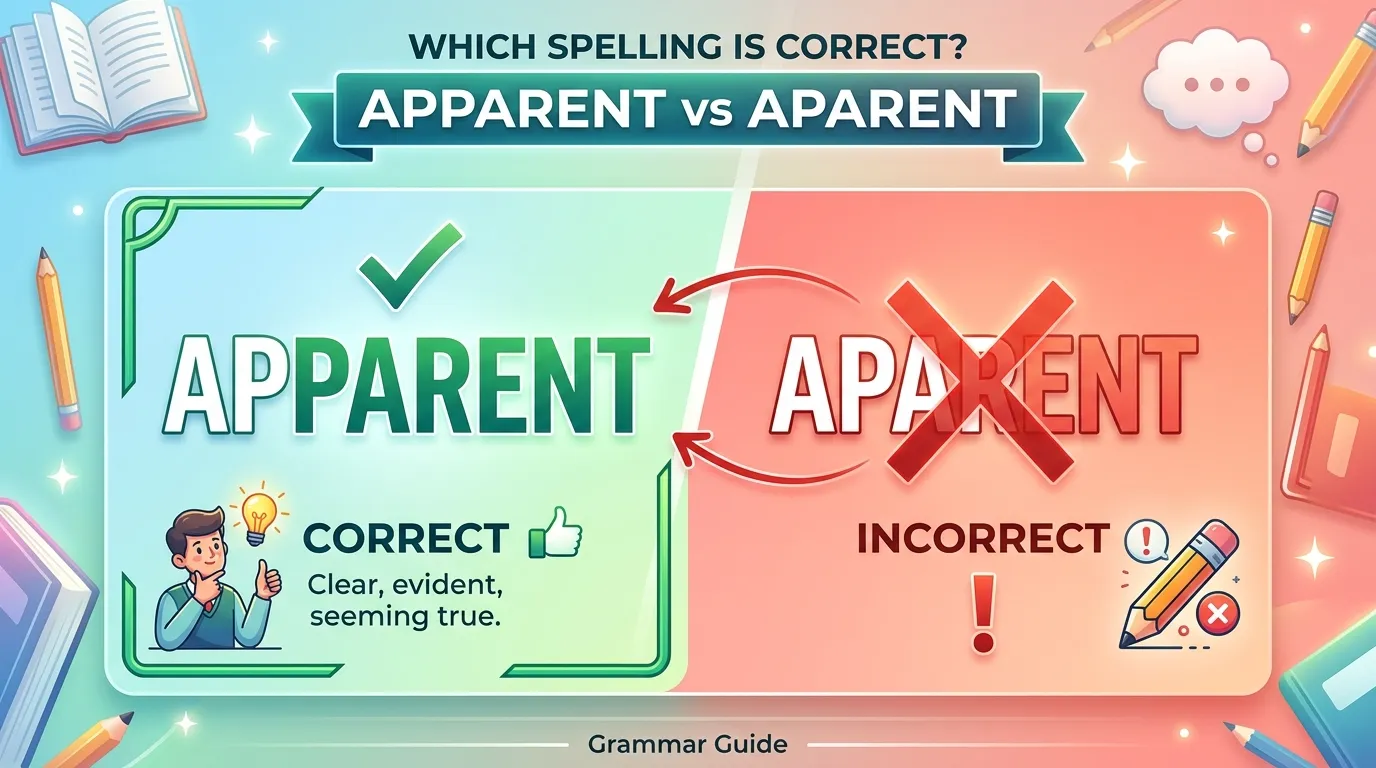
If you are wondering whether “apparent” or “aparent” is the correct spelling, the answer is simple: apparent is the correct English spelling. Aparent is a misspelling and should not be used in standard American English.
The word apparent is a common adjective meaning easy to see, understand, notice, or recognize, or seeming to be true based on the available evidence. For example, you might say, “It was apparent that she was tired” or “The damage was apparent immediately.”
The confusion usually happens because apparent contains a double p, while many people pronounce the word without clearly hearing both consonants. This can make aparent look or feel natural when writing it.
In this guide, you will learn the difference between apparent and aparent, how to spell and pronounce apparent, what it means, how to use it naturally, its grammatical role, synonyms and antonyms, common expressions, word history, and the mistakes writers frequently make.
Quick Answer: Apparent vs Aparent
Apparent is the correct spelling.
Aparent is incorrect in standard English and is simply a spelling mistake.
| Word | Correct? | Meaning |
|---|---|---|
| apparent | ✅ Yes | Clear, obvious, noticeable, or seeming to be true |
| aparent | ❌ No | Incorrect spelling of apparent |
Correct examples
- The reason for the delay became apparent.
- It was apparent that he was upset.
- Her confidence was apparent from the beginning.
- The problem became apparent after several tests.
Incorrect examples
- The reason became aparent.
- It was aparent that he was upset.
- The difference was aparent to everyone.
The easiest rule to remember is:
Apparent has two p’s: app + arent.
What Does “Apparent” Mean?
Apparent is an adjective with two closely related meanings.
1. Easy to see, notice, or understand
When something is apparent, it is clear or obvious.
For example:
The damage to the building was apparent from the street.
This means the damage was easy to see.
Another example:
Her excitement was apparent when she opened the gift.
Her excitement was clearly visible or noticeable.
2. Seeming to be true
Apparent can also describe something that appears to be true based on what people can see or understand, even if it has not been completely proven.
For example:
The apparent cause of the problem was a software error.
Here, apparent suggests that the software error seemed to be the cause based on the information available.
Similarly:
There was an apparent disagreement between the two managers.
This means the managers appeared to disagree.
This second meaning is especially important in journalism, academic writing, business communication, and formal reports because apparent can allow a writer to describe what seems true without claiming absolute certainty.
Is “Aparent” a Word?
No. Aparent is not the standard English spelling of the word.
If you intend to use the adjective meaning “obvious,” “clear,” “visible,” or “seeming,” write:
apparent
not:
aparent
The spelling aparent may appear in text because of typing mistakes, spelling errors, or interference from another language. However, in standard American English, it should be corrected to apparent.
Correct spelling
The mistake became apparent after the review.
Incorrect spelling
The mistake became aparent after the review.
For school assignments, professional emails, websites, articles, reports, resumes, and other formal writing, always use apparent.
Why Do People Confuse Apparent and Aparent?
There are several reasons people accidentally write aparent.
1. The pronunciation can hide the double “p”
When spoken naturally, the two p’s in apparent may not sound as distinct as they look in writing.
The word is generally pronounced:
uh-PAIR-uhnt
The first syllable is relatively weak, while the stressed syllable is pair.
Because speakers focus on the stressed syllable, the spelling pattern app- may be easy to forget.
2. English spelling is not always phonetic
English contains many words whose spelling cannot be predicted perfectly from pronunciation.
For example:
- necessary
- separate
- accommodation
- occurrence
- apparent
A writer may hear the sounds and spell the word based on pronunciation. That can result in aparent.
3. The word resembles related forms
The word belongs to a family of words connected with ideas such as appearance and seeming.
Related words include:
- appear
- appearance
- apparently
- apparent
- apparition
The relationship can sometimes make spelling easier to remember once you recognize the pattern.
Apparent vs Aparent: Key Difference
The most important difference is straightforward:
Apparent is a real English word. Aparent is a misspelling.
There is therefore no genuine difference in meaning, grammar, pronunciation, or tone between the two spellings.
| Feature | Apparent | Aparent |
|---|---|---|
| Standard English word | Yes | No |
| Correct spelling | Yes | No |
| Part of speech | Adjective | — |
| Meaning | Clear, obvious, noticeable, or seeming | — |
| Used in formal writing | Yes | No |
| Used in American English | Yes | No |
| Used in British English | Yes | No |
| Dictionary entry as standard English adjective | Yes | No |
| Recommended spelling | Apparent | Avoid |
How to Pronounce “Apparent”
The standard pronunciation of apparent is approximately:
uh-PAIR-uhnt
The main stress falls on the second syllable:
ap-PAR-ent
In phonetic notation, American pronunciation is commonly represented approximately as:
/əˈpærənt/
The exact vowel quality can vary somewhat by accent.
Example
Say:
It became apparent.
The word sounds roughly like:
uh-PAIR-uhnt
Do not worry about making every syllable overly strong. Natural English pronunciation usually gives the greatest emphasis to PAIR.
Is Apparent an Adjective?
Yes. Apparent is an adjective.
It can describe a person, thing, situation, condition, cause, relationship, problem, difference, or other noun.
Examples
- an apparent mistake
- an apparent problem
- an apparent reason
- an apparent change
- an apparent contradiction
- an apparent advantage
- an apparent disagreement
- an apparent lack of interest
In sentences
The apparent problem was easy to identify.
His apparent confidence disappeared during the interview.
There was an apparent difference between the two results.
Dictionary-Style Definition of Apparent
Apparent (adjective)
Definition 1
Clearly visible, noticeable, or easy to understand.
Example:
The improvement was apparent after only a few weeks.
Definition 2
Seeming to be true, real, or present based on available evidence.
Example:
The apparent cause of the accident is still being investigated.
Simple meaning
Depending on context, apparent can mean:
- obvious
- clear
- visible
- noticeable
- evident
- seeming
- seemingly true
The surrounding sentence tells you which sense is intended.
Apparent vs Obvious vs Evident
These words are similar, but they are not always interchangeable.
Apparent
Apparent often means something is clear or seems to be true.
It became apparent that the plan was not working.
Obvious
Obvious is stronger. It suggests something is extremely easy to recognize or understand.
It was obvious that he had forgotten the meeting.
Evident
Evident is more formal and often emphasizes evidence or observable facts.
The results provided evident proof of improvement.
Comparison
| Word | Basic idea | Typical tone |
|---|---|---|
| apparent | Clear or seemingly true | Neutral/formal |
| obvious | Very easy to recognize | Neutral |
| evident | Clearly supported or observable | Formal |
Synonyms for Apparent
The best synonym depends on the context.
When “apparent” means obvious
Possible synonyms include:
- obvious
- clear
- evident
- noticeable
- visible
- plain
- unmistakable
- manifest
- discernible
Example:
The error was apparent.
Possible alternatives:
The error was obvious.
The error was evident.
The error was clear.
When “apparent” means seeming
Possible synonyms include:
- seeming
- seeming to be
- ostensible
- supposed
- presumed
- purported
- perceived
Example:
The apparent cause was a technical problem.
Possible alternative:
The presumed cause was a technical problem.
However, these words can carry slightly different meanings, so replacing apparent mechanically is not always a good idea.
Antonyms of Apparent
When apparent means obvious or clear, possible opposites include:
- unclear
- hidden
- obscure
- invisible
- uncertain
- ambiguous
- concealed
- imperceptible
Example:
The difference was apparent.
Opposite:
The difference was barely noticeable.
When apparent means “seeming,” the opposite may be something like:
- actual
- real
- genuine
- proven
For example:
The apparent cause was human error, but the actual cause was equipment failure.
Common Collocations With Apparent
A collocation is a group of words that naturally occur together.
Learning common collocations can help you use apparent more naturally.
Common combinations include:
- apparent reason
- apparent cause
- apparent difference
- apparent problem
- apparent lack
- apparent contradiction
- apparent advantage
- apparent disadvantage
- apparent change
- apparent attempt
- apparent connection
- apparent conflict
- apparent mistake
- apparent solution
- apparent interest
- apparent weakness
- apparent strength
- apparent relationship
- apparent failure
- apparent success
Examples
There was an apparent lack of communication.
The apparent cause was identified during the investigation.
An apparent contradiction appeared in the report.
The team’s apparent weakness became a major issue.
Common Phrases With “Apparent”
“It became apparent”
This is one of the most common structures.
It became apparent that the project needed more time.
Meaning: It gradually became clear that the project needed more time.
“It is apparent that…”
This formal construction means that something seems clear.
It is apparent that the company needs a new strategy.
“For no apparent reason”
This means something happened without an obvious or known reason.
The computer suddenly shut down for no apparent reason.
“To all apparent purposes”
This is much less common than the phrase “to all appearances.” In most modern writing, choose a more natural construction.
“Apparently”
Apparently is the adverbial form of apparent.
Apparently, the meeting has been canceled.
It can mean that something seems to be true based on available information.
Apparent vs Apparently
These words are related but have different grammatical functions.
| Word | Part of speech | Example |
|---|---|---|
| apparent | Adjective | The problem was apparent. |
| apparently | Adverb | Apparently, the problem was serious. |
Apparent
Her disappointment was apparent.
Apparently
She was apparently disappointed.
A useful rule is:
Apparent describes a noun. Apparently modifies a verb, adjective, or entire statement.
Apparent vs Appear
These words are closely related.
Appear
Appear is usually a verb.
The problem appears serious.
Apparent
Apparent is an adjective.
The problem is apparent.
Compare
It appears that the machine is damaged.
The damage is apparent.
Both express related ideas, but their grammatical structures are different.
Apparent vs Seeming
These words can sometimes be used in similar contexts.
His apparent confidence surprised everyone.
His seeming confidence surprised everyone.
However, apparent is often more versatile. It can mean either clearly observable or seemingly true.
Seeming generally focuses more strongly on appearance rather than established fact.
Formal vs Informal Use of Apparent
Apparent works well in both everyday and formal English, but it is especially common in formal writing.
Casual
It was obvious that he was tired.
More formal
It was apparent that he was tired.
Academic
The results make it apparent that additional research is necessary.
Business
It became apparent that the current process was inefficient.
Journalism
It was apparent that the decision had created controversy.
You do not need to avoid apparent in casual conversation. It is a normal English word. However, obvious or clear may sound more conversational in some situations.
Apparent in Academic Writing
The word is useful in academic writing because it can describe observations without making unnecessarily absolute claims.
For example:
An apparent relationship exists between the two variables.
This is more cautious than saying:
The two variables are definitely related.
Academic writers often need to distinguish between what evidence demonstrates and what evidence merely appears to demonstrate.
Natural academic examples
- The apparent difference requires further investigation.
- An apparent increase occurred during the second phase.
- The apparent relationship may be explained by several factors.
- The cause of the change remains uncertain despite its apparent simplicity.
Apparent in Business Writing
Apparent is useful in reports, emails, proposals, and professional analysis.
Examples
The apparent decline in sales requires further analysis.
There is an apparent gap between customer expectations and the current service.
The reason for the delay became apparent during the review.
The apparent benefits should be evaluated against the associated costs.
In business writing, apparent can sound more measured than obvious, particularly when evidence is still being evaluated.
Apparent in Journalism
Journalists frequently need language that distinguishes observed facts from conclusions that have not been fully established.
For example:
The apparent cause of the fire remains under investigation.
Here, the writer is not necessarily saying that the cause has been proven.
Another example:
The apparent disagreement between the officials raised questions about the policy.
The word signals that the disagreement is visible or reported but may require additional confirmation.
Apparent in Technical Writing
Technical writers may use apparent when describing an observable condition without claiming a definitive underlying cause.
For example:
The apparent failure occurred during the final testing stage.
An apparent connection between the two systems was identified.
The apparent source of the error was a configuration issue.
When precision matters, technical writers should be careful with apparent because it can signal uncertainty.
If something has been conclusively established, a more precise term such as confirmed, verified, or identified may be better.
Apparent in Sports Writing
The word is also natural in sports reporting and commentary.
Examples
The team’s apparent lack of confidence affected its performance.
Their apparent advantage disappeared in the second half.
The player’s apparent injury forced an early substitution.
The apparent turning point came late in the game.
Sports writers often use apparent when interpreting visible events without claiming certainty about a player’s internal thoughts or motives.
Apparent in Everyday English
You can use apparent in ordinary conversation.
For example:
It became apparent that we were going to be late.
His disappointment was apparent.
The difference is apparent if you look closely.
For no apparent reason, the lights went out.
However, in very casual speech, people often choose simpler words:
- clear
- obvious
- noticeable
- easy to see
That does not make apparent overly formal. It simply means that other words may sound more conversational.
American vs British English: Is “Apparent” Different?
There is no meaningful spelling difference between standard American and British English for this word.
Both use:
apparent
Not:
aparent
The pronunciation can vary slightly by regional accent, but the spelling remains the same.
American English
The reason became apparent.
British English
The reason became apparent.
The word is standard in both varieties.
Word History and Etymology of Apparent
Apparent ultimately comes from Latin apparēre, meaning “to appear” or “to come into view.”
It entered English through French and developed its modern meanings around things that appear clearly or seem to be true.
This history connects apparent with the related word appear.
The underlying idea is therefore closely associated with appearance: something comes into view, becomes noticeable, or seems to be the case.
Understanding this word family can make the spelling easier to remember:
appear → apparent → apparently → appearance
Although the forms are not identical, they share a historical connection.
Memory Tricks for Spelling Apparent
If you frequently misspell apparent as aparent, try one of these memory tricks.
Trick 1: Remember “two p’s”
Think:
Apparent = apparent with two p’s.
The repeated p is the key spelling feature.
Trick 2: Break it into parts
Think of it as:
app + arent
The first part contains pp.
Trick 3: Connect it with “appear”
Think:
Appear → apparent
Both begin with app-.
Trick 4: Use a sentence
Memorize:
The answer became apparent.
If you can remember the phrase, the spelling becomes easier.
Common Mistakes With Apparent
Mistake 1: Writing “aparent”
❌ The problem was aparent.
✅ The problem was apparent.
Mistake 2: Using “apparent” when you mean “apparently”
❌ Apparent, the meeting was canceled.
✅ Apparently, the meeting was canceled.
Mistake 3: Confusing “apparent” with “obvious”
These words overlap, but apparent can also mean “seeming.”
Compare:
The apparent cause was a technical failure.
This may mean the cause seemed to be a technical failure.
By contrast:
The obvious cause was a technical failure.
This suggests the cause was easy to identify.
Mistake 4: Using “apparent” when you need a stronger factual claim
Consider:
The apparent cause was equipment failure.
This leaves room for uncertainty.
If the cause has been confirmed, you might write:
The confirmed cause was equipment failure.
Choose the word that accurately reflects the evidence.
Awkward vs Natural Examples
Awkward
It was apparent obviously that he was angry.
Natural
It was apparent that he was angry.
Or:
It was obvious that he was angry.
Awkward
The apparentness of the problem was easy to see.
Natural
The problem was immediately apparent.
Apparentness is technically understandable but is rarely the best choice in ordinary writing.
Awkward
The situation was apparent obvious to everyone.
Natural
The situation was obvious to everyone.
Or:
The situation was apparent to everyone.
20 Everyday Examples of Apparent
- The mistake became apparent after the second review.
- Her disappointment was apparent.
- It was apparent that he needed help.
- The difference is apparent when you compare the two versions.
- The team’s advantage was apparent early in the game.
- The reason for the delay soon became apparent.
- There was no apparent reason for the change.
- His lack of experience was apparent during the interview.
- The improvement was apparent within a few weeks.
- The damage was immediately apparent.
- An apparent contradiction appeared in the report.
- The company’s apparent success did not last.
- Her apparent confidence impressed the audience.
- The apparent cause was later questioned.
- The benefits were apparent to the entire team.
- The problem was not immediately apparent.
- There was an apparent connection between the events.
- The player’s apparent injury changed the team’s strategy.
- His apparent reluctance surprised his colleagues.
- The solution seems simple, but its limitations are also apparent.
Apparent in Different Contexts
| Context | Example |
|---|---|
| Everyday | It became apparent that we were late. |
| Academic | The apparent relationship requires further study. |
| Business | The apparent decline requires investigation. |
| Journalism | The apparent cause remains under review. |
| Technical | The apparent error occurred during testing. |
| Sports | Their apparent advantage disappeared quickly. |
| Casual | His disappointment was apparent. |
| Formal | The consequences are now apparent. |
| Blogging | The benefits of the approach are apparent. |
| Professional | The apparent issue should be addressed immediately. |
“For No Apparent Reason” Meaning
One of the most useful expressions containing apparent is:
for no apparent reason
It means that something happened without an obvious, known, or visible reason.
Examples
The computer restarted for no apparent reason.
She suddenly left for no apparent reason.
The dog began barking for no apparent reason.
The phrase does not necessarily mean there was literally no reason. It means that no reason was obvious to the observer.
This distinction is important.
“It Became Apparent” Meaning
The phrase “it became apparent” means that something gradually became clear or noticeable.
For example:
After several meetings, it became apparent that the project was behind schedule.
At first, the problem may not have been obvious. Later, the evidence made it clear.
This phrase is particularly common in formal and professional writing.
Apparent: Common Sentence Patterns
Here are useful grammatical structures you can copy as models.
It became apparent that + clause
It became apparent that the plan needed revision.
It is apparent that + clause
It is apparent that more information is needed.
apparent + noun
The apparent problem was resolved.
no apparent + noun
There was no apparent explanation.
apparent to + person/group
The difference was apparent to everyone.
for no apparent reason
The system stopped for no apparent reason.
These patterns will help you use the word naturally instead of simply memorizing its definition.
Can “Apparent” Be Used as a Noun?
No. Apparent is normally an adjective.
You should not treat it as a regular noun.
Instead of trying to create a noun from it, restructure the sentence.
Less natural
The apparentness of the situation was surprising.
Better
The situation was surprisingly apparent.
Or:
The situation was surprisingly clear.
In most everyday, academic, and professional writing, clarity, appearance, or another suitable noun will usually work better depending on the intended meaning.
Can “Apparent” Be Used as a Verb?
No.
The verb is:
appear
For example:
The problem appears serious.
Not:
The problem apparents serious.
The adjective is:
The problem is apparent.
So remember:
appear = verb
apparent = adjective
apparently = adverb
Apparent vs Evident: Which Is Better?
Both can mean “clear,” but apparent is often more flexible because it can also express the idea of something merely seeming to be true.
Compare:
The benefits were apparent.
This can mean the benefits were clear or noticeable.
The benefits were evident.
This strongly emphasizes that the benefits were clearly demonstrated or observable.
When uncertainty matters, apparent can be especially useful:
The apparent cause was a manufacturing error.
This does not necessarily mean the cause has been proven.
Apparent vs Obvious: Which Should You Use?
Use obvious when something is extremely easy to recognize.
Use apparent when you want a somewhat more neutral or formal expression, or when you mean that something seems to be true.
Choose “obvious”
It was obvious that she was upset.
Choose “apparent”
It was apparent that she was upset.
Choose “apparent” for uncertainty
The apparent cause of the issue was a database error.
The final sentence is especially useful when the writer does not want to claim that the cause has been conclusively established.
Is “Aparent” Ever Correct?
For standard English writing, no.
If you are writing in English and mean the adjective apparent, use:
apparent
The spelling aparent should be treated as an error and corrected.
If you encounter aparent in a username, brand name, proper noun, quotation, or another special context, it may be intentional. But that does not make it the standard spelling of the English adjective.
Quick Editing Checklist
Before publishing or submitting your writing, check the following:
- Did I spell it apparent?
- Did I accidentally leave out one p?
- Am I using it as an adjective?
- Do I actually mean “obvious,” “clear,” or “seeming”?
- If I mean “seemingly,” should I use apparently instead?
- If I am describing a confirmed fact, would confirmed or actual be more precise?
- Does the surrounding sentence make the intended meaning clear?
Apparent vs Aparent: Final Comparison
| Category | Apparent | Aparent |
|---|---|---|
| Correct spelling | ✅ | ❌ |
| Standard English | ✅ | ❌ |
| American English | ✅ | ❌ |
| British English | ✅ | ❌ |
| Part of speech | Adjective | — |
| Main meaning | Clear, noticeable, or seeming | — |
| Pronunciation | uh-PAIR-uhnt | Not applicable as standard spelling |
| Formal writing | Recommended | Avoid |
| Academic writing | Recommended | Avoid |
| Business writing | Recommended | Avoid |
| Journalism | Recommended | Avoid |
| Casual writing | Acceptable | Avoid |
| Common mistake | No | Yes |
FAQs About Apparent vs Aparent
1. Is it “apparent” or “aparent”?
Apparent is correct. Aparent is a misspelling. The correct word contains two p’s.
2. What does apparent mean?
Apparent means clear, obvious, noticeable, or seemingly true. The exact meaning depends on context.
For example:
Her disappointment was apparent.
Here it means clearly noticeable.
The apparent cause was a technical error.
Here it means the cause seemed to be a technical error.
3. Is “aparent” a word?
No. Aparent is not the standard English spelling of the word. Use apparent instead.
4. How do you spell apparent correctly?
Spell it:
A-P-P-A-R-E-N-T
The easiest feature to remember is the double p:
apparent
5. How do you pronounce apparent?
It is generally pronounced approximately uh-PAIR-uhnt, with the main stress on the middle syllable.
6. What is the difference between apparent and obvious?
Both can mean “clear,” but obvious usually suggests that something is very easy to recognize. Apparent can also mean that something seems to be true without being completely proven.
7. What is the difference between apparent and apparently?
Apparent is an adjective:
The problem was apparent.
Apparently is an adverb:
Apparently, the problem was serious.
8. Is apparent formal or informal?
Apparent works in both everyday and formal English. It is especially common in academic, business, technical, and journalistic writing.
9. Is apparent spelled differently in American and British English?
No. Both standard American and British English use apparent. The spelling aparent is incorrect in both varieties.
10. What is an easy way to remember the spelling of apparent?
Remember:
Apparent has two p’s.
You can also connect it with appear, which begins with app-.
Conclusion
When choosing between apparent vs aparent, there is no real spelling competition: apparent is the correct English word, while aparent is a misspelling.
The adjective apparent can mean clear, obvious, visible, or noticeable, but it can also mean seeming to be true based on the available evidence. That second meaning is especially useful in academic, professional, journalistic, and technical writing because it allows you to describe an observation without presenting an uncertain conclusion as an established fact.
Remember these key points:
- Apparent is correct.
- Aparent is incorrect.
- Apparent is an adjective.
- Appear is the related verb.
- Apparently is the related adverb.
- Apparent can mean “obvious” or “seeming.”
- It is used in American and British English.
- The spelling contains two p’s.
- “For no apparent reason” means no obvious reason is known.
- “It became apparent” means something became clear or noticeable.
- Use apparent when you want to describe something observable or something that seems to be true.
If you are writing an email, essay, article, report, website page, academic paper, or social media post, simply choose apparent whenever this is the word you mean. When in doubt, remember the spelling pattern:
appear → apparent → apparently
That small connection can make it much easier to avoid the common aparent spelling mistake.


