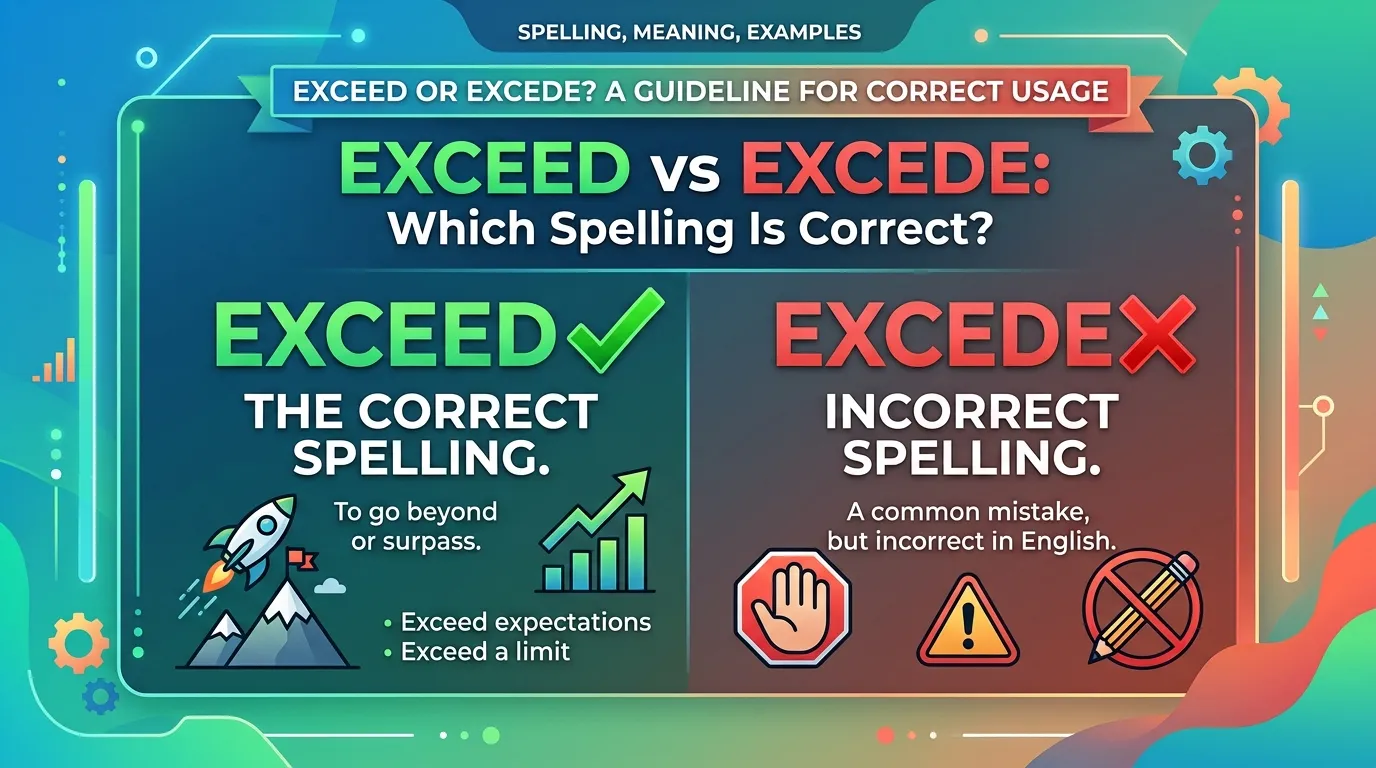
If you are wondering whether the correct spelling is exceed or excede, the answer is simple: exceed is the correct English spelling. Excede is not a standard English word and is usually a spelling mistake.
The verb exceed means to go beyond a limit, amount, number, expectation, or standard. For example, you might say, The cost may exceed $500 or Her performance exceeded expectations.
The confusion happens because exceed contains the letters -ceed, while many English words have endings that sound similar but are spelled differently. The pronunciation also does not make the spelling obvious.
In this guide, you will learn the difference between exceed and excede, how to pronounce and use exceed, its grammatical forms, common collocations, synonyms and antonyms, its history, regional usage, frequent spelling mistakes, and dozens of natural examples.
Quick Answer: Exceed or Excede?
Exceed is the correct English spelling.
Excede is generally an incorrect spelling in standard English.
| Word | Correct English spelling? | Meaning |
|---|---|---|
| exceed | ✅ Yes | To go beyond a limit, amount, standard, or expectation |
| excede | ❌ No | Usually a misspelling of exceed |
Correct examples
- The final cost may exceed our budget.
- Sales exceeded expectations this quarter.
- Do not exceed the speed limit.
- The temperature exceeded 100 degrees.
- Her results exceeded the required standard.
Incorrect example
- The final cost may excede our budget. ❌
The correct version is:
- The final cost may exceed our budget. ✅
A useful rule is:
Exceed = go beyond.
Excede = misspelling in standard English.
What Does Exceed Mean?
Exceed is a verb meaning to be greater than something, go beyond a particular limit, or do better than an expected level or standard.
It can describe numbers, physical limits, rules, expectations, performance, quality, speed, budgets, and many other things.
For example:
- The population exceeds one million.
- The driver exceeded the speed limit.
- The project exceeded its original budget.
- The movie exceeded my expectations.
The word can be used for both measurable and abstract things.
Exceed with numbers
When exceed refers to a number or quantity, it means that something is greater than that number.
- The building exceeds 200 feet in height.
- The package cannot exceed 20 kilograms.
- The company has exceeded 10,000 sales.
- The temperature exceeded 40°C.
Exceed with expectations
Exceed is also extremely common with expectations.
If something exceeds expectations, it performs better than people expected.
- The new product exceeded expectations.
- Her performance exceeded my expectations.
- The restaurant exceeded our expectations.
This is one of the most common professional uses of the word.
What Does Excede Mean?
In standard modern English, excede is not the correct spelling of the verb meaning to go beyond.
If you type excede when you mean exceed, you should change it to exceed.
For example:
Incorrect:
The project will excede the budget.
Correct:
The project will exceed the budget.
The extra e at the end is the main spelling problem.
English spelling can be confusing because words that sound similar do not always follow the same spelling pattern. However, in this case, the standard English form is straightforward:
E-X-C-E-E-D
Why Do People Confuse Exceed and Excede?
The confusion mostly comes from pronunciation and spelling patterns.
They sound the same when the incorrect form is read aloud
Exceed is pronounced approximately:
/ɪkˈsiːd/
It sounds like ik-SEED.
If someone has only heard the word spoken, they may not know whether the final sound should be spelled -ceed or -cede.
This creates the same type of spelling uncertainty found in other English words.
The ending looks familiar
English contains words ending in -cede, including:
- concede
- precede
- recede
- proceed
At the same time, English has words ending in -ceed, including:
- exceed
- succeed
Because both patterns occur in English, it is easy to write excede by analogy with words such as precede or recede.
But exceed is the established English spelling.
Exceed vs Excede: Key Difference
The most important difference is that only exceed is normally used as an English word with this meaning.
| Feature | Exceed | Excede |
|---|---|---|
| Standard English | ✅ Yes | ❌ No |
| Part of speech | Verb | Not normally a standard English verb |
| Pronunciation | /ɪkˈsiːd/ | Intended pronunciation may be the same |
| Meaning | Go beyond or be greater than | — |
| Formal writing | Correct | Incorrect |
| Academic writing | Correct | Incorrect |
| Business writing | Correct | Incorrect |
| Casual writing | Correct | Incorrect |
| SEO/content writing | Correct | Incorrect |
| Recommended spelling | Exceed | Avoid |
If your goal is to write correct English, use exceed.
Exceed: Dictionary-Style Definition
Exceed
Part of speech: Verb
Definition: To be greater than a particular amount, number, limit, standard, or expectation; to go beyond something.
Example
The company’s expenses exceeded its annual budget.
Here, exceeded means the expenses went beyond the amount that had been budgeted.
Another example:
The athlete exceeded the previous record.
The athlete performed beyond the previous record.
Grammatical Forms of Exceed
Because exceed is a regular verb, its main forms are easy to learn.
| Form | Word |
|---|---|
| Base form | exceed |
| Third-person singular | exceeds |
| Present participle | exceeding |
| Past tense | exceeded |
| Past participle | exceeded |
Present tense
- I exceed the minimum requirement.
- We exceed our sales target.
- The cost exceeds the estimate.
Notice that exceeds adds -s.
Past tense
The past tense is exceeded.
- The project exceeded its budget.
- Sales exceeded the target.
- The team exceeded expectations.
Present participle
The present participle is exceeding.
- The company is exceeding its quarterly goal.
- The temperature is exceeding normal levels.
How to Pronounce Exceed
Exceed is pronounced:
/ɪkˈsiːd/
A simple pronunciation guide is:
ik-SEED
The stress falls on the second syllable.
The word sounds like seed, but it begins with an ik- sound.
Does Exceed Sound Like Excede?
If someone writes excede as a mistaken spelling of exceed, they will generally intend the same pronunciation.
The problem is spelling, not pronunciation.
Is Exceed a Verb or Adjective?
Exceed is a verb.
It describes an action or condition involving going beyond something.
For example:
- Costs exceed the estimate.
- Demand exceeds supply.
- The result exceeded expectations.
You should not normally use exceed as an adjective.
Instead, use related adjectives such as:
- excessive
- exceptional
- superior
- outstanding
The correct related word depends on the intended meaning.
Exceed vs Excessive
These words are related but have different grammatical roles and meanings.
Exceed is a verb.
Excessive is an adjective meaning more than necessary, reasonable, or appropriate.
Compare:
- The expenses exceed the budget.
- The expenses are excessive.
Another example:
- The noise level exceeded the legal limit.
- The noise was excessive.
Related noun: Excess
Excess is a noun referring to an amount beyond what is necessary, allowed, or normal.
- The company had an excess of inventory.
- Avoid excess spending.
Exceed vs Surpass
Surpass is one of the closest synonyms for exceed.
Both can mean to go beyond a standard, level, achievement, or expectation.
Exceed
- The results exceeded expectations.
Surpass
- The results surpassed expectations.
Both are correct, but surpass can sound slightly more achievement-focused when discussing performance.
For example:
- She exceeded the required score.
- She surpassed the previous record.
Exceed vs Excel
These words are sometimes confused because both can describe excellent performance.
However, they are not interchangeable in every sentence.
Exceed means to go beyond a limit, amount, requirement, or expectation.
Excel means to perform extremely well.
Compare:
- He exceeded the sales target.
- He excels at sales.
You can also say:
- Her performance exceeded expectations.
- She excels in mathematics.
Exceed vs Proceed, Recede, and Precede
English has several words with similar-looking endings.
| Word | Meaning |
|---|---|
| exceed | Go beyond |
| proceed | Continue or move forward |
| precede | Come before |
| recede | Move backward or become less |
| concede | Admit or grant something |
| succeed | Achieve a desired result or come after |
These words may look similar, but their meanings are different.
Examples
- Costs exceed the budget.
- Please proceed with the plan.
- A short introduction will precede the presentation.
- The floodwaters began to recede.
- He finally conceded that she was right.
- The company hopes to succeed internationally.
This is one reason excede may look plausible, but English convention requires exceed.
Common Collocations With Exceed
A collocation is a combination of words that commonly appears together.
Learning collocations can make your writing sound more natural.
Common combinations with exceed include:
- exceed expectations
- exceed the limit
- exceed the budget
- exceed the target
- exceed the maximum
- exceed the minimum
- exceed capacity
- exceed demand
- exceed supply
- exceed the standard
- exceed the threshold
- exceed the requirement
- exceed the estimate
- exceed the average
- exceed the record
- exceed the speed limit
- exceed the recommended amount
- exceed the legal limit
- exceed the permitted level
Examples in context
Exceed expectations
The new service exceeded customer expectations.
Exceed the budget
Construction costs exceeded the original budget.
Exceed the limit
The vehicle must not exceed the posted speed limit.
Exceed capacity
The venue cannot safely exceed its maximum capacity.
Exceed the standard
The product exceeds the required safety standard.
Common Expressions With Exceed
Some phrases with exceed are especially common in professional and everyday English.
Exceed expectations
This means to perform better than expected.
The candidate exceeded expectations during the interview.
Exceed the limit
This means to go beyond an established maximum.
Drivers should never exceed the speed limit.
Exceed the budget
This means to spend more money than planned.
The renovation exceeded the budget by several thousand dollars.
Exceed the threshold
This means to go beyond a specified level at which something changes or an action is triggered.
The temperature exceeded the safety threshold.
Exceed in Business English
Exceed is very common in business communication.
Companies use it when discussing:
- sales
- revenue
- budgets
- targets
- forecasts
- performance
- customer expectations
- production
- capacity
- growth
Examples:
Quarterly revenue exceeded the forecast.
The team exceeded its annual sales target.
Operating costs exceeded the original estimate.
Customer satisfaction scores exceeded expectations.
In formal business writing, exceed is precise and professional.
Exceed in Academic Writing
Academic writers frequently use exceed when describing data, limits, findings, or numerical values.
Examples:
The observed value exceeded the predicted value.
The sample size exceeded the minimum required for the analysis.
The results exceeded the researchers’ initial expectations.
It is often preferable to vague phrases such as was more than when the context specifically involves crossing a known limit or benchmark.
Exceed in Technical Writing
Technical documentation often uses exceed to describe maximum values, safety limits, specifications, or operating conditions.
Examples:
Do not exceed the maximum operating temperature.
The device should not exceed the specified voltage.
If the load exceeds the recommended capacity, the system may shut down.
This use is especially important because exceed can communicate a clear boundary.
Exceed in Sports
Sports writers and commentators use exceed when discussing records, expectations, targets, and performance.
Examples:
The rookie exceeded expectations in his first season.
The team exceeded its preseason win projection.
The runner exceeded the previous record.
The player’s performance exceeded everyone’s predictions.
In sports journalism, break, beat, surpass, and exceed can sometimes overlap, but they are not always identical.
For example, athletes typically break a record, while they may exceed expectations.
Exceed in Journalism
Journalists often use exceed when reporting measurable information.
Examples:
The number of visitors exceeded one million.
The storm’s winds exceeded 100 miles per hour.
The final estimate exceeded initial projections.
Because journalism values concise and precise language, exceed is useful when a specific benchmark is involved.
Exceed in Casual Writing
Although exceed can sound formal in some situations, it is perfectly normal in everyday English.
For example:
This movie exceeded my expectations.
The bill exceeded what I expected.
Don’t exceed the recommended amount.
In casual speech, people might also say:
- go over
- be more than
- be above
- pass
For example:
The bill went over my budget.
This is less formal than:
The bill exceeded my budget.
Both can be appropriate depending on the context.
Formal vs Informal Alternatives to Exceed
| Formal/standard | More conversational |
|---|---|
| exceed the budget | go over the budget |
| exceed the limit | go over the limit |
| exceed expectations | do better than expected |
| exceed the target | go past the target |
| exceed the maximum | go above the maximum |
| exceed the requirement | do more than required |
Which should you use?
Use exceed when you want concise, precise, and professional language.
Use conversational alternatives when writing dialogue, casual messages, or informal content.
Synonyms for Exceed
The best synonym depends on context.
Common synonyms
- surpass
- go beyond
- overtake
- outdo
- beat
- transcend
- go over
- top
- outstrip
Examples
Surpass
The new record surpassed the previous one.
Go beyond
The project went beyond our original expectations.
Outdo
The company outdid its previous sales record.
Go over
The expenses went over the budget.
Not every synonym works in every context. For example, go over is natural in conversation but can be less suitable in highly formal writing.
Antonyms of Exceed
Possible antonyms include:
- fall below
- remain under
- stay within
- fail to meet
- be less than
- undershoot
Examples:
The results fell below expectations.
The cost remained under the budget.
The vehicle stayed within the speed limit.
Word History and Etymology of Exceed
The English word exceed has historical roots in Latin.
It ultimately comes from the Latin excedere, meaning to go beyond or go out of bounds. The word entered English through French and developed into the modern English form exceed.
Its historical structure helps explain the meaning:
- ex- = out, beyond
- cedere = to go
The same Latin root is related to several English words involving movement, going, or advancement.
This historical connection also helps explain why English has several words with endings such as -cede and -ceed.
However, knowing the etymology does not mean that excede is an acceptable modern English spelling. The established English spelling remains exceed.
Is Excede Used in Other Languages?
A spelling resembling excede can occur in other languages or language contexts. For example, Romance languages may have related forms derived from Latin.
However, that does not make excede a standard English spelling.
If you are writing in English, use:
exceed
This distinction is particularly important for multilingual writers who may encounter similar-looking words in another language.
Is Exceed Used in American and British English?
Yes.
Exceed is standard in both American English and British English.
There is no major US-versus-UK spelling difference here.
| English variety | Correct form |
|---|---|
| American English | exceed |
| British English | exceed |
| Canadian English | exceed |
| Australian English | exceed |
| International English | exceed |
Unlike pairs such as color/colour or center/centre, exceed does not normally change spelling between American and British English.
Is Exceed Formal or Informal?
Exceed is neutral to formal.
It is appropriate in:
- everyday conversations
- emails
- business documents
- academic papers
- technical manuals
- news articles
- reports
- websites
- professional presentations
In casual conversation, people may prefer simpler expressions such as go over.
For example:
Professional:
Expenses exceeded the approved budget.
Casual:
We went over the budget.
Neither is wrong. The choice depends on tone.
Common Mistakes With Exceed
Mistake: Writing Excede
Incorrect:
The cost may excede $1,000.
Correct:
The cost may exceed $1,000.
Mistake: Using Exceed as a Noun
Incorrect:
The exceed was significant.
Better:
The excess was significant.
Or:
The amount exceeded expectations.
Mistake: Confusing Exceed With Excess
Exceed is a verb.
Excess is a noun.
Compare:
Costs exceed the budget.
The company has an excess of inventory.
Mistake: Confusing Exceed With Excel
Exceed means go beyond.
Excel means perform exceptionally well.
Incorrect:
She exceeds at mathematics.
Correct:
She excels at mathematics.
But:
Her test score exceeded the class average.
Awkward vs Natural Examples
Example 1
Awkward:
The price was more than the limit, so it exceded it.
Natural:
The price exceeded the limit.
Example 2
Awkward:
The results were more high than we thought.
Natural:
The results exceeded our expectations.
Example 3
Incorrect:
The company exceded its sales goal.
Correct:
The company exceeded its sales goal.
Example 4
Less concise:
The temperature went to a level that was higher than the recommended maximum.
More concise:
The temperature exceeded the recommended maximum.
Everyday Examples of Exceed
Here are natural examples you might encounter in daily life:
- The bill exceeded my budget.
- The package cannot exceed the weight limit.
- The car’s speed exceeded the legal limit.
- The crowd exceeded the expected size.
- The repair cost exceeded the estimate.
- The movie exceeded my expectations.
- The noise level exceeded the recommended limit.
- The trip exceeded our original budget.
- The student exceeded the minimum requirement.
- The temperature exceeded 90 degrees.
Examples for Professional Writing
Business
Revenue exceeded the company’s forecast for the third quarter.
Academic
The observed results exceeded the predicted values.
Technical
Do not exceed the maximum recommended operating pressure.
Journalism
Attendance exceeded 50,000 during the three-day event.
Sports
The team exceeded its preseason expectations.
Blogging
The guide aims to exceed the needs of first-time readers.
Our expenses exceeded the amount approved in the original proposal.
How to Remember the Correct Spelling
A simple memory trick can help:
Think: Exceed = go beyond
The word exceed has EE before the final D:
EX + CEED
You can remember it with the phrase:
Exceed has double E before D.
Another useful association is:
exceed → succeed
Both contain the -ceed ending.
- exceed
- succeed
This can help distinguish exceed from words such as precede and recede.
Is Exceed a Commonly Used Word?
Yes. Exceed is a common English verb, especially in writing involving numbers, expectations, rules, limits, performance, and standards.
It appears frequently in:
- business
- education
- government
- technology
- finance
- journalism
- sports
- technical documentation
- everyday conversation
Because it is widely used, spelling it correctly is important in professional and academic writing.
When Should You Use Exceed?
Use exceed when something:
- Goes above a numerical limit.
- Is greater than a specified amount.
- Performs better than expected.
- Goes beyond a standard.
- Passes a permitted level.
- Is greater than a target or estimate.
- Surpasses a previous benchmark.
For example:
The temperature exceeded the forecast.
The project exceeded the budget.
Her performance exceeded expectations.
The truck exceeded the weight limit.
When Should You Not Use Exceed?
Do not use exceed when you simply mean be good at something.
For example:
Incorrect:
He exceeds at writing.
Correct:
He excels at writing.
Also, do not use exceed simply because something is excellent.
Instead:
She excels in mathematics.
But:
Her mathematics score exceeded the required standard.
Quick Comparison: Exceed, Excel, Excess, and Exceeded
| Word | Part of speech | Meaning | Example |
|---|---|---|---|
| exceed | Verb | Go beyond | Costs exceed the budget. |
| exceeded | Verb, past tense | Went beyond | Costs exceeded the budget. |
| excel | Verb | Perform very well | She excels at math. |
| excess | Noun | More than necessary | The excess was removed. |
| excessive | Adjective | More than reasonable or necessary | The fee was excessive. |
Understanding these related words can prevent several common grammar mistakes.
Exceed vs Excede: Final Verdict
If you are choosing between exceed and excede in standard English, choose exceed.
Exceed is the correct English verb meaning to go beyond, be greater than, or surpass a limit, amount, expectation, or standard.
Excede is generally a misspelling and should not be used in standard American, British, or international English.
The correct spelling is:
E-X-C-E-E-D
The pronunciation is approximately:
ik-SEED
Remember:
Exceed = go beyond.
Whether you are writing a business report, academic paper, blog post, email, technical document, sports article, or casual message, exceed is the safe and standard choice.
Frequently Asked Questions About Exceed vs Excede
Is exceed or excede correct?
Exceed is correct in standard English. Excede is generally a misspelling. Use exceed when you mean to go beyond a limit, amount, expectation, or standard.
What is the difference between exceed and excede?
The main difference is spelling. Exceed is the standard English verb, while excede is not normally accepted as the English spelling of this word. Exceed means to go beyond something.
How do you spell exceed correctly?
The correct spelling is E-X-C-E-E-D: exceed. A useful memory trick is to remember the double E before the final D.
What does exceed mean?
Exceed means to go beyond something or be greater than a particular amount, limit, standard, expectation, or requirement. For example, The cost exceeded the budget.
How do you pronounce exceed?
Exceed is pronounced approximately ik-SEED, with the phonetic form /ɪkˈsiːd/. The stress falls on the second syllable.
Is excede a word in English?
Excede is not normally a standard English word when intended as the spelling of exceed. If you mean go beyond, the correct English spelling is exceed.
Is exceed used in American and British English?
Yes. Exceed is standard in both American and British English. Unlike some words with US and UK spelling differences, exceed normally has the same spelling in both varieties.
What is a synonym for exceed?
Common synonyms include surpass, go beyond, outdo, overtake, top, transcend, and outstrip. The best choice depends on the sentence and the intended level of formality.
What is the difference between exceed and excel?
Exceed means to go beyond a limit, amount, expectation, or standard. Excel means to perform exceptionally well. For example, She exceeded the required score but She excels at mathematics.
What is the difference between exceed and excessive?
Exceed is a verb meaning to go beyond something. Excessive is an adjective meaning more than is reasonable, necessary, or appropriate. For example, Costs exceeded the budget and The costs were excessive.
Conclusion: Exceed vs Excede
The exceed vs excede question has a clear answer: exceed is the correct standard English spelling.
Use exceed when something goes beyond a number, limit, target, requirement, expectation, budget, standard, or other benchmark. It is a versatile verb used in everyday English as well as business, academic, technical, journalistic, and professional writing.
The spelling excede is generally incorrect in English, even though it may look logical because English contains other words ending in -cede.
Remember these key points:
- Exceed is correct.
- Excede is generally a misspelling.
- Exceed means to go beyond or be greater than something.
- It is pronounced approximately ik-SEED.
- It is used in both American and British English.
- Common phrases include exceed expectations, exceed the limit, and exceed the budget.
- Excel, excess, and excessive are related but have different meanings and grammatical roles.
When in doubt, remember the simplest rule: exceed has double E before the final D. If you mean go beyond, write exceed.


