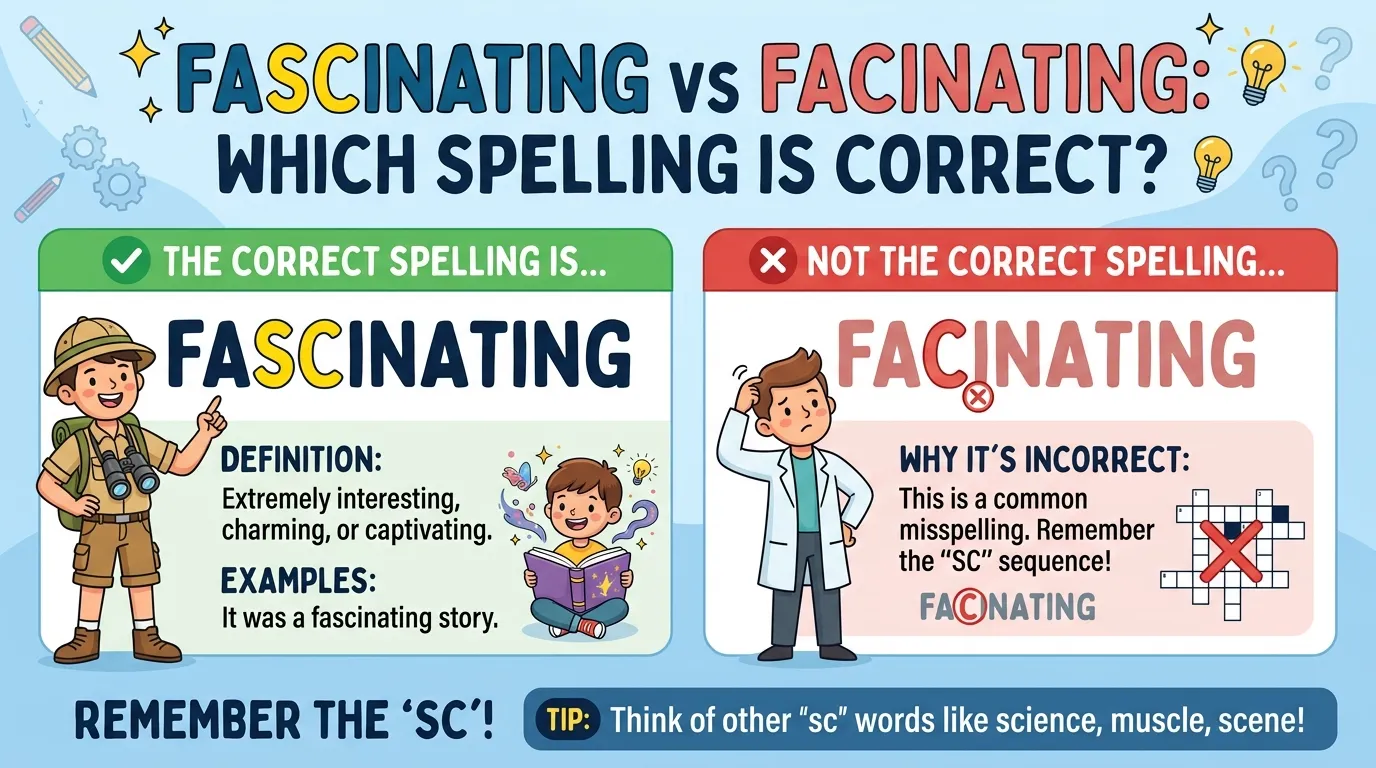
If you have ever wondered whether fascinating or facinating is the correct spelling, the answer is simple: fascinating is correct, while facinating is a misspelling.
The confusion is understandable. When we say the word aloud, the c in fascinating is not strongly pronounced as a separate sound. This can make the spelling feel less obvious, especially for English learners and people typing quickly.
The correct word, fascinating, means extremely interesting, exciting, or captivating. You can use it to describe a person, story, idea, discovery, place, subject, experience, or fact that strongly holds your attention.
This guide explains the difference between fascinating vs facinating, why the spelling mistake happens, how to pronounce and use fascinating, its grammar, word history, synonyms, common collocations, real-world examples, and simple ways to remember the correct spelling.
Quick Answer: Fascinating or Facinating?
Fascinating is the correct spelling.
Facinating is incorrect and should not be used in standard American or British English.
| Spelling | Correct? | Meaning |
|---|---|---|
| fascinating | ✅ Yes | Extremely interesting or captivating |
| facinating | ❌ No | Common misspelling of fascinating |
Correct examples
- That was a fascinating documentary.
- She told us a fascinating story.
- The history of the city is fascinating.
- I find astronomy fascinating.
- He has a fascinating personality.
Incorrect examples
- That was a facinating documentary. ❌
- She has a facinating story. ❌
- History can be facinating. ❌
The easiest rule is:
Always spell it fascinating: F-A-S-C-I-N-A-T-I-N-G.
What Does Fascinating Mean?
Fascinating is an adjective that describes something that is very interesting, attractive, or captivating.
When something is fascinating, it captures your attention and makes you want to know more.
For example:
The scientist gave a fascinating explanation of how volcanoes work.
This means the explanation was so interesting that the listener wanted to pay close attention.
Dictionary-style definition
Fascinating
Adjective: Extremely interesting, engaging, captivating, or attractive.
It can describe:
- People
- Stories
- Books
- Movies
- Facts
- Ideas
- Places
- Cultures
- Discoveries
- Conversations
- Experiences
- Historical events
- Scientific subjects
Examples
- The museum had a fascinating collection of ancient objects.
- We had a fascinating conversation about artificial intelligence.
- She is a fascinating person with many unusual experiences.
- The documentary presented a fascinating look at ocean life.
- I learned a fascinating fact about the human brain.
Why Is Facinating Wrong?
Facinating is a spelling error caused by leaving out the letter s.
The correct spelling is:
F-A-S-C-I-N-A-T-I-N-G
The incorrect spelling is:
F-A-C-I-N-A-T-I-N-G
Notice the missing s:
fascinating → correct
facinating → incorrect
The word comes from fascinate, so the spelling keeps the sc sequence:
fascinate → fascinating
This is one reason learning the base word can help you remember the longer form.
Why Do People Confuse Fascinating and Facinating?
There are several reasons this spelling mistake is common.
The pronunciation can hide the spelling
In normal speech, the middle of fascinating can sound like:
FAS-uh-nay-ting
The c does not stand out as a separate sound. Because the spoken form does not clearly reveal every letter, writers may accidentally spell it as facinating.
English spelling is not perfectly phonetic
English contains many words whose pronunciation does not tell you exactly how to spell them.
Consider:
- fascinating
- Wednesday
- business
- separate
- necessary
- definitely
The pronunciation of a word does not always provide a complete spelling guide.
The base word is easier to recognize
Remembering fascinate makes the correct spelling much easier.
Think:
fascinate + ing = fascinating
The spelling connection helps prevent the common mistake of dropping the s.
Fascinating vs Facinating: Key Difference
The main difference is not meaning. It is correctness.
There is no standard English word facinating with a separate meaning.
| Feature | Fascinating | Facinating |
|---|---|---|
| Standard spelling | ✅ | ❌ |
| Dictionary word | ✅ | ❌ |
| Meaning | Extremely interesting | No standard meaning |
| Used in formal writing | ✅ | ❌ |
| Used in casual writing | ✅ | ❌ |
| American English | Correct | Incorrect |
| British English | Correct | Incorrect |
| Academic writing | Correct | Incorrect |
| Business writing | Correct | Incorrect |
So this is not a case like color vs colour, where both spellings are accepted in different varieties of English.
It is simply:
fascinating = correct
facinating = misspelling
How Do You Pronounce Fascinating?
The word fascinating is commonly pronounced approximately:
FAS-uh-nay-ting
In phonetic notation, it is commonly represented as:
/ˈfæsəneɪtɪŋ/
The first syllable receives the main stress.
Break it into parts
fas + ci + nat + ing
A useful pronunciation guide is:
FAS-uh-nay-ting
The middle sounds can make the spelling difficult to hear, which explains why some people write facinating.
Pronunciation example
The subject is fascinating.
You do not normally pronounce every letter exactly as it appears. English pronunciation often compresses unstressed syllables.
Is Fascinating an Adjective?
Yes. Fascinating is commonly used as an adjective.
It describes something that creates strong interest or attention.
Examples
- a fascinating book
- a fascinating person
- a fascinating story
- a fascinating discovery
- a fascinating place
- a fascinating question
- a fascinating conversation
- a fascinating subject
For example:
Ancient Egyptian history is fascinating.
Here, fascinating describes ancient Egyptian history.
Is Fascinating Also a Verb Form?
Yes.
Fascinating is also the present participle of the verb fascinate.
The verb is:
fascinate
The present participle is:
fascinating
Compare:
The story fascinated me.
The story is fascinating.
The first sentence uses the past tense of the verb.
The second uses fascinating as an adjective describing the story.
Fascinate vs Fascinating
Fascinate means to strongly interest or attract someone’s attention.
Fascinating describes something that produces that reaction.
For example:
Space exploration fascinates me.
Space exploration is fascinating.
Both sentences communicate a similar idea, but their grammar is different.
Fascinating vs Fascinated
This is another important distinction.
Fascinating describes the thing that creates interest.
Fascinated describes the person who experiences that interest.
Compare:
The lecture was fascinating.
The students were fascinated by the lecture.
The lecture causes the feeling, so it is fascinating.
The students experience the feeling, so they are fascinated.
More examples
- The book was fascinating.
- I was fascinated by the book.
- The documentary was fascinating.
- We were fascinated by the documentary.
A useful memory trick is:
Fascinating = causing interest
Fascinated = feeling interest
Fascinating vs Interesting
Both words describe something that attracts attention, but fascinating is generally stronger than interesting.
Interesting
Something is interesting when it catches your attention or gives you useful information.
Fascinating
Something is fascinating when it holds your attention very strongly and makes you especially curious.
Compare:
The article was interesting.
This tells us the article held the reader’s attention.
The article was fascinating.
This suggests a stronger reaction. The article was unusually engaging or captivating.
Intensity comparison
You might think of the words like this:
interesting → very interesting → fascinating → captivating
These are not exact levels in every situation, but they show how fascinating can express stronger enthusiasm.
Fascinating vs Captivating
These words are close in meaning.
Fascinating emphasizes strong interest and curiosity.
Captivating emphasizes the ability to hold someone’s attention.
For example:
The scientist gave a fascinating presentation.
This focuses on how interesting the content was.
The speaker gave a captivating presentation.
This focuses more on how strongly the presentation held the audience’s attention.
In many situations, either word can work.
Fascinating vs Intriguing
Intriguing means interesting because something is unusual, mysterious, or makes you curious.
Fascinating is broader.
Compare:
She asked an intriguing question.
The question makes people curious.
She gave a fascinating explanation.
The explanation is extremely interesting.
Similar words
Depending on context, synonyms for fascinating include:
- captivating
- intriguing
- engaging
- absorbing
- compelling
- interesting
- enthralling
- appealing
- remarkable
- stimulating
- thought-provoking
- engrossing
Not every synonym works perfectly in every sentence, so choose according to the exact meaning you want.
Antonyms of Fascinating
The opposite of fascinating is something that fails to hold your attention.
Possible antonyms include:
- boring
- dull
- uninteresting
- tedious
- monotonous
- tiresome
- ordinary
- uninspiring
For example:
The first presentation was fascinating, but the second was dull.
Or:
The documentary was fascinating rather than boring.
Common Collocations With Fascinating
A collocation is a combination of words that naturally appear together.
Knowing common collocations can make your English sound more natural.
Fascinating story
He told us a fascinating story about his childhood.
Fascinating person
She is a fascinating person to talk to.
Fascinating subject
Biology is a fascinating subject.
Fascinating fact
Here is a fascinating fact about dolphins.
Fascinating insight
The book offers a fascinating insight into modern society.
Fascinating history
The town has a fascinating history.
Fascinating world
Welcome to the fascinating world of astronomy.
Fascinating discovery
Researchers made a fascinating discovery.
Fascinating conversation
We had a fascinating conversation after dinner.
Fascinating example
This is a fascinating example of how language changes.
Common Phrases With Fascinating
Here are natural expressions that frequently use fascinating:
- absolutely fascinating
- truly fascinating
- incredibly fascinating
- particularly fascinating
- genuinely fascinating
- deeply fascinating
- fascinating to watch
- fascinating to learn about
- fascinating to observe
- fascinating to discover
- a fascinating story
- a fascinating idea
- a fascinating subject
- a fascinating question
Example sentences
The results were absolutely fascinating.
It is fascinating to see how children learn language.
Her explanation was particularly fascinating.
The relationship between language and culture is fascinating to study.
Fascinating in Formal Writing
Fascinating is grammatically correct in formal writing, but whether it is the best word depends on context.
In an academic paper, a precise alternative may sometimes be better.
For example, instead of:
This is a fascinating result.
You could write:
This result is particularly significant.
The second version gives more specific academic information.
However, fascinating is not grammatically informal or incorrect. It can appear in professional, academic, journalistic, and general writing when the writer genuinely wants to express strong interest.
Academic example
The study provides a fascinating perspective on language development.
This is acceptable, although a more objective academic style might say:
The study provides an important perspective on language development.
Fascinating in Business Writing
In business communication, fascinating can work when the tone is conversational or persuasive.
For example:
We discovered some fascinating insights during our customer interviews.
This sounds natural in a presentation or marketing article.
For highly formal business documents, words such as these may be more precise:
- significant
- notable
- valuable
- relevant
- informative
- important
Fascinating in Journalism
Journalists frequently use fascinating to describe unusual facts, people, events, or stories.
Examples:
The investigation uncovered a fascinating story from the city’s past.
The athlete has a fascinating journey from local competition to international success.
The word works particularly well in feature writing and human-interest journalism.
Fascinating in Sports Writing
There is no special sports-specific meaning of fascinating.
It simply means unusually interesting or compelling.
Examples:
The championship produced a fascinating final.
The rivalry has a fascinating history.
Fans watched a fascinating tactical battle.
In sports journalism, words such as thrilling, dramatic, and compelling may sometimes be more precise if the focus is excitement rather than curiosity.
Fascinating in Technical and Scientific Writing
The word can describe a scientific or technical subject, but technical writers should consider precision.
For example:
The behavior of black holes is fascinating.
This is natural general-audience writing.
A technical paper might instead say:
The behavior of black holes presents several important theoretical questions.
The second sentence communicates a more specific research point.
Therefore, fascinating is perfectly valid but should not replace precise technical language when precision matters.
Is Fascinating American or British English?
Fascinating is standard in both American and British English.
There is no major regional spelling difference here.
| Variety | Correct spelling |
|---|---|
| American English | fascinating |
| British English | fascinating |
| Canadian English | fascinating |
| Australian English | fascinating |
| International English | fascinating |
So you do not need to change the spelling based on your audience.
This is different from words such as:
- color / colour
- favorite / favourite
- center / centre
With fascinating, the standard spelling remains the same.
Word History and Etymology of Fascinating
The word fascinating comes from the verb fascinate.
The English verb ultimately traces back to Latin fascinare, meaning to enchant, bewitch, or cast a spell.
Over time, the word developed broader meanings connected with powerful attraction and intense interest.
The modern English sense is not usually about literal magic. Instead, when something is fascinating, it figuratively seems to have a powerful hold on your attention.
This history also helps explain why the spelling contains fascin.
Think of the word family:
fascinate → fascination → fascinating → fascinated
Keeping the shared spelling pattern in mind makes the correct form easier to remember.
Fascinating Word Family
Learning related words can help strengthen your spelling.
Fascinate
Verb:
The subject fascinates me.
Fascinated
Adjective or participle:
I am fascinated by history.
Fascinating
Adjective or participle:
History is fascinating.
Fascination
Noun:
Her fascination with space began when she was young.
Fascinatingly
Adverb:
Fascinatingly, the two cultures developed similar traditions.
These words share the important fascin spelling.
How to Remember the Spelling of Fascinating
If you frequently write facinating, use a simple memory trick.
Remember the base word
Start with:
FASCINATE
Then change it to:
FASCINATING
The S does not disappear.
Use the phrase “Fascinate has S”
A simple memory sentence is:
Fascinate has an S, so fascinating has an S.
Another way to remember it:
FAS + CINATING
The word starts with FAS, not FAC.
Remember the word family
Write these together:
fascinate
fascinated
fascinating
fascination
Seeing the shared spelling makes the pattern easier to remember.
Common Spelling Mistakes
Here are some frequent mistakes involving fascinating.
| Incorrect | Correct |
|---|---|
| facinating | fascinating |
| fascinting | fascinating |
| fascinaiting | fascinating |
| facsinating | fascinating |
| fascinatingg | fascinating |
| fascinateing | fascinating |
The most common error is facinating, where the s is missing.
Another mistake is fascinateing. This happens when writers add -ing to fascinate without removing the final silent e.
The correct transformation is:
fascinate → fascinating
not:
fascinate → fascinateing
Awkward vs Natural Examples
Example 1
Awkward:
I think this book is very interesting and fascinating.
Natural:
I think this book is fascinating.
Using both very interesting and fascinating can be repetitive when they express the same idea.
Example 2
Incorrect:
The documentary was facinating.
Correct:
The documentary was fascinating.
Example 3
Less natural:
The fascinating thing that I find interesting is the history.
Better:
I find the history fascinating.
The shorter sentence is clearer and more natural.
Example 4
Incorrect:
She was fascinating by the story.
Correct:
She was fascinated by the story.
Remember:
The story was fascinating.
She was fascinated.
Everyday Examples of Fascinating
You can use fascinating in many ordinary situations.
At school
Science becomes fascinating when you can see the experiments yourself.
At work
The presentation included some fascinating customer insights.
While traveling
We learned some fascinating facts about the local culture.
While reading
This novel has a fascinating plot.
During conversation
That is a fascinating question.
About people
He has a fascinating background.
About nature
Coral reefs are fascinating ecosystems.
About history
The region has a fascinating history.
About technology
Artificial intelligence is a fascinating field.
Formal vs Informal Alternatives
Depending on your audience, you may want to replace fascinating with a more precise or casual word.
| Context | Possible alternative |
|---|---|
| Casual conversation | interesting |
| Friendly writing | fascinating |
| Academic writing | significant |
| Business writing | valuable |
| Technical writing | notable |
| Journalism | compelling |
| Marketing | captivating |
| Scientific explanation | noteworthy |
| Emotional description | captivating |
| General use | fascinating |
These are not exact substitutes in every situation. The best choice depends on what you want to communicate.
Is Fascinating Overused?
Like many positive adjectives, fascinating can become repetitive if used too often.
If every topic in an article is described as fascinating, the word may lose its impact.
Instead, choose more specific words when possible.
For example:
Instead of:
The results were fascinating.
You might write:
The results were surprising.
Or:
The results were unexpected.
Or:
The results revealed a significant difference.
Specific vocabulary usually creates stronger writing.
When Should You Use Fascinating?
Use fascinating when you genuinely want to express strong interest or admiration.
It works especially well when something:
- Holds your attention
- Makes you curious
- Reveals something unexpected
- Has unusual details
- Is intellectually engaging
- Has a rich history
- Is visually captivating
- Encourages further exploration
For example:
The history of written language is fascinating because it shows how human communication has changed over thousands of years.
Here, the word clearly communicates strong interest.
When Should You Avoid Fascinating?
Avoid it when a more precise word communicates your meaning better.
For example:
The experiment produced fascinating results.
This is acceptable.
But in a scientific report, you may want:
The experiment produced statistically significant results.
The second sentence tells the reader exactly what matters.
Likewise:
The company had a fascinating increase in sales.
sounds unusual.
Better:
The company experienced a remarkable increase in sales.
Or:
The company experienced a substantial increase in sales.
Is Facinating Ever Correct?
No. Facinating is not the standard spelling of an English word meaning interesting or captivating.
If you intend to describe something as extremely interesting, use:
fascinating
There is no American versus British spelling rule that makes facinating acceptable.
Fascinating vs Fascination
These words are related but have different grammatical roles.
Fascinating is usually an adjective.
The subject is fascinating.
Fascination is a noun.
Her fascination with history is obvious.
Compare:
Space is fascinating.
His fascination with space began in childhood.
The first describes space.
The second names the strong interest itself.
Fascinating vs Fascinate
Fascinate is a verb.
Art fascinates her.
Fascinating can describe the thing that creates the reaction.
Art is fascinating.
This distinction is useful for sentence construction.
Pattern 1
Something + fascinates + person
History fascinates me.
Pattern 2
Something + is + fascinating
History is fascinating.
Pattern 3
Person + is + fascinated by + something
I am fascinated by history.
These three structures are closely related but grammatically different.
SEO and Content Writing: Fascinating vs Facinating
If you are writing a blog, website article, product description, or social media post, always use fascinating.
Search engines can understand common misspellings, but deliberately using an incorrect spelling throughout your content is not a good writing practice.
If people search for facinating, you can discuss the misspelling naturally when the topic is specifically about the spelling difference.
For example:
Many people search for “fascinating vs facinating” because the word is easy to misspell. The correct spelling is fascinating.
This satisfies the search intent without presenting the error as correct.
Quick Grammar Guide
Here is the easiest way to understand the related forms.
| Word | Part of speech | Example |
|---|---|---|
| fascinate | verb | Books fascinate me. |
| fascinated | adjective/participle | I am fascinated by books. |
| fascinating | adjective/participle | Books are fascinating. |
| fascination | noun | I have a fascination with books. |
| fascinatingly | adverb | Fascinatingly, the trend continued. |
Understanding this word family can improve both spelling and grammar.
Common Questions About Fascinating vs Facinating
Is fascinating spelled with an S?
Yes. The correct spelling is fascinating, with an s after the a.
Correct:
fascinating
Incorrect:
facinating
Is facinating a word?
No. Facinating is a common misspelling of fascinating. It is not the standard spelling of the adjective meaning extremely interesting.
Why is fascinating spelled with SC?
Because it comes from fascinate, and the related word family retains the fascin spelling.
Examples include:
- fascinate
- fascinating
- fascinated
- fascination
What is the difference between fascinating and fascinated?
Fascinating describes something that creates strong interest.
Fascinated describes someone who feels that strong interest.
The documentary was fascinating.
I was fascinated by the documentary.
Is fascinating a positive word?
Usually, yes. Fascinating generally expresses strong positive interest or admiration, although context can affect its tone.
For example:
The historical mystery was fascinating.
It can also be used neutrally to express intellectual interest.
Is fascinating formal or informal?
Fascinating can be used in both formal and informal English. It is appropriate in conversation, journalism, business writing, general nonfiction, and many academic contexts.
For highly technical or formal writing, a more precise word may sometimes be preferable.
Is fascinating the same in American and British English?
Yes. Fascinating is the standard spelling in both American and British English.
Unlike color/colour or center/centre, there is no major regional spelling difference.
What is a synonym for fascinating?
Depending on context, synonyms include captivating, intriguing, compelling, absorbing, engaging, enthralling, stimulating, and interesting.
How do you spell fascinating correctly?
Spell it:
F-A-S-C-I-N-A-T-I-N-G
A useful memory trick is to remember the base word:
fascinate → fascinating
Is “fascinating” stronger than “interesting”?
Usually, yes. Fascinating generally suggests a stronger level of interest than interesting. However, the exact strength depends on context and the speaker’s intention.
Final Conclusion: Fascinating vs Facinating
When comparing fascinating vs facinating, there is one clear winner: fascinating is the correct spelling.
Facinating is a common spelling mistake caused partly by the way the word sounds. The missing s is easy to overlook because the pronunciation does not strongly highlight every letter.
Remember the word family:
fascinate → fascinated → fascinating → fascination
The word fascinating means extremely interesting, engaging, or captivating. It can describe people, stories, books, ideas, discoveries, places, conversations, experiences, and subjects.
The spelling is the same in American English, British English, Canadian English, Australian English, and international English.
For everyday writing, professional communication, academic work, journalism, blogging, and business content, use fascinating.
If you are unsure, remember this simple rule:
Fascinate has an S, so fascinating has an S.
Once you connect fascinating with its base word fascinate, the spelling becomes much easier to remember.


