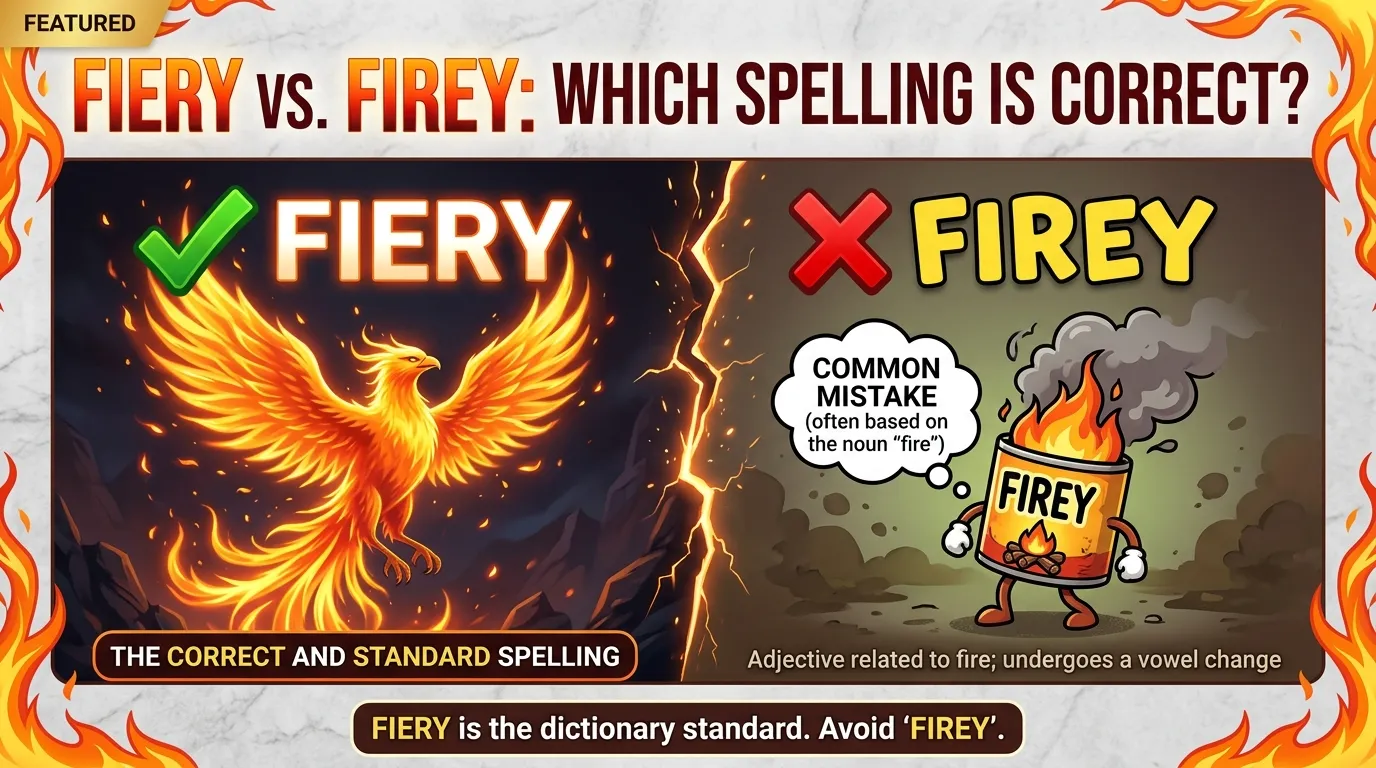
If you are wondering whether fiery or firey is the correct spelling, the answer is simple: fiery is the standard and correct spelling in modern American English. The spelling firey is generally considered a misspelling.
The confusion is understandable. The word comes from fire, so many people naturally assume that adding -y should produce firey. However, English spelling does not always work by simply attaching a suffix to the original word. In this case, fire + -y historically developed into fiery, with the spelling changing to make the word easier to pronounce and distinguish.
Fiery can describe something literally related to fire, such as fiery flames, but it can also describe a person’s passion, anger, energy, enthusiasm, or strong personality. For example, you might read about a fiery speech, a fiery debate, or a fiery personality.
This guide explains fiery vs firey, including the correct spelling, pronunciation, definitions, grammatical use, etymology, regional differences, common mistakes, synonyms, collocations, examples, and practical writing advice.
Quick Answer: Is It Fiery or Firey?
Fiery is the correct standard spelling.
Firey is generally incorrect in standard American English and should be avoided in formal, academic, professional, and published writing.
| Spelling | Correct? | Standard Usage | Example |
|---|---|---|---|
| fiery | ✅ Yes | Standard English | She gave a fiery speech. |
| firey | ❌ No | Usually a misspelling | She gave a firey speech. |
The easiest rule to remember
Use “fiery,” not “firey.”
The word fiery is pronounced approximately FY-uh-ree or FY-ree, depending on the speaker and context.
What Does Fiery Mean?
Fiery is an adjective that means relating to fire, resembling fire, burning strongly, or showing intense emotion or energy.
The word has both literal and figurative meanings.
Literal meaning
When used literally, fiery describes something associated with flames, heat, burning, or fire.
Examples:
- The volcano released a fiery stream of lava.
- The sunset filled the sky with fiery orange colors.
- The firefighters battled the fiery blaze.
- A fiery ball of debris crossed the night sky.
Figurative meaning
Fiery can also describe someone or something that is passionate, energetic, aggressive, intense, or emotionally powerful.
Examples:
- She is a fiery leader.
- His fiery speech energized the crowd.
- They had a fiery argument.
- The coach has a fiery personality.
- She is known for her fiery determination.
So, fiery does not always mean literally burning. It is frequently used as a metaphor for strong emotion or intensity.
Why Is “Fiery” Correct Instead of “Firey”?
The spelling fiery may look unusual because the base word is fire.
It seems logical to write:
fire + y = firey
But standard English uses:
fiery
This is an example of how English spelling can preserve older word forms rather than following a simple modern spelling formula.
When the suffix -y is added to fire, the resulting adjective developed as fiery, rather than firey.
The spelling also helps reflect the word’s pronunciation. If you saw firey, you might be tempted to pronounce it as FIRE-ee, closely following the pronunciation of fire. Fiery, however, has a conventional pronunciation that is usually closer to FY-uh-ree.
Compare these forms
- fire → fiery
- fun → funny
- sun → sunny
- cloud → cloudy
- storm → stormy
English spelling changes can involve historical patterns, pronunciation, and established usage. That is why you cannot always predict the correct spelling simply by attaching -y to a noun.
Fiery vs Firey: Key Difference
The primary difference is spelling and standardness.
Fiery
Fiery is the accepted standard adjective.
It can mean:
- Related to fire
- Burning or glowing
- Extremely hot
- Passionate
- Energetic
- Angry or intense
- Strong-willed or spirited
Firey
Firey is generally a spelling error.
You may occasionally see it in:
- Informal online writing
- Usernames
- Brand names
- Creative names
- Social media posts
- Typographical errors
- Fictional names
However, these special uses do not make firey the standard spelling of the adjective.
Correct:
The politician delivered a fiery speech.
Incorrect in standard English:
The politician delivered a firey speech.
How Do You Pronounce Fiery?
Fiery is commonly pronounced approximately:
FY-uh-ree
It may also be pronounced more like:
FY-ree
The exact pronunciation can vary slightly depending on the speaker, dialect, and speaking speed.
The first syllable is related to the pronunciation of fire, but the word generally does not sound like simply saying fire followed by ee.
Example
She has a fiery personality.
A common pronunciation is approximately:
FY-uh-ree
Because pronunciation can vary, it is useful to remember that fiery is not normally pronounced exactly as fire-ee with two completely separate words.
Is Fiery a Noun, Verb, or Adjective?
Fiery is an adjective.
It modifies a noun by describing its qualities.
Examples
- a fiery speech
- a fiery debate
- a fiery sunset
- a fiery personality
- a fiery temper
- fiery flames
- a fiery performance
The related noun is fire.
The related verb is also fire, depending on the meaning.
Other related forms include:
- fire
- fiery
- firebrand
- fireproof
- fireplace
- firelight
- firefighting
- firefighter
Dictionary-Style Definition of Fiery
A concise dictionary-style definition would be:
Fiery (adjective): relating to, resembling, or characterized by fire; intensely hot, bright, passionate, energetic, angry, or emotionally intense.
Example
The artist used fiery reds and oranges in the painting.
Here, fiery means the colors resemble the appearance or intensity of fire.
Another example:
Her fiery determination helped the team succeed.
Here, fiery is figurative and means strong, passionate, and energetic.
Literal vs Figurative Meanings of Fiery
One reason fiery is such a useful word is that it works naturally in both literal and figurative contexts.
Literal uses
Literal fiery describes something physically associated with fire or intense heat.
- fiery flames
- fiery lava
- fiery explosion
- fiery furnace
- fiery smoke
- fiery glow
- fiery embers
Figurative uses
Figurative fiery describes emotional or personal intensity.
- fiery passion
- fiery debate
- fiery personality
- fiery determination
- fiery temper
- fiery response
- fiery speech
- fiery competitor
Compare
The fiery lava flowed down the mountain.
Literal.
The candidate gave a fiery speech.
Figurative.
In the second example, the speech is not burning. The word describes its intensity and passion.
Why Do People Spell It “Firey”?
The most obvious reason is that firey looks logical.
People recognize the noun fire and may assume that adding -y creates the adjective:
fire + y → firey
That reasoning is understandable, but standard English uses the established form:
fire → fiery
Other reasons for the confusion
People may write firey because:
- They spell the word based on its appearance.
- They have never seen the correct spelling.
- They hear the pronunciation and guess the spelling.
- They type quickly on social media.
- Autocorrect does not always catch every spelling error.
- They confuse it with regular -y adjective formations.
- They assume every noun ending in e keeps the e before y.
The important point is that firey may look logical, but it is not the standard spelling.
Common Mistakes With Fiery
Here are several common errors and their corrections.
| Incorrect | Correct |
|---|---|
| firey personality | fiery personality |
| firey debate | fiery debate |
| firey speech | fiery speech |
| firey sunset | fiery sunset |
| firey temper | fiery temper |
| firey red | fiery red |
| firey passion | fiery passion |
| firey performance | fiery performance |
Incorrect
She has a firey temper.
Correct
She has a fiery temper.
Incorrect
The sunset had a firey glow.
Correct
The sunset had a fiery glow.
Fiery in American English
In American English, fiery is the standard spelling.
Use it in:
- School assignments
- Essays
- Business writing
- News articles
- Reports
- Emails
- Websites
- Blogs
- Academic writing
- Professional documents
- Creative writing
If you are writing for an American audience, there is generally no reason to use firey as the ordinary adjective.
American English examples
The senator delivered a fiery response.
The chef is famous for his fiery sauces.
The athlete has a fiery competitive spirit.
The sunset created a fiery horizon.
Fiery in British English
British English also uses fiery as the standard spelling.
Therefore, this is not primarily an American-versus-British spelling difference.
Both varieties generally use:
fiery
rather than:
firey
This makes fiery the safest choice for international English as well.
Is “Firey” Ever Acceptable?
There are situations in which Firey might appear as a proper name, creative spelling, username, character name, product name, or brand.
For example, a fictional character could intentionally be called Firey.
In that situation, the spelling is a name rather than the standard adjective.
The same principle applies to unusual brand spellings. A company can intentionally spell a word differently for marketing purposes.
However, that does not change standard English grammar.
If you mean the adjective describing something as passionate, burning, or fire-like, use:
fiery
Fiery as a Description of Personality
One of the most common figurative uses of fiery involves personality.
A fiery personality is usually energetic, passionate, confident, outspoken, or emotionally intense.
Depending on context, the word can be positive, neutral, or slightly negative.
Positive
She has a fiery spirit and never gives up.
Here, fiery suggests determination and energy.
Neutral
He is known for his fiery personality.
This simply describes someone as intense or passionate.
Negative
His fiery temper often gets him into trouble.
Here, the word suggests anger or a lack of emotional control.
The surrounding noun and context determine the exact meaning.
Fiery in Politics
Fiery is frequently used in political journalism and commentary.
It often describes:
- Speeches
- Debates
- Responses
- Rallies
- Statements
- Campaigns
- Arguments
- Criticism
Examples
The candidate delivered a fiery speech during the campaign.
The two lawmakers exchanged fiery remarks.
The president issued a fiery response to the criticism.
In political writing, fiery usually means strong, passionate, forceful, or confrontational rather than literally involving fire.
Fiery in Sports
Sports writers frequently use fiery to describe players, coaches, competition, or performances.
Examples
- a fiery competitor
- a fiery coach
- a fiery rivalry
- a fiery performance
- a fiery exchange
- a fiery response
Example sentences
The team showed a fiery determination in the second half.
The coach is known for his fiery sideline personality.
The two teams have developed a fiery rivalry.
In sports, the word often suggests passion, intensity, competitiveness, and emotional energy.
Fiery in Food and Cooking
Fiery is also common when describing spicy food.
A fiery sauce is usually very hot or spicy.
Examples:
- fiery salsa
- fiery curry
- fiery hot sauce
- fiery chicken wings
- fiery chili
- fiery noodles
Example
This restaurant serves a fiery chili sauce that is not for beginners.
Here, fiery does not necessarily mean the sauce contains actual flames. It means the food produces an intense sensation of heat.
Fiery in Art, Color, and Nature
The word can describe colors that resemble flames.
Common combinations include:
- fiery red
- fiery orange
- fiery yellow
- fiery sunset
- fiery sky
- fiery glow
- fiery landscape
Examples
The sky turned fiery orange at sunset.
The painter used fiery reds to create a dramatic mood.
The mountain appeared against a fiery sky.
This use is usually metaphorical or descriptive rather than literal.
Common Collocations With Fiery
A collocation is a group of words that naturally appear together.
Here are some common collocations with fiery:
Personality and emotion
- fiery personality
- fiery temper
- fiery spirit
- fiery passion
- fiery determination
- fiery enthusiasm
- fiery attitude
Communication
- fiery speech
- fiery response
- fiery remarks
- fiery argument
- fiery debate
- fiery exchange
- fiery criticism
Fire and nature
- fiery flames
- fiery blaze
- fiery glow
- fiery sky
- fiery sunset
- fiery lava
Food
- fiery sauce
- fiery curry
- fiery salsa
- fiery chili
- fiery dish
Learning these combinations can make your English sound more natural.
Synonyms for Fiery
The best synonym depends on the context.
When fiery means passionate
Use:
- passionate
- enthusiastic
- fervent
- ardent
- zealous
- intense
- spirited
Example:
She gave a fiery speech.
Possible alternatives:
She gave a passionate speech.
She gave an impassioned speech.
When fiery means angry
Use:
- angry
- heated
- furious
- fierce
- aggressive
- forceful
Example:
They had a fiery argument.
Possible alternative:
They had a heated argument.
When fiery means burning
Use:
- blazing
- burning
- flaming
- glowing
- scorching
- incandescent
Example:
The fiery flames filled the room.
Possible alternative:
The blazing flames filled the room.
Antonyms of Fiery
There is no single antonym that works in every context because fiery has several meanings.
Depending on the sentence, possible opposites include:
- calm
- cool
- cold
- mild
- peaceful
- unemotional
- restrained
- indifferent
- subdued
Example
a fiery personality → a calm personality
a fiery debate → a peaceful discussion
a fiery sauce → a mild sauce
fiery emotions → restrained emotions
Related Words and Word Family
The word fiery belongs to a larger group of fire-related vocabulary.
Common related words
- fire
- fiery
- fireplace
- firelight
- firewood
- firefighter
- firefighting
- fireproof
- firestorm
- firebrand
- fireball
- firework
- wildfire
Some of these are literal compounds, while others have developed figurative meanings.
Firebrand
Firebrand is especially interesting because it can describe a passionate or radical person.
Example:
The young activist became known as a political firebrand.
This is related conceptually to the figurative intensity associated with fiery.
Word History and Etymology of Fiery
The history of fiery goes back to the word fire, which has very old Germanic roots.
The noun fire has cognates in several Germanic languages and ultimately traces back to an ancient Indo-European root associated with fire.
The adjective fiery developed from the idea of being of, resembling, or characteristic of fire.
English spelling has changed over many centuries, and modern forms do not always follow the spelling patterns that a learner might expect today.
That historical development helps explain why:
fire + y
does not produce the standard modern form:
firey
Instead, English established:
fiery
The spelling has remained conventional even though it can seem less intuitive to modern learners.
Is Fiery Formal or Informal?
Fiery is neutral in formality.
It can be used in casual conversation, journalism, academic writing, business writing, and creative writing.
Casual
My brother has a fiery temper.
Business
The meeting ended with a fiery exchange between the executives.
Journalism
The candidate delivered a fiery speech at the rally.
Academic
The novel presents a fiery protagonist whose actions challenge traditional social expectations.
Creative
A fiery sunset stretched across the horizon.
The word is versatile and does not automatically make writing informal.
Fiery in Academic Writing
In academic writing, fiery can be appropriate, but writers should use it precisely.
For example:
The author presents a fiery critique of social inequality.
This works if the critique is genuinely forceful or passionate.
However, academic writing often benefits from more precise alternatives such as:
- forceful
- intense
- passionate
- confrontational
- vigorous
- strongly worded
Instead of:
The researcher made a fiery argument.
You might write:
The researcher presented a forceful argument.
The best choice depends on whether emotional intensity is important to your meaning.
Fiery in Business Writing
In professional communication, fiery can be useful when describing a strong disagreement, debate, or personality.
For example:
The board meeting included a fiery debate over the proposed changes.
However, avoid using emotionally charged language when writing sensitive workplace documents.
Instead of:
The employees had a fiery fight.
A more professional version might be:
The employees had a heated disagreement.
Or:
The discussion became increasingly contentious.
Professional writing often benefits from neutral language when the facts are sensitive.
Fiery vs Heated
These words are sometimes interchangeable, but they are not identical.
Fiery often suggests passion, energy, or strong emotion.
Heated commonly describes disagreement, argument, or tension.
Compare:
She gave a fiery speech.
This emphasizes passion and energy.
They had a heated argument.
This emphasizes disagreement and emotional tension.
You can say fiery argument, but heated argument is an especially common collocation.
Fiery vs Fierce
Fiery and fierce overlap, but their meanings differ.
Fiery often suggests:
- passion
- emotional intensity
- enthusiasm
- anger
- fire-like qualities
Fierce often suggests:
- strength
- aggression
- determination
- intensity
- competitiveness
Compare:
She is a fiery speaker.
She speaks passionately and intensely.
She is a fierce competitor.
She competes with great determination.
Both can describe strong personalities, but they emphasize different qualities.
Fiery vs Flaming
These words can also overlap.
Flaming generally refers more directly to actual flames or something literally burning.
Fiery can be literal or figurative.
Literal
The flaming building was visible from miles away.
Figurative
The senator gave a fiery speech.
You would not normally replace fiery with flaming in the second sentence.
Fiery vs Firey in Search and Digital Writing
People searching for “fiery vs firey”, “firey or fiery”, or “is firey a word?” are usually trying to determine the correct spelling.
For digital content, the standard recommendation is straightforward:
Use fiery.
If you are writing:
- Blog posts
- Website copy
- Product descriptions
- Social media captions
- News content
- SEO articles
- Emails
- School assignments
choose fiery unless Firey is intentionally being used as a proper name.
SEO example
Correct:
Discover the meaning of fiery, its pronunciation, and common examples.
Incorrect:
Discover the meaning of firey, its pronunciation, and common examples.
Common Phrases With Fiery
Here are several natural expressions you may encounter.
Fiery debate
A passionate or intense disagreement or discussion.
The proposal sparked a fiery debate.
Fiery speech
A passionate and forceful speech.
She delivered a fiery speech to the audience.
Fiery personality
A highly energetic, passionate, outspoken, or intense personality.
His fiery personality makes him memorable.
Fiery temper
A tendency to become angry quickly or strongly.
She has a fiery temper, but she usually apologizes afterward.
Fiery passion
Very strong enthusiasm or emotional commitment.
He pursued his career with fiery passion.
Fiery spirit
Strong energy, courage, or determination.
Her fiery spirit inspired everyone around her.
Memory Tricks for Spelling Fiery
If you repeatedly forget whether to write fiery or firey, try one of these memory tricks.
Trick 1: Remember “fire” loses the e
Think:
fire → fiery
The e in fire does not remain in the standard spelling.
Trick 2: Associate it with “fiery”
Think of the phrase:
Fiery flames
Both words begin with fi.
Trick 3: Remember the common phrase
fiery personality
This is one of the most common figurative combinations.
Trick 4: “Firey” looks tempting, but “fiery” is standard
When in doubt, choose:
FIERY
Awkward vs Natural Examples
Example 1
❌ Awkward/incorrect:
He gave a firey speech.
✅ Natural:
He gave a fiery speech.
Example 2
❌ Incorrect:
She has a firey personality.
✅ Correct:
She has a fiery personality.
Example 3
❌ Incorrect:
The sky turned firey red.
✅ Correct:
The sky turned fiery red.
Example 4
❌ Incorrect:
We watched the firey sunset.
✅ Correct:
We watched the fiery sunset.
Example 5
❌ Incorrect:
The coach is known for his firey temper.
✅ Correct:
The coach is known for his fiery temper.
Everyday Examples of Fiery
Here are practical examples you might encounter in daily English.
- The restaurant serves a fiery curry.
- She has a fiery personality.
- We watched the fiery sunset.
- His fiery speech motivated the team.
- The debate became increasingly fiery.
- She has a fiery temper.
- The artist used fiery colors.
- The volcano produced a fiery glow.
- He is a fiery competitor.
- The sauce has a fiery kick.
- Their rivalry became fiery during the final match.
- Her fiery determination impressed everyone.
- The novel features a fiery heroine.
- The sky was filled with fiery orange clouds.
- The two leaders exchanged fiery remarks.
Formal and Informal Alternatives to Fiery
The best alternative depends on what you mean.
| Meaning of Fiery | More Formal Alternative | Casual Alternative |
|---|---|---|
| Passionate | impassioned | fired-up |
| Angry | forceful/contentious | heated |
| Energetic | vigorous | energetic |
| Intense | intense | strong |
| Fire-like | flame-colored | blazing |
| Spicy | intensely hot | super spicy |
For example:
Fiery speech
Formal:
an impassioned speech
Casual:
a fired-up speech
But these alternatives are not perfect synonyms in every context. Fiery can combine several shades of meaning at once.
Is Fiery a Slang Word?
No. Fiery is not primarily slang.
It is a standard English adjective.
However, its figurative meanings can appear in casual and modern expressions.
For example:
That sauce is fiery!
Here, the word is informal because of the conversational context, but fiery itself is still standard vocabulary.
It can also be used creatively in social media and popular culture.
Can Fiery Describe a Person?
Yes.
When fiery describes a person, it often means the person is:
- Passionate
- Energetic
- Confident
- Strong-willed
- Outspoken
- Emotionally intense
- Easily angered, depending on context
For example:
Maria is a fiery advocate for environmental protection.
This is likely positive.
But:
He has a fiery temper.
This suggests that he becomes angry easily.
Therefore, fiery is not automatically positive or negative. Context determines the tone.
Is Fiery a Compliment?
It can be.
Calling someone fiery may be a compliment if you mean they are:
- Passionate
- Courageous
- Energetic
- Confident
- Determined
- Spirited
For example:
She has a fiery spirit that inspires everyone around her.
But it can have a negative meaning if it refers to anger:
His fiery temper makes teamwork difficult.
So, always consider the noun that follows fiery and the context in which it appears.
Fiery in Journalism
Journalists frequently use fiery to make descriptions more vivid.
Common journalistic combinations include:
- fiery speech
- fiery debate
- fiery exchange
- fiery response
- fiery criticism
- fiery remarks
- fiery confrontation
Example:
The two candidates engaged in a fiery debate before the election.
The adjective quickly tells readers that the discussion was emotionally intense.
However, journalists should avoid using fiery when it exaggerates an otherwise calm event. Precise language is more trustworthy.
Fiery in Technical and Scientific Contexts
In technical writing, fiery is less precise than scientific terminology.
For example, an engineer would generally describe a combustion event using terms such as:
- combustion
- flame
- thermal
- high-temperature
- ignition
- oxidation
- combustion products
Instead of:
The machine produced a fiery reaction.
A technical report might say:
The machine produced a high-temperature combustion reaction.
However, fiery can still be appropriate in general-audience science communication.
Example:
The volcano produced a fiery display of lava.
The key difference is precision. Technical writing usually favors measurable and specific terminology.
Regional Variations: Is Firey Used Anywhere?
The spelling fiery is standard across major varieties of English, including American and British English.
You may encounter firey online, but this usually reflects:
- A spelling mistake
- Informal typing
- A username
- A creative spelling
- A brand or character name
It should not normally be treated as a regional alternative to fiery.
International recommendation
For writing intended for:
- American readers
- British readers
- Canadian readers
- Australian readers
- International English learners
fiery is the safest standard form.
How to Use Fiery Correctly in a Sentence
A simple pattern is:
fiery + noun
Examples:
- fiery speech
- fiery debate
- fiery personality
- fiery temper
- fiery sunset
- fiery sauce
- fiery passion
You can also use fiery after linking verbs.
The sunset looked fiery.
Her response became fiery.
The debate grew fiery.
Comparative and superlative forms
You may occasionally see:
- fierier
- fieriest
For example:
Today’s sunset was fierier than yesterday’s.
That was the fieriest debate of the campaign.
These forms are grammatically possible, although writers may sometimes choose more fiery or most fiery, especially in formal prose.
“Fierier” or “More Fiery”?
Both patterns can occur, but more fiery is often clearer in formal writing.
Example
Her second speech was more fiery than her first.
This sounds natural.
You may also encounter:
Her second speech was fierier than her first.
This is grammatically understandable and can be used, but more fiery is often preferred because the spelling of fierier can look awkward.
Similarly:
the most fiery speech
is often more natural in polished prose than:
the fieriest speech
Fiery vs Firey: A Practical Decision Guide
If you are unsure which spelling to choose, use this checklist.
Choose “fiery” when:
- You mean related to fire.
- You mean burning or glowing.
- You mean passionate.
- You mean intense.
- You mean emotionally forceful.
- You mean energetic.
- You mean easily angered.
- You are writing for a professional audience.
- You are writing an academic assignment.
- You are publishing online.
- You are writing for American or British readers.
Avoid “firey” when:
- You are using the standard adjective.
- You are writing formal English.
- You are preparing an essay.
- You are writing business content.
- You are publishing an article.
- You are writing a news report.
- You are creating educational content.
Unless Firey is deliberately a name or brand, fiery is the correct choice.
Fiery vs Firey: Comparison Table
| Feature | Fiery | Firey |
|---|---|---|
| Standard spelling | ✅ Yes | ❌ No |
| Standard American English | ✅ | ❌ |
| Standard British English | ✅ | ❌ |
| Part of speech | Adjective | Not standard as adjective |
| Related to fire | Yes | Intended meaning, but misspelled |
| Figurative meaning | Yes | Not standard |
| Formal writing | Recommended | Avoid |
| Academic writing | Recommended | Avoid |
| Business writing | Recommended | Avoid |
| Casual writing | Recommended | Usually avoid |
| Proper name | Possible | Possible if intentionally created |
| Common error | No | Yes |
What Should You Write in an Essay?
Always write:
fiery
For example:
The author creates a fiery protagonist whose passion drives the central conflict.
Avoid:
The author creates a firey protagonist whose passion drives the central conflict.
The first version follows standard English spelling and is appropriate for school, college, and professional writing.
What Should You Write in a Blog Post?
Use fiery.
For example:
This recipe combines smoky flavors with a fiery chili sauce.
Even if your target keyword is “fiery vs firey,” the actual article should consistently use fiery when referring to the adjective.
If discussing the misspelling itself, you can write:
Many writers wonder whether fiery or firey is correct. The standard spelling is fiery.
This clearly satisfies the search query without introducing the misspelling as if it were correct.
Common Questions About Fiery vs Firey
Is “firey” a correct spelling?
No. Firey is generally considered a misspelling of fiery in standard English. Use fiery in formal, academic, professional, and published writing.
Is fiery spelled with an e?
No. The standard spelling is fiery, not firey. Although the word comes from fire, the adjective has the established spelling fiery.
What does fiery mean?
Fiery means related to fire or resembling fire. Figuratively, it can mean passionate, energetic, intense, forceful, or easily angered.
How do you pronounce fiery?
Fiery is commonly pronounced approximately FY-uh-ree or FY-ree, depending on the speaker and dialect.
Is fiery American or British English?
Fiery is standard in both American and British English. It is not a major US-versus-UK spelling difference.
Can fiery describe a person?
Yes. A fiery person may be passionate, energetic, outspoken, determined, or emotionally intense. Depending on context, the word can also suggest someone with a quick temper.
Is fiery a positive word?
It can be positive, neutral, or negative. Fiery determination is usually positive, while a fiery temper can be negative. Context determines the tone.
What is the difference between fiery and firey?
Fiery is the standard spelling. Firey is generally a misspelling unless it is intentionally used as a name, brand, username, or other proper name.
Can you say “fierier”?
Yes, fierier can be used as a comparative form. However, more fiery is often clearer and more natural in polished writing.
What is a synonym for fiery?
Depending on context, synonyms include passionate, intense, heated, fierce, fervent, energetic, blazing, burning, and spirited. The best synonym depends on whether fiery refers to fire, emotion, personality, color, or intensity.
Conclusion: Fiery or Firey?
When choosing between fiery vs firey, there is a clear standard-English answer: fiery is correct.
The spelling firey may seem logical because the word comes from fire, but it is not the standard spelling of the adjective. Use fiery when describing something related to flames, heat, brightness, passion, anger, intensity, or strong emotion.
Remember these key points:
- Fiery is the standard spelling.
- Firey is generally a misspelling.
- Fiery is an adjective.
- It can have both literal and figurative meanings.
- It works in American, British, and international English.
- It can describe fire, colors, food, personalities, speeches, debates, sports, and emotions.
- Its meaning can be positive or negative depending on context.
- Use fiery in academic, business, journalistic, professional, and casual writing.
- Treat Firey as acceptable only when it is intentionally used as a proper name, brand, username, or creative spelling.
The simplest rule is worth remembering:
Fire → fiery, not firey.
Whenever you are writing standard English, choose fiery.


