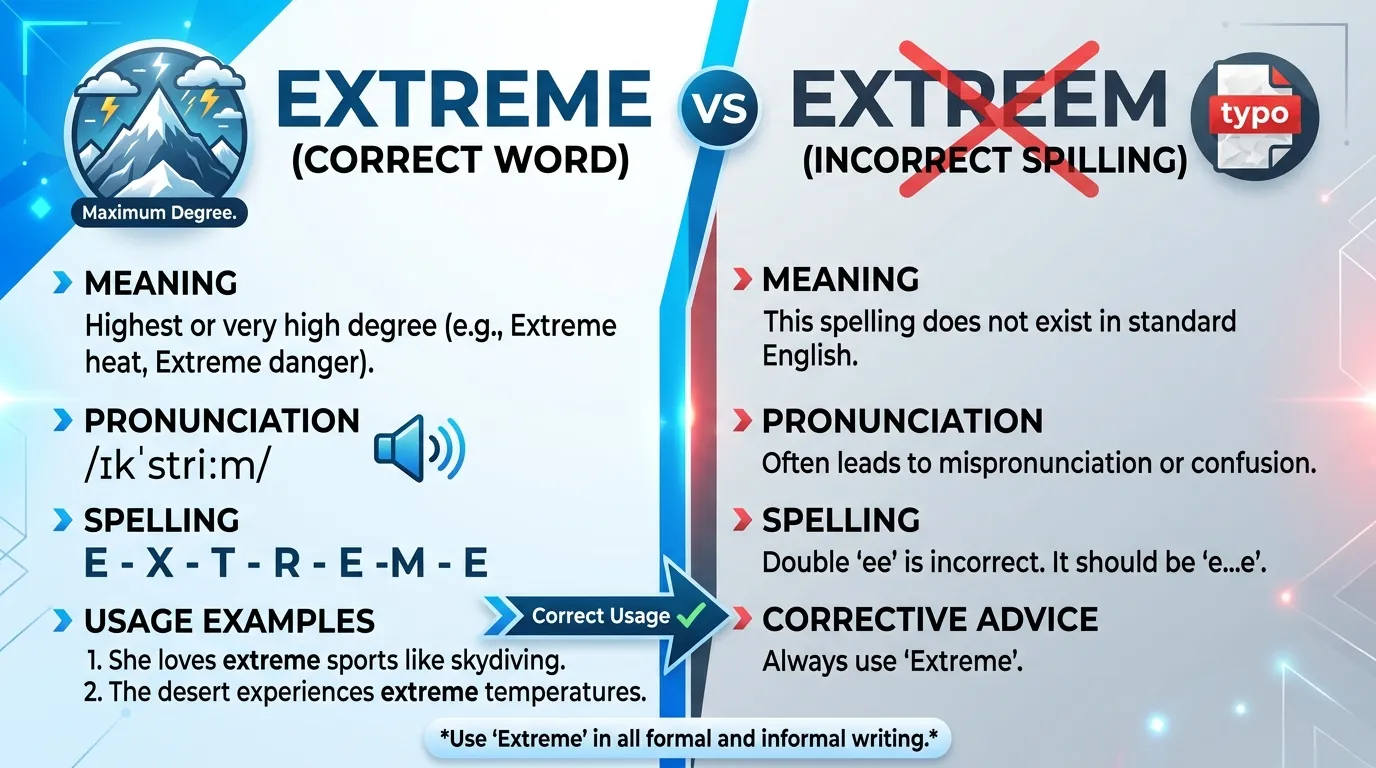
If you have ever wondered whether the correct spelling is extreme or extreem, you are not alone. The two spellings look almost identical, and their pronunciation can make the difference even harder to notice. However, in standard modern English, “extreme” is the correct spelling. “Extreem” is not a standard English spelling of the word.
The word extreme can describe something very intense, unusually large or small, severe, excessive, or far beyond what is considered normal. It can describe weather, emotions, opinions, sports, behavior, physical conditions, or situations.
In this guide, you will learn the difference between extreme and extreem, how to pronounce extreme, where the word comes from, how its meaning developed, and how to use it naturally in American English. You will also see common mistakes, synonyms, antonyms, collocations, formal and informal examples, and useful memory tricks.
Quick Answer: Extreme or Extreem?
Extreme is the correct English spelling.
Extreem is generally incorrect in standard English.
| Spelling | Correct in standard English? | Meaning |
|---|---|---|
| extreme | Yes | Very great, severe, intense, or far from ordinary |
| extreem | No | Not the standard English spelling |
Correct examples
- The heat was extreme.
- She has an extreme fear of heights.
- The athlete enjoys extreme sports.
- The company took extreme measures.
- His political views are considered extreme.
Incorrect examples
- The heat was extreem.
- She has an extreem fear of heights.
- He enjoys extreem sports.
The spelling extreem may appear in another language or as an informal spelling mistake, but it is not the normal spelling used in English.
What Does Extreme Mean?
Extreme means something that exists at a very high or very low level, goes far beyond what is normal, or reaches an outer limit.
The exact meaning depends on context.
For example:
The weather is extreme.
This could mean the weather is unusually hot, cold, stormy, dry, or otherwise severe.
Consider another sentence:
She showed extreme patience.
Here, extreme means very great or unusually strong.
In:
They live in extreme poverty.
The word describes a condition that is far beyond ordinary poverty and involves severe hardship.
So, the central idea behind extreme is distance from the ordinary or normal range.
Dictionary-style definition
Extreme can be defined as:
Existing at the greatest or highest degree; very intense, severe, unusual, or far from the ordinary.
It can also refer to an outer limit or one of two opposite ends of a range.
For example:
- extreme heat
- extreme cold
- extreme wealth
- extreme poverty
- extreme happiness
- extreme sadness
- extreme danger
- extreme caution
What Does Extreem Mean?
Extreem is not the standard English spelling of the word.
If you are writing in American English, British English, academic English, business English, journalism, or ordinary online English, use extreme.
The confusion usually happens because English pronunciation does not always make spelling obvious.
Someone may hear extreme and imagine that the word contains a long ee sound represented by ee in the spelling. That can lead to the incorrect form extreem.
However, English spelling does not work that way here.
The correct spelling is:
e-x-t-r-e-m-e
Not:
e-x-t-r-e-e-m
Extreme vs Extreem: The Main Difference
The difference is primarily spelling and language usage.
Extreme is an English word.
Extreem is not the standard English spelling of that English word.
The pronunciation is not a reason to change the spelling.
| Feature | Extreme | Extreem |
|---|---|---|
| Standard English spelling | Yes | No |
| Common English word | Yes | No |
| Standard American English | Yes | No |
| Standard British English | Yes | No |
| Pronounced as the intended English word | Yes | Usually intended to represent extreme |
| Appropriate for formal writing | Yes | No |
| Appropriate for academic writing | Yes | No |
| Common spelling mistake | No | Yes |
How Do You Pronounce Extreme?
Extreme is pronounced roughly like ik-STREEM.
The main stress falls on the second syllable:
ex-TREME
The ending sounds like the word team.
This pronunciation can contribute to the spelling mistake because the final sound is a long ee sound.
Breaking the word into sounds
A simple learner-friendly pronunciation is:
ik-STREEM
The first part is weak, while the second part receives the main stress.
Examples:
- extreme weather
- extreme sports
- extreme pressure
- extreme difficulty
In each phrase, extreme has the same basic pronunciation.
Why Do People Spell Extreme as Extreem?
There are several reasons people make this mistake.
The pronunciation suggests “ee”
The final part of extreme sounds like eem.
That may cause learners to think the spelling should contain ee:
extreem
But the correct spelling is:
extreme
English has many words where pronunciation does not directly reveal spelling.
English spelling is not purely phonetic
English words often contain letters that do not correspond perfectly to the sounds we hear.
Compare:
- extreme
- theme
- complete
- supreme
- machine
The long e sound can be represented in different ways.
Influence from other languages
Another reason for confusion is that similar-looking forms occur in other languages. For example, extreem is a legitimate spelling in Dutch.
That does not make it the correct spelling in English.
A person who knows or encounters another language may therefore see extreem and assume it is also acceptable in English.
For English writing, however, use extreme.
Extreme Etymology: Where Does the Word Come From?
The history of extreme goes back to Latin.
The English word ultimately comes from the Latin extremus, meaning outermost, utmost, or farthest.
This Latin word is related to the idea of being at the furthest point or outer limit.
The word entered English through forms influenced by French and developed into the modern English extreme.
This history helps explain an important part of the modern meaning.
When we call something extreme, we are often saying that it is located at an outer limit.
For example:
- extreme heat is far beyond ordinary heat
- extreme cold is far beyond ordinary cold
- extreme wealth is far beyond ordinary wealth
- extreme poverty is far below normal economic security
- an extreme opinion is far from the political or social center
The basic concept of going to an outer limit has remained important throughout the word’s development.
The Original Idea Behind Extreme
Understanding the historical idea of outermost makes modern uses easier to remember.
Imagine a scale:
low → moderate → high → extreme
The extreme point lies at the far end.
The same idea works with opposites:
cold → cool → mild → warm → hot → extreme heat
The word does not simply mean “a lot.”
It often suggests that something has moved far outside the ordinary range.
That distinction matters.
Very vs Extreme
Consider:
The movie was very scary.
This tells us the movie was highly frightening.
Now compare:
The movie was extremely scary.
This gives a stronger impression. The fear was at an unusually high level.
However, extreme can carry more meaning than simply very.
For example:
extreme poverty
means severe poverty, not merely “very poverty.”
That is why extreme should not be treated as a universal replacement for very.
Extreme as an Adjective
The most common grammatical role of extreme is an adjective.
An adjective describes a noun.
Examples:
- extreme weather
- extreme conditions
- extreme pressure
- extreme behavior
- extreme pain
- extreme caution
- extreme difficulty
- extreme temperatures
Example sentences
The hikers faced extreme weather conditions.
The experiment was performed under extreme pressure.
The region experienced extreme temperatures.
His extreme reaction surprised everyone.
The rescue team worked in extreme conditions.
In each sentence, extreme describes a noun.
Extreme as a Noun
Extreme can also function as a noun.
As a noun, it can refer to one of two farthest or opposite points.
For example:
The two political extremes were unable to agree.
Here, extremes refers to opposite ends of a range.
Another example:
The temperature moved from one extreme to another.
The two extremes could be very cold and very hot.
Common noun patterns
- one extreme
- the other extreme
- opposite extremes
- political extremes
- at either extreme
- from one extreme to another
Extreme as a Concept of Opposites
One particularly useful meaning of extreme involves two opposite ends.
Consider:
love ↔ hatred
These can be described as emotional extremes.
Or:
poverty ↔ wealth
These represent economic extremes.
Or:
silence ↔ noise
These can represent opposite extremes of sound.
This use is common in academic, political, journalistic, and everyday English.
Extreme in Everyday English
You will encounter extreme in many ordinary situations.
Weather
- extreme heat
- extreme cold
- extreme weather
- extreme temperatures
- extreme humidity
Example:
The city issued a warning because of extreme heat.
Sports
- extreme sports
- extreme skiing
- extreme climbing
- extreme competition
Example:
He became interested in extreme sports as a teenager.
Emotions
- extreme happiness
- extreme sadness
- extreme anger
- extreme fear
- extreme excitement
Example:
She felt extreme relief when the results arrived.
Behavior
- extreme behavior
- extreme reaction
- extreme measures
- extreme caution
Example:
The doctor advised extreme caution.
Extreme in Formal and Academic Writing
Extreme is completely acceptable in formal English.
It is often used in academic, scientific, business, medical, political, and journalistic contexts.
Examples:
Extreme temperatures can affect infrastructure.
Researchers examined the effects of extreme environmental conditions.
The organization adopted extreme measures to reduce costs.
Extreme inequality can create social instability.
However, formal writing should use the word precisely.
Do not use extreme simply to make a statement sound stronger.
Instead, ask whether the situation genuinely describes an unusually high, low, severe, or far-reaching condition.
Extreme in Business English
Business writers commonly use extreme with words related to risk, conditions, and outcomes.
Common combinations include:
- extreme risk
- extreme pressure
- extreme circumstances
- extreme conditions
- extreme competition
- extreme caution
- extreme measures
Example:
The company took extreme measures to prevent further losses.
A more neutral alternative might be:
The company took significant measures to prevent further losses.
The choice depends on how severe the situation actually is.
Extreme in Technical and Scientific English
The word is also common in technical writing.
Examples include:
- extreme temperature
- extreme pressure
- extreme conditions
- extreme environments
- extreme values
- extreme events
In science and mathematics, extreme can have more specialized meanings.
For example, an extreme value can refer to a maximum or minimum in a mathematical or statistical context.
This is different from simply saying something is “very large.”
Context determines the exact meaning.
Extreme in Politics
The word extreme is frequently used in political language.
Examples include:
- extreme political views
- extreme ideology
- extreme policies
- political extremes
- extremist movements
However, writers should use this language carefully.
Calling an opinion extreme is often a judgment about where that opinion falls on a political spectrum.
For objective writing, especially journalism or academic work, it is better to explain what makes the position extreme rather than simply applying the label.
Instead of:
His views are extreme.
A more informative sentence could be:
His proposal would significantly depart from the policies currently supported by most members of the group.
This gives readers evidence rather than only a label.
Extreme in Sports
Sports are one of the most recognizable areas where the word appears.
Extreme sports generally refers to sports or recreational activities involving unusually high levels of physical challenge, speed, risk, or danger.
Examples may include:
- extreme skiing
- extreme climbing
- extreme mountain biking
- extreme snowboarding
Example:
Extreme sports require careful preparation and appropriate safety equipment.
The phrase has become common enough that many readers immediately understand the general idea.
Common Collocations With Extreme
A collocation is a combination of words that naturally occur together.
Learning collocations can help English learners use extreme more naturally.
Common adjective-noun combinations
- extreme weather
- extreme heat
- extreme cold
- extreme danger
- extreme pressure
- extreme stress
- extreme caution
- extreme difficulty
- extreme poverty
- extreme wealth
- extreme pain
- extreme anger
- extreme fear
- extreme happiness
- extreme conditions
- extreme measures
- extreme sports
- extreme temperatures
- extreme circumstances
- extreme behavior
Common expressions
- go to extremes
- take something to extremes
- at the extreme
- the extreme opposite
- from one extreme to another
- in extreme cases
Idioms and Phrases With Extreme
Go to extremes
Go to extremes means to take unusually strong or excessive action.
Example:
Some people go to extremes to save money.
From one extreme to another
This means moving between two very different or opposite conditions.
Example:
His diet changed from one extreme to another.
At the extreme
This refers to a situation at the farthest end of a range.
Example:
At the extreme, the policy could affect millions of people.
Take something to extremes
This means pushing an idea or behavior too far.
Example:
Healthy exercise is useful, but taking it to extremes can create problems.
Synonyms for Extreme
The best synonym depends on context.
Common synonyms
- severe
- intense
- excessive
- extraordinary
- exceptional
- drastic
- radical
- immense
- enormous
- tremendous
- profound
- absolute
These words are not always interchangeable.
For example:
extreme weather
can often become:
severe weather
But:
extreme sports
cannot naturally become:
severe sports
That is why learning the context is more useful than simply memorizing synonyms.
Antonyms of Extreme
Common antonyms include:
- moderate
- mild
- ordinary
- normal
- reasonable
- balanced
- moderate
- restrained
Example:
The region moved from extreme temperatures to more moderate conditions.
The word moderate is especially useful because it represents the middle rather than the outer limit.
Extreme vs Very
English learners sometimes ask whether extreme simply means very.
Not exactly.
Very is a general intensifier.
Extreme describes something that reaches an unusually high, low, severe, or far-reaching level.
Compare:
It was very cold.
It was extremely cold.
Both are natural.
But:
The region experienced extreme cold.
This can suggest unusually severe conditions, possibly beyond what is normally expected.
In other words, extreme carries stronger semantic content than a simple intensifier.
Extreme vs Severe
These words overlap but are not identical.
Extreme focuses on being far from the normal or moderate range.
Severe often emphasizes seriousness, harshness, or intensity.
Compare:
extreme weather
severe weather
Both are natural.
But:
severe criticism
is more natural than:
extreme criticism
in some contexts.
Likewise:
extreme wealth
is natural, while severe wealth is not.
Extreme vs Excessive
Extreme means very far from normal.
Excessive usually means more than is appropriate, necessary, or reasonable.
Compare:
He showed extreme confidence.
This describes a very high level of confidence.
He showed excessive confidence.
This suggests his confidence was too much or inappropriate.
That distinction is useful in professional and academic writing.
Extreme vs Radical
In some contexts, extreme and radical overlap.
However, radical often describes a major departure from established ideas, systems, or practices.
Examples:
- radical political ideas
- radical reform
- radical change
Extreme is broader:
- extreme temperatures
- extreme pain
- extreme poverty
- extreme opinions
You cannot normally replace extreme with radical in all these situations.
Extreme vs Extreem: Pronunciation Does Not Change the Spelling
One of the most important lessons for English learners is this:
Do not spell a word only according to how it sounds.
The pronunciation of extreme ends with a sound similar to eem, but the spelling remains extreme.
This pattern appears in many English words.
For example:
- theme
- supreme
- machine
- complete
- unique
- extreme
English spelling reflects word history and established conventions, not just pronunciation.
Common Mistakes With Extreme
Mistake: Extreem
Incorrect:
The weather was extreem.
Correct:
The weather was extreme.
Mistake: Extrem
Incorrect:
That was an extrem situation.
Correct:
That was an extreme situation.
The final e is important.
Mistake: Extremeley
Incorrect:
She was extremeley tired.
Correct:
She was extremely tired.
Notice that the adverb is formed as:
extreme → extremely
Not extremeley.
Mistake: Extremly
Incorrect:
The conditions were extremly difficult.
Correct:
The conditions were extremely difficult.
The spelling contains extreme + ly, with the spelling adjusted to form extremely.
Extreme vs Extremely
This distinction is important for grammar.
Extreme is usually an adjective.
Extremely is an adverb.
Compare:
It was an extreme situation.
It was extremely difficult.
The adjective describes a noun:
extreme situation
The adverb modifies an adjective or another adverb:
extremely difficult
More examples
Correct:
She experienced extreme stress.
Correct:
She was extremely stressed.
Correct:
The weather was extreme.
Correct:
The weather was extremely hot.
Incorrect:
The weather was extreme hot.
Use extremely, not extreme, before an adjective such as hot.
Awkward vs Natural Examples
Awkward
The problem was extreme big.
Natural
The problem was extremely big.
Even better in many formal contexts:
The problem was enormous.
Awkward
He extreme dislikes the idea.
Natural
He strongly dislikes the idea.
Or:
He extremely dislikes the idea.
The second sentence is grammatically possible in limited contexts but sounds unnatural. English speakers normally choose strongly with dislikes.
This shows why knowing a word’s grammar and collocations matters as much as knowing its dictionary meaning.
Formal vs Informal Alternatives
Depending on your audience, you may choose a different word.
| Situation | Natural choice |
|---|---|
| Casual conversation | extreme |
| General writing | extreme |
| Academic writing | extreme, severe, significant |
| Business writing | extreme, severe, substantial |
| Journalism | extreme, severe, drastic |
| Technical writing | extreme, maximum, minimum, severe |
| Blogging | extreme, intense, huge |
| Formal analysis | extreme, exceptional, excessive, severe |
The correct choice depends on the meaning you want.
Regional English: American vs British English
There is no major American-British spelling difference between extreme and extreem.
Both American and British English use:
extreme
Examples:
American English:
The region experienced extreme weather.
British English:
The region experienced extreme weather.
The spelling remains the same.
This is unlike pairs such as:
- color / colour
- center / centre
- realize / realise
Therefore, you do not need to change extreme when switching between American and British English.
Is Extreem Ever Correct?
For standard English writing, no.
If you see extreem, it may be:
- a spelling mistake
- a typo
- a learner’s spelling
- a username or brand name
- a deliberate stylistic spelling
- a word from another language
The important distinction is between English vocabulary and proper names or foreign-language vocabulary.
A company, username, product, or title could deliberately use Extreem. That does not make it the standard English spelling.
Memory Trick: How to Remember Extreme
Here is an easy way to remember the spelling.
Think:
extreme = end + e
The word ends with:
-eme
not:
-eem
You can also connect it with similar words:
- supreme
- extreme
Both have the -eme pattern.
Another memory trick is:
Extreme reaches the end of the range.
The word itself ends with e, just as the concept points toward an outer end.
How to Use Extreme Naturally
When deciding whether to use extreme, ask three questions:
Is it far from normal?
If yes, extreme may work.
The area suffered extreme flooding.
Is it unusually intense or severe?
If yes, extreme may be appropriate.
The workers faced extreme pressure.
Am I simply trying to say “very”?
If yes, consider whether another word would sound more natural.
Instead of:
an extreme improvement
you might prefer:
a major improvement
Instead of:
extreme interest
you might prefer:
strong interest
Precise word choice makes English sound more natural.
Everyday Examples of Extreme
Here are natural examples you may encounter in everyday English:
We had extreme heat last summer.
He showed extreme patience with the children.
The road conditions became extreme after the storm.
She was under extreme pressure at work.
The company faced extreme competition.
They took extreme measures to solve the problem.
The athlete trains for extreme events.
Extreme caution is required in this area.
His reaction seemed extreme.
The temperature reached an extreme level.
Examples for English Learners
At school
The teacher explained how extreme temperatures affect plants.
At work
The project was completed under extreme time pressure.
In conversation
That seems a little extreme.
This last expression is very common.
That seems a little extreme usually means:
I think that reaction, decision, or statement is stronger than necessary.
Example:
You want to quit your job because your manager was five minutes late?
That seems a little extreme.
Here, extreme has a figurative meaning. It does not refer to physical distance or temperature.
Figurative Meaning of Extreme
The word is often used figuratively.
For example:
That punishment is extreme.
The speaker does not mean the punishment occupies a physical outer edge. Instead, they mean it is far more severe than expected or reasonable.
Other figurative examples include:
- an extreme reaction
- an extreme decision
- an extreme opinion
- extreme confidence
- extreme jealousy
- extreme loyalty
These describe intensity rather than physical measurement.
Extreme and Emotional Language
Because extreme is a strong word, it can affect the tone of a sentence.
Compare:
She was worried.
She was very worried.
She was extremely worried.
She was in extreme distress.
The final sentence is much stronger and more serious.
Therefore, use extreme carefully when writing about emotions, personal experiences, or serious situations.
Extreme in Journalism
Journalists may use extreme to describe:
- weather
- political positions
- economic conditions
- social behavior
- environmental events
- risks
However, good journalism should avoid vague exaggeration.
Instead of simply saying:
The country faced extreme economic problems.
A stronger report might identify the actual problems, such as unemployment, inflation, falling production, or shortages.
The word is useful, but specific evidence makes writing more informative.
Extreme in Blogging and Online Writing
Bloggers often use extreme because it is vivid and easy to understand.
Examples:
- extreme productivity
- extreme fitness
- extreme weather
- extreme travel
- extreme challenges
However, using extreme repeatedly can make writing sound exaggerated.
Instead of:
This is an extreme, extreme, extreme problem.
Use a precise description:
This problem could affect thousands of customers.
Specific language is usually more persuasive than repeated intensifiers.
Extreme: Related Words
Understanding related words can expand your vocabulary.
Extremely
Meaning: to a very high or severe degree.
The test was extremely difficult.
Extremity
Meaning: an extreme condition, quality, or point.
The soldiers endured great extremity.
It can also refer to a limb or outer part of the body.
Extremist
Meaning: a person who holds or supports extreme views, especially political or ideological ones.
The organization was accused of promoting extremist views.
Extremism
Meaning: extreme beliefs or actions, particularly in politics or ideology.
The government announced measures against violent extremism.
These words are related to extreme, but they have different grammatical roles and meanings.
A Simple Grammar Guide
| Word | Part of speech | Example |
|---|---|---|
| extreme | adjective | extreme weather |
| extreme | noun | political extremes |
| extremely | adverb | extremely difficult |
| extremity | noun | the extremity of the situation |
| extremist | noun/adjective | an extremist group |
| extremism | noun | political extremism |
For English learners, remembering these forms can prevent many grammatical mistakes.
Extreme vs Extreem: Final Comparison
| Question | Extreme | Extreem |
|---|---|---|
| Is it standard English? | Yes | No |
| Correct spelling? | Yes | No |
| Used in American English? | Yes | No |
| Used in British English? | Yes | No |
| Used in academic writing? | Yes | No |
| Used in professional writing? | Yes | No |
| Common pronunciation | ik-STREEM | Usually intended as extreme |
| Standard dictionary English word? | Yes | No |
| Meaning | Very intense, severe, far-reaching, or outermost | Not the standard English form |
Frequently Asked Questions
Is extreme or extreem correct?
Extreme is the correct spelling in standard English. Extreem is not the standard English spelling of the word.
What does extreme mean?
Extreme means very intense, severe, unusual, excessive, or far from the ordinary or moderate range. It can also refer to an outer limit or opposite end of a range.
How do you pronounce extreme?
Extreme is pronounced roughly ik-STREEM, with the main stress on the second syllable.
Why do people spell extreme as extreem?
The mistake often happens because the final sound of extreme resembles eem. Learners may therefore spell the word phonetically as extreem. English spelling, however, uses -eme.
Is extreem a British spelling?
No. British English also uses extreme. There is no standard British spelling extreem for this word.
Is extreem a word in English?
It is not a standard English spelling of extreme. You may encounter it as a typo, a proper name, a brand name, or a word from another language.
What is the difference between extreme and extremely?
Extreme is usually an adjective or sometimes a noun, while extremely is an adverb.
It was an extreme situation.
The situation was extremely serious.
What is the opposite of extreme?
Depending on context, common opposites include moderate, mild, ordinary, normal, balanced, and reasonable.
Is extreme a formal word?
Yes. Extreme is appropriate in casual, professional, academic, technical, journalistic, and formal English. The key is to use it accurately and avoid unnecessary exaggeration.
What is the origin of extreme?
The word ultimately comes from the Latin extremus, meaning outermost, utmost, or farthest. It entered English through historical forms influenced by French and developed into the modern word extreme.
Conclusion
When choosing between extreme vs extreem, the answer is simple: use extreme in standard English.
The spelling extreme is used in both American and British English and works in casual conversation, business writing, academic papers, journalism, technical documents, and everyday communication. Extreem is not the standard English spelling, even though its appearance may seem logical from the pronunciation.
The word extreme describes something that reaches a very high or low level, becomes unusually intense or severe, or lies at an outer end of a range. Its historical connection to the Latin idea of being outermost or farthest helps explain why the word is used for conditions that go beyond the ordinary.
For English learners, remember three things:
Extreme is spelled with “-eme,” not “-eem.”
Extreme is pronounced roughly “ik-STREEM.”
Extremely is the adverbial form, as in “extremely difficult.”
If you remember that extreme reaches the outer end of a range, you can connect both its meaning and spelling more easily. When writing in English, choose extreme confidently and avoid extreem unless you are intentionally reproducing a proper name or foreign-language spelling.


