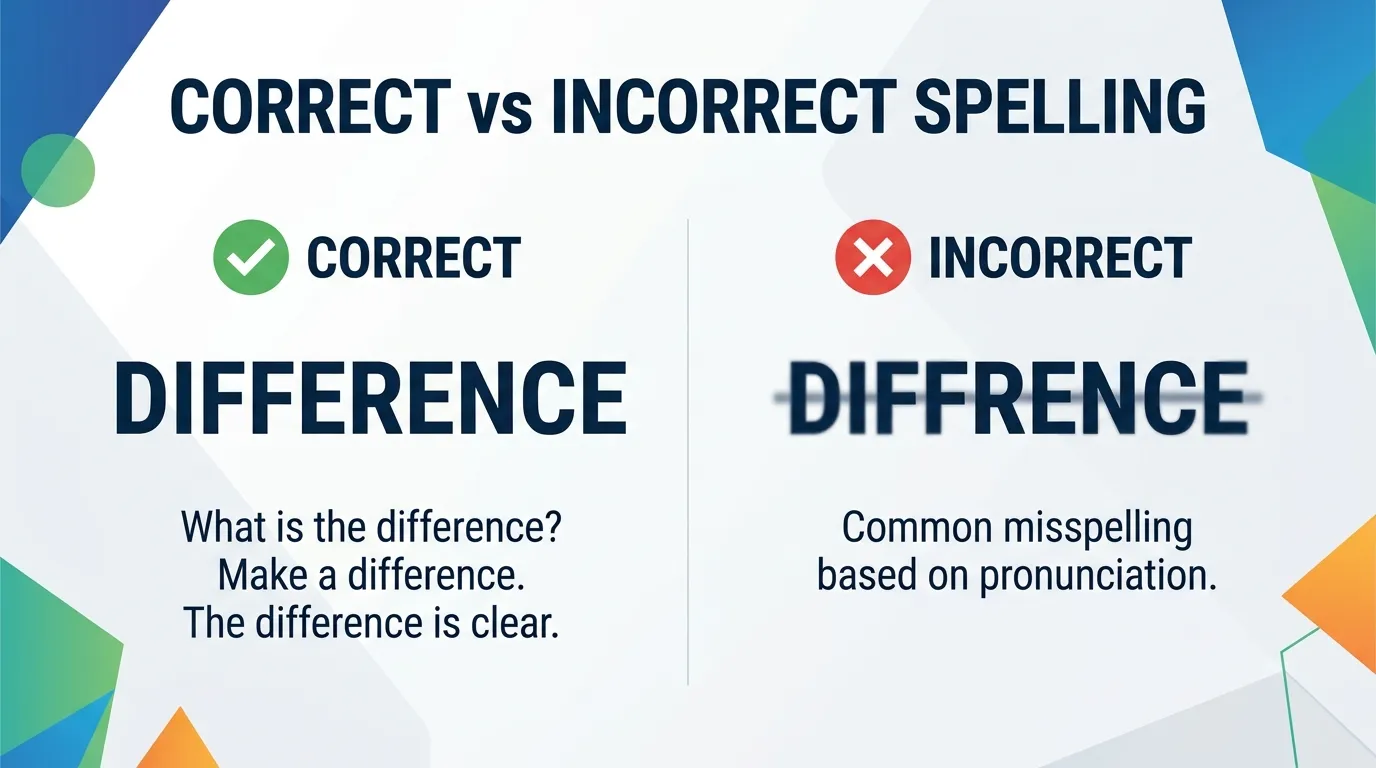
If you are wondering whether “difference” or “diffrence” is the correct spelling, the answer is simple: difference is correct, while diffrence is a misspelling.
The word difference is a common English noun used to describe the way two or more things are not the same. You may use it when comparing people, ideas, objects, opinions, results, or situations.
The spelling diffrence is incorrect because it leaves out the second “e” in the middle of the word. This is an easy mistake to make because the word is often pronounced quickly, and the unstressed vowel can be difficult to hear.
In this guide, you will learn the correct spelling, pronunciation, definition, grammatical role, history, common phrases, collocations, regional usage, and practical examples of difference. You will also see why diffrence is wrong and how to remember the correct spelling.
Quick Answer: Difference or Diffrence?
Difference is the correct spelling.
Diffrence is incorrect and should not be used in standard English.
| Spelling | Correct? | Meaning |
|---|---|---|
| difference | ✅ Yes | A way in which things or people are not the same |
| diffrence | ❌ No | Misspelling of “difference” |
Correct examples
- There is a big difference between the two products.
- Can you explain the difference between these words?
- Small changes can make a significant difference.
- I noticed a difference in her attitude.
Incorrect example
- ❌ There is a big diffrence between the two products.
The correct version is:
- ✅ There is a big difference between the two products.
The key is to remember the sequence:
dif + fer + ence = difference
Not:
dif + fr + ence = diffrence
What Does “Difference” Mean?
Difference is a noun that refers to a way in which two or more things are unlike each other.
For example:
What is the difference between a laptop and a desktop computer?
The question asks how the two types of computers are different.
The word can describe differences in:
- Appearance
- Size
- Color
- Quality
- Price
- Behavior
- Opinion
- Meaning
- Function
- Results
- Personality
- Experience
Dictionary-style definition
Difference (noun): A quality, feature, condition, or amount that makes one person or thing unlike another.
It can also refer to a disagreement between people:
The two business partners had a difference of opinion.
In mathematics, difference has another specific meaning. It can mean the result obtained by subtracting one number from another.
For example:
The difference between 15 and 9 is 6.
So, although difference is usually used for comparison, it also has mathematical and figurative applications.
Is “Diffrence” a Correct Word?
No. Diffrence is not the standard English spelling of the word.
It is a common spelling error caused by the pronunciation and structure of difference.
When people say the word naturally, the middle vowel can sound weak:
difference → /ˈdɪfərəns/
Because the pronunciation does not strongly emphasize every vowel, a writer may accidentally leave out the e after the f.
However, in written English, the standard spelling is always:
difference
Why “diffrence” looks tempting
The incorrect spelling often happens because writers mentally reduce:
difference → diffrence
The missing e is easy to overlook.
Similar spelling problems happen with other words containing unstressed vowels. The best solution is to learn the word as a complete spelling pattern rather than relying only on pronunciation.
Difference vs Diffrence: Key Spelling Difference
The entire issue can be reduced to one important letter.
Correct
difference
Incorrect
diffrence
The correct spelling contains “fer” in the middle:
dif + fer + ence
The incorrect spelling removes the e:
dif + fr + ence
That missing e makes diffrence a spelling error.
Easy visual comparison
| Correct | Incorrect |
|---|---|
| difference | diffrence |
| difference | diffrence |
| difference | diffrence |
A useful way to remember the spelling is:
There is an “e” in “difference” between the f and r.
How Do You Pronounce “Difference”?
In American English, difference is commonly pronounced approximately as:
/ˈdɪfərəns/
It sounds roughly like:
DIF-er-uhns
The first syllable receives the strongest stress:
DIF-er-ence
The word has three syllables in careful pronunciation:
dif-fer-ence
In everyday speech, the middle vowel may be reduced, which is one reason learners sometimes have trouble spelling the word correctly.
Pronunciation breakdown
- dif — stressed
- fer — weaker
- ence — weak final syllable
The spelling, however, does not change based on how quickly someone pronounces the word.
Why Do People Confuse “Difference” and “Diffrence”?
There are several reasons this spelling mistake is common.
1. The middle vowel is weak
The e in the middle is not strongly stressed when the word is pronounced naturally.
As a result, a writer may not consciously hear it.
2. English spelling is not perfectly phonetic
English words are not always spelled exactly as they sound.
For example:
- different
- difference
- reference
- preference
- conference
These words contain vowel patterns that may be less obvious in speech.
3. Fast typing causes omissions
When people type quickly, they often leave out letters without noticing.
Difference is long enough for this to happen easily.
4. The eye recognizes familiar patterns
When reading, your brain may recognize diffrence as an intended version of difference, even though the spelling is incorrect.
This is especially common when proofreading your own work.
Difference: Grammatical Role
Difference is primarily a noun.
It can be used as a countable or uncountable noun depending on the context.
Countable use
When referring to a specific distinction, use a difference or differences.
Examples:
- There is a difference between the two plans.
- I noticed several differences in the reports.
- The two versions have three major differences.
Uncountable or general use
It can also refer to the general concept of variation or distinction.
Examples:
- Education can make a difference.
- Experience makes a difference in this profession.
- The new policy made little difference.
Common Uses of “Difference”
The word difference appears in many everyday expressions.
Difference between
This is one of the most common constructions.
What is the difference between these two products?
I do not understand the difference between these terms.
Use between when comparing two or more distinct things.
Make a difference
This means to have an effect or produce a meaningful change.
Your support can make a difference.
A few extra minutes can make a difference.
Make a big difference
This means to create a significant effect.
Better lighting can make a big difference in a small room.
Make no difference
This means something has no effect on the result.
It will make no difference to me.
Tell the difference
This means to recognize how two things differ.
Can you tell the difference between real leather and synthetic leather?
Know the difference
This means to understand the distinction between two things.
Students should know the difference between formal and informal writing.
A difference of opinion
This refers to disagreement between people about an issue.
We had a difference of opinion about the best approach.
Split the difference
This expression means to compromise by choosing a middle position.
Neither side wanted to accept the full proposal, so they decided to split the difference.
Difference vs Different
Although difference and different are related, they are not interchangeable.
Difference
Difference is a noun.
There is a difference between the two cars.
Different
Different is usually an adjective.
The two cars are different.
Compare:
| Word | Part of Speech | Example |
|---|---|---|
| difference | Noun | I noticed a difference. |
| different | Adjective | The two designs are different. |
A useful pattern is:
Things are different.
There is a difference between them.
Difference vs Distinction
These words are closely related but are not always identical.
Difference is the broader and more common word.
Distinction often suggests a more specific or meaningful difference.
For example:
There is a difference in price.
But:
The professor explained the distinction between the two theories.
“Distinction” can suggest that understanding the specific difference matters.
Simple rule
Use difference for general comparisons.
Use distinction when emphasizing a particular or important separation between concepts.
Difference vs Variation
Variation usually refers to changes or differences within a group, system, or range.
For example:
There is considerable variation in the quality of these products.
Difference is more general:
There is a difference between these products.
Both can be correct, but the context determines which word sounds most natural.
Difference vs Contrast
Difference identifies how things are not alike.
Contrast often emphasizes the striking or opposite qualities of two things.
For example:
There is a significant difference in their ages.
The bright walls contrast with the dark furniture.
“Contrast” is particularly useful when the difference is visually or conceptually strong.
Difference vs Disagreement
A difference does not necessarily involve conflict.
For example:
There is a difference in the two measurements.
This is simply a variation.
But:
They had a difference of opinion.
Here, the word refers to disagreement.
Therefore, difference can describe both neutral variation and disagreement depending on the context.
Common Collocations With “Difference”
A collocation is a group of words that commonly appear together.
Learning collocations can make your English sound more natural.
Common collocations with difference include:
- big difference
- major difference
- significant difference
- important difference
- slight difference
- small difference
- noticeable difference
- fundamental difference
- clear difference
- key difference
- major differences
- subtle difference
- meaningful difference
- dramatic difference
- substantial difference
Examples
There is a significant difference between the two results.
We found a slight difference in color.
The new software made a noticeable difference.
There is a fundamental difference between the two approaches.
Common Phrases With “Difference”
Here are some of the most useful expressions.
Make a difference
Your advice really made a difference.
Make a significant difference
Regular practice can make a significant difference.
Tell the difference
Can you tell the difference?
Know the difference
It is important to know the difference.
See the difference
You can immediately see the difference.
Notice a difference
I noticed a difference after changing the settings.
A world of difference
This idiom means a very large or important difference.
A good night’s sleep can make a world of difference.
At a difference
This expression is not generally natural in standard English. Writers should normally choose a clearer phrase such as “make a difference” or “have a difference.”
“Difference” in Mathematics
The word has a precise mathematical meaning.
In basic subtraction, the difference is the amount left when one number is subtracted from another.
For example:
20 − 8 = 12
Therefore, the difference between 20 and 8 is 12.
More examples:
- 10 − 4 = 6 → Difference: 6
- 25 − 10 = 15 → Difference: 15
- 100 − 75 = 25 → Difference: 25
In mathematics, “difference” does not mean a disagreement or general distinction. It refers specifically to the result of subtraction.
“Difference” in Business and Professional Writing
Difference is completely appropriate in business communication.
Examples:
We need to understand the difference between the two proposals.
The updated process made a measurable difference in productivity.
There is a significant difference in operating costs.
In professional writing, you can make the language more precise by adding an adjective:
- measurable difference
- significant difference
- material difference
- substantial difference
- operational difference
- competitive difference
Business writing tip
Avoid vague statements such as:
There is a big difference.
Instead, when possible, explain what the difference actually is:
The new system reduces processing time by 20 percent.
This gives readers useful information rather than simply describing the difference as “big.”
“Difference” in Academic Writing
The word is common in academic English.
Examples:
The study found a significant difference between the two groups.
Researchers observed differences in participant responses.
There is an important difference between correlation and causation.
Academic writing often uses more specific modifiers:
- statistically significant difference
- meaningful difference
- measurable difference
- theoretical difference
- methodological difference
- cultural difference
- individual difference
Example
Instead of:
There was a big difference between the groups.
Academic writing may say:
The researchers observed a statistically significant difference between the two groups.
The second sentence is more precise and appropriate for formal research.
“Difference” in Journalism
Journalists frequently use difference when comparing policies, opinions, candidates, companies, teams, or events.
Examples:
The candidates have sharply different views on the issue.
The report highlights major differences between the two proposals.
The new figures show a significant difference from last year’s results.
Journalistic writing generally favors clear, direct language, so difference is a natural choice.
“Difference” in Technical Writing
Technical documents may use difference to describe variations in:
- Measurements
- System behavior
- Performance
- Specifications
- Outputs
- Configurations
- Algorithms
- Materials
- Processes
For example:
The difference in temperature affected the test results.
Engineers identified a difference between the expected and actual output.
When precision matters, specify exactly what differs.
“Difference” in Sports
Sports writing commonly uses difference to describe scores, performance, statistics, and outcomes.
Examples:
The team won by a difference of five points.
There was only a two-point difference at halftime.
The goalkeeper made the difference in the final minutes.
A related expression is:
The difference-maker
A “difference-maker” is a person or factor that has a major positive effect on an outcome.
Example:
The rookie became a difference-maker for the team.
“Difference” in Casual Conversation
The word is extremely common in everyday speech.
Examples:
What’s the difference?
I can’t tell the difference.
Does it really make a difference?
What’s the difference between these two?
I noticed a big difference.
It doesn’t make any difference to me.
These expressions are natural in American English and can be used in informal conversations.
Formal vs Informal Alternatives
The word difference itself works in both formal and informal English. However, different synonyms may suit different contexts.
| Context | Natural wording |
|---|---|
| Casual | What’s the difference? |
| Everyday | I can see a big difference. |
| Professional | There is a significant difference. |
| Academic | The study identified a significant difference. |
| Technical | The measurements show a measurable difference. |
| Journalistic | The report highlights major differences. |
| Formal | The distinction between the two approaches is important. |
There is no need to replace difference simply to sound formal. It is already a standard and versatile English word.
American vs British English: Is There a Spelling Difference?
There is no major American-British spelling difference for this word.
Both American and British English use:
difference
The misspelling diffrence is incorrect in both varieties.
For example:
American English:
There is a difference between the two systems.
British English:
There is a difference between the two systems.
The spelling remains the same.
Some English words have regional spelling differences, such as:
- color / colour
- center / centre
- organize / organise
But difference is not one of them.
Is “Difference” Singular or Plural?
Both forms are possible.
Singular: difference
Use difference when referring to one distinction.
There is one major difference between the plans.
Plural: differences
Use differences when referring to multiple distinctions.
There are several differences between the plans.
Compare:
The biggest difference is the price.
The biggest differences involve price, size, and quality.
Common Mistakes With “Difference”
Mistake 1: Writing “diffrence”
❌ The diffrence is obvious.
✅ The difference is obvious.
Mistake 2: Omitting the middle “e”
❌ What is the diffrence?
✅ What is the difference?
Mistake 3: Confusing “different” and “difference”
❌ There is very different between them.
✅ There is a big difference between them.
Or:
✅ They are very different.
Mistake 4: Using “difference” as an adjective
❌ They have difference opinions.
✅ They have different opinions.
“Difference” is a noun. “Different” is the adjective.
Mistake 5: Confusing “difference” with “distinction”
Sometimes writers use the words as if they were always interchangeable. They are related, but distinction can suggest a more precise conceptual separation.
Awkward vs Natural Examples
Understanding natural phrasing is just as important as knowing the spelling.
Example 1
Awkward:
What is the difference among these two phones?
Natural:
What is the difference between these two phones?
Example 2
Awkward:
This feature does a difference.
Natural:
This feature makes a difference.
Example 3
Awkward:
I cannot difference the two colors.
Natural:
I cannot tell the difference between the two colors.
Example 4
Awkward:
They are difference from each other.
Natural:
They are different from each other.
Example 5
Awkward:
There is a difference opinions.
Natural:
There is a difference of opinion.
How to Remember the Correct Spelling of “Difference”
Here are several memory tricks.
Memory Trick 1: Remember “different”
Start with:
different
Then remember:
difference
Both begin with:
d-i-f-f-e-r
The important middle sequence is:
FFER
Memory Trick 2: Break it into parts
Think:
dif + fer + ence
This makes the missing e easier to remember.
Memory Trick 3: Connect “different” and “difference”
If you know how to spell different, it can help you remember difference.
different → difference
Both contain:
diff-er
Memory Trick 4: Remember the sentence
There is an e in the middle of difference.
This simple visual reminder can prevent the common typo diffrence.
Synonyms for “Difference”
Depending on context, several words can replace difference.
Common synonyms
- distinction
- contrast
- variation
- discrepancy
- divergence
- disparity
- dissimilarity
- change
- deviation
- gap
However, these words are not perfect substitutes in every sentence.
Difference vs discrepancy
Discrepancy usually suggests that two things that should agree do not match.
There is a discrepancy between the two reports.
Difference vs disparity
Disparity often refers to a noticeable inequality or imbalance.
The study examined income disparities.
Difference vs divergence
Divergence suggests that things move apart or develop in different directions.
The two theories show increasing divergence.
Difference vs dissimilarity
Dissimilarity emphasizes a lack of resemblance.
The dissimilarity between the two designs was obvious.
Antonyms of “Difference”
Depending on context, possible opposites include:
- similarity
- sameness
- agreement
- likeness
- equality
- uniformity
- consistency
For example:
The difference between the designs was obvious.
Possible contrast:
The similarity between the designs was obvious.
The best antonym depends on what kind of “difference” you mean.
Word History and Etymology of “Difference”
The word difference has a long history in English.
It ultimately traces back to Latin differentia, meaning a distinction or difference. The word is related to Latin different-, associated with the idea of being different or carrying apart.
It entered English through Old French and developed into the modern English form difference.
The related word different comes from the same historical family.
This explains why different and difference are so closely related in both spelling and meaning.
Related word family
- differ
- different
- difference
- differently
- differential
- differentiation
Understanding this word family can help learners recognize spelling and meaning patterns.
Related Words From the Same Word Family
Differ
Differ is a verb.
Their opinions differ on this issue.
Different
Different is an adjective.
Their opinions are different.
Difference
Difference is a noun.
There is a difference between their opinions.
Differently
Differently is an adverb.
They approached the problem differently.
Differential
Differential can function as an adjective or noun and has specialized meanings in mathematics, science, medicine, and other fields.
Differentiation
Differentiation refers to the process of distinguishing one thing from another.
Common Questions About Difference vs Diffrence
Is “diffrence” a word?
No. Diffrence is a misspelling of the standard English word difference.
Which is correct: difference or diffrence?
Difference is correct. Diffrence is incorrect.
Why do people spell difference as diffrence?
The mistake usually occurs because the middle e is weak in natural pronunciation and is easy to omit when writing or typing quickly.
Is difference spelled differently in British English?
No. Difference is spelled the same in standard American and British English.
Is difference a noun?
Yes. Difference is primarily a noun.
There is a difference between the two options.
What is the adjective form of difference?
The common adjective is different.
The two options are different.
What is the verb form?
The related verb is differ.
Their opinions differ.
What is the difference between different and difference?
Different is an adjective describing things that are not alike, while difference is a noun referring to the distinction itself.
The cars are different.
There is a difference between the cars.
What is the difference between difference and distinction?
Difference is the broader, more common term for ways in which things are not the same. Distinction often emphasizes a particular or meaningful separation between ideas, categories, or concepts.
How do you spell difference correctly?
Spell it:
D-I-F-F-E-R-E-N-C-E
A useful pattern is:
diff + er + ence
Do not omit the e after the second f.
Frequently Asked Questions
1. Is “difference” the only correct spelling?
For standard modern English, difference is the correct spelling. Forms such as diffrence are spelling errors.
2. How do you pronounce difference?
In American English, difference is commonly pronounced approximately /ˈdɪfərəns/, with the main stress on the first syllable.
3. What does difference mean in simple English?
Difference means a way that two or more people or things are not the same.
For example:
The main difference between the shirts is their color.
4. Can difference be used in formal writing?
Yes. Difference is completely appropriate for formal, academic, business, technical, and professional writing.
5. What is the plural of difference?
The plural is differences.
We found several differences between the two reports.
6. Is “difference” a noun or adjective?
Difference is a noun. The related adjective is different.
There is a difference.
They are different.
7. What is the difference between “difference” and “different”?
Difference names the distinction, while different describes things that are not alike.
I noticed a difference.
The two products are different.
8. Can “difference” mean disagreement?
Yes. In expressions such as “difference of opinion,” it can refer to disagreement.
They had a difference of opinion about the decision.
9. What does “make a difference” mean?
Make a difference means to have an effect or produce a meaningful change.
Your help can make a difference.
10. What is the difference between two numbers?
In mathematics, the difference is the result of subtracting one number from another.
For example:
18 − 7 = 11
Therefore, the difference is 11.
Final Verdict
When choosing between difference and diffrence, there is no difficult regional or grammatical rule to memorize.
The correct spelling is:
✅ difference
The incorrect spelling is:
❌ diffrence
The most important thing to remember is the middle e:
dif-fer-ence
The word difference is a common noun used in everyday conversation, academic writing, business communication, journalism, technical documents, mathematics, and many other settings. It can describe a simple variation, an important distinction, a disagreement, or the result of subtraction.
If you frequently make the diffrence spelling mistake, connect the word with its related forms different and differ. You can also break the spelling into dif + fer + ence to make the internal e easier to remember.
For American English, British English, international English, formal writing, casual messages, and professional communication, the recommendation is the same: always write “difference.”
When proofreading, look especially for the missing e in diffrence. Correct spelling improves clarity, professionalism, and reader confidence—even when the intended meaning is obvious.
In short: If you mean a way in which things are not the same, write “difference,” never “diffrence.”


