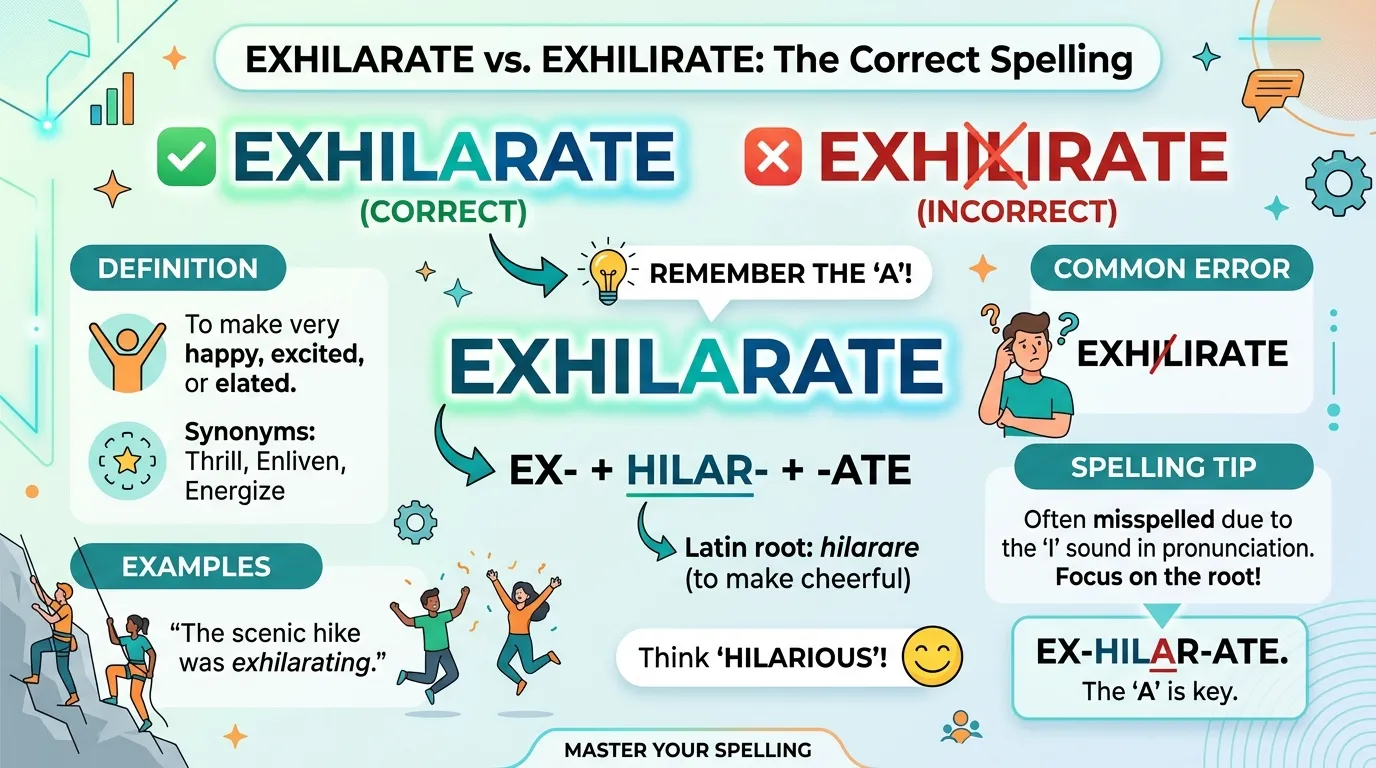
If you are wondering whether the correct spelling is exhilarate or exhilirate, the answer is simple: exhilarate is the correct standard English spelling. Exhilirate is a misspelling and should not be used in standard American or British English.
The confusion is understandable. Both forms look similar, and the pronunciation of exhilarate does not make every letter easy to identify. The unusual sequence -hilar- can also make writers instinctively replace the a with i, producing exhilirate.
This guide explains the difference between exhilarate and exhilirate, including their meanings, pronunciation, grammatical forms, word history, synonyms, common mistakes, examples, and practical usage. By the end, you will know exactly which spelling to choose in casual writing, schoolwork, business communication, journalism, academic writing, and professional content.
Quick Answer: Exhilarate or Exhilirate?
Exhilarate is the correct spelling.
Exhilirate is not a standard English word. It is a spelling error caused by confusion about the pronunciation and letter sequence in exhilarate.
| Spelling | Correct? | Meaning |
|---|---|---|
| Exhilarate | ✅ Yes | To make someone extremely happy, excited, or energized |
| Exhilirate | ❌ No | Misspelling of exhilarate |
| Exhilarated | ✅ Yes | Extremely happy, excited, or energized |
| Exhilarating | ✅ Yes | Causing great excitement or happiness |
| Exhilaration | ✅ Yes | A feeling of intense excitement or happiness |
The easiest rule to remember
If you mean to make someone feel extremely excited or happy, spell it:
EXHILARATE
Not:
EXHILIRATE
A useful memory trick is to remember the middle of the word as hilar, giving you:
ex + hilar + ate = exhilarate
What Does Exhilarate Mean?
The verb exhilarate means to make someone feel extremely happy, excited, lively, or energized.
It usually describes a strong positive emotional reaction.
For example:
- The mountain view exhilarated the hikers.
- The fast ride exhilarated the children.
- Winning the championship exhilarated the team.
- The concert exhilarated the crowd.
The word suggests more than ordinary happiness. If something exhilarates you, it gives you a powerful feeling of excitement, energy, or joy.
Dictionary-style definition
Exhilarate (verb):
To make someone feel very happy, excited, cheerful, or energized.
Example
The freedom of riding a motorcycle along the open road exhilarated him.
Here, exhilarated means that the experience produced a powerful feeling of excitement and joy.
What Does Exhilirate Mean?
Exhilirate is a misspelling of exhilarate.
It is not the standard spelling of an English verb.
You may occasionally encounter exhilirate online, in informal writing, social media posts, or user-generated content. Its appearance does not make it a recognized alternative spelling.
For standard writing, replace:
The experience will exhilirate you.
with:
The experience will exhilarate you.
The same rule applies to related forms. Do not write exhilirated or exhilirating when you mean the standard words exhilarated and exhilarating.
Why Do People Confuse Exhilarate and Exhilirate?
The main reason is spelling uncertainty.
Exhilarate contains an unusual letter sequence:
e-x-h-i-l-a-r-a-t-e
The section -hilar- is not a pattern many English learners see frequently. Because the word is pronounced differently from how some writers expect it to sound, they may write what they think they hear.
This can produce:
- exhilirate
- exhilirated
- exhilirating
- exhiliration
The correct forms are:
- exhilarate
- exhilarated
- exhilarating
- exhilaration
Pronunciation also contributes to the confusion
In American English, exhilarate is commonly pronounced approximately:
ig-ZIL-uh-rate
The pronunciation does not clearly emphasize every individual vowel in the spelling. As a result, someone hearing the word may remember the sound but not the exact written form.
Exhilarate vs Exhilirate: Key Difference
The difference is primarily correct spelling versus misspelling.
There is no standard semantic distinction between the two forms because exhilirate does not function as an accepted standard English word.
| Feature | Exhilarate | Exhilirate |
|---|---|---|
| Standard English | ✅ | ❌ |
| Standard American English | ✅ | ❌ |
| Standard British English | ✅ | ❌ |
| Part of speech | Verb | — |
| Meaning | To make very excited or happy | No standard meaning |
| Dictionary form | Yes | No |
| Formal writing | Appropriate | Incorrect |
| Academic writing | Appropriate | Incorrect |
| Business writing | Appropriate | Incorrect |
| Casual writing | Appropriate | Avoid |
| Correct past tense | Exhilarated | — |
| Correct adjective | Exhilarating | — |
So if you are choosing between the two, there is no difficult usage decision to make.
Always choose exhilarate.
How to Pronounce Exhilarate
The pronunciation of exhilarate can vary slightly by accent, but in American English it is commonly pronounced approximately:
ig-ZIL-uh-rate
A simplified pronunciation guide is:
ig-ZIL-uh-rayt
The main stress falls on the second syllable.
Break the word into parts
You can think of the pronunciation as:
ex-hil-a-rate
However, pronunciation should not be used to reconstruct the spelling letter by letter. English contains many words whose spelling and pronunciation do not line up perfectly.
For example:
- exhilarate
- exhaust
- exhibit
- exhort
The initial exh- combination can appear unusual, but it is legitimate English spelling.
Is Exhilarate a Verb?
Yes. Exhilarate is a verb.
It describes the action of causing someone to feel intense excitement, happiness, or energy.
Verb forms
| Form | Example |
|---|---|
| Base form | exhilarate |
| Third-person singular | exhilarates |
| Present participle | exhilarating |
| Past tense | exhilarated |
| Past participle | exhilarated |
Examples:
- The race exhilarates him.
- The race exhilarated him.
- Racing can be exhilarating.
- She felt exhilarated after the competition.
Exhilarate vs Exhilarated vs Exhilarating
These related words are easy to mix up because they describe the same general idea from different grammatical perspectives.
Exhilarate
Exhilarate is the verb.
The experience will exhilarate her.
It means the experience will cause her to feel intense excitement.
Exhilarated
Exhilarated usually describes the person experiencing the emotion.
She felt exhilarated after reaching the summit.
She is the one feeling the excitement.
Exhilarating
Exhilarating describes the thing or experience that produces the emotion.
Reaching the summit was exhilarating.
The experience itself caused excitement.
A simple pattern
Something is exhilarating → it exhilarates you → you feel exhilarated.
For example:
The roller coaster was exhilarating.
It exhilarated the passengers.
The passengers were exhilarated afterward.
This distinction is especially useful for English learners.
Exhilarate in a Sentence
Here are natural examples of exhilarate in different contexts.
Everyday examples
- The surprise trip exhilarated the children.
- The beautiful scenery exhilarated her.
- The sudden victory exhilarated the fans.
- The adventure exhilarated everyone involved.
- The unexpected opportunity exhilarated him.
Sports examples
- The dramatic final goal exhilarated the supporters.
- Winning the race exhilarated the young athlete.
- The team’s comeback exhilarated the crowd.
Travel examples
- Flying over the mountains exhilarated the tourists.
- The first skydive exhilarated him.
- Exploring the remote island exhilarated the travelers.
Professional examples
- The successful launch exhilarated the development team.
- The breakthrough exhilarated the researchers.
- The unexpected business opportunity exhilarated the investors.
Exhilarate vs Excite
Exhilarate and excite are close synonyms, but they are not always interchangeable.
Excite is much more common and has a broader range of meanings.
For example:
The announcement excited the students.
This sounds completely natural.
You could also say:
The announcement exhilarated the students.
But exhilarated sounds stronger and more emotionally intense.
The difference in strength
Excite can mean to create interest, anticipation, or enthusiasm.
Exhilarate generally suggests a more powerful feeling of joy, energy, or thrilling excitement.
Compare:
The new movie trailer excited me.
This means it made you interested or enthusiastic.
The final scene exhilarated me.
This suggests an intense emotional rush.
Exhilarate vs Thrill
Thrill is another close synonym.
The roller coaster thrilled the passengers.
The roller coaster exhilarated the passengers.
Both sentences work, but thrill is more common in everyday English.
Exhilarate often sounds slightly more literary or expressive.
Similar words
Depending on context, alternatives include:
- excite
- thrill
- delight
- energize
- stimulate
- enliven
- animate
- inspire
- uplift
- invigorate
These words are not perfect substitutes in every sentence.
Synonyms for Exhilarate
Here are useful synonyms grouped by meaning.
When you mean intense excitement
- thrill
- excite
- electrify
- stimulate
- energize
When you mean happiness
- delight
- please
- gladden
- cheer
- uplift
When you mean renewed energy
- invigorate
- enliven
- energize
- refresh
- animate
For example, invigorate emphasizes energy more strongly:
The morning exercise invigorated her.
Delight emphasizes pleasure:
The gift delighted her.
Exhilarate combines strong positive emotion with excitement and energy:
The unexpected victory exhilarated her.
Antonyms of Exhilarate
The opposite of exhilarate depends on the context.
Possible antonyms include:
- depress
- sadden
- discourage
- disappoint
- bore
- exhaust
- dishearten
- dull
- weaken
For example:
The exciting victory exhilarated the players.
Possible opposite:
The disappointing loss discouraged the players.
Exhilarate and Its Word Family
Knowing the word family makes the spelling easier to remember.
Exhilarate
Verb:
The adventure exhilarated them.
Exhilarated
Adjective or past participle:
They felt exhilarated.
Exhilarating
Adjective or present participle:
It was an exhilarating experience.
Exhilaration
Noun:
She felt a rush of exhilaration.
Exhilaratingly
Adverb:
The race was exhilaratingly fast.
The important spelling pattern remains:
exhilar-
Not:
exhilir-
Common Collocations With Exhilarate
A collocation is a combination of words that naturally appear together.
Common combinations with exhilarate include:
- exhilarate the audience
- exhilarate the crowd
- exhilarate the fans
- exhilarate the senses
- exhilarate the mind
- exhilarate the spirit
- exhilarate the participants
- exhilarate the team
- feel exhilarated
- become exhilarated
- truly exhilarating
- absolutely exhilarating
- an exhilarating experience
- an exhilarating adventure
- an exhilarating ride
- an exhilarating journey
- an exhilarating performance
Example
The breathtaking performance exhilarated the audience.
This sounds natural because exhilarated works well with people or groups experiencing a powerful emotional response.
Can Exhilarate Be Used for Things?
Yes, but the grammatical construction matters.
Usually, something exhilarates a person or group.
The music exhilarated the audience.
You can also use the passive form:
The audience was exhilarated by the music.
And the adjective:
The music was exhilarating.
The last construction is often more natural in everyday writing.
Compare
Less conversational:
The concert exhilarated me.
Natural:
The concert was exhilarating.
Both are grammatically correct, but the adjective is often more common when describing an experience.
Formality and Tone of Exhilarate
Exhilarate is a standard word with a moderately formal or literary tone.
It is not slang.
It is perfectly acceptable in:
- essays
- journalism
- books
- professional writing
- academic writing
- marketing
- travel writing
- sports reporting
- creative writing
- everyday conversation
However, everyday speakers may more often choose excite, thrill, or amaze.
Casual
That ride was awesome!
Neutral
That ride was exciting.
More expressive
That ride was exhilarating.
Formal or literary
The experience exhilarated the participants.
The choice depends on the tone you want.
Exhilarate in Academic Writing
Exhilarate is grammatically acceptable in academic writing, but it should be used only when it accurately describes the emotional response being discussed.
For example:
The researchers reported that participants felt exhilarated after completing the demanding task.
That can work well.
However, if a more precise scientific term is available, it may be preferable.
For example:
Participants reported increased excitement and positive emotional arousal.
In technical or scientific writing, precision is generally more important than expressive vocabulary.
Exhilarate in Business Writing
The word can be used in business communication when discussing strong enthusiasm or excitement.
For example:
The successful product launch exhilarated the marketing team.
However, business writers may prefer simpler alternatives such as:
The successful product launch energized the marketing team.
or:
The successful launch generated considerable excitement among employees.
For formal business documents, choose the word that communicates the intended emotion without sounding overly dramatic.
Exhilarate in Sports Writing
Sports writing is an excellent setting for exhilarate because sports often involve intense excitement.
Examples:
The last-minute goal exhilarated thousands of fans.
The comeback victory exhilarated the home crowd.
The dramatic finish left spectators exhilarated.
Sports journalists may also use:
- thrilled
- electrified
- energized
- excited
- inspired
- delighted
Exhilarate in Journalism
Journalists can use exhilarate when describing strong public or individual reactions.
For example:
The unexpected announcement exhilarated supporters.
However, journalists should avoid exaggeration. If the reaction was merely positive or interested, pleased, excited, or encouraged may be more accurate.
Exhilarate in Blogging and Content Writing
In blog posts, exhilarating is generally more natural than exhilarate.
Compare:
The hike exhilarated me.
with:
The hike was exhilarating.
The second sentence is often smoother for lifestyle, travel, fitness, and adventure content.
Examples:
The trail offers an exhilarating combination of steep climbs and stunning views.
For many travelers, exploring the canyon is an exhilarating experience.
This makes exhilarating particularly useful for descriptive content.
Is Exhilarate Used in British English?
Yes.
Exhilarate is a standard English word in both American and British English.
There is no major American-versus-British spelling difference here.
| Variety | Correct spelling |
|---|---|
| American English | exhilarate |
| British English | exhilarate |
| Canadian English | exhilarate |
| Australian English | exhilarate |
| International English | exhilarate |
Unlike words such as color/colour or organize/organise, exhilarate does not normally change spelling between these varieties.
Exhilirate is not a standard regional variant.
Is Exhilirate Ever Correct?
In standard modern English, no.
If you see exhilirate in an online post, comment, article, message, or document, it is almost certainly a spelling mistake.
It should be corrected to exhilarate.
The same applies to:
❌ exhilirated
✅ exhilarated
❌ exhilirating
✅ exhilarating
❌ exhiliration
✅ exhilaration
The Etymology of Exhilarate
The history of exhilarate helps explain why its spelling may look unusual.
The word ultimately comes from Latin hilarare, meaning to make cheerful or merry, related to hilaris, meaning cheerful or merry.
This history is connected with English words such as:
- hilarity
- hilarious
- hilariously
The spelling of exhilarate preserves part of this historical connection.
That is one reason the unusual sequence hilar appears in the word.
A useful spelling connection
Think:
hilarious → hilarity → exhilarate
These words share the historical hilar- element.
This connection can help you remember why the word contains a after the l:
ex-hil-a-rate
rather than:
ex-hil-i-rate
A Simple Memory Trick for Exhilarate
If you repeatedly misspell exhilarate, use this trick:
Remember HILAR
The correct spelling contains:
HILAR
Then add:
EX + HILAR + ATE
That gives:
EXHILARATE
You can also connect it to hilarious and hilarity.
Another memory sentence
Think:
Exhilarate has a happy A.
The important point is that the word contains -hilar-, not -hilir-.
Common Spelling Mistakes
Mistake: Exhilirate
❌ The victory will exhilirate the fans.
✅ The victory will exhilarate the fans.
Mistake: Exhilirated
❌ She was exhilirated after the race.
✅ She was exhilarated after the race.
Mistake: Exhilirating
❌ It was an exhilirating adventure.
✅ It was an exhilarating adventure.
Mistake: Exhiliration
❌ He felt a sense of exhiliration.
✅ He felt a sense of exhilaration.
Awkward vs Natural Examples
Sometimes the problem is not spelling but word choice.
Awkward
The email exhilarated me because the meeting was moved.
The situation probably produced relief rather than intense excitement.
More natural
The email relieved me because the meeting was moved.
Awkward
The spreadsheet exhilarated the accountant.
Possible grammatically, but unusual unless the spreadsheet produced extraordinary excitement.
More natural
The spreadsheet impressed the accountant.
Natural
The breathtaking view exhilarated the hikers.
The emotional intensity makes exhilarated appropriate.
Natural
The exhilarating final lap had everyone on the edge of their seats.
Here, exhilarating is an especially natural choice.
Exhilarate vs Excite vs Delight vs Thrill
| Word | Main idea | Typical intensity |
|---|---|---|
| Excite | Create enthusiasm or interest | Moderate to high |
| Delight | Give great pleasure | Moderate to high |
| Thrill | Cause strong excitement | High |
| Exhilarate | Produce intense excitement, joy, or energy | High |
Examples
The announcement excited the students.
They became interested and enthusiastic.
The gift delighted the child.
The child experienced great pleasure.
The roller coaster thrilled the passengers.
They experienced strong excitement.
The breathtaking flight exhilarated the passengers.
They experienced an intense rush of excitement and energy.
Does Exhilarate Mean Happy?
It can involve happiness, but exhilarate means more than simply make happy.
If something makes you happy, you may feel pleased or content.
If something exhilarates you, you generally experience a stronger emotional rush involving:
- excitement
- energy
- joy
- enthusiasm
- liveliness
For example:
A kind message made me happy.
But:
The unexpected victory exhilarated me.
The second sentence suggests a much stronger reaction.
Is Exhilarate a Positive Word?
Yes. Exhilarate has a strongly positive meaning.
It describes an enjoyable, exciting, or energizing emotional experience.
Examples include:
- winning a competition
- completing a difficult challenge
- experiencing an exciting adventure
- seeing an extraordinary view
- participating in an exciting performance
It is generally associated with positive emotional intensity.
Literal and Figurative Uses
Exhilarate can describe both direct emotional reactions and figurative experiences.
Direct use
The roller coaster exhilarated the riders.
The physical experience created excitement.
Figurative use
The new opportunity exhilarated her.
The opportunity itself did not physically stimulate her; it created a strong emotional response.
Another example:
The discovery exhilarated the researchers.
The discovery created intense enthusiasm and excitement.
Common Phrases With Exhilarating
The adjective exhilarating is especially common in phrases such as:
- exhilarating experience
- exhilarating adventure
- exhilarating journey
- exhilarating ride
- exhilarating performance
- exhilarating moment
- exhilarating feeling
- exhilarating speed
- exhilarating challenge
- exhilarating atmosphere
Examples:
Skydiving was an exhilarating experience.
The final match created an exhilarating atmosphere.
She described the journey as exhilarating.
Which Form Should You Use?
Use exhilarate when you need a verb.
The experience will exhilarate you.
Use exhilarated when describing someone’s resulting emotional state.
I felt exhilarated after the race.
Use exhilarating when describing something that causes excitement.
The race was exhilarating.
Use exhilaration when you need the noun.
He felt a rush of exhilaration.
Quick formula
Thing = exhilarating
Thing causes emotion = exhilarates
Person experiences emotion = exhilarated
Emotion itself = exhilaration
Which Spelling Should You Use in Professional Writing?
Always use exhilarate.
This applies to:
- resumes
- cover letters
- business emails
- reports
- academic assignments
- websites
- blogs
- advertisements
- news articles
- presentations
- technical documentation
Avoid exhilirate, even in informal professional writing.
If a spell checker flags exhilirate, accept the correction to exhilarate.
Final Comparison: Exhilarate vs Exhilirate
| Question | Answer |
|---|---|
| Is exhilarate correct? | Yes |
| Is exhilirate correct? | No |
| Is exhilarate a verb? | Yes |
| What does exhilarate mean? | To make someone extremely excited, happy, or energized |
| Is exhilarate used in American English? | Yes |
| Is exhilarate used in British English? | Yes |
| Is exhilirate a British spelling? | No |
| Is exhilirate a slang term? | No |
| Correct adjective | Exhilarating |
| Correct past form | Exhilarated |
| Correct noun | Exhilaration |
| Common synonym | Excite or thrill |
| Main spelling trick | Remember HILAR |
Frequently Asked Questions
Is exhilarate or exhilirate correct?
Exhilarate is correct. Exhilirate is a misspelling and is not a standard English word. Use exhilarate in American, British, and other standard varieties of English.
What does exhilarate mean?
Exhilarate means to make someone feel extremely excited, happy, energetic, or joyful. For example, The victory exhilarated the fans.
How do you spell exhilarate?
The correct spelling is:
E-X-H-I-L-A-R-A-T-E
A useful way to remember it is ex + hilar + ate.
How do you pronounce exhilarate?
In American English, exhilarate is commonly pronounced approximately ig-ZIL-uh-rate, with the primary stress on the second syllable.
Is exhilirate a word?
No. Exhilirate is not a standard English word. It is generally a misspelling of exhilarate.
What is the past tense of exhilarate?
The past tense is exhilarated.
Example:
The victory exhilarated the players.
What is the adjective form of exhilarate?
There are two common adjective forms:
Exhilarating describes something that causes excitement.
It was an exhilarating experience.
Exhilarated describes someone who feels the excitement.
She felt exhilarated.
What is the noun form of exhilarate?
The noun is exhilaration.
Example:
He experienced a feeling of exhilaration after completing the race.
Is exhilarate formal or informal?
Exhilarate is a standard word that can be used in both ordinary and formal writing. However, excite, thrill, or energize may sound more conversational in some contexts.
What is the easiest way to remember exhilarate?
Remember the spelling pattern HILAR:
EX + HILAR + ATE = EXHILARATE
Connecting it with words such as hilarious and hilarity can also help you remember the a after the l.
Conclusion
When choosing between exhilarate vs exhilirate, there is only one standard spelling to use: exhilarate.
Exhilarate is a verb meaning to make someone feel extremely excited, happy, energized, or joyful. Its related forms include exhilarated, exhilarating, and exhilaration.
Exhilirate is simply a misspelling. It is not an accepted American or British spelling and should be corrected in professional, academic, journalistic, business, and everyday writing.
If you have trouble remembering the spelling, focus on the middle:
HILAR
So:
ex + hilar + ate = exhilarate
For most descriptive situations, exhilarating may sound more natural, while exhilarated is the right choice for a person experiencing the emotion. Once you remember that distinction—and the correct -hilar- spelling—you can confidently avoid the common exhilirate error.


