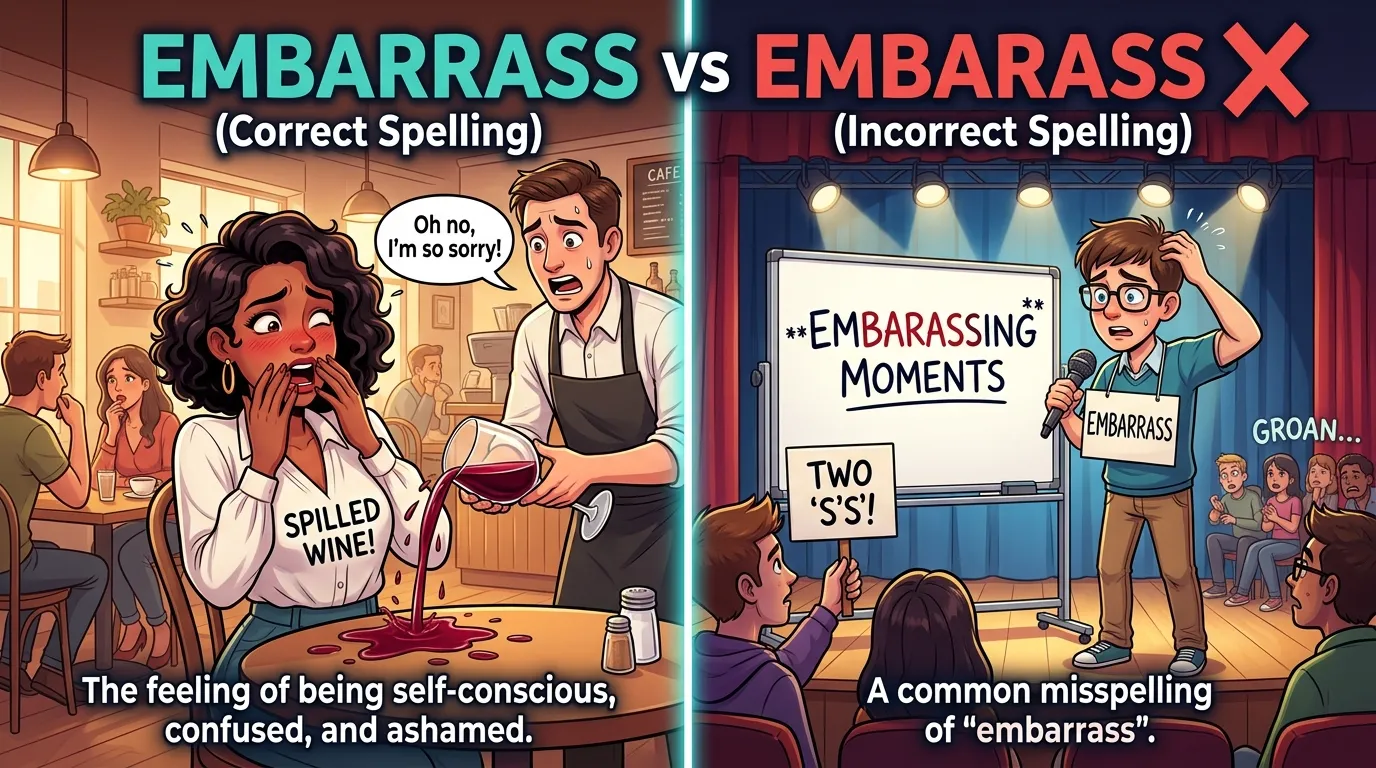
English spelling can sometimes feel confusing, especially when a word contains double letters. One of the most common examples is embarrass vs. embarass. At first glance, both spellings may look correct, and when we say the word aloud, it can be difficult to notice that one letter is missing. This is why many students, English learners, and even experienced writers sometimes type embarass instead of embarrass.
The correct spelling is embarrass. The spelling embarass is incorrect and should not be used in standard English. The word embarrass is a verb that means to make someone feel ashamed, uncomfortable, awkward, or self-conscious. It is a very common word used in everyday conversations, academic writing, workplace communication, social media, and many other situations.
For example, you might say, “I didn’t mean to embarrass you,” when you accidentally make someone uncomfortable. You might also say, “His mistake embarrassed him,” when describing something that happened in the past.
The spelling becomes easier when you remember that embarrass contains two R’s and two S’s. The correct spelling is:
E-M-B-A-R-R-A-S-S
Many spelling mistakes happen because writers remember the sound of the word rather than its exact letter pattern. Since the two R’s are not strongly noticeable when the word is pronounced, it is easy to leave one out.
In this complete guide, we will explain embarrass vs. embarass, their meanings, pronunciation, grammar, word forms, sentence examples, common mistakes, spelling rules, memory tricks, and practical exercises. By the end, you will know exactly when and how to use embarrass correctly.
What Is the Correct Spelling: Embarrass or Embarass?
The correct spelling is:
✅ Embarrass
The incorrect spelling is:
❌ Embarass
The word embarrass contains two R’s and two S’s.
Correct spelling:
E-M-B-A-R-R-A-S-S
Incorrect spelling:
E-M-B-A-R-A-S-S
The incorrect version embarass is simply missing one r.
Examples
Correct:
- I didn’t want to embarrass my friend.
- Don’t embarrass yourself in front of everyone.
- His mistake could embarrass the entire team.
- She didn’t intend to embarrass him.
Incorrect:
- ❌ I didn’t want to embarass my friend.
- ❌ Don’t embarass yourself.
What Does “Embarrass” Mean?
Embarrass is a verb that means to make someone feel uncomfortable, ashamed, awkward, or self-conscious.
It can happen when someone makes a mistake, receives unwanted attention, is criticized publicly, or finds themselves in an uncomfortable situation.
Example
The teacher’s question embarrassed the student.
This means that the student’s feelings were affected by the situation.
Another example is:
I didn’t mean to embarrass you.
This means the speaker did not intend to make the other person feel uncomfortable or ashamed.
Embarrass as a Verb
The word embarrass is primarily used as a verb.
A verb describes an action, and embarrass describes the action of causing someone to feel uncomfortable or ashamed.
Examples
- Don’t embarrass me.
- His parents embarrassed him at school.
- I don’t want to embarrass her.
- The mistake may embarrass the company.
- That story will embarrass him.
The person experiencing the feeling is usually the object of the verb.
Basic Pattern
Subject + embarrass + person
For example:
The joke embarrassed Sarah.
Here:
- The joke = subject
- embarrassed = verb
- Sarah = person affected
Embarrass vs. Embarass
| Word | Correct Spelling? | Meaning |
|---|---|---|
| Embarrass | ✅ Yes | To make someone feel ashamed or uncomfortable |
| Embarass | ❌ No | Common spelling mistake |
There is no different meaning between these two forms because embarass is not the standard spelling of the word.
If you are writing an essay, email, resume, report, or professional document, always use embarrass.
Why Is “Embarass” a Common Mistake?
The spelling mistake embarass is very common because of the way the word sounds.
When people pronounce embarrass, the two R’s are not clearly noticeable. As a result, writers may remember only one R and produce the incorrect spelling embarass.
Another reason is that English has many words where consonants are not doubled.
For example:
- embarrass
- address
- necessary
- successful
- occurrence
These words require attention because their spelling contains repeated letters.
The brain may also automatically simplify the spelling while typing quickly. This is especially common when writing messages, emails, or social media posts.
The Correct Spelling Pattern
The easiest way to understand the spelling is to break the word into parts:
Em + barr + ass
The middle contains:
RR
The ending contains:
SS
So:
Embarrass = RR + SS
This is one of the best ways to remember the word.
Does Embarrass Have Two R’s?
Yes.
The correct spelling contains two R’s:
embaRRass
It also contains two S’s:
embarraSS
Therefore, remember:
Embarrass has double R and double S.
This simple rule can prevent one of the most common spelling mistakes.
Embarrass, Embarrassed, and Embarrassing
The word changes form depending on how it is used.
Embarrass
This is the basic verb.
I don’t want to embarrass you.
Embarrassed
This describes someone’s feeling after something embarrassing happens.
She felt embarrassed after making a mistake.
Embarrassing
This describes something that causes embarrassment.
That was an embarrassing moment.
Embarrassment
This is the noun form.
He tried to hide his embarrassment.
Quick Comparison
| Word | Part of Speech | Meaning |
|---|---|---|
| Embarrass | Verb | To make someone uncomfortable |
| Embarrassed | Adjective / past participle | Feeling uncomfortable or ashamed |
| Embarrassing | Adjective | Causing embarrassment |
| Embarrassment | Noun | The feeling or situation of being embarrassed |
Embarrassed vs. Embarrassing
This is another important distinction.
Embarrassed = How a person feels
I was embarrassed when I forgot his name.
The person feels embarrassed.
Embarrassing = What causes the feeling
Forgetting his name was embarrassing.
The situation causes embarrassment.
Easy Rule
Remember:
People feel embarrassed.
Situations are embarrassing.
More Examples
- She felt embarrassed.
- The situation was embarrassing.
- He became embarrassed after falling.
- Falling in front of everyone was embarrassing.
Embarrass in Everyday English
The word embarrass is commonly used in everyday conversations.
Examples
- Please don’t embarrass me.
- I didn’t mean to embarrass you.
- My parents used to embarrass me when I was younger.
- He tried not to embarrass his friend.
- She was worried that she might embarrass herself.
Because it is a common everyday word, learning its correct spelling is especially useful.
Embarrass in Workplace Communication
The word can also be used in professional settings.
Examples
- The error could embarrass the company.
- The manager did not want to embarrass the employee in front of the team.
- Public criticism can embarrass workers.
- The company apologized to avoid further embarrassment.
- He was embarrassed by the mistake in the report.
In professional writing, correct spelling is important because spelling errors can affect how readers view your attention to detail.
Embarrass in Academic Writing
Students may use this word when discussing social behavior, emotions, communication, or personal experiences.
Examples
- Public criticism can embarrass students.
- The student felt embarrassed after giving the wrong answer.
- The incident caused considerable embarrassment.
- Teachers should correct students without trying to embarrass them.
When writing an academic paper, make sure you use embarrass, not embarass.
Embarrass in Social Media and Texting
Social media and texting often use informal language, but correct spelling is still useful.
Examples:
- “Please don’t embarrass me 😂”
- “That was so embarrassing!”
- “I can’t believe I did that. I’m so embarrassed.”
- “My friend always tries to embarrass me.”
Although casual communication often includes abbreviations and slang, the correct spelling remains embarrass.
Common Mistake: Embarrass vs. Embarrassed
Some writers confuse the base verb with the past form.
Embarrass
Don’t embarrass me.
Embarrassed
You embarrassed me yesterday.
The first sentence refers to an action that may happen.
The second sentence refers to an action that already happened.
Common Mistake: Embarrassing vs. Embarrassed
Another frequent mistake is using these words incorrectly.
Incorrect:
I am very embarrassing.
This normally means you cause other people to feel embarrassed.
Correct:
I am very embarrassed.
This means you feel uncomfortable or ashamed.
Correct:
That situation was embarrassing.
This means the situation caused embarrassment.
Common Spelling Mistakes with Embarrass
1. Embarass
❌ embarass
✅ embarrass
The incorrect form has only one R.
2. Embarras
❌ embarras
✅ embarrass
The correct word ends in SS.
3. Embarrass
❌ embaras
✅ embarrass
Both the double R and double S are important.
4. Embarrased
❌ embarrased
✅ embarrassed
The past form also keeps the double R and double S.
How to Remember the Spelling
One of the easiest memory tricks is:
Embarrass = Double R + Double S
Write it like this:
EM + BA + RR + A + SS
Another useful sentence is:
Embarrass has two R’s and two S’s.
If you remember this sentence, you are much less likely to write embarass.
Pronunciation of Embarrass
Embarrass is commonly pronounced approximately:
im-BARR-us
The pronunciation may vary slightly depending on the speaker’s accent.
The important point for spelling is that pronunciation does not clearly show the double R and double S. That is why memorizing the written form is helpful.
Is “Embarrass” a Formal Word?
Yes.
Embarrass can be used in both formal and informal English.
Informal
Don’t embarrass me!
Professional
The incident could embarrass the organization.
Academic
Public criticism may embarrass students and negatively affect classroom participation.
The word itself is completely standard English.
When Should You Use “Embarrass”?
Use embarrass when you want to describe making someone feel:
- Uncomfortable
- Ashamed
- Awkward
- Self-conscious
- Humiliated
It can be used in conversations, emails, essays, reports, articles, and professional documents.
When Should You Avoid “Embarrass”?
You should not use embarrass when you simply mean that someone made a mistake.
For example:
He made a spelling mistake.
This does not automatically mean:
He embarrassed himself.
A mistake may be embarrassing, but the two ideas are not always the same.
Embarrass vs. Humiliate
These words are related but not always identical.
Embarrass usually refers to making someone feel uncomfortable, awkward, or ashamed.
Humiliate is generally stronger and suggests a serious loss of dignity or respect.
Examples
I didn’t mean to embarrass him.
This could refer to a small awkward moment.
They tried to humiliate him in front of everyone.
This suggests a much more severe experience.
Real-World Sentence Examples
Personal Life
- I didn’t mean to embarrass my sister.
- My friends sometimes embarrass me.
- He felt embarrassed after forgetting the answer.
School
- Teachers should avoid trying to embarrass students.
- The student was embarrassed by the mistake.
- It was an embarrassing moment for the class.
Workplace
- The error could embarrass the company.
- She was embarrassed by the incorrect report.
- The manager handled the situation without causing unnecessary embarrassment.
Online
- I accidentally posted the wrong picture and felt embarrassed.
- That video is so embarrassing!
- Please don’t embarrass me in the comments.
Practice Exercises
Fill in the Blanks
Complete each sentence with the correct form of the word.
- Please don’t ________ me.
- I felt ________ after making the mistake.
- That was an ________ situation.
- He tried to hide his ________.
- She didn’t want to ________ her friend.
Answers
- embarrass
- embarrassed
- embarrassing
- embarrassment
- embarrass
Multiple-Choice Questions
Question 1
Which spelling is correct?
A. Embarass
B. Embarrass
C. Embarras
D. Embarres
Answer: B. Embarrass
Question 2
Which sentence is correct?
A. I don’t want to embarass you.
B. I don’t want to embarrass you.
Answer: B
Question 3
Which word describes how a person feels?
A. Embarrassing
B. Embarrassed
C. Embarrass
Answer: B. Embarrassed
Question 4
Which sentence uses “embarrassing” correctly?
A. I am embarrassing about the mistake.
B. The mistake was embarrassing.
Answer: B
Sentence Rewriting Practice
Incorrect
I didn’t mean to embarass you.
Correct
I didn’t mean to embarrass you.
Incorrect
She was embarrased by the mistake.
Correct
She was embarrassed by the mistake.
Incorrect
It was an embarassing moment.
Correct
It was an embarrassing moment.
Frequently Asked Questions
Is “embarrass” the correct spelling?
Yes. Embarrass is the correct spelling.
Is “embarass” wrong?
Yes. Embarass is a common misspelling of embarrass.
How do you spell embarrass?
The correct spelling is:
E-M-B-A-R-R-A-S-S
Does embarrass have two R’s?
Yes. Embarrass has two R’s.
Does embarrass have two S’s?
Yes. It has two S’s at the end.
What does embarrass mean?
Embarrass means to make someone feel uncomfortable, ashamed, awkward, or self-conscious.
What is the past tense of embarrass?
The past tense is embarrassed.
Example:
He embarrassed himself during the presentation.
What is the noun form of embarrass?
The noun is embarrassment.
Example:
She tried to hide her embarrassment.
What is the adjective form?
The two common forms are embarrassed and embarrassing.
Is embarrass used in American English?
Yes. Embarrass is standard in American English and is also standard in British English.
Quick Comparison Table
| Feature | Embarrass | Embarass |
|---|---|---|
| Correct spelling | ✅ Yes | ❌ No |
| Part of speech | Verb | — |
| Meaning | To make someone uncomfortable or ashamed | — |
| Standard English | ✅ Yes | ❌ No |
| Double R | ✅ Yes | ❌ No |
| Double S | ✅ Yes | ✅ Yes |
| Example | Don’t embarrass me. | ❌ Don’t embarass me. |
Easy Way to Remember
If you only remember one thing from this article, remember:
EMBARRASS = RR + SS
The correct spelling contains two R’s and two S’s.
Embarrass ✅
Embarass ❌
Conclusion
The difference between embarrass and embarass is a simple spelling issue, but it is an important one for anyone who wants to write accurate English. The correct spelling is embarrass, with two R’s and two S’s. The spelling embarass is incorrect and should be avoided in academic, professional, and everyday writing.
The word embarrass is a common verb that means to make someone feel uncomfortable, ashamed, awkward, or self-conscious. It can be used in many situations, from personal conversations and school experiences to workplace communication and social media.
It is also important to understand the related words embarrassed, embarrassing, and embarrassment. A person feels embarrassed, while something that causes that feeling is embarrassing. The noun embarrassment describes the feeling or situation itself.
The best spelling trick is simple: embarrass has double R and double S. When you remember RR + SS, you can quickly recognize why embarrass is correct and embarass is not.
Correct spelling may seem like a small part of communication, but it can make a big difference in how your writing is understood. Whether you are writing a school assignment, professional email, social media post, or everyday message, choosing embarrass instead of embarass will help you communicate clearly and confidently.


