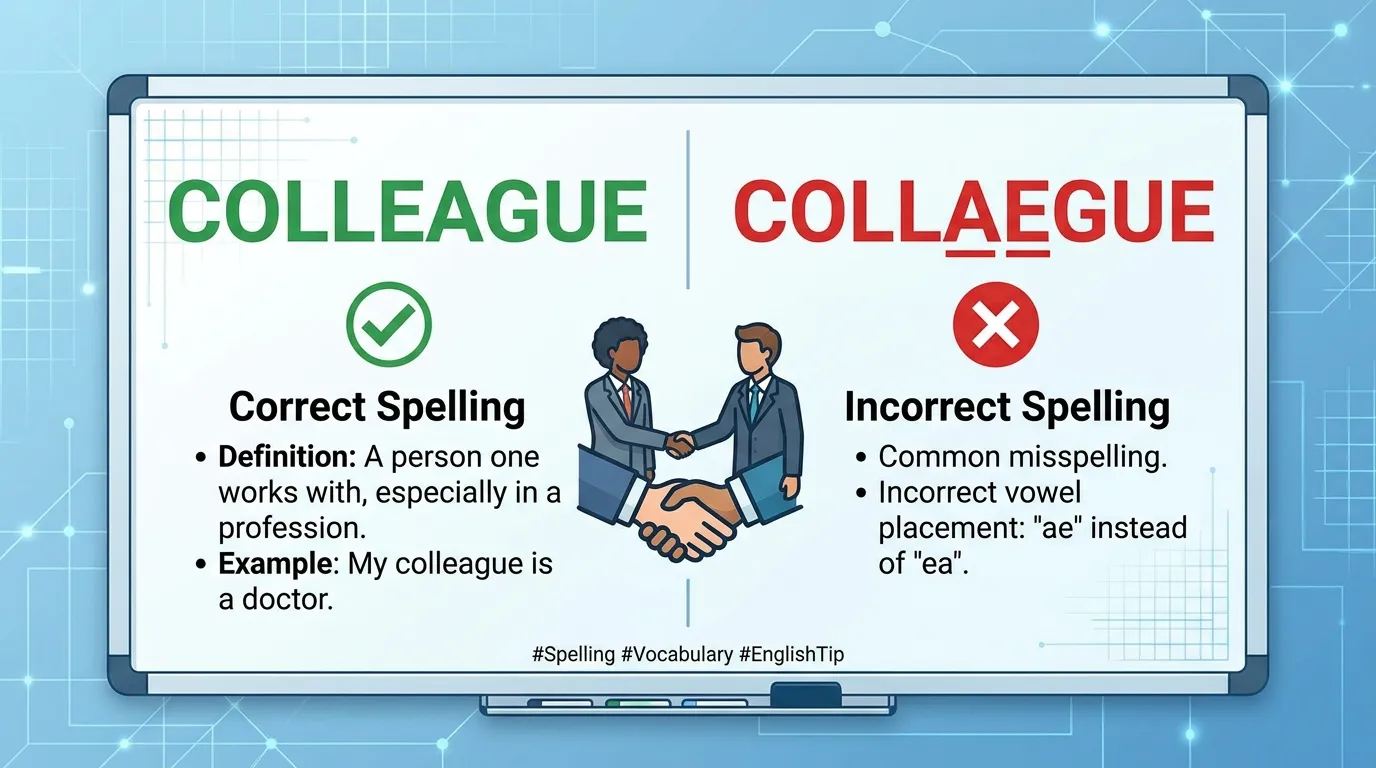
If you are wondering about colleague vs collaegue, the correct spelling is colleague. Collaegue is a misspelling and should not be used in standard American or British English.
A colleague is a person you work with, especially someone who belongs to the same organization, profession, department, or workplace. You might have a colleague at an office, school, hospital, company, university, sports organization, or other professional setting.
The confusion happens because the word contains several vowels close together: colleague. Many writers remember the pronunciation but are unsure about the order of the letters. The spelling can look especially difficult because colleague does not sound exactly as it appears.
In this guide, you will learn the correct spelling, meaning, pronunciation, grammatical use, word history, common phrases, examples, formal and informal alternatives, regional differences, and easy memory tricks for remembering colleague.
Quick Answer: Colleague or Collaegue?
Colleague is the correct spelling.
Collaegue is incorrect.
| Spelling | Correct? | Meaning |
|---|---|---|
| colleague | ✅ Yes | A person you work with |
| collaegue | ❌ No | Misspelling of colleague |
| colleague’s | ✅ Yes | Something belonging to one colleague |
| colleagues | ✅ Yes | More than one colleague |
| colleagues’ | ✅ Yes | Something belonging to multiple colleagues |
Correct example
My colleague helped me finish the report.
Incorrect example
My collaegue helped me finish the report.
The second sentence should use colleague.
What Does Colleague Mean?
A colleague is someone who works with you or is part of the same professional or academic community.
For example:
- A teacher may call another teacher a colleague.
- A doctor may describe another doctor at the same hospital as a colleague.
- An employee may refer to someone on the same team as a colleague.
- A researcher may call another researcher in the same field a colleague.
- A journalist may describe another journalist in the same profession as a colleague.
The word generally suggests a professional or work-related relationship.
Dictionary-style definition
Colleague (noun): A person with whom one works or shares a profession, organization, institution, or professional activity.
Example sentences
- I discussed the project with my colleague.
- Sarah is my colleague at the marketing agency.
- Several colleagues attended the conference.
- My former colleague recently started a new job.
- He asked a colleague for advice.
- The professor thanked her colleagues for their support.
Why Is Collaegue Incorrect?
Collaegue is simply a spelling error.
The correct spelling is:
C-O-L-L-E-A-G-U-E
The incorrect form often appears as:
C-O-L-L-A-E-G-U-E
The main problem is the position of e and a after the double l.
Correct:
colleague
Incorrect:
collaegue
This is a common type of spelling mistake because English spelling often does not give learners an obvious clue about the correct vowel sequence.
Why Do People Confuse Colleague and Collaegue?
There are several reasons.
The pronunciation is not fully phonetic
In American English, colleague is commonly pronounced approximately:
/ˈkɑːliːɡ/
It sounds roughly like:
KAH-leeg
The spelling contains letters that are not individually pronounced in the way a learner might expect.
Because the spoken form is much shorter than the written form, it can be difficult to reconstruct the spelling from sound alone.
The vowel sequence is unusual
The middle of the word contains:
-e-a-gue
That combination can make the word visually difficult.
Compare:
colleague
with:
collaegue
Both may look plausible at first glance, especially when typed quickly.
English has many irregular spellings
English includes many words whose spellings cannot always be predicted from pronunciation. Words such as league, fatigue, plague, and colleague contain letter combinations that learners may need to memorize.
Colleague: Correct Spelling Breakdown
One useful way to remember the word is to divide it visually:
col + league
This gives:
COLLEAGUE
The ending resembles league, which can help you remember the final letters:
league → l-e-a-g-u-e
Then remember that colleague begins with col-:
col + league → colleague
This is not necessarily the modern word’s morphological construction in the everyday sense, but it is a useful spelling aid.
Colleague Pronunciation
American English pronunciation
In American English, colleague is generally pronounced:
/ˈkɑːliːɡ/
A simple pronunciation guide is:
KAH-leeg
The stress falls on the first syllable.
British English pronunciation
British English commonly uses a pronunciation close to:
/ˈkɒliːɡ/
It can be approximated as:
KOL-leeg
The vowel in the first syllable differs somewhat between common American and British pronunciations.
Is the final “ue” pronounced?
No.
The ending -gue does not produce a separate sound like “gwee.”
In colleague, the final sound is essentially the g sound:
colleague → KAH-leeg
This is one reason the spelling may be confusing for English learners.
Is Colleague a Noun or an Adjective?
Colleague is primarily a noun.
It names a person who works with you or shares a professional setting.
Noun examples
- My colleague is preparing the presentation.
- I spoke with three colleagues this morning.
- Her colleague works in the legal department.
You generally would not use colleague as an adjective.
For example, this is unnatural:
I attended a colleague meeting.
Instead, say:
I attended a meeting with my colleagues.
Or:
I attended a staff meeting.
Colleague vs Colleagues
The singular form is:
colleague
The plural form is:
colleagues
Singular
My colleague works from home on Fridays.
Plural
My colleagues work from home on Fridays.
The plural is formed by adding -s:
colleague → colleagues
The pronunciation changes slightly at the end, but the spelling remains straightforward.
Colleague’s vs Colleagues’
Possessive forms can also cause confusion.
One colleague
Use:
colleague’s
Example:
I borrowed my colleague’s notebook.
This means the notebook belongs to one colleague.
More than one colleague
Use:
colleagues’
Example:
I reviewed my colleagues’ suggestions.
This means the suggestions came from multiple colleagues.
Quick comparison
| Form | Use | Example |
|---|---|---|
| colleague | One person | My colleague called me. |
| colleagues | Multiple people | My colleagues called me. |
| colleague’s | Possession by one person | My colleague’s desk is nearby. |
| colleagues’ | Possession by multiple people | My colleagues’ desks are nearby. |
Colleague vs Coworker
Colleague and coworker are close in meaning, but they are not always interchangeable.
A coworker is generally someone who works with you, particularly in the same workplace.
A colleague can have a somewhat broader professional meaning.
For example, two teachers working at different schools might still describe each other as colleagues because they share the same profession.
Compare these examples
John is my coworker at the software company.
This strongly suggests that John and the speaker work for the same organization.
John is my colleague in the software industry.
This can describe a professional relationship without necessarily suggesting that they work for the same employer.
General difference
| Word | Typical meaning | Tone |
|---|---|---|
| colleague | Person in the same workplace, profession, or professional community | Professional |
| coworker | Person who works with you | Everyday |
| teammate | Person on the same team | Specific |
| associate | Professional connection or business partner | Formal/business |
| peer | Person of similar status, ability, or professional standing | Academic/professional |
| partner | Person working with you on a task or venture | Context-dependent |
Colleague vs Associate
Associate can be broader than colleague.
A colleague is usually someone who shares a workplace, profession, or professional environment.
An associate can be someone you work with, conduct business with, or know professionally.
For example:
She is my colleague at the university.
But:
She is a business associate.
The second sentence may describe a professional relationship without suggesting that the two people work for the same employer.
Colleague vs Teammate
A teammate is specifically someone on the same team.
A colleague may work in the same organization without being on your particular team.
For example:
Maria is my colleague in the accounting department.
She may work in the same organization but not necessarily on the speaker’s immediate team.
Maria is my teammate on the accounting project.
This specifically indicates that they are working together on the same team or project.
Colleague vs Friend
A colleague is not automatically a friend.
Someone can be your colleague without having a personal friendship with you.
For example:
I respect my colleague, but we do not socialize outside work.
The relationship is professional rather than personal.
However, colleagues can certainly become friends.
My colleague became one of my closest friends.
Therefore, colleague describes the professional relationship, while friend describes a personal relationship.
Common Collocations With Colleague
A collocation is a group of words that naturally appear together.
Some common collocations include:
- work colleague
- former colleague
- close colleague
- trusted colleague
- senior colleague
- junior colleague
- professional colleague
- fellow colleague
- longtime colleague
- respected colleague
- valued colleague
- new colleague
- international colleague
- academic colleague
- business colleague
Examples
She is a trusted colleague.
I met an old work colleague yesterday.
His former colleague now runs the company.
We invited several international colleagues to the conference.
She is a highly respected academic colleague.
Common Phrases With Colleague
The word frequently appears in professional expressions such as:
A colleague of mine
A colleague of mine recommended this software.
This is a natural way to introduce someone you work with.
A former colleague
I ran into a former colleague at the airport.
This refers to someone you worked with in the past.
A close colleague
She is a close colleague and a trusted adviser.
A senior colleague
I asked a senior colleague for guidance.
A fellow colleague
He thanked his fellow colleagues for their support.
However, fellow colleague can sometimes sound repetitive because both words already suggest a shared professional relationship. In many situations, simply colleagues is cleaner.
Natural and Awkward Examples
Good word choice matters as much as correct spelling.
Natural
I spoke with my colleague about the deadline.
Natural
One of my colleagues helped me solve the problem.
Natural
My former colleague now works for another company.
Less natural
I spoke with my colleague person about the deadline.
The word colleague already identifies the person as someone you work with.
Awkward
My colleague coworker sent me an email.
Usually, choose one:
My colleague sent me an email.
or:
My coworker sent me an email.
Formal vs Informal Use of Colleague
Colleague works well in both formal and everyday professional communication.
Formal example
I would like to thank my colleagues for their valuable contributions.
Neutral example
I asked a colleague to check the document.
Casual example
One of my colleagues told me about the opening.
The word itself is professional but not excessively formal.
Is Colleague Common in Business Writing?
Yes.
Colleague is widely appropriate for:
- emails
- reports
- company announcements
- business presentations
- workplace conversations
- professional biographies
- academic writing
- journalism
- corporate communication
- recommendation letters
For example:
I am pleased to recommend my former colleague for this position.
This sounds professional and natural.
Colleague in Academic Writing
The word is especially common in universities and research environments.
Examples include:
The researcher discussed the findings with her colleagues.
Several academic colleagues reviewed the proposal.
His colleagues in the department supported the study.
In academic contexts, colleague can refer to someone in the same institution or someone working in the same academic field.
Colleague in Journalism
Journalists frequently use colleague when discussing people working in the same profession.
For example:
Her colleagues in the newsroom praised the investigation.
It can also be used when one professional discusses another professional’s work.
Colleague in Sports
In sports writing, teammate is usually more specific when people play on the same team.
However, colleague can be used when referring broadly to professional athletes, coaches, officials, or people in the same organization.
For example:
The coach praised his colleagues after the tournament.
If the people are specifically on the same playing team, teammates is usually the more natural choice.
Colleague in Technical and Professional Fields
The word is useful across specialized fields.
Medicine
The surgeon discussed the case with her colleagues.
Law
The attorney consulted with colleagues before the hearing.
Engineering
The engineer shared the design with his colleagues.
Technology
Several colleagues reviewed the software update.
Education
The teacher discussed the lesson plan with her colleagues.
The meaning remains essentially the same across these fields.
Regional Differences: American vs British English
The spelling colleague is standard in both American and British English.
There is no major regional spelling difference such as:
color vs colour
or:
center vs centre
Both American and British English use:
colleague
The pronunciation can differ slightly, particularly in the vowel of the first syllable.
American English
colleague → /ˈkɑːliːɡ/
British English
colleague → /ˈkɒliːɡ/
The spelling remains the same.
Is Colleague Used Internationally?
Yes.
Colleague is widely understood in international English, particularly in professional, academic, business, and workplace contexts.
For global communication, it is generally a safe word choice.
If writing for an audience with basic English proficiency, coworker may sometimes be more immediately familiar, depending on the audience and context.
Colleague Word History and Etymology
The word colleague has a long history connected with the idea of a partner in an official or professional role.
It entered English through French collègue, ultimately deriving from Latin collega, meaning a partner or associate in office.
The Latin term is associated with the idea of someone chosen or appointed to share an official position or responsibility.
Over time, the meaning developed toward its modern sense of a person who works with another person or belongs to the same profession or organization.
This history helps explain why colleague carries a strong association with professional cooperation.
Synonyms for Colleague
The best synonym depends on the context.
Common alternatives
- coworker
- co-worker
- teammate
- associate
- peer
- professional contact
- fellow worker
- fellow professional
- workmate
- collaborator
Context matters
Coworker is often best for ordinary workplace situations.
Teammate is best when people belong to the same team.
Peer emphasizes similar professional status or ability.
Associate often sounds more business-oriented.
Collaborator emphasizes working together on a specific project.
Workmate is more common in some varieties of English, particularly British and Australian usage.
Antonyms and Contrasting Terms
There is no single perfect antonym for colleague.
Depending on the context, contrasting terms might include:
- competitor
- customer
- client
- supervisor
- subordinate
- outsider
- stranger
However, these are not direct dictionary opposites.
For example, a supervisor can also be a colleague because that person may belong to the same organization. Context determines the relationship.
Related Words
Some useful words related to colleague include:
- collaboration
- collaborative
- coworker
- cooperation
- teamwork
- professional
- workplace
- organization
- department
- teammate
- associate
- peer
Example
Good collaboration between colleagues can improve teamwork and productivity.
Common Mistakes With Colleague
Here are some frequent errors.
Mistake: collaegue
❌ My collaegue sent the file.
✅ My colleague sent the file.
Mistake: collegue
❌ She is my collegue.
✅ She is my colleague.
This version is especially common because writers may leave out the a.
Mistake: collegue
The correct sequence is:
col-lea-gue
not:
col-legue
Mistake: colleage
❌ He is a trusted colleage.
✅ He is a trusted colleague.
Mistake: colleegue
❌ I asked my colleegue for help.
✅ I asked my colleague for help.
A Simple Memory Trick for Colleague
Try remembering:
COL + LEAGUE = COLLEAGUE
The word league appears at the end:
league → l-e-a-g-u-e
Put col before it:
col + league = colleague
Another useful trick is to focus on this spelling pattern:
COLLEA-GUE
Do not rearrange the vowels.
The correct sequence is:
E-A
not:
A-E
So remember:
colleEa? No — colleague.
The safest visual memory is simply:
COLLEAGUE
How to Spell Colleague Correctly
Write it in four parts:
COL – LE – A – GUE
Then combine them:
COLLEAGUE
The complete spelling is:
C-O-L-L-E-A-G-U-E
If you frequently make this mistake while typing, adding the correct spelling to your personal dictionary or using a spelling checker can help.
Colleague in Email Writing
The word is especially useful in workplace emails.
Professional
Hi James,
I spoke with my colleague about the updated schedule. We should be able to send the final version tomorrow.
Friendly workplace communication
Thanks for your help. I’ll check with my colleague and get back to you.
Formal communication
I would like to thank my colleagues for their assistance throughout the project.
All three uses are grammatically correct.
Colleague in Social Media and Casual Writing
You can use colleague on social media, although casual speakers may prefer coworker.
For example:
Excited to celebrate another successful project with my amazing colleagues!
This sounds natural on LinkedIn or a professional social media post.
For casual conversation:
My coworker told me about that place.
Both words are correct. The choice depends on tone and context.
Colleague vs Coworker: Which Should You Choose?
Use colleague when you want a professional, neutral term.
Use coworker when you want a straightforward everyday expression for someone who works with you.
Choose colleague for:
- business writing
- academic writing
- professional emails
- formal reports
- workplace announcements
- professional networking
- journalism
- international communication
Choose coworker for:
- casual conversation
- informal messages
- everyday American English
- situations where the person works directly with you
Neither word is inherently better.
Is Colleague More Formal Than Coworker?
Generally, colleague can sound slightly more professional than coworker, but it is not an unusually formal word.
Compare:
My coworker helped me with the printer.
This sounds conversational.
My colleague helped me prepare the presentation.
This sounds professional but completely natural.
The distinction is mostly about tone and context, not correctness.
Common Questions
Is colleague the correct spelling?
Yes. Colleague is the correct standard English spelling. Collaegue is a misspelling.
What does colleague mean?
A colleague is someone you work with or someone who shares your profession, organization, institution, or professional environment.
Is colleague American or British English?
Colleague is used in both American and British English. The spelling is the same in both varieties.
How do you pronounce colleague?
In American English, it is commonly pronounced approximately KAH-leeg, with IPA /ˈkɑːliːɡ/. British pronunciation commonly uses a slightly different first vowel.
What is the plural of colleague?
The plural is colleagues.
Example:
I met several colleagues at the conference.
Is coworker the same as colleague?
They have similar meanings, but coworker usually refers to someone who works with you, while colleague can also refer to someone in the same profession or professional community.
Is colleague a noun?
Yes. Colleague is primarily a noun.
Example:
My colleague called me this morning.
Can colleague mean friend?
Not exactly. A colleague is someone connected to you professionally. A colleague can become a friend, but the word itself does not mean friend.
Is collaegue a word?
No. Collaegue is not the standard spelling of the English word. The correct spelling is colleague.
How can I remember the spelling of colleague?
A useful spelling trick is to remember the word as:
COL + LEAGUE = COLLEAGUE
The ending has the same letters as league: L-E-A-G-U-E.
Final Verdict
When choosing between colleague and collaegue, there is no real spelling competition: colleague is correct, while collaegue is a misspelling.
The correct word is:
colleague
It is a noun referring to someone you work with or someone who shares your profession, organization, institution, or professional community.
The word works naturally in American English, British English, international English, business writing, academic writing, journalism, workplace communication, and everyday professional conversations.
Remember the spelling:
C-O-L-L-E-A-G-U-E
A simple memory aid is:
COL + LEAGUE = COLLEAGUE
If you are writing an email, report, article, résumé, business document, academic paper, or social media post, use colleague, not collaegue.
The most important distinction is simple: colleague is the correct spelling; collaegue is not. Once you remember the -league ending, this commonly confused spelling becomes much easier to recognize and use correctly.


