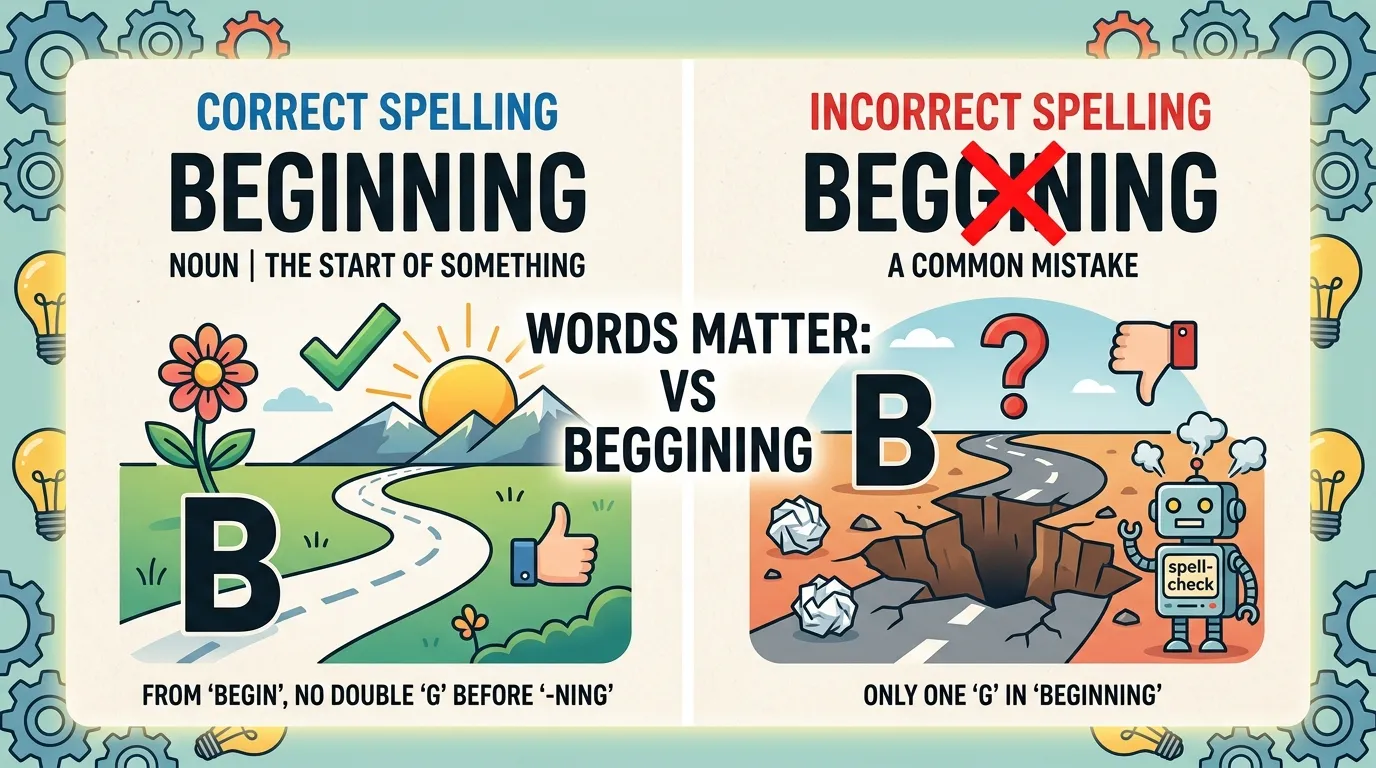
English spelling can be confusing when words contain double letters. A common example is beginning vs. beggining. Many people accidentally write beggining because they know the word contains repeated letters but are unsure which letter should be doubled.
The correct spelling is beginning. The spelling beggining is incorrect. This common mistake usually happens because writers accidentally double the g instead of the n.
Whether you’re writing a school assignment, professional email, article, social media post, or everyday message, knowing the correct spelling helps make your writing clearer and more professional.
In this guide, you’ll learn the correct spelling, meaning, grammar, pronunciation, word forms, examples, common mistakes, memory tricks, and practice exercises.
What Is the Correct Spelling?
✅ Correct: Beginning
❌ Incorrect: Beggining
The word beginning refers to the starting point of something or the early part of an event, activity, or period.
Examples
- We are at the beginning of a new project.
- The movie was interesting from the beginning.
- She was nervous at the beginning of the presentation.
Incorrect:
- ❌ We are at the beggining of a new project.
What Does “Beginning” Mean?
Beginning can refer to the point when something starts or the first part of something.
Examples
- The beginning of the year is often busy.
- Let’s start from the beginning.
- He explained everything from the beginning.
The word can be used for events, stories, relationships, projects, periods, and processes.
Beginning vs. Beggining
| Word | Correct? | Meaning |
|---|---|---|
| Beginning | ✅ Yes | The start or first part of something |
| Beggining | ❌ No | Incorrect spelling |
Always use beginning in standard English.
Why Do People Spell It “Beggining”?
The most common reason is confusion about which letter should be doubled.
The correct spelling is:
B-E-G-I-N-N-I-N-G
Notice that the word contains:
- One g after “be”
- Two n’s in the middle
- One final g
Many writers mistakenly produce:
B-E-G-G-I-N-I-N-G
This incorrectly doubles the g and removes one n.
The Correct Spelling Pattern
Break the word into parts:
Begin + ning
The verb is:
Begin
When we form the noun beginning, the final consonant n is doubled before adding -ing.
So:
Begin + ing → Beginning
Not:
Beggining
Beginning as a Noun
Beginning is commonly used as a noun.
It means the point at which something starts.
Examples
- The beginning of the book was exciting.
- We missed the beginning of the movie.
- At the beginning of the lesson, the teacher introduced the topic.
Beginning as an Adjective
Beginning can also appear in phrases where it describes something related to starting.
Examples:
- Beginning students need extra practice.
- The course is designed for beginning learners.
- She is taking a beginning English class.
Beginning vs. Begin
These words are related but have different grammatical roles.
Begin
Begin is a verb.
We will begin the meeting at nine.
Beginning
Beginning can be a noun or a present participle.
The beginning of the meeting was delayed.
They are beginning the meeting now.
Beginning vs. Began vs. Begun
These forms are often confused.
| Word | Usage | Example |
|---|---|---|
| Begin | Present/base verb | We begin at noon. |
| Began | Simple past | We began at noon. |
| Begun | Past participle | We have begun the work. |
| Beginning | -ing form/noun | The beginning was exciting. |
Examples
- I begin work at 8 a.m.
- I began work yesterday.
- I have begun my new project.
- The beginning was difficult.
Common Mistakes
Mistake 1: Writing “Beggining”
❌ beggining
✅ beginning
The g should not be doubled.
Mistake 2: Using One “N”
❌ begining
✅ beginning
The correct word has two N’s.
Mistake 3: Confusing “Beginning” With “Begining”
Both incorrect versions are common.
Correct:
Beginning
Incorrect:
Beggining
Incorrect:
Begining
Memory Trick
Use this simple trick:
Begin with one G, but finish the middle with two N’s.
Think:
BE-GIN-NING
The important part is:
NN
So remember:
Beginning = one G + two N’s
Real-World Usage Examples
Everyday Conversation
- Let’s start from the beginning.
- I didn’t understand the beginning of the story.
- The beginning of the trip was exciting.
Workplace
- The beginning of the project was challenging.
- We discussed the goals at the beginning of the meeting.
- The company is beginning a new training program.
Academic Writing
- The beginning of the study focused on background information.
- Students often struggle at the beginning of a new course.
- The researchers began collecting data in January.
Social Media
- It’s only the beginning! More exciting things are coming.
- Every journey has a beginning.
- I’m excited about this new beginning.
Beginning in Formal Writing
Beginning is perfectly acceptable in formal English.
You can use it in:
- Essays
- Reports
- Academic papers
- Business emails
- Articles
- Presentations
- Professional documents
Example
At the beginning of the study, researchers collected background information.
Beginning in Informal Writing
It is also very common in casual communication.
Examples:
- “Let’s go back to the beginning.”
- “This is just the beginning!”
- “The beginning was rough, but everything worked out.”
Practice Exercises
Fill in the Blank
- Let’s start from the ________.
- The ________ of the movie was exciting.
- We are ________ a new project.
Answers
- beginning
- beginning
- beginning
Multiple-Choice Questions
Which spelling is correct?
A. Beggining
B. Begining
C. Beginning
D. Begginingg
✅ Answer: C. Beginning
Which sentence is correct?
A. The beggining of the book was interesting.
B. The beginning of the book was interesting.
✅ Answer: B
Sentence Rewriting Practice
Incorrect
The beggining of the meeting was delayed.
Correct
The beginning of the meeting was delayed.
Incorrect
We are at the begining of a new chapter.
Correct
We are at the beginning of a new chapter.
Frequently Asked Questions
Is “beginning” the correct spelling?
Yes. Beginning is the correct spelling.
Is “beggining” a word?
No. Beggining is a common spelling mistake.
Does beginning have two G’s?
No. Beginning has one G and two N’s.
Does beginning have two N’s?
Yes. The correct spelling is beginning, with two N’s.
What does beginning mean?
Beginning means the start or first part of something.
What is the verb form of beginning?
The base verb is begin.
Example:
We will begin the lesson soon.
What is the past tense of begin?
The past tense is began.
Example:
The meeting began at 9 a.m.
What is the past participle of begin?
The past participle is begun.
Example:
The meeting has begun.
Quick Summary
| Feature | Answer |
|---|---|
| Correct spelling | Beginning |
| Incorrect spelling | Beggining |
| Part of speech | Noun / verb form |
| Meaning | The start or first part of something |
| Base verb | Begin |
| Past tense | Began |
| Past participle | Begun |
| Spelling tip | One G + two N’s |
Conclusion
The correct spelling is beginning, not beggining. The most important spelling detail to remember is that beginning has one G and two N’s. The incorrect spelling beggining happens when writers accidentally double the G instead of the N.
Understanding the difference between begin, began, begun, and beginning can also improve your grammar. Begin is the base verb, began is the simple past form, begun is the past participle, and beginning is the -ing form that can also function as a noun.
Whether you are writing an academic essay, professional email, blog post, social media caption, or everyday message, always use beginning when referring to the start of something. A simple memory trick can help: “Beginning has one G and two N’s.”
Once you remember this pattern, you’ll be much less likely to write beggining or begining again. Correct spelling may seem like a small detail, but it makes your writing more accurate, polished, and easier to understand.


