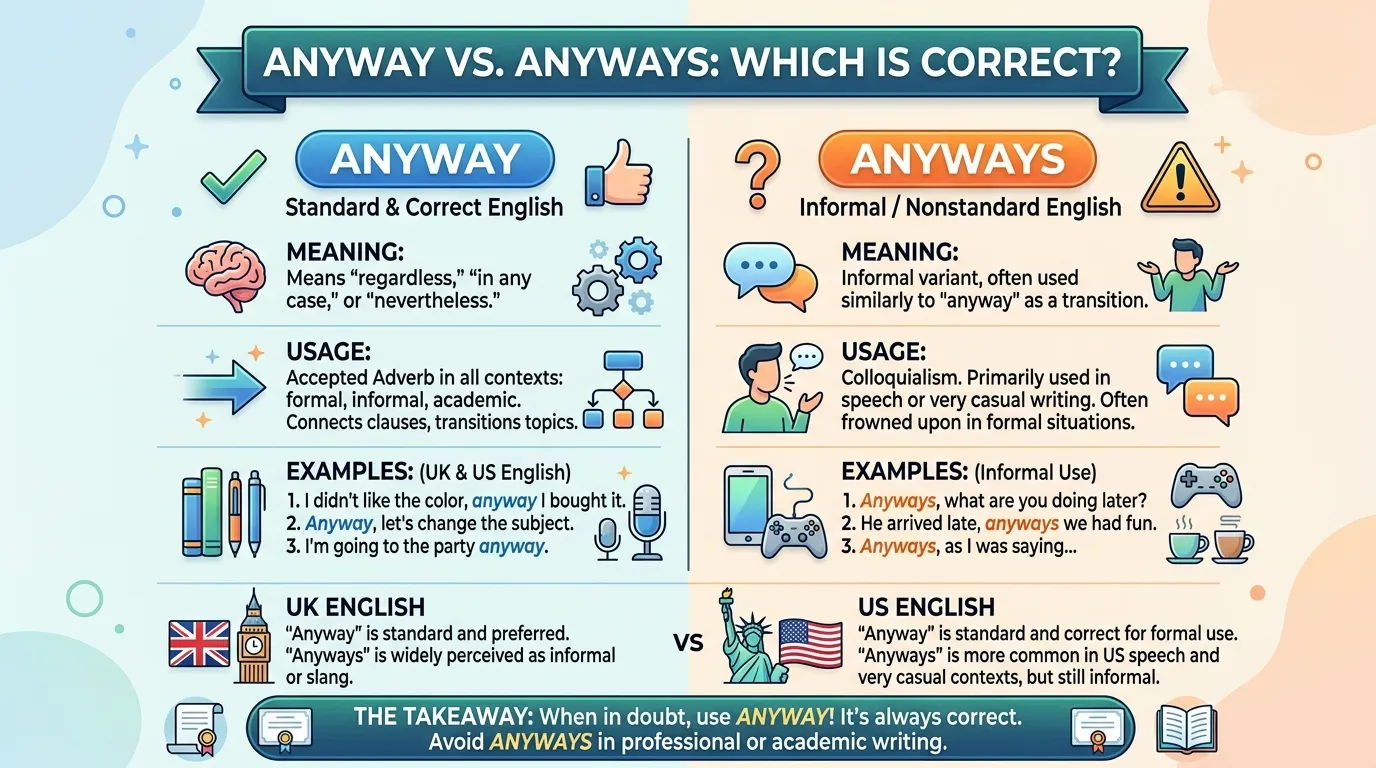
If you have ever wondered about anyway vs anyways, you are not alone. Both forms appear in everyday speech, texts, social media, and online conversations. However, they are not equally common in all types of English.
Anyway is the standard form and is the safest choice in formal and professional writing. It can mean in spite of something, regardless of that, or returning to the main point. For example: I was tired, but I went anyway.
Anyways is also a real word, but it is usually considered informal. It is especially common in casual American English and in speech. In British English, anyway is much more common, while anyways can sound informal, regional, or nonstandard depending on the speaker.
This guide explains the anyway vs anyways meaning, grammar difference, pronunciation, history, correct usage, and common mistakes. If you need one simple rule, remember this: use anyway when you are unsure.
Quick Answer
- ✅ Anyway — standard and widely accepted
- ⚠️ Anyways — accepted in some dictionaries, but mainly informal
- ✅ Anyway — preferred in formal writing
- ⚠️ Anyways — more common in casual speech, especially in North American English
So, is anyways wrong? Not always. It is a recognized informal variant of anyway. However, anyway is the better choice for school, business, academic, and professional writing.
What Does Anyway Mean?
Anyway is an adverb. It has several related uses.
It can mean regardless, despite what has been said, or in any case.
- It was raining, but we went anyway.
- I do not know if she will come, but I will go anyway.
It can also help a speaker return to an earlier subject:
- Anyway, what were you saying?
- Anyway, let’s get back to work.
Another common use is to show that something does not change the final result:
- He warned me not to go, but I went anyway.
Anyway in a Sentence
Here are some simple examples:
- I was busy, but I answered the phone anyway.
- She did not feel well, but she went to school anyway.
- Anyway, let’s talk about the meeting.
- It may be expensive, but I want it anyway.
- We missed the bus, so we walked anyway.
Anyway Examples in American English
In American English, anyway is extremely common in both speech and writing.
- I forgot my umbrella, but I went outside anyway.
- Anyway, what time should we meet?
- She said she was tired, but she finished the project anyway.
- I do not know the answer, but I will try anyway.
- Anyway, thanks for helping me today.
- The store was closing, so we left anyway.
- He knew it would be difficult, but he tried anyway.
- Anyway, let’s move on to the next topic.
- I was not planning to buy anything, but I bought it anyway.
- They were late, but we waited anyway.
Anyway Examples in British English
British speakers also use anyway very often. These examples sound natural in British English:
- I was tired, but I went to work anyway.
- Anyway, what shall we do now?
- She did not want to go, but she came anyway.
- It is rather expensive, but I think I will buy it anyway.
- Anyway, let’s get back to the point.
- He knew it was risky, but he did it anyway.
- I thought the shop was closed, but I went anyway.
- Anyway, that’s enough about that.
- We missed the train, so we walked anyway.
- I do not agree, but I will help anyway.
The UK vs US English difference is mainly about anyways. Anyway is standard and natural in both varieties.
Is Anyways Wrong?
This is where many online grammar guides oversimplify the issue.
Anyways is not simply a spelling mistake. It has a long history and is listed as a word in major dictionaries. However, it is generally more informal than anyway.
In casual conversation, you may hear:
- Anyways, what are you doing tonight?
- I was going to call you anyways.
- Anyways, let’s leave.
These sentences are common in informal speech.
However, in a formal email, academic essay, business report, or job application, anyway is usually the better choice.
Why Do People Think Anyways Is Wrong?
There are two main reasons.
First, anyway is the standard form taught to learners. Second, anyways often sounds more conversational. Because formal English usually prefers anyway, some people assume that anyways is always incorrect.
That is too strict.
A better rule is:
Anyways is an informal variant, while anyway is the standard choice.
Incorrect and Correct Examples
Instead of saying:
- ❌ Anyways, I will send the report tomorrow.
Use:
- ✅ Anyway, I will send the report tomorrow.
For casual speech, however:
- ⚠️ Anyways, I will see you later.
This can be perfectly understandable and natural in informal conversation.
Another example:
- ❌ Anyways, thank you for your help. — not ideal for formal writing
- ✅ Anyway, thank you for your help. — standard
- ⚠️ Anyways, thanks for your help. — casual speech
The important point is that context matters.
Anyway vs Anyways: Comparison Table
| Feature | Anyway | Anyways |
|---|---|---|
| Part of speech | Adverb | Adverb |
| Standard form | Yes | Informal variant |
| Formal writing | Preferred | Usually avoided |
| Casual speech | Very common | Common in some varieties |
| American English | Very common | Informal/common in speech |
| British English | Very common | Less common |
| Meaning | Regardless, in any case, returning to a point | Usually the same |
| Academic writing | Recommended | Usually avoid |
| Business writing | Recommended | Usually avoid |
| Social media | Common | Common in casual posts |
| Correct usage | Standard | Informal |
Pronunciation: Anyway vs Anyways
The pronunciation is another reason these words can feel closely connected.
Anyway
IPA: /ˈeniweɪ/
It sounds roughly like:
EN-ee-way
Example:
Anyway, let’s continue.
Anyways
IPA: /ˈeniweɪz/
It sounds like:
EN-ee-wayz
The difference is mainly the final /z/ sound.
Because anyways is formed by adding -s to anyway, learners may wonder whether the extra sound changes the grammar. Usually, it does not. The two words perform similar functions, but their level of formality and regional use can differ.
Why Are Anyway and Anyways Commonly Confused?
There are several reasons.
First, both words have nearly the same meaning.
Second, both can introduce a new thought.
Third, people often learn language through speech. If someone frequently says anyways, listeners may assume it is the standard written form.
Fourth, English has many adverbs that end in -s, such as sometimes and always. This can make anyways seem more grammatically natural.
But English does not require every adverb to follow the same pattern.
Word Origins and Etymology
The history of anyway goes back to the combination of any + way.
The basic idea was something like in any manner or by any means. Over time, the word developed its modern adverbial uses, including meanings such as in any case and regardless.
Anyways has also existed for centuries. Historical forms of the word appear in English, although its frequency and status have changed over time.
Modern dictionaries generally treat anyways as an informal or regional variant of anyway. In contemporary usage, it is especially associated with casual North American speech.
So, the word is not a modern internet invention.
Anyway Synonyms
If you are looking for an anyway synonym, the best choice depends on the meaning.
| Anyway | Possible synonym | Best use |
|---|---|---|
| Anyway, let’s continue. | In any case | Formal or neutral |
| I went anyway. | Regardless | Neutral/formal |
| She came anyway. | Nevertheless | More formal |
| Anyway, what happened? | Moving on | Conversational |
| I will do it anyway. | Even so | Depends on context |
| Anyway, back to work. | In any event | Formal |
Which Synonyms Are Best in the UK and US?
Most of these expressions work in both American and British English.
In any case, regardless, and in any event are useful in formal writing on both sides of the Atlantic.
Anyway is often the most natural choice in everyday conversation in both varieties.
Seven Common Mistakes
Using Anyways in a Formal Essay
❌ Anyways, the results show that the plan worked.
✅ Anyway, the results show that the plan worked.
Use the standard form in academic writing.
Treating Anyways as a Spelling Error
❌ Anyways is never a real word.
This is too absolute.
Better:
✅ Anyways is a recognized informal variant of anyway.
Using Anyway When You Mean Any Way
These are different.
- Anyway = regardless or in any case
- Any way = any method or manner
Compare:
✅ I will go anyway.
✅ Is there any way to fix this problem?
Writing Any Way as One Word
❌ Is there anyway to contact him?
Here, the intended meaning is usually any way, not anyway.
✅ Is there any way to contact him?
Assuming UK and US English Use Different Meanings
The core meaning of anyway is broadly the same in British and American English.
The bigger difference concerns how frequently anyways is used.
Using Anyways in a Business Email
❌ Anyways, I attached the invoice.
✅ Anyway, I attached the invoice.
Better still, depending on context:
✅ I have attached the invoice for your review.
Using Anyway Without Understanding the Context
Anyway can signal a change of subject, a return to a subject, or something that happens despite a problem.
Knowing the function makes your writing clearer.
Real-Life Examples
Professional:
Anyway, I have attached the revised document for your review.
More formal:
I have attached the revised document for your review.
Office
The meeting was difficult, but we reached an agreement anyway.
Banking
The payment was delayed, but the bank processed it anyway.
Invoice
The invoice was sent late, but the client paid it anyway.
School
I was nervous about the exam, but I took it anyway.
Social Media
Anyways, who else is watching the new series?
This use is casual and fits social media well.
Rent Payment
My rent was due yesterday, but I paid it anyway.
Everyday Conversation
Anyway, what are you doing this weekend?
This is one of the most common conversational uses.
Grammar Difference: Anyway and Anyways
Both words function primarily as adverbs.
An adverb can modify a verb, adjective, another adverb, or sometimes an entire sentence.
With anyway, the word does not change form according to tense, person, or number.
- I went anyway.
- She went anyway.
- They went anyway.
- We will go anyway.
The verb changes, but anyway stays the same.
Neither anyway nor anyways is a verb or adjective.
So you should not try to create forms such as:
❌ anywayed
❌ anywaying
The correct grammar rule is simple: anyway is an adverb, and it normally remains unchanged.
Five Easy Memory Tricks
Think of the Standard Form
Remember:
Anyway = the safe way.
When you are unsure, choose anyway.
Formal Writing Rule
Think:
Formal → anyway.
This works well for essays, reports, applications, and professional emails.
Remember the Extra S
Anyways has an extra S, so think:
S = speech.
It can remind you that anyways is more common in casual speech.
Connect Anyway With Regardless
If you can replace the word with regardless, anyway may work.
I was tired, but I went anyway.
= I was tired, but I went regardless.
Separate Any Way
If you mean a method or option, write two words:
any way
Is there any way to solve this?
Anyway vs Related Expressions
The phrase any way deserves special attention because it looks almost identical.
Compare:
- I will help you anyway. → regardless
- Is there any way I can help you? → any method or possibility
Another related expression is anyhow.
Anyhow can mean roughly the same thing as anyway, especially in informal speech. It can also mean in any manner.
For formal writing, however, always consider the exact tone and meaning before choosing a substitute.
Anyway in Formal vs Informal English
Anyway works across almost every level of English.
Formal
The proposal was rejected; anyway, we have decided to continue our research.
Neutral
It was expensive, but I bought it anyway.
Informal
Anyway, what are you doing tonight?
Anyways, on the other hand, is strongly associated with informal usage.
You may see it in:
- Text messages
- Social media
- Casual emails
- Online comments
- Friendly conversations
- Dialogue in fiction
It is usually better to avoid it in:
- Academic essays
- Legal documents
- Business reports
- Formal applications
- Professional correspondence
FAQs
What is the meaning of anyway?
Anyway can mean regardless, in any case, or despite something. It can also be used to return to an earlier topic.
Is anyway or anyways correct?
Both are recognized English words, but anyway is the standard form. Anyways is generally informal or regional.
Is anyways grammatically correct?
Yes, anyways is recognized as an informal variant in dictionaries. However, it is not normally the preferred form for formal writing.
Is anyway more common in American English?
Yes. Anyway is extremely common in American English. Anyways also occurs often in casual American speech.
Do British people say anyways?
Some British speakers do, but anyway is much more common and standard in British English.
What is an anyway synonym?
Depending on the sentence, synonyms include regardless, in any case, nevertheless, anyhow, and in any event.
How do you pronounce anyway?
Anyway is pronounced /ˈeniweɪ/, roughly EN-ee-way.
How do you pronounce anyways?
Anyways is pronounced /ˈeniweɪz/, roughly EN-ee-wayz.
Is anyways formal?
Generally, no. It is best treated as informal, especially in careful professional and academic writing.
Should I use anyway in an essay?
Yes. Anyway is the safer and more standard choice. In many formal essays, however, you may want a more precise transition such as nevertheless, however, or in any case, depending on your meaning.
People Also Ask
Is Anyways a Proper Word?
Yes. Anyways is a real English word found in dictionaries, but it is generally labeled informal or regional. It is not simply a misspelling of anyway.
Is Anyway More Correct Than Anyways?
For standard English, anyway is preferred. This is especially true in formal writing. Anyways can be appropriate in relaxed conversation and informal online communication.
Do Americans Say Anyway or Anyways?
Americans use both. Anyway is the standard form, while anyways is common in some casual speech and informal writing.
Do British People Say Anyway or Anyways?
British English strongly favors anyway. Anyways may be heard, but it is much less typical in standard British usage.
Can I Use Anyways in a Text?
Yes. In a casual text to a friend, anyways can sound natural. For example: Anyways, I will call you later. For a professional text or formal message, choose anyway.
Is Anyways Old-Fashioned?
Not exactly. The form has a long history, but its modern use is mainly informal or regional. It is common enough to be familiar to most English speakers.
Is Anyways American Slang?
It can be associated with informal American speech, but calling it simply slang is not quite accurate. It is better described as an informal variant of anyway.
Final Takeaway
The main lesson in the anyway vs anyways debate is simple: anyway is the standard form, while anyways is an informal variant. Both can express ideas such as regardless or in any case, and both can help a speaker move back to a topic.
For beginners, ESL learners, students, and professionals, anyway is the safest choice. Use it in essays, schoolwork, business emails, reports, applications, and other formal writing.
Anyways is not necessarily wrong. It is widely understood and can sound natural in casual speech, social media, and friendly messages. Still, it is less suitable when you want polished, standard English.
Also remember the important difference between anyway and any way. The first usually means regardless or in any case. The second refers to a possible method or option.
So, when in doubt, choose anyway. It is clear, standard, natural in both American and British English, and appropriate in almost every situation.


