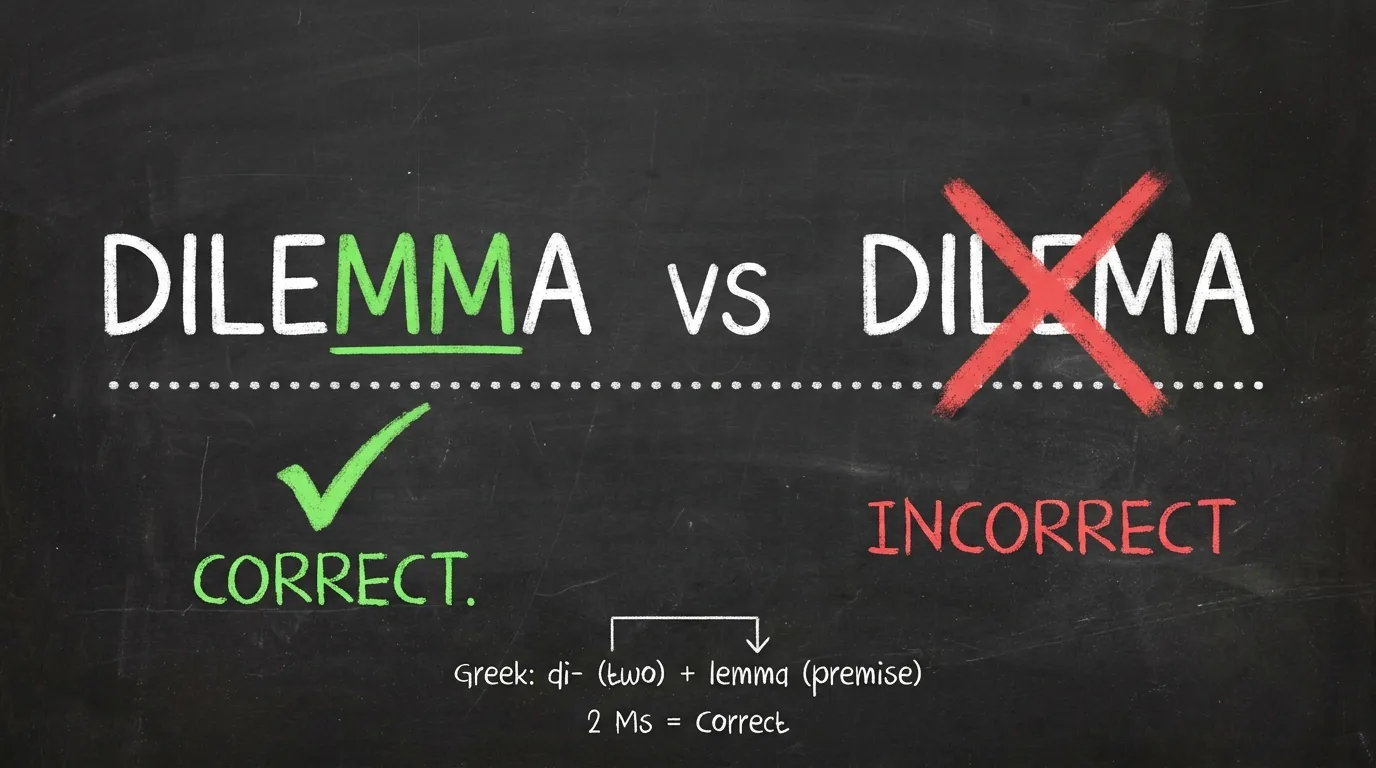
Have you ever typed dilema and wondered whether something looked wrong? You are not alone. The correct English spelling is dilemma, with two m’s. The spelling dilema is a common misspelling and is not considered standard English.
The word dilemma refers to a difficult situation in which a person must choose between two or more options, especially when each choice has drawbacks. For example, if you can accept a job you dislike or reject it and remain unemployed, you may face a dilemma.
In this guide, you will learn the difference between dilemma vs dilema, why the incorrect spelling is so common, how to pronounce and use dilemma, where the word came from, common phrases and collocations, spelling mistakes to avoid, and how to use the word naturally in academic, professional, casual, journalistic, and everyday English.
Quick Answer: Dilemma or Dilema?
Dilemma is the correct spelling.
Dilema is a misspelling.
| Spelling | Correct? | Meaning |
|---|---|---|
| dilemma | Yes | A difficult choice or situation |
| dilema | No | Incorrect spelling of dilemma |
Correct example
I am facing a difficult dilemma about whether to accept the offer.
Incorrect example
I am facing a difficult dilema about whether to accept the offer.
The easiest rule to remember is simple:
Dilemma has two m’s.
If you are writing an email, essay, article, report, application, or professional document, always use dilemma.
What Does Dilemma Mean?
A dilemma is a difficult situation that requires someone to make a choice between competing options.
Usually, the choices are not completely good or completely bad. Each option may have an advantage, disadvantage, risk, or consequence.
For example:
Sarah had a dilemma: stay at her current job or accept a higher paying position in another city.
Sarah has two choices:
- Stay where she is and keep her familiar life.
- Move to another city and earn more money.
Neither choice is obviously perfect. That conflict creates a dilemma.
The word can describe personal, professional, moral, political, academic, financial, or practical situations.
Simple dictionary style definition
Dilemma: A difficult situation in which a person must choose between two or more possible actions or outcomes, especially when each option has disadvantages.
In simple English
A dilemma is:
A hard choice where there is no easy answer.
Why Is Dilemma Spelled With Two M’s?
The spelling comes from the word’s historical development.
Dilemma entered English through Latin from the Greek word dilēmma. The Greek word is associated with the idea of a reasoning problem involving two assumptions or alternatives.
The Greek elements are commonly explained as:
- di, meaning two
- lemma, meaning an assumption, proposition, or premise
The word eventually developed into the English spelling dilemma.
The double m is therefore part of the established spelling.
This is one reason dilema can look tempting. When people pronounce the word, the second m is not strongly noticeable. English spelling often preserves historical letters that are not obvious from pronunciation.
Dilemma vs Dilema: The Key Difference
The difference is entirely about spelling.
Dilemma is a standard English word.
Dilema is not the standard English spelling.
There is no meaningful difference in definition, pronunciation, formality, or grammatical function because dilema is simply an error when intended as the English word dilemma.
Compare them
| Feature | Dilemma | Dilema |
|---|---|---|
| Standard English | Yes | No |
| Correct spelling | Yes | No |
| Meaning | Difficult choice or situation | None as a standard English spelling |
| Pronunciation | /dɪˈlɛmə/ | Usually intended to mean dilemma |
| Formal writing | Appropriate | Incorrect |
| Academic writing | Appropriate | Incorrect |
| Business writing | Appropriate | Incorrect |
| Casual writing | Appropriate | Incorrect |
| Dictionaries | Listed | Generally not listed as the English word |
The answer is therefore straightforward:
Use dilemma, never dilema, when writing standard English.
Why Do People Confuse Dilemma and Dilema?
The most common reason is pronunciation.
When people hear dilemma, they may not clearly hear both m’s. The word is commonly pronounced approximately:
di LEM uh
The spelling contains two m’s:
d i l e m m a
But the pronunciation does not sound like a strong, repeated m m.
This creates a spelling trap.
Other reasons for the confusion
The second m is easy to overlook
When typing quickly, people may write:
dilema
instead of:
dilemma
This is especially common when someone knows the word through speech rather than writing.
English contains many spelling patterns
English has many words in which pronunciation does not perfectly reveal spelling.
For example:
- accommodate
- committee
- recommend
- necessary
- embarrass
- millennium
- occurrence
Words with repeated consonants often cause spelling problems.
Autocorrect may not always help
If a misspelling is entered in a context where spell checking is limited, the error can survive unnoticed.
This is especially possible in informal messages, comments, notes, and quick social media posts.
People may remember the sound instead of the spelling
Someone who frequently hears the word but rarely reads it may build an incorrect spelling based on pronunciation.
How Do You Pronounce Dilemma?
The standard American English pronunciation is approximately:
dih LEM uh
Phonetically, it can be represented as:
/dɪˈlɛm.ə/
The stress falls on the middle syllable:
di LEM ma
The final sound is a relaxed uh sound.
Does the double m change the pronunciation?
No.
The spelling dilemma contains two m’s, but this does not mean you pronounce two separate m sounds.
You do not need to say:
di lem ma
with an exaggerated pause between the m’s.
Instead, say it naturally:
dih LEM uh
Is Dilemma a Noun or a Verb?
Dilemma is a noun.
It names a situation, problem, or difficult choice.
Examples
He faced a serious dilemma.
The company must resolve an ethical dilemma.
I am in a difficult dilemma.
The decision created a political dilemma.
You would not normally use dilemma as a verb.
For example, this is incorrect:
The situation dilemmad him.
Instead, use a verb such as:
The situation forced him to choose.
The decision put him in a difficult position.
The problem created a dilemma for him.
What Is the Plural of Dilemma?
The standard English plural is:
dilemmas
Example:
The manager faced several difficult dilemmas during the project.
You do not need to use an unusual plural form.
Singular
This is a serious dilemma.
Plural
These are serious dilemmas.
Common Meanings and Contexts of Dilemma
The word dilemma works in many different contexts.
Moral dilemma
A moral dilemma occurs when a person must choose between competing actions involving ethical concerns.
Example:
The doctor faced a moral dilemma about whether to disclose the patient’s private information.
Ethical dilemma
An ethical dilemma is similar and is especially common in professional, academic, medical, legal, and business discussions.
Example:
The company faced an ethical dilemma after discovering that the product had a safety problem.
Personal dilemma
A personal dilemma involves an individual’s private decision.
Example:
Moving abroad created a personal dilemma because she wanted both career growth and time with her family.
Financial dilemma
A financial dilemma involves money or economic choices.
Example:
Buying a new car or saving for a house created a financial dilemma.
Professional dilemma
A professional dilemma occurs in the workplace.
Example:
The employee faced a professional dilemma when her manager asked her to change the report.
Political dilemma
A political dilemma involves competing political interests or choices.
Example:
The government faced a political dilemma over the proposed policy.
Academic dilemma
Students and researchers can also face dilemmas.
Example:
The researcher faced a dilemma about whether to publish the findings before completing additional tests.
Common Collocations With Dilemma
A collocation is a group of words that naturally appear together.
Learning common collocations can make your English sound more natural.
Common expressions include:
- difficult dilemma
- serious dilemma
- moral dilemma
- ethical dilemma
- personal dilemma
- political dilemma
- professional dilemma
- financial dilemma
- challenging dilemma
- painful dilemma
- difficult choice
- face a dilemma
- face the dilemma
- create a dilemma
- present a dilemma
- resolve a dilemma
- confront a dilemma
- pose a dilemma
- dilemma between two options
Natural examples
She faced a difficult dilemma.
The decision created an ethical dilemma.
We need to resolve this dilemma.
The new policy poses a serious dilemma for employers.
He was confronted with a moral dilemma.
Common Phrases With Dilemma
Some expressions occur frequently in everyday and professional English.
Face a dilemma
We face a dilemma about how to spend the remaining budget.
Be faced with a dilemma
The committee was faced with a difficult dilemma.
Create a dilemma
The new rule could create a dilemma for small businesses.
Pose a dilemma
The situation poses a dilemma for policymakers.
Resolve a dilemma
The team met to resolve the dilemma.
Ethical dilemma
The manager encountered an ethical dilemma.
Moral dilemma
The story presents a classic moral dilemma.
Dilemma vs Difficult Choice
These expressions are related, but they are not always identical.
A difficult choice can involve several options and may simply be hard to make.
A dilemma usually suggests a deeper conflict between competing alternatives.
Compare:
Choosing between two good restaurants is a difficult choice.
This does not necessarily feel like a dilemma.
Now consider:
The employee must either report the misconduct or protect a close colleague.
That is more naturally described as a dilemma because the person faces competing values and consequences.
In simple terms:
Every dilemma involves a difficult choice, but not every difficult choice is a dilemma.
Dilemma vs Problem
A problem is something that needs to be solved.
A dilemma is a difficult situation involving competing choices.
Problem
My computer is not working.
The solution may simply be to repair it.
Dilemma
I can repair my old computer or spend my savings on a new one.
Now the person must choose between competing options.
A dilemma is therefore often a type of problem, but it emphasizes the choice rather than simply the difficulty.
Dilemma vs Predicament
A predicament is an unpleasant, difficult, or awkward situation.
A dilemma specifically emphasizes a difficult choice.
Example:
I forgot my passport at home and missed my flight.
This is a predicament.
Example:
I can either cancel the trip or return home for my passport and miss the meeting.
This is a dilemma.
Dilemma vs Quandary
Quandary is a close synonym of dilemma.
Both words can describe uncertainty about what to choose.
However, dilemma is more common in everyday English and professional writing.
Quandary can sound slightly more literary or formal.
Compare:
I am in a dilemma about whether to accept the offer.
I am in a quandary about whether to accept the offer.
Both are correct.
For most everyday situations, dilemma is the safer and more familiar choice.
Dilemma vs Predicament vs Quandary
| Word | Main idea | Common use |
|---|---|---|
| Dilemma | Difficult choice | Everyday, academic, professional |
| Predicament | Difficult situation | Problems and awkward situations |
| Quandary | Uncertainty about what to choose | Formal or literary contexts |
| Problem | Something requiring a solution | Very broad usage |
Synonyms for Dilemma
Depending on the context, possible synonyms include:
- difficult choice
- difficult decision
- quandary
- predicament
- problem
- conflict
- uncertainty
- challenge
- difficult situation
- tough choice
- predicament
- crossroads
These words are not always interchangeable.
For example, crossroads can be figurative:
She is at a crossroads in her career.
A dilemma is more direct:
She faces a dilemma about whether to change careers.
Antonyms of Dilemma
There is no single perfect antonym for dilemma, but contextually opposite ideas include:
- certainty
- clear choice
- easy decision
- straightforward decision
- solution
- resolution
- clarity
- agreement
Example:
The committee finally reached a resolution, ending the dilemma.
Figurative Use of Dilemma
Although dilemma originally relates to a choice involving alternatives, modern English often uses the word more broadly.
For example:
The company is caught in a dilemma between reducing costs and maintaining quality.
The company may not literally have only two options. The word emphasizes the conflict between competing goals.
This broader use is common in business, journalism, politics, and everyday conversation.
Is Dilemma Used in Politics?
Yes.
Political writers frequently use dilemma to describe situations where governments, political parties, or leaders must balance competing interests.
Examples:
The government faces a dilemma over how to reduce spending without cutting essential services.
The candidate’s policy created a dilemma for voters.
The party faces a political dilemma before the election.
Political usage is usually literal rather than slang.
Is Dilemma Used in Business?
Very often.
Business writing commonly discusses dilemmas involving:
- costs
- employees
- customers
- growth
- quality
- deadlines
- technology
- ethics
- competition
- risk
Example:
The company faced a dilemma between launching the product quickly and conducting additional safety tests.
For business writing, dilemma is professional and appropriate.
Is Dilemma Used in Technical Writing?
Yes, although technical writers often prefer more precise language when possible.
For example:
The engineering team faced a design dilemma.
This is acceptable.
However, if the situation has a specific technical description, a more precise term may be better.
Instead of:
The system has a dilemma.
You might write:
The system must choose between two conflicting configurations.
Technical writing usually benefits from precise descriptions.
Dilemma in Academic Writing
Dilemma is common in academic English.
It appears frequently in subjects such as:
- philosophy
- psychology
- ethics
- sociology
- political science
- business
- law
- medicine
- education
Examples:
The study examines the ethical dilemma faced by healthcare professionals.
Philosophers have debated moral dilemmas for centuries.
The research highlights a dilemma between individual freedom and public safety.
If you are writing an essay, research paper, or academic assignment, dilemma is the correct spelling and a perfectly acceptable word.
Dilemma in Journalism
Journalists frequently use dilemma to describe conflicts facing individuals, companies, governments, and communities.
Examples:
The city faces a dilemma over housing development.
The decision leaves voters with a difficult dilemma.
The new law creates a dilemma for local businesses.
In headlines, the word can also help summarize a complicated conflict in a concise way.
Dilemma in Sports
The word can describe decisions faced by athletes, coaches, managers, or teams.
Examples:
The coach faces a dilemma over which goalkeeper should start.
The team has a dilemma about whether to trade its veteran player.
The injury created a difficult selection dilemma.
However, sports writers may also use simpler terms such as decision, choice, or selection problem when the situation is not especially difficult.
Dilemma in Casual Conversation
The word is completely normal in everyday speech.
You can say:
I have a dilemma.
I am in a bit of a dilemma.
Here is my dilemma.
I cannot decide what to do. It is such a dilemma.
For casual conversation, these expressions sound natural.
Everyday example
I have a dilemma. Should I save my money for vacation or buy the laptop I want?
Formal vs Informal Alternatives
The word dilemma works in both formal and informal settings, but you can choose alternatives based on tone.
| Formal | Neutral | Informal |
|---|---|---|
| dilemma | difficult choice | tough choice |
| predicament | difficult situation | tricky situation |
| quandary | uncertainty | hard decision |
| ethical dilemma | ethical problem | tough call |
For example:
Formal:
The organization faces an ethical dilemma.
Neutral:
The organization faces a difficult choice.
Informal:
The organization has a tough call to make.
Awkward vs Natural Examples
Understanding natural usage helps you avoid awkward sentences.
Awkward
I have a dilemma problem.
Better
I have a dilemma.
Or:
I have a difficult problem to solve.
Using dilemma and problem together can be redundant when both refer to the same situation.
Awkward
I am dilemmed about the decision.
Better
I am struggling with the decision.
Or:
I am facing a dilemma.
Awkward
She dilemmas whether to leave.
Better
She faces a dilemma about whether to leave.
Natural
He is facing a difficult dilemma.
Natural
The decision presents an ethical dilemma.
Natural
We have a dilemma about how to proceed.
Common Mistakes With Dilemma
Mistake 1: Writing dilema
Incorrect:
This is a serious dilema.
Correct:
This is a serious dilemma.
Remember the two m’s.
Mistake 2: Treating dilemma as a verb
Incorrect:
The situation dilemmas the manager.
Correct:
The situation puts the manager in a difficult position.
Mistake 3: Using dilemma for every decision
Not every decision is a dilemma.
Incorrect or exaggerated:
I have a dilemma about whether to drink tea or coffee.
This could technically describe a difficult personal choice, but unless the decision genuinely feels difficult, choice or decision sounds more natural.
Better:
I cannot decide whether to drink tea or coffee.
Mistake 4: Using unnecessary repetition
Awkward:
She faced a difficult dilemma problem.
Better:
She faced a difficult dilemma.
A Simple Memory Trick for Dilemma
Use this spelling trick:
Dilemma has two m’s because it is a major decision with a middle double m.
You can also break the spelling into:
DI + LEMMA
That gives you:
D I L E M M A
Another useful visual reminder is:
diLEMMa
The capitalized section highlights the double m.
How to Remember Dilemma vs Dilema
If you repeatedly make this spelling mistake, use these steps:
- Write dilemma three times.
- Say double m while writing it.
- Connect the word with the phrase difficult decision.
- Add it to your personal spelling list.
- Use spell check when writing important documents.
The most important visual pattern is:
dileMMa
Not:
dileMa
Real World Examples of Dilemma
Here are natural examples across different situations.
At work
My boss gave me a difficult dilemma: finish the report tonight or delay the presentation.
In education
The student faced a dilemma about whether to study for the exam or attend an important family event.
In relationships
She faced a personal dilemma about whether to move closer to her partner.
In business
The company faces a dilemma between lowering prices and protecting its profit margin.
In politics
The government faces a dilemma over how to balance economic growth with environmental protection.
In medicine
The doctor faced an ethical dilemma involving patient privacy.
In sports
The coach has a difficult dilemma because both players are performing well.
In everyday life
I have a dilemma. I want to go on vacation, but I also want to save money.
When Should You Use Dilemma?
Use dilemma when:
- a choice is genuinely difficult
- two or more competing options exist
- each option has disadvantages or consequences
- the decision involves conflicting goals
- the situation creates uncertainty
- you want to emphasize the difficulty of choosing
Avoid using it simply because something is a normal decision.
Good use
The company faces a dilemma between reducing expenses and keeping employees.
Less natural use
I have a dilemma about which flavor of ice cream to buy.
The second sentence is possible if the speaker is being humorous or dramatic, but choice is usually more natural.
American English Recommendation
For American English, always use:
dilemma
Avoid:
dilema
American dictionaries and standard writing conventions recognize dilemma as the correct spelling.
This applies to:
- school assignments
- college essays
- business emails
- resumes
- reports
- blogs
- websites
- journalism
- professional documents
- social media posts
British English Recommendation
British English also uses:
dilemma
The spelling does not normally change between American and British English.
Unlike words such as color/colour or center/centre, dilemma is generally spelled the same in both major varieties of English.
So whether you are writing for an American, British, Canadian, Australian, or international audience, dilemma is the safe standard spelling.
Is Dilema Ever Correct?
In standard English, dilema should be treated as a spelling error when the intended word is dilemma.
You may occasionally encounter similar forms in another language, a personal name, a brand, a username, or a proper noun. Those situations are different.
But if you are writing an ordinary English sentence and mean a difficult choice, write:
dilemma
Dilemma vs Dilema: Final Comparison
| Question | Answer |
|---|---|
| Which spelling is correct? | Dilemma |
| Is dilema correct English? | No |
| Does dilemma have two m’s? | Yes |
| What part of speech is dilemma? | Noun |
| What does dilemma mean? | A difficult choice or situation |
| Is dilemma used in American English? | Yes |
| Is dilemma used in British English? | Yes |
| Is dilemma formal? | Yes, but it also works in casual English |
| Is dilemma suitable for academic writing? | Yes |
| Is dilemma suitable for business writing? | Yes |
| Is dilemma a synonym for problem? | Sometimes, but not always |
| What is the plural? | Dilemmas |
| Is dilemma a verb? | No |
| What is the easiest spelling trick? | Remember the double m |
Frequently Asked Questions
Is dilemma or dilema correct?
Dilemma is correct. Dilema is a misspelling in standard English. The correct word contains two m’s.
Why does dilemma have two m’s?
The spelling dilemma comes through Latin from Greek dilēmma. Its historical spelling contains the double m, which English retained.
How do you spell dilemma correctly?
Spell it:
D I L E M M A
A useful memory trick is to remember double m.
What does dilemma mean?
A dilemma is a difficult situation involving a choice between competing options, especially when each option has disadvantages or consequences.
Is dilemma a noun?
Yes. Dilemma is a noun.
Example:
She faced a difficult dilemma.
What is the plural of dilemma?
The plural is dilemmas.
Example:
The manager faced several ethical dilemmas.
Is dilemma used in American and British English?
Yes. Dilemma is standard in both American and British English. Unlike some spelling differences between the two varieties, this word normally keeps the same spelling.
What is another word for dilemma?
Depending on context, alternatives include difficult choice, quandary, predicament, difficult decision, tough choice, and difficult situation.
The best synonym depends on what you want to emphasize.
Is a dilemma the same as a difficult choice?
They are closely related, but not exactly the same. A difficult choice can simply be hard to make. A dilemma usually suggests a conflict between competing options, values, goals, or consequences.
Can I use dilemma in formal writing?
Yes. Dilemma is appropriate in academic, business, professional, journalistic, political, and formal writing. It is also common in everyday conversation.
Conclusion
When choosing between dilemma vs dilema, there is one clear answer: dilemma is the correct English spelling.
The word dilemma is a noun that describes a difficult choice or situation, especially when competing options have significant disadvantages or consequences. It works naturally in American and British English and is suitable for casual conversation as well as academic, professional, business, journalistic, political, and technical contexts.
The spelling dilema is a common mistake, often caused by the fact that the second m is easy to miss when the word is heard aloud.
The best way to remember the spelling is simple:
dilemma = double m
So when you face a difficult decision, remember that the word describing it also has a difficult little spelling trap.
Write dilemma, not dilema.


