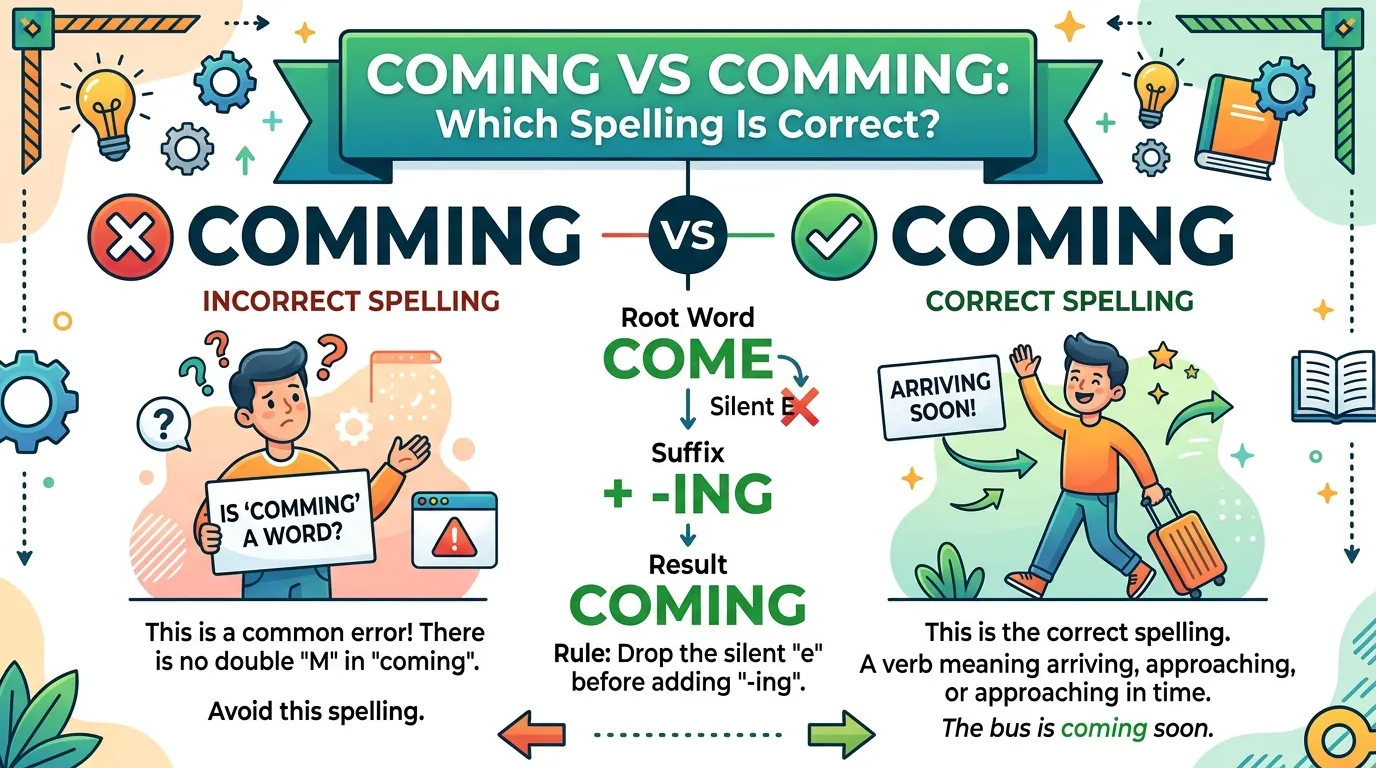
If you are unsure whether the correct spelling is coming or comming, the answer is simple: coming is correct, while comming is a misspelling in standard English.
The word coming is the present participle and gerund form of the verb come. It can describe someone moving toward a place, something that is about to happen, or an event that is approaching. You will see it in everyday conversation, business writing, academic English, journalism, social media, and countless common expressions.
The confusion happens because English has many words that double their final consonant before adding -ing, such as running, sitting, and swimming. However, come does not follow that pattern. Its final e is removed before -ing is added:
come → coming
Not:
come → comming
In this guide, you will learn why coming is correct, why comming is wrong, how to pronounce the word, how it works grammatically, where the spelling rule comes from, and how to avoid this common mistake in formal and everyday writing.
Quick Answer: Coming or Comming?
Coming is the correct spelling.
Comming is incorrect in standard American English and standard British English when you intend the word related to come.
| Spelling | Correct? | Meaning |
|---|---|---|
| coming | ✅ Yes | Moving toward something, approaching, or about to happen |
| comming | ❌ No | Common misspelling of coming |
Correct examples
- She is coming to my house tonight.
- The summer vacation is coming soon.
- Thank you for coming to the meeting.
- A new store is coming to town.
- The coming year could bring major changes.
Incorrect example
- ❌ She is comming to my house tonight.
The corrected sentence is:
- ✅ She is coming to my house tonight.
The spelling comming should generally be treated as a typo when it appears in ordinary English writing.
What Does “Coming” Mean?
Coming is the -ing form of the verb come. It has several related meanings depending on context.
At its most basic level, coming means moving toward a particular person, place, or point.
For example:
I am coming home now.
Here, coming describes movement toward the speaker’s home.
But coming can also refer to something that is approaching in time:
The coming weekend will be busy.
In this sentence, coming means the next or approaching weekend.
It can also describe something that is expected to happen:
A major announcement is coming.
So, depending on context, coming can mean:
- Moving toward a place
- Approaching a person
- Arriving
- Happening soon
- Developing or emerging
- Occurring in the future
- Becoming popular or successful
- Being the next or approaching period
Why Is “Coming” Correct and “Comming” Wrong?
The spelling difference comes from the way English forms words ending in -ing.
The base verb is:
come
When -ing is added, the final silent e is normally removed:
come + ing → coming
The important point is that the letter m is not doubled.
Therefore:
- come → coming ✅
- come → comming ❌
Compare this with verbs where the final consonant is doubled:
- run → running
- sit → sitting
- swim → swimming
- stop → stopping
These verbs follow a different spelling pattern.
The fact that running has two ns does not mean coming should have two ms.
The Spelling Rule Behind “Coming”
A useful English spelling rule says that when a verb ends in a silent e, the e is often dropped before a suffix beginning with a vowel.
The suffix -ing begins with the vowel i.
Examples include:
- make → making
- take → taking
- write → writing
- drive → driving
- use → using
- give → giving
- come → coming
Notice what happens:
| Base verb | Add -ing | Correct form |
|---|---|---|
| make | make + ing | making |
| take | take + ing | taking |
| write | write + ing | writing |
| drive | drive + ing | driving |
| come | come + ing | coming |
The final e disappears, but the consonant before it does not become doubled.
Why Doesn’t the “M” Double?
Because come does not meet the spelling conditions that normally cause a final consonant to double.
Words such as run → running and sit → sitting use consonant doubling to preserve their pronunciation and follow established English spelling patterns.
With come, the established form is simply:
coming
There is no spelling rule that changes come into comm- when -ing is added.
Coming vs. Comming: Key Difference
The most important difference is that one spelling is standard and the other is not.
Coming
Coming is a standard English word.
It is used as:
- A present participle
- A gerund
- An adjective
- Part of a verb phrase
- Part of common expressions and phrasal constructions
Examples:
- Are you coming with us?
- Thanks for coming.
- The coming months will be important.
- A storm is coming.
Comming
Comming is not the standard spelling of the -ing form of come.
If you write:
I am comming tomorrow.
the correct version is:
I am coming tomorrow.
In normal English editing, schoolwork, professional writing, emails, websites, and published content, comming should be corrected to coming.
Coming: Dictionary-Style Definition
coming — adjective, noun, present participle
Basic definition: Moving, traveling, or progressing toward a particular place, person, time, or state; approaching or about to happen.
Verb form: Present participle and gerund of come.
Pronunciation: /ˈkʌmɪŋ/
Simple pronunciation: KUM-ing
Example
The train is coming into the station.
Here, coming describes movement toward the station.
Another example:
The coming election will receive considerable attention.
Here, coming means approaching or upcoming.
How Do You Pronounce “Coming”?
Coming is usually pronounced:
/ˈkʌmɪŋ/
A simple pronunciation guide is:
KUM-ing
It has two syllables:
com-ing
The first syllable sounds like “kum.”
Importantly, the pronunciation does not contain a long or doubled m sound corresponding to the spelling comming.
Examples
- coming home → KUM-ing home
- coming soon → KUM-ing soon
- coming tomorrow → KUM-ing tomorrow
- coming together → KUM-ing together
The incorrect spelling comming is often produced because writers hear the stronger consonant sound and assume the letter should be doubled.
Is “Coming” a Verb?
Yes, coming is an -ing form of the verb come, but its grammatical role can change according to the sentence.
1. Present participle
It can form part of a continuous verb construction.
She is coming home.
Here, is coming is the present progressive verb phrase.
2. Gerund
It can function as a noun.
Coming here was a good decision.
Here, coming acts as the subject of the sentence.
3. Adjective
It can describe something approaching or upcoming.
The coming year may be challenging.
Here, coming modifies year.
Coming in Different Contexts
The word coming is extremely flexible. Its meaning changes slightly according to the context.
Physical movement
The children are coming toward us.
Here, coming means moving toward the speaker or another reference point.
Future events
The holidays are coming.
Here, coming means approaching in time.
Upcoming products or services
A new smartphone model is coming next month.
Here, coming means expected to become available.
Developing situations
Change is coming to the industry.
This means change is expected to happen.
Social situations
Thanks for coming to my party.
Here, coming refers to attending or arriving at an event.
Coming vs. Come vs. Came
These words are related, but they perform different grammatical jobs.
| Word | Form | Example |
|---|---|---|
| come | Base form | Please come inside. |
| came | Simple past | She came yesterday. |
| coming | -ing form | She is coming now. |
| come | Past participle | She has come home. |
A common mistake is using the wrong form in a sentence.
Correct
- I am coming tomorrow.
- She came yesterday.
- Please come inside.
- They have come to help us.
Incorrect
- ❌ I am comming tomorrow.
- ❌ She has came home.
- ❌ He is come tomorrow.
The exact form depends on the grammatical structure.
Common Expressions With “Coming”
Coming appears in many natural English phrases.
Coming soon
Used to say that something will be available or happen in the near future.
Our new website is coming soon.
Coming up
Often means something is approaching or will happen shortly.
Your birthday is coming up.
Coming back
Means returning.
She is coming back next week.
Coming over
Usually means visiting someone.
Are you coming over tonight?
Coming along
Can mean accompanying someone or making progress.
Are you coming along with us?
It can also describe progress:
The project is coming along nicely.
Coming together
Means joining, cooperating, or becoming unified.
The community is coming together to help families affected by the storm.
Coming of age
A common expression referring to reaching adulthood or a period of maturity.
The novel is a coming-of-age story.
Coming to terms with
Means accepting or beginning to understand a difficult situation.
He is coming to terms with the changes.
Coming in Formal and Informal Writing
Coming is appropriate in virtually every variety of standard English.
Casual writing
Are you coming tonight?
Texting
Are u coming?
In informal texting, people may shorten words, but the standard spelling remains coming.
Business writing
We are pleased to announce that a new service is coming to our customers next quarter.
Academic writing
The coming decades may bring significant changes to the field.
Journalism
The coming election is expected to attract national attention.
Technical writing
The coming software release will introduce several security improvements.
There is no standard professional context in which comming should replace coming.
American vs. British English: Is There a Difference?
No meaningful spelling difference exists here.
Both American and British English use:
coming
Examples:
American English:
Are you coming with us?
British English:
Are you coming with us?
The spelling is identical.
This is unlike certain words that have recognized regional variants, such as:
- color / colour
- center / centre
- organize / organise
Coming is not one of those cases.
Whether you are writing for readers in the United States, United Kingdom, Canada, Australia, or another English-speaking region, coming is the standard spelling.
Why Do People Spell “Coming” as “Comming”?
The error is understandable because English spelling contains many examples of doubled consonants.
Consider:
- run → running
- plan → planning
- win → winning
- begin → beginning
- swim → swimming
A learner may therefore reason:
come → comming
But that analogy is incorrect.
Another reason is that writers may focus on pronunciation instead of the spelling pattern. The m sound in coming can feel prominent, especially when the word is spoken quickly.
Typing habits can also cause the mistake. Someone who frequently writes words with double consonants may accidentally type comming without noticing.
Autocorrect and spell-check tools often catch this error, but they should not be your only line of defense.
Common Mistakes With Coming
Here are some frequent errors and their corrections.
| Incorrect | Correct |
|---|---|
| comming | coming |
| comming soon | coming soon |
| I am comming | I am coming |
| Thanks for comming | Thanks for coming |
| The event is comming | The event is coming |
| Are you comming with us? | Are you coming with us? |
Mistake 1: Doubling the “m”
❌ He is comming home.
✅ He is coming home.
Mistake 2: Writing “comming soon”
❌ Our new product is comming soon.
✅ Our new product is coming soon.
Mistake 3: Using “coming” incorrectly with another verb
❌ She coming to school.
✅ She is coming to school.
The issue in the first sentence is not just spelling. The continuous verb construction needs the auxiliary verb is.
Awkward vs. Natural Examples
Sometimes a sentence can be grammatically correct but still sound less natural.
Example 1
Awkward:
The new product will be coming in the future.
More natural:
The new product is coming soon.
Example 2
Awkward:
The meeting is coming at 3 p.m.
More natural:
The meeting is at 3 p.m.
Or, when emphasizing that it is approaching:
The meeting is coming up at 3 p.m.
Example 3
Natural:
Are you coming to the wedding?
This is a normal way to ask whether someone plans to attend.
Formal Alternatives to “Coming”
Sometimes a more precise word works better in formal or technical writing.
Depending on the context, alternatives include:
- approaching
- upcoming
- arriving
- forthcoming
- emerging
- advancing
- anticipated
- expected
- imminent
- arriving shortly
For example:
Everyday:
The coming changes may affect employees.
More formal:
The forthcoming changes may affect employees.
Another example:
Everyday:
The coming election will be important.
Formal:
The upcoming election will be closely watched.
The alternatives are not always exact substitutes, so choose according to meaning.
Synonyms for “Coming”
The best synonym depends on how coming is being used.
When referring to movement
- approaching
- arriving
- advancing
- traveling
- moving toward
When referring to future events
- upcoming
- forthcoming
- approaching
- imminent
- expected
When referring to development
- emerging
- developing
- advancing
- evolving
Example
The coming changes will affect the company.
Possible alternatives include:
The upcoming changes will affect the company.
or:
The forthcoming changes will affect the company.
Antonyms and Contrasting Words
There is no single opposite of coming in every context.
When coming means moving toward something, possible contrasts include:
- going
- leaving
- departing
- retreating
- moving away
Example:
She is coming toward us.
Contrast:
She is going away from us.
When coming means approaching in time, a contrast might be:
- past
- previous
- completed
- departed
- gone
For example:
the coming year
contrasts with:
the previous year
Collocations With “Coming”
A collocation is a group of words that commonly occur together.
Some natural collocations with coming include:
- coming soon
- coming year
- coming months
- coming weeks
- coming days
- coming season
- coming generation
- coming election
- coming changes
- coming events
- coming home
- coming back
- coming together
- coming over
- coming up
- coming down
- coming forward
Examples
We will announce the details in the coming weeks.
She is coming back tomorrow.
The team is coming together well.
Several important events are coming up.
These combinations are common in everyday, professional, and published English.
Memory Trick: How to Remember “Coming”
A simple trick can help you remember the spelling:
Think:
COME + ING = COMING
Remove the silent e:
COM(E) + ING = COMING
Do not add another m.
You can also remember:
One M in COME, one M in COMING.
The word coming has:
- C
- O
- M
- I
- N
- G
So it has one m, not two.
Coming in Blogging, SEO, and Digital Content
For bloggers, marketers, and SEO writers, spelling accuracy matters because a misspelled word can reduce credibility and make otherwise useful content look unprofessional.
Use coming in phrases such as:
- coming soon
- upcoming trends
- coming changes
- coming year
- coming months
- coming technology
- coming opportunities
For example:
Learn about the coming changes before they affect your business.
Avoid:
❌ Learn about the comming changes before they affect your business.
Although search engines can often understand spelling variations and user errors, published content should use the standard spelling.
If your keyword research shows that people search for “coming vs comming,” you can discuss the misspelling naturally in an educational article without deliberately repeating it excessively.
Is “Comming” Ever Correct?
For ordinary English, no.
If someone writes comming when they mean the present participle of come, it is a spelling error.
You may occasionally encounter unusual names, usernames, trademarks, technical identifiers, or specialized strings containing comming, but these do not make comming a standard English spelling of coming.
In normal grammar and spelling questions, the correct answer is:
coming.
Coming in Academic and Professional Writing
In formal writing, coming is perfectly acceptable when it expresses the intended meaning.
Academic example
The coming decades may require new approaches to climate research.
Business example
The company will introduce several improvements in the coming months.
Journalistic example
The coming election is likely to dominate political discussion.
Technical example
The coming software update will improve system performance.
Sports example
The team is preparing for the coming season.
The important point is not to avoid coming merely because it is an everyday word. Instead, use it when it communicates your meaning clearly.
Coming vs. Upcoming
These words are closely related but are not always interchangeable.
Coming can describe movement:
She is coming toward us.
You cannot replace it naturally with upcoming:
❌ She is upcoming toward us.
Upcoming, however, commonly describes a future event:
The upcoming meeting will begin at noon.
Similarly:
The coming meeting will begin at noon.
Both can work, although upcoming meeting is often more natural in modern professional writing.
Coming vs. Arriving
Coming is broader than arriving.
John is coming to the office.
This focuses on John’s movement toward the office.
John is arriving at the office.
This focuses more specifically on reaching the destination.
The two words overlap, but they are not identical.
Coming vs. Going
These words describe movement from different perspectives.
Coming generally indicates movement toward a person, place, or reference point.
Are you coming to my house?
Going generally indicates movement away from the current location or toward another destination.
Are you going to my house?
The correct choice depends on the speaker’s perspective and the direction of movement.
Is “Coming” a Slang Word?
Coming itself is not inherently slang. It is a standard English word.
However, it appears in many informal expressions and slang phrases depending on the context.
For example:
I’m coming over.
This is casual but standard English.
Other expressions involving come or coming may have specialized meanings in social, sexual, cultural, or online contexts. Those meanings depend heavily on the surrounding words.
Therefore, you should not assume that coming has one fixed meaning in every conversation.
The ordinary dictionary meaning remains related to movement, arrival, approach, or something expected to happen.
Does “Coming” Have Political or Sports Meanings?
The word itself does not have a special political or sports spelling.
However, it is frequently used in these contexts.
Political example
The coming election could change the balance of power.
Here, coming means upcoming or approaching.
Sports example
The team is preparing for the coming season.
Here, coming means next or upcoming.
Business example
Investors are watching the coming quarter closely.
Again, it refers to a future period.
These are ordinary uses of the standard word coming, not special alternative spellings.
Word History and Etymology of “Coming”
The word coming comes from the verb come, one of the oldest and most fundamental verbs in English.
The history of come can be traced through earlier forms of English and related Germanic languages. The modern spelling developed over centuries as English spelling and pronunciation changed.
The present participle coming follows the established English formation of adding -ing to the verb.
Although English spelling has many irregularities, coming is firmly established as the standard form.
This historical development also explains why it is not useful to invent a spelling such as comming simply because some other verbs double their final consonants.
A Practical Editing Checklist
Before publishing an article, email, essay, report, or social media post, check the following:
- ✅ Use coming, not comming.
- ✅ Remember that come + ing = coming.
- ✅ Remove the final silent e from come.
- ✅ Do not double the m.
- ✅ Use coming in both American and British English.
- ✅ Check whether the sentence needs an auxiliary verb such as is, are, or was.
- ✅ Choose alternatives such as upcoming, approaching, or forthcoming only when they fit the context.
- ✅ Proofread professional content for spelling errors.
Quick Comparison: Coming vs. Comming
| Feature | Coming | Comming |
|---|---|---|
| Standard English | ✅ Yes | ❌ No |
| Correct spelling of come + -ing | ✅ Yes | ❌ No |
| American English | ✅ Yes | ❌ No |
| British English | ✅ Yes | ❌ No |
| Present participle of come | ✅ Yes | ❌ No |
| Gerund form | ✅ Yes | ❌ No |
| Common typo | No | ✅ Yes |
| Formal writing | Appropriate | Incorrect |
| Casual writing | Appropriate | Incorrect |
| Pronunciation | /ˈkʌmɪŋ/ | Not a standard form |
Frequently Asked Questions
1. Is it “coming” or “comming”?
Coming is correct. Comming is a misspelling when you mean the -ing form of come.
2. Why is “coming” spelled with one m?
Because the base verb is come. When -ing is added, the final silent e is removed:
come → coming
The m is not doubled.
3. Is “comming” a word?
Comming is not the standard English spelling of the present participle of come. In ordinary writing, it should be corrected to coming.
4. Is “coming” correct in American English?
Yes. Coming is the standard spelling in American English.
5. Is “coming” also correct in British English?
Yes. British English also uses coming. There is no standard American-British spelling difference for this word.
6. What is the pronunciation of “coming”?
Coming is pronounced approximately KUM-ing, with the IPA pronunciation /ˈkʌmɪŋ/.
7. What is the difference between “coming” and “upcoming”?
Coming can describe movement toward something as well as something approaching in time. Upcoming mainly describes something expected to happen in the near future.
For example:
She is coming home.
but:
The upcoming meeting starts at noon.
8. Is “coming” a verb or adjective?
It can be both, depending on how it is used. In “She is coming home,” it is part of a verb phrase. In “the coming year,” it functions as an adjective modifying year. It can also function as a gerund, as in “Coming here was helpful.”
9. Why do people write “comming”?
The mistake often comes from confusion with words such as running, sitting, and swimming, where a final consonant is doubled. However, come does not follow that pattern.
10. What is the easiest way to remember the correct spelling?
Remember:
COME + ING = COMING
Remove the silent e, but do not double the m.
Conclusion
When choosing between coming vs. comming, there is a clear winner: coming is the correct standard English spelling.
The word comes from the verb come and is formed by removing the final silent e before adding -ing:
come → coming
The m is not doubled.
You can use coming in American English, British English, academic writing, business communication, journalism, technical writing, blogging, social media, and everyday conversation. It can describe physical movement, an approaching event, a future period, an expected change, or attendance at an event.
The spelling comming is a common error, probably influenced by words such as running and swimming that double their final consonants. It should be corrected whenever it is used as the -ing form of come.
If you remember just one rule, make it this:
Come + ing = coming, not comming.
Using the correct spelling will make your writing clearer, more professional, and grammatically sound.


