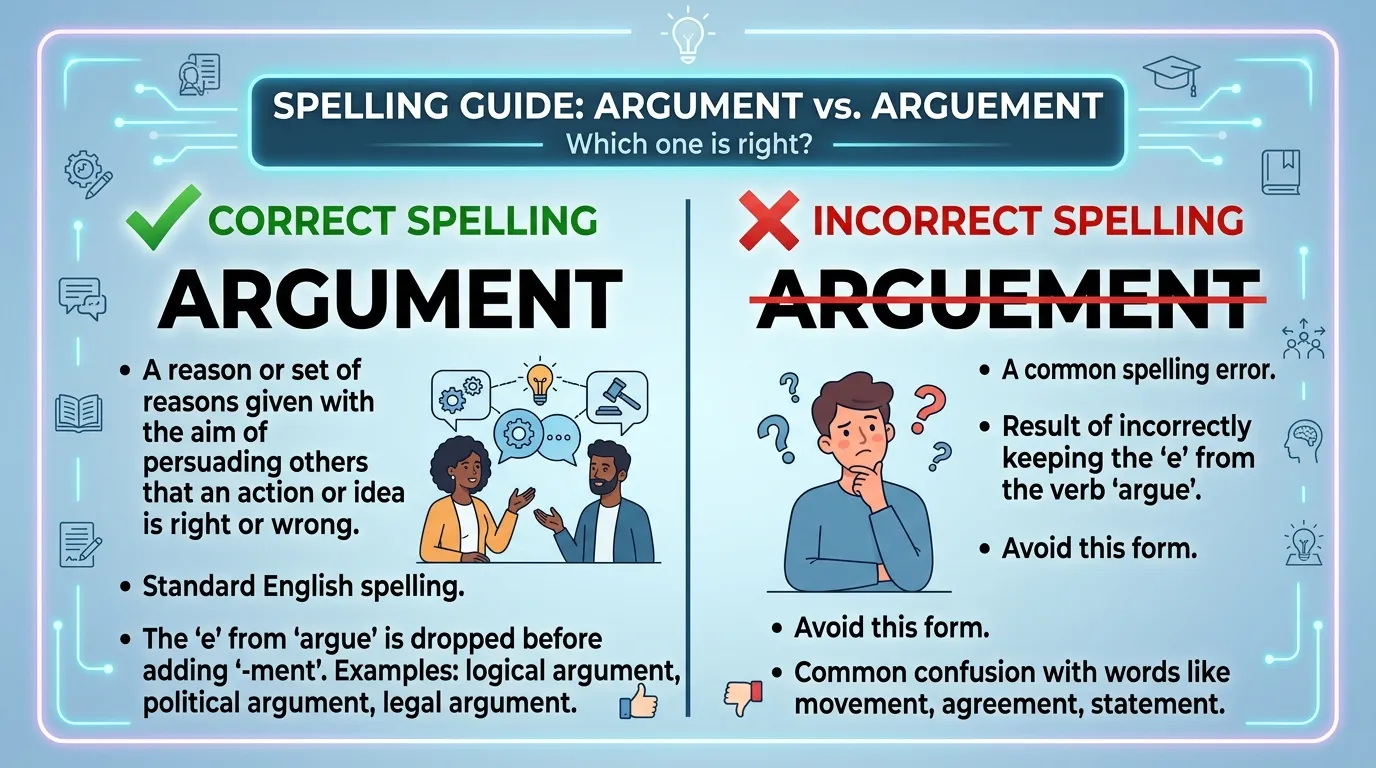
If you have ever written arguement instead of argument, you are not alone. The two spellings look almost identical, and the pronunciation of argument can make the extra e feel natural. However, there is an important difference: argument is the correct spelling, while arguement is a misspelling.
The correct word is argument. It can mean a disagreement between people, a reason or set of reasons supporting an idea, or a formal case presented to persuade someone. The incorrect spelling arguement does not have a separate meaning in standard American English.
This guide explains argument vs arguement in simple terms. You will learn the correct spelling, pronunciation, meaning, grammar, word history, common mistakes, usage differences, memory tricks, examples, synonyms, related words, and practical ways to avoid this spelling error in everyday, academic, professional, and online writing.
Quick Answer: Argument or Arguement?
Argument is the correct spelling.
Arguement is incorrect.
| Spelling | Correct? | Meaning |
|---|---|---|
| argument | Yes | A disagreement, reason, or case supporting an idea |
| arguement | No | Common misspelling of argument |
Correct examples
- We had an argument about money.
- Her argument was supported by strong evidence.
- The lawyer presented a convincing argument.
- His main argument is easy to understand.
Incorrect example
- We had an arguement about the decision.
The corrected version is:
- We had an argument about the decision.
If your goal is writing accuracy, remember one simple rule:
Argument has no e after the u.
What Does Argument Mean?
The noun argument has several related meanings. Its meaning depends on the context.
Argument as a disagreement
An argument can be a disagreement between two or more people.
For example:
Sarah had an argument with her brother.
Here, argument means a verbal disagreement or conflict.
It does not necessarily mean that people are physically fighting. An argument can involve raised voices, opposing opinions, frustration, or a serious disagreement.
Argument as a reason or point
An argument can also mean a reason used to support an opinion or conclusion.
For example:
The writer made a strong argument for better public transportation.
Here, the word does not describe a fight. It describes a reasoned case supporting an idea.
Argument in academic writing
In academic writing, an argument is usually a position or claim supported by evidence and reasoning.
For example:
The essay presents an argument that regular exercise improves concentration.
A good academic argument normally includes:
- A clear claim
- Supporting evidence
- Logical reasoning
- Relevant examples
- A conclusion
This meaning is especially important for students because argument is common in essays, research papers, debates, and analytical writing.
Argument in law
In legal writing, an argument is a reasoned case presented to support a legal position.
For example:
The attorney presented a detailed argument before the court.
Legal arguments may rely on evidence, laws, previous decisions, and logical interpretation.
Why Do People Spell Argument as Arguement?
The spelling arguement is a common error because English spelling does not always match pronunciation perfectly.
The confusion often comes from the word argue.
You may naturally think:
argue → arguement
But English does not form the noun that way.
The correct pattern is:
argue → argument
The word changes slightly when the noun is formed. The final e in argue does not remain before the suffix in the same way that many writers expect.
This creates a visual trap:
- argue
- argued
- arguing
- argument
The first three forms make the spelling argu- familiar, while the noun has the shorter form argument.
Another reason for the mistake is pronunciation. In normal speech, argument may sound as though there is an additional vowel after the u. This can encourage writers to insert an e when spelling the word.
Argument vs Arguement: The Key Difference
The most important difference is simple:
Argument is a real English word. Arguement is not the standard spelling of that word.
There is therefore no difference in meaning between the two spellings.
| Feature | Argument | Arguement |
|---|---|---|
| Standard English word | Yes | No |
| Correct spelling | Yes | No |
| Used in formal writing | Yes | No |
| Used in academic writing | Yes | No |
| Used in business writing | Yes | No |
| Used in journalism | Yes | No |
| Can mean disagreement | Yes | No |
| Can mean reason or case | Yes | No |
| Recommended spelling | Yes | Never |
This is different from word pairs such as color and colour, where both spellings are accepted in different English varieties.
With argument vs arguement, there is no comparable regional spelling distinction.
Argument: Dictionary-Style Definition
Argument is a noun.
A practical dictionary-style definition is:
Argument: A disagreement between people, or a reason, claim, or set of reasons used to support a particular idea or conclusion.
Main senses of argument
Sense 1: A disagreement
The couple had an argument over the schedule.
Sense 2: A reason supporting an opinion
She gave a strong argument against the proposal.
Sense 3: A structured case
The scientist developed an argument based on years of research.
Sense 4: A mathematical or technical input
In some technical contexts, argument has a specialized meaning. For example, in mathematics and programming, an argument can refer to a value supplied to a function.
For example:
The function takes two arguments.
This technical meaning is completely different from a heated disagreement.
Is Arguement Ever Correct?
No. Arguement is not the standard correct spelling of the noun argument.
If you are writing in American English, British English, Canadian English, Australian English, or another standard variety of English, use:
argument
Do not use:
arguement
This is a spelling error rather than a regional variation.
What about dictionaries?
Standard English dictionaries list argument, not arguement, as the correct noun.
You may encounter arguement online, in informal messages, social media posts, student writing, comments, or user-generated content. Its appearance in these places does not make it a correct spelling.
How to Pronounce Argument
The pronunciation of argument can contribute to the spelling mistake.
In American English, it is commonly pronounced approximately as:
AR-gyuh-mənt
The first syllable is stressed.
The word is generally pronounced with three syllables:
ar-gu-ment
The ending sounds like mənt, rather than clearly sounding like the word meant.
Why pronunciation causes spelling confusion
When people say the word quickly, the middle vowel can be reduced. As a result, the pronunciation does not always provide a clear guide to the spelling.
This is a useful reminder:
Do not spell argument based only on how it sounds.
Instead, remember its standard written form:
argument
Argument as a Noun
Argument is primarily a countable noun, although usage depends on context.
Countable use
When referring to a particular disagreement or a particular reason, it is commonly countable.
Examples:
- We had an argument yesterday.
- She presented three arguments.
- His strongest argument concerned cost.
- They had several arguments during the meeting.
Common noun phrases
You will often see:
- a strong argument
- a weak argument
- a convincing argument
- a logical argument
- a reasonable argument
- a valid argument
- a compelling argument
- a persuasive argument
- a detailed argument
- a legal argument
- a political argument
- an academic argument
Argument vs Arguing
Another source of confusion is the difference between argument and arguing.
Argument is a noun.
Arguing is the present participle or gerund form of argue.
Compare:
Their argument lasted an hour.
They were arguing for an hour.
The first sentence refers to the disagreement itself.
The second describes the activity.
Related forms
| Word | Part of Speech | Example |
|---|---|---|
| argue | Verb | They argue about politics. |
| argued | Verb | They argued yesterday. |
| arguing | Verb/gerund | They are arguing again. |
| argument | Noun | Their argument was serious. |
Notice that argument is spelled differently from what you might expect from argue.
Argument vs Debate
These words are related but not identical.
An argument can be a disagreement between individuals. It can also be a structured case supporting a position.
A debate is usually a more organized exchange of opposing views.
Compare:
The two friends had an argument about the movie.
The candidates participated in a debate about education.
A debate can contain arguments, but not every argument is a debate.
Argument vs Discussion
A discussion is usually a conversation in which people exchange ideas or information.
An argument can involve disagreement or an attempt to persuade.
For example:
We had a discussion about the new policy.
This sounds neutral.
We had an argument about the new policy.
This suggests conflict or disagreement.
However, argument in academic contexts can also be neutral:
The article develops an argument about economic inequality.
Here, there is no suggestion of anger.
Argument vs Disagreement
A disagreement means that people do not share the same opinion.
An argument can describe that disagreement, especially when it becomes more intense.
For example:
We had a disagreement about the budget.
This sounds relatively neutral.
We had an argument about the budget.
This may suggest a more emotional exchange.
The exact difference depends on context and tone.
Argument in Formal and Informal Writing
The word argument works in both formal and informal English.
Informal examples
We got into an argument about where to eat.
I don’t want to start an argument.
They had a silly argument over the game.
Formal examples
The study presents a strong argument for reform.
The author develops a persuasive argument throughout the paper.
The evidence supports the central argument.
The word itself does not sound overly formal. Its meaning and surrounding vocabulary determine the tone.
Argument in Academic Writing
Argument is one of the most important words in academic English.
Students are often asked to:
- Make an argument
- Support an argument
- Develop an argument
- Present an argument
- Defend an argument
- Challenge an argument
- Evaluate an argument
- Strengthen an argument
- Refute an argument
- Explain an argument
Natural academic examples
The author presents a convincing argument.
The evidence strengthens the central argument.
This example challenges the author’s argument.
The conclusion reinforces the main argument.
Less natural example
The author makes a very fighting argument.
This sounds unnatural because fighting does not normally describe an academic argument in this way.
A better choice is:
The author makes a strong argument.
Argument in Business Writing
In professional communication, argument can describe reasoning used to support a business decision.
For example:
Her argument for expanding the service was based on customer demand.
The manager presented a strong argument for changing the schedule.
In business settings, alternatives such as case, reasoning, rationale, and position may sometimes sound more professional depending on the context.
Compare:
He made an argument for hiring another employee.
He presented a business case for hiring another employee.
The second version can sound more formal and decision-oriented.
Argument in Journalism
Journalists and commentators frequently use argument when discussing positions or claims.
Examples include:
The editorial presents a strong argument for reform.
Critics rejected the argument that the policy would reduce costs.
The debate centered on competing arguments about public spending.
In this context, argument usually refers to reasoning rather than a personal fight.
Argument in Politics
Political writing commonly uses argument to describe competing positions.
Examples:
The senator’s main argument focused on economic growth.
Opponents challenged that argument.
The campaign built its argument around public safety.
The word can also refer to political disagreements:
The two candidates had a heated argument during the discussion.
Context determines whether argument means a reasoned position or an angry disagreement.
Argument in Sports
Sports writing can use argument when describing disputes.
For example:
The coach had an argument with the referee.
The players got into an argument after the match.
Sports commentators may also use argument in its reasoning sense:
There is a strong argument that the team needs a better defense.
So the word works naturally in both senses.
Argument in Technical and Computer Writing
The word argument has an important technical meaning in mathematics and programming.
In programming, an argument is generally a value supplied to a function or method.
For example:
The function accepts a string argument.
In mathematics, an argument can also have specialized meanings depending on the field.
This is a useful example of how context changes meaning without changing spelling.
Whether you are discussing a disagreement, an academic claim, or a programming value, the spelling remains:
argument
Never arguement.
Argument Word History and Etymology
The word argument has a long history in English.
It ultimately comes through French and Latin. Its development is connected with the Latin argumentum, meaning evidence, proof, or a reason.
The word entered English in the medieval period and developed several related meanings.
Historically, the idea of an argument was strongly connected with reasoning and evidence. Over time, the word also became associated with disagreement and verbal conflict.
This explains why modern English has two major everyday meanings:
- A reason or case supporting an idea
- A disagreement between people
These meanings may seem different, but both involve opposing or supporting positions.
Synonyms for Argument
The best synonym depends on the meaning.
When argument means disagreement
Possible synonyms include:
- disagreement
- dispute
- quarrel
- conflict
- altercation
- confrontation
- row
- squabble
These words do not have exactly the same tone.
For example, squabble often suggests a small or unimportant disagreement, while dispute can sound more formal.
When argument means reasoning
Possible synonyms include:
- case
- reasoning
- claim
- position
- rationale
- justification
- explanation
- contention
- point
- assertion
Again, context matters.
You should not automatically replace argument with one of these words because their meanings can differ.
Antonyms and Contrasting Words
There is no single perfect antonym for argument because the word has multiple meanings.
When argument means disagreement, contrasting words may include:
- agreement
- harmony
- cooperation
- consensus
- understanding
For example:
Their argument ended in agreement.
When argument means a reasoned case, possible contrasting ideas include:
- concession
- uncertainty
- silence
- withdrawal
These are contextual rather than strict dictionary antonyms.
Common Collocations With Argument
A collocation is a combination of words that naturally appear together.
Learning collocations can make your writing sound more natural.
Common examples include:
- strong argument
- weak argument
- valid argument
- logical argument
- convincing argument
- compelling argument
- persuasive argument
- central argument
- main argument
- key argument
- legal argument
- political argument
- academic argument
- heated argument
- bitter argument
- pointless argument
- serious argument
- verbal argument
Common verb combinations
You can:
- make an argument
- present an argument
- develop an argument
- support an argument
- strengthen an argument
- challenge an argument
- defend an argument
- reject an argument
- refute an argument
- accept an argument
- advance an argument
Common Expressions With Argument
Several everyday expressions contain argument.
Have an argument
They had an argument after dinner.
Get into an argument
I don’t want to get into an argument.
Start an argument
That comment could start an argument.
Win an argument
She eventually won the argument.
Lose an argument
He realized he had lost the argument.
Make an argument
The writer makes a strong argument for reform.
Build an argument
The evidence helps build a convincing argument.
These expressions are all spelled with argument, never arguement.
Common Spelling Mistakes With Argument
Mistake: arguement
Incorrect:
The writer presented a strong arguement.
Correct:
The writer presented a strong argument.
Mistake: arguemental
Writers sometimes create additional incorrect forms based on arguement.
Instead, use the correct related words such as:
argumentative
For example:
His tone became argumentative.
Mistake: argumentation spelled from arguement
The correct word is:
argumentation
Not:
arguementation
Mistake: assuming every form keeps the e
English word formation does not always work by simply adding letters to the original word.
For example:
argue → argument
not:
argue → arguement
This is why memorizing the noun form is useful.
Awkward vs Natural Examples
| Awkward or Incorrect | Natural and Correct |
|---|---|
| We had an arguement. | We had an argument. |
| Her arguement was convincing. | Her argument was convincing. |
| The essay has a strong arguement. | The essay has a strong argument. |
| They started an arguement. | They started an argument. |
| His main arguement was unclear. | His main argument was unclear. |
| The lawyer made a legal arguement. | The lawyer made a legal argument. |
| The article supports this arguement. | The article supports this argument. |
The problem in each example is spelling, not meaning.
How to Remember the Correct Spelling
Here are several easy memory tricks.
Memory trick 1: Think of “argument” as the shorter form
Remember:
argue → argument
The noun drops the final e.
Memory trick 2: No extra E
Use this simple phrase:
An argument has no extra E.
When you type arguement, stop and remove the e.
Memory trick 3: Compare the word visually
Correct:
A R G U M E N T
Incorrect:
A R G U E M E N T
The incorrect version inserts an extra E after U.
Memory trick 4: Learn it as a fixed spelling
Instead of trying to construct the word every time, memorize:
argument
This is especially useful for students, ESL learners, bloggers, and anyone who frequently writes essays.
How to Improve Your Spelling Accuracy
If arguement is a recurring mistake, try these practical methods.
Read the correct word often
Seeing argument repeatedly helps build visual familiarity.
Use word families
Learn these together:
- argue
- argued
- arguing
- argument
- argumentative
- argumentation
This makes the relationship between the words easier to remember.
Check before publishing
If you are writing an essay, article, email, report, or business document, search your document for:
arguement
If you find it, replace it with:
argument
Build a personal spelling list
If you regularly confuse particular English words, keep a short list.
For example:
- argument, not arguement
- separate, not seperate
- definitely, not definately
- necessary, not neccessary
- receive, not recieve
Repeated exposure can gradually eliminate these mistakes.
Argument vs Arguement for American English
For American English, the recommendation is straightforward:
Always use argument.
The spelling arguement is not an accepted American variant.
This applies to:
- School assignments
- College essays
- Emails
- Business reports
- Websites
- Blog posts
- Resumes
- Cover letters
- News writing
- Technical documents
- Social media posts
- Professional communication
Even in casual writing, arguement should be considered a spelling error.
Argument vs Arguement in British English
British English also uses:
argument
There is no standard British spelling arguement.
Therefore, unlike differences such as colour/color or centre/center, this is not an American-versus-British spelling issue.
International English
The same recommendation applies to standard international English:
argument is correct.
Is Argument Formal or Informal?
Argument is neutral.
It can appear in casual conversation:
We had an argument.
It can appear in formal writing:
The researcher develops a persuasive argument.
Its register depends heavily on the surrounding words and context.
For example:
They had a stupid argument over dinner.
This is casual.
The report presents a compelling argument for institutional reform.
This is formal.
Argumentative: A Related Word
Argumentative is an adjective related to argument.
It usually describes someone who likes to argue or a tone that seems confrontational.
Examples:
He became argumentative during the meeting.
Her argumentative tone made the discussion difficult.
Do not confuse argumentative with argument.
An argument can be calm and logical, while argumentative often suggests a tendency to challenge or disagree.
Argumentation: Another Related Word
Argumentation is a noun referring to the process or practice of forming and presenting arguments.
It is more formal than everyday argument.
Example:
The course focuses on persuasive argumentation.
You are more likely to see argumentation in academic, legal, rhetorical, or specialized contexts.
Common Search Questions About Argument vs Arguement
People who search for argument vs arguement, arguement meaning, or how to spell argument are usually trying to solve the same basic problem: they want to know whether the extra e belongs in the word.
It does not.
The correct spelling is:
argument
If you see arguement, treat it as a spelling error unless you are specifically discussing or reproducing someone else’s mistake.
Quick Accuracy Checklist
Before submitting your writing, ask:
- Did I spell the word argument?
- Did I accidentally write arguement?
- Am I using argument as a noun?
- Does the context mean a disagreement or a reasoned case?
- Would another word such as discussion, debate, or disagreement be more precise?
- If the writing is academic, have I supported my argument with evidence?
- If the writing is professional, is my argument clear and logical?
This quick check can prevent a surprisingly common spelling error.
Argument vs Arguement: Final Comparison
| Category | Argument | Arguement |
|---|---|---|
| Correct spelling | Yes | No |
| Standard English | Yes | No |
| American English | Yes | No |
| British English | Yes | No |
| Noun | Yes | No |
| Meaning | Disagreement, reason, or case | None as a standard word |
| Academic use | Common | Incorrect |
| Business use | Common | Incorrect |
| Journalism | Common | Incorrect |
| Technical use | Common | Incorrect |
| Recommended for publication | Yes | Never |
Frequently Asked Questions
Is argument or arguement correct?
Argument is correct. Arguement is a misspelling. Use argument in American English, British English, academic writing, professional communication, and casual writing.
Why do people spell argument as arguement?
People often spell argument as arguement because the word comes from argue, and the pronunciation can make an extra vowel sound seem natural. However, the standard noun spelling is argument.
Is arguement a real word?
No. Arguement is not the standard English spelling of a separate word. It is generally a misspelling of argument.
How do you spell argument correctly?
The correct spelling is:
A-R-G-U-M-E-N-T
Remember that there is no extra E after the U.
What is the plural of argument?
The plural is arguments.
For example:
The author presents several strong arguments.
Is argument a noun or a verb?
Argument is a noun. The related verb is argue.
For example:
They argue about politics.
Their argument lasted an hour.
What is the difference between an argument and a disagreement?
A disagreement means people have different opinions. An argument can describe that disagreement, especially when it becomes more intense. Argument can also mean a reasoned case supporting an idea.
Is argument a formal word?
Argument is a neutral English word. It works in casual conversation, business communication, academic writing, journalism, legal writing, and technical contexts.
How can I remember the spelling of argument?
Remember the phrase no extra E. The correct spelling is argument, not arguement. Learning argue → argument as a word pair can also help.
Is arguement accepted in British English?
No. Argument is the standard spelling in British English as well as American English. Arguement is not a standard regional variant.
Conclusion
When comparing argument vs arguement, there is only one correct standard spelling: argument.
Arguement is a common spelling mistake, not an alternative English word. The error often happens because writers connect the noun too closely with argue or because pronunciation makes an extra vowel seem appropriate.
The easiest rule to remember is simple:
Argument has no extra E after the U.
Use argument when you mean a disagreement, a reason supporting an opinion, an academic position, a legal case, a political point, or even a technical input in programming.
For accurate American English writing, the choice is always:
argument ✅
arguement ❌
Once you memorize the spelling and recognize the relationship between argue and argument, this common error becomes much easier to avoid. Whether you are writing a school essay, professional email, blog post, business report, or casual message, choosing argument will keep your writing clear, polished, and correct.


