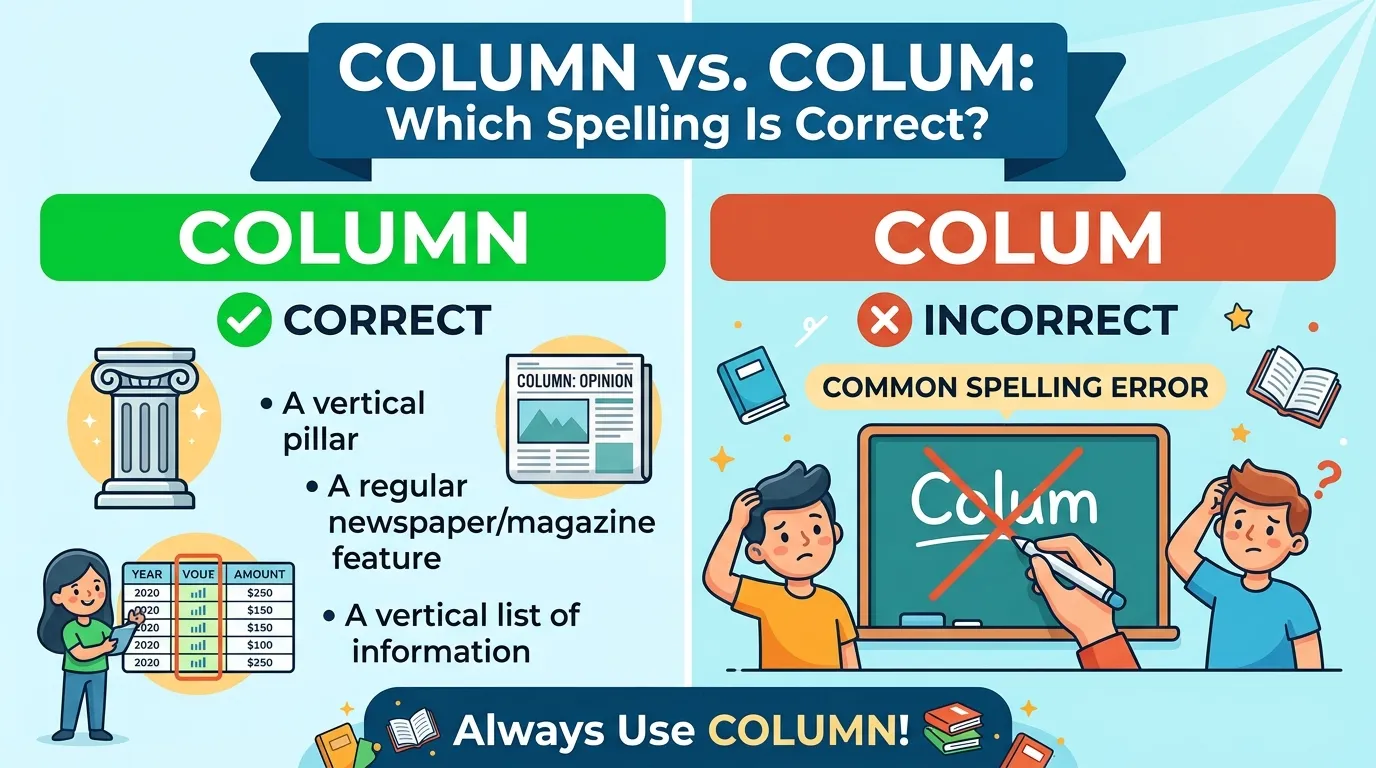
If you are wondering whether the correct spelling is column or colum, the answer is simple: column is the standard English spelling. The word colum is generally a misspelling when you mean the English noun column.
A column can refer to a vertical structure that supports a building, a vertical section in a newspaper or website, a vertical arrangement of information in a table, or a regular article written by a particular writer. The word is common in architecture, journalism, publishing, newspapers, spreadsheets, databases, and everyday English.
The confusion happens mainly because the n in column is not pronounced. English learners may hear something like KOL-um and naturally spell the word colum. However, the standard spelling retains the final n.
In this guide, you will learn the difference between column and colum, how to pronounce column, what the word means, why the spelling is confusing, when to use it, and how to avoid common mistakes.
Quick Answer: Column vs Colum
Column is the correct standard English spelling when you mean a vertical structure, section, list, or recurring article.
Colum is not normally a correct spelling of the English word column. It may appear as a proper name in some contexts, but it should not replace column in ordinary English writing.
| Word | Standard English word? | Meaning |
|---|---|---|
| Column | ✅ Yes | A vertical structure, section, arrangement, or article |
| Colum | ❌ Usually no | Generally a misspelling of column |
| Colum as a name | ✅ In some contexts | A personal name, especially in Irish usage |
Correct examples
- Please add a new column to the spreadsheet.
- The building has six marble columns.
- She writes a weekly newspaper column.
- The figures appear in the second column.
- The newspaper published his latest column yesterday.
Incorrect examples when referring to the English noun
- Please add a new colum to the spreadsheet. ❌
- She writes a weekly newspaper colum. ❌
- The building has several stone colums. ❌
The easiest rule is:
If you mean the English word for a vertical section, structure, or article, spell it column.
What Does Column Mean?
The noun column has several related meanings. Its basic idea is something arranged or extending vertically.
Column as a physical structure
In architecture, a column is a vertical support used to hold up part of a building or structure.
For example:
- The entrance was surrounded by tall stone columns.
- The ancient temple had rows of marble columns.
- The architect designed four concrete columns for the front of the building.
A column may be decorative, structural, or both.
Column in a table or spreadsheet
A column can also mean a vertical series of information.
For example, in a spreadsheet, names might appear in one column while phone numbers appear in another.
| Name | Age | City |
|---|---|---|
| James | 28 | Boston |
| Maria | 34 | Chicago |
| Daniel | 41 | Seattle |
In this example:
- Name is a column.
- Age is a column.
- City is a column.
The information running horizontally is usually called a row.
Column in newspapers and magazines
A column can be a regular article or feature written by a particular person.
For example:
- She writes a political column for the newspaper.
- His sports column appears every Monday.
- I always read her technology column.
- The editor rejected the proposed column.
A columnist may write about politics, sports, business, entertainment, culture, food, technology, or personal experiences.
What Does Colum Mean?
In ordinary English, colum is generally not the standard spelling of the word meaning a vertical structure, newspaper feature, or vertical section of information.
If you write:
Add another colum to the table.
the reader will usually understand what you mean, but the spelling is considered incorrect.
The correct version is:
Add another column to the table.
There is an important exception: Colum can be a personal name.
For example, Colum is found as a given name in Irish contexts. Therefore, seeing Colum does not automatically mean that someone has made a spelling mistake.
The distinction depends on context:
- column = the ordinary English noun
- Colum = potentially a person’s name
Why Do People Confuse Column and Colum?
The biggest reason is pronunciation.
The word column is usually pronounced:
/ˈkɑːləm/ in American English
It sounds approximately like:
KOL-um
The final n is silent.
This creates a spelling problem because English spelling and pronunciation do not always match perfectly.
Someone who hears column may think:
“It sounds like colum, so perhaps it is spelled colum.”
But the standard spelling is column.
This is similar to other English words where letters are written but not pronounced.
Examples include:
- autumn → the n is silent
- solemn → the n is silent
- hymn → the n is silent
- column → the n is silent
The spelling column preserves the historical form of the word even though modern pronunciation does not pronounce the final n.
Column vs Colum: Key Differences
The most important difference is that column is the standard English noun, while colum is generally not.
| Feature | Column | Colum |
|---|---|---|
| Standard English noun | ✅ Yes | ❌ No |
| Refers to a vertical structure | ✅ Yes | ❌ No |
| Refers to a spreadsheet section | ✅ Yes | ❌ No |
| Refers to a newspaper article | ✅ Yes | ❌ No |
| Final n pronounced | ❌ No | Not applicable |
| Can be a personal name | Sometimes as a surname/name | ✅ Yes, in some contexts |
| Common in formal writing | ✅ Yes | ❌ Not as the noun |
| Correct spelling for ordinary usage | ✅ Yes | ❌ No |
How Do You Pronounce Column?
Column is pronounced approximately:
KAH-lum
American English pronunciation:
/ˈkɑːləm/
British English commonly uses:
/ˈkɒləm/
The important point is that the n is silent.
Is the N in Column Silent?
Yes.
You do not normally pronounce column as:
KOL-umn ❌
Instead, it sounds like:
KOL-um ✅
The silent n is one of the main reasons people misspell the word.
Column vs Colon Pronunciation
Do not confuse column with colon.
- column → KOL-um
- colon → KOH-lən
A colon is the punctuation mark :.
A column is a vertical structure, section, or arrangement.
For example:
Put the figures in the first column.
versus:
Use a colon before the list.
Column as a Noun
The most common grammatical role of column is as a noun.
It can describe a physical object:
The column supports the roof.
It can describe information:
The address is in the third column.
It can describe journalism:
I read her column every week.
The plural is:
columns
Notice that the plural still contains the n:
one column
two columns
The n remains silent in pronunciation.
Can Column Be Used as a Verb?
Yes, although column is overwhelmingly more common as a noun.
In specialized contexts, related forms such as columned and columnar are more common when describing structures or arrangements.
For example:
The hall is columned with large stone supports.
However, in ordinary writing, you will usually encounter column as a noun.
Common Meanings of Column
The word column has several important meanings.
Architectural column
A vertical support in a building:
The entrance has twelve white columns.
Newspaper column
A recurring article written by a columnist:
Her latest column discusses education reform.
Spreadsheet column
A vertical group of cells:
Select the entire column before sorting the data.
Table column
A vertical category of information:
The final column contains the totals.
Military column
A group of people or vehicles arranged in a long formation:
The soldiers moved in a column along the road.
Scientific column
In technical contexts, a column can refer to a vertical arrangement or apparatus.
For example, chromatography uses specialized columns to separate substances.
Architectural or decorative column
A column may also be primarily decorative:
The hotel lobby featured elaborate Corinthian columns.
Column in Journalism
Column is especially important in journalism.
A column is usually a recurring piece of writing associated with a particular writer or viewpoint.
Examples include:
- political column
- sports column
- advice column
- business column
- opinion column
- fashion column
- technology column
- entertainment column
- personal column
A person who writes columns is called a columnist.
Column vs Article
These words are related but not identical.
An article is a broad term for a piece of writing published in a newspaper, magazine, website, or other publication.
A column is often a recurring feature associated with a particular writer, subject, style, or viewpoint.
For example:
The newspaper published an article about the election.
But:
The political columnist discussed the election in her weekly column.
A column may be an article, but not every article is a column.
Column in Business Writing
In business settings, column is extremely common.
You may see the word in:
- financial reports
- spreadsheets
- invoices
- databases
- charts
- accounting documents
- sales reports
- inventory systems
- data tables
Examples:
Enter the customer’s name in the first column.
The revenue column shows monthly totals.
Add a column for projected expenses.
Sort the table by the final column.
In professional writing, always use column, not colum.
Column in Technical and Academic Writing
The word column is also common in technical fields.
Data science
A dataset may contain multiple columns representing different variables.
The age column contains numerical values.
Databases
Database tables are made up of columns and rows.
Create a new column for the customer’s registration date.
Chemistry
A column can refer to specialized laboratory equipment.
The sample was passed through a chromatography column.
Engineering
Engineers may use column for a vertical structural member.
The steel column must support the specified load.
Publishing
A page can be divided into columns to improve readability.
The report uses two columns on each page.
Column in Sports
The word column can appear in sports statistics.
For example:
Check the goals column for the latest totals.
Sports newspapers may also publish sports columns written by regular commentators.
You might see phrases such as:
- sports column
- statistics column
- standings column
- opinion column
- baseball column
- football column
The spelling remains column in every case.
Column in Political Writing
A political column is a regular newspaper, magazine, or online feature discussing politics.
For example:
The columnist criticized the government’s latest proposal.
Political columns often contain analysis, commentary, interpretation, or opinion rather than straightforward reporting.
Related terms include:
- political columnist
- opinion column
- editorial column
- newspaper column
- syndicated column
Again, colum would be incorrect when referring to this type of writing.
Column vs Row
One of the most common vocabulary questions involves column vs row.
A column runs vertically.
A row runs horizontally.
Think of a spreadsheet:
| Product | Price | Quantity |
|---|---|---|
| Notebook | $5 | 10 |
| Pen | $2 | 20 |
The vertical groups are columns.
The horizontal groups are rows.
Easy memory trick
Think:
Column = up and down
Row = across
This distinction is useful in spreadsheets, tables, databases, statistics, and data analysis.
Column vs Line
These words are also sometimes confused.
A line is a general term for a narrow or continuous mark or arrangement.
A column is specifically associated with vertical organization or a structural vertical form.
For example:
Write your name on the first line.
But:
Put your name in the first column.
The context determines which word is appropriate.
Column vs Pillar
In architecture, column and pillar can overlap in meaning.
A pillar is generally a vertical structural support.
A column can also be a vertical support, but the word often carries a more specific architectural or stylistic meaning.
For example:
Massive pillars supported the bridge.
versus:
The Greek temple had elegant marble columns.
In casual conversation, these terms may sometimes be interchangeable, but technical architectural writing may distinguish them more carefully.
Column vs Vertical Section
In everyday and technical writing, column is often the most natural term for a vertical section of information.
Instead of:
Put the data into the vertical section on the right.
you would usually write:
Put the data into the right-hand column.
The shorter word is more precise and natural.
Column: Dictionary-Style Definition
Column (noun)
Pronunciation: /ˈkɑːləm/ in American English
Definition 1
A vertical structural element used to support part of a building.
Example:
The entrance is supported by four stone columns.
Definition 2
A vertical division or series of information in a table, spreadsheet, or database.
Example:
The total appears in the last column.
Definition 3
A regular article or feature written by a particular person for a newspaper, magazine, or website.
Example:
Her weekly column focuses on personal finance.
Definition 4
A group of people, vehicles, or objects arranged in a vertical or elongated formation.
Example:
A column of soldiers moved through the valley.
Definition 5
A specialized vertical arrangement or apparatus in a technical or scientific setting.
Example:
The laboratory uses a chromatography column.
Word History and Etymology of Column
The history of column helps explain why its spelling looks different from its pronunciation.
The English word developed through French from Latin columna, meaning a pillar or column.
The Latin form was associated with a vertical support or pillar. Over time, the word entered English and developed into the modern spelling column.
The pronunciation changed as English developed, but the written form retained the historical n.
This is why English has a situation where:
spelling: column
pronunciation: KOL-um
The silent letter is therefore not random. It reflects the word’s historical development.
Related Words for Column
Several English words are closely connected to column.
Columnist
A person who regularly writes a column.
The columnist published her latest opinion piece.
Columnar
An adjective meaning shaped like or arranged in columns.
The rock has a distinctive columnar structure.
Columned
Having columns or being supported by columns.
The columned entrance looked impressive.
Colonnade
A row of columns supporting a structure, often with a roof or entablature.
Visitors walked through the stone colonnade.
Synonyms for Column
The best synonym depends on the meaning.
For a structural column
- pillar
- support
- post
- shaft
For a newspaper column
- feature
- article
- commentary
- opinion piece
- regular feature
For a data column
There may not be a perfect one-word synonym, but related terms include:
- field
- category
- vertical section
- data field
Be careful: these words are not always exact substitutes.
Antonyms of Column
There is no single universal antonym for column because the word has several meanings.
In data organization, row can serve as a contrasting term:
The value appears in the fourth column and second row.
In architecture, however, there is no simple direct antonym.
This is a good example of why dictionaries define words according to their different senses rather than forcing one opposite onto every use.
Common Collocations With Column
A collocation is a group of words that commonly appear together.
Common collocations include:
- newspaper column
- newspaper columnist
- opinion column
- political column
- sports column
- advice column
- personal column
- data column
- spreadsheet column
- database column
- column heading
- column width
- column number
- column chart
- column layout
- column format
- stone column
- marble column
- concrete column
- supporting column
- vertical column
Example sentences
The newspaper introduced a new opinion column.
Increase the column width so the text fits.
The spreadsheet has twenty columns.
The architect added decorative columns to the entrance.
Common Phrases With Column
Here are some natural phrases using column:
A column of numbers
The accountant checked a column of numbers.
A column of smoke
A column of smoke rose above the building.
Here, column describes something extending vertically.
A column of soldiers
A column of soldiers marched toward the city.
A newspaper column
I read his newspaper column every Sunday.
A column chart
The report includes a column chart showing annual sales.
Is Colum Ever Correct?
Yes, but context matters.
Colum can be a personal name. In that situation, it should not be corrected to column.
For example:
Colum attended the meeting.
Here, Colum is a person’s name.
However:
Add another colum to the spreadsheet.
is not standard English.
The correct sentence is:
Add another column to the spreadsheet.
Therefore, the question is not simply whether colum can ever appear in English. It can. The important question is whether it is the correct spelling for the word you intend.
Common Mistakes With Column
Mistake 1: Writing colum
Incorrect:
The table has five colums.
Correct:
The table has five columns.
Mistake 2: Pronouncing the N
Less natural:
KOL-umn
Standard:
KOL-um
The spelling contains n, but the n is silent.
Mistake 3: Confusing column with row
Incorrect understanding:
A column runs from left to right.
Correct:
A column generally runs from top to bottom.
Mistake 4: Using article when column is intended
Less precise:
She writes a regular newspaper article every week.
More precise:
She writes a weekly newspaper column.
An article is a broad category, while a column often refers to a recurring feature.
Mistake 5: Forgetting the N in plural
Incorrect:
The spreadsheet has ten colums.
Correct:
The spreadsheet has ten columns.
Awkward vs Natural Examples
Example 1
Awkward:
Put the information in the second colum.
Natural:
Put the information in the second column.
Example 2
Awkward:
The article appeared in her newspaper colum.
Natural:
The article appeared in her newspaper column.
Example 3
Awkward:
This table contains three colums.
Natural:
This table contains three columns.
Example 4
Awkward:
The building has eight marble colums.
Natural:
The building has eight marble columns.
Formal vs Informal Usage
There is no informal version of column that should replace the standard spelling.
Whether you are writing a text message or a formal report, the correct spelling is still:
column
For example:
Casual:
Check the last column.
Professional:
Please enter the revised figures in the final column.
Academic:
The results are presented in the third column of Table 2.
The tone changes, but the spelling does not.
Column in American English vs British English
The spelling column is standard in both American and British English.
There is no major regional spelling difference comparable to pairs such as:
- color / colour
- center / centre
- organize / organise
Both American and British English use:
column
Pronunciation can vary slightly between the two varieties, but the spelling remains the same.
American English
Often approximately:
/ˈkɑːləm/
British English
Often approximately:
/ˈkɒləm/
In both varieties, the final n is silent.
Column in Academic Writing
Column is perfectly appropriate in academic writing.
Use it when discussing:
- tables
- figures
- statistical results
- databases
- research data
- newspaper analysis
- architecture
- scientific apparatus
Examples:
The values in the fourth column indicate the percentage change.
The first column lists the participants’ ages.
Academic writers should avoid the misspelling colum, particularly because spelling errors can make otherwise strong work appear careless.
Column in Blogging and Digital Content
Bloggers frequently use column when discussing layouts, tables, or recurring opinion pieces.
Examples:
The sidebar occupies a narrow column.
Divide the page into two columns.
Her new blog column focuses on travel.
When writing for the web, correct spelling matters because readers may interpret repeated spelling mistakes as a sign of poor editing or low-quality content.
Column in Casual Writing
Even casual writers should use column.
For example:
Which column is the total in?
I can’t find the last column.
The newspaper has a funny new column.
The word is common enough that there is no reason to replace it with a shorter spelling.
Memory Trick: How to Remember Column
A simple trick is:
Think of the silent N
Remember:
columN
The N is written but not spoken.
You can connect it with other words containing silent n:
- autumn
- solemn
- hymn
- column
Another memory trick is:
A column has an N even though you don’t hear it.
If you are typing a spreadsheet instruction, newspaper description, or architectural sentence, stop yourself before writing colum and remember the hidden N.
How to Spell Column Correctly
Break the word into its written parts:
C-O-L-U-M-N
Then remember:
COLUMN
Not:
C-O-L-U-M
A useful visual memory is:
COL + UM + N = COLUMN
You do not pronounce the final n, but you write it.
Is Column a Commonly Misspelled Word?
Yes. Because of its pronunciation, column can be confusing for learners and native speakers alike.
The silent n creates a mismatch between what people hear and what they write.
Common incorrect forms may include:
- colum
- colomn
- colmun
- collumn
- columm
The correct spelling is:
column
Its plural is:
columns
Practical Recommendations
If you are unsure which form to use, follow these rules:
- Use column for a vertical section of a table.
- Use column for a spreadsheet category.
- Use column for a newspaper or magazine feature.
- Use column for an architectural support.
- Use column for a vertical formation.
- Use column in technical and scientific contexts when appropriate.
- Use column in formal and informal writing.
- Remember that the final n is silent.
- Use Colum only when it is intentionally being used as a proper name or another context-specific term.
Column vs Colum: Final Comparison
| Question | Column | Colum |
|---|---|---|
| Is it the standard English spelling? | ✅ Yes | ❌ Usually no |
| Is it used for spreadsheets? | ✅ Yes | ❌ No |
| Is it used for newspaper features? | ✅ Yes | ❌ No |
| Is it used for architectural supports? | ✅ Yes | ❌ No |
| Is the N pronounced? | ❌ No | — |
| Is it used in American English? | ✅ Yes | Only in special contexts |
| Is it used in British English? | ✅ Yes | Only in special contexts |
| Can it be a name? | Possible | ✅ Yes, in some contexts |
Frequently Asked Questions
Is column or colum correct?
Column is the correct standard English spelling for the noun referring to a vertical structure, vertical section of information, or recurring newspaper feature. Colum is generally a misspelling in these contexts, although Colum can be a personal name.
Why is column spelled with an N?
The spelling column comes from the word’s historical development through French from Latin columna. English retained the historical spelling even though the final n is no longer pronounced.
Is the N silent in column?
Yes. In standard English pronunciation, the n is silent. Column is pronounced approximately KOL-um, rather than KOL-umn.
What is the plural of column?
The plural of column is columns.
For example:
The spreadsheet contains five columns.
The final n remains part of the spelling even though it is not normally pronounced.
Is colum a word?
Colum can occur as a personal name, particularly in Irish contexts. However, it is not the standard spelling of the English noun column.
What is the difference between a column and a row?
A column generally runs vertically, from top to bottom, while a row generally runs horizontally, from left to right. This distinction is especially important in spreadsheets, databases, and tables.
How do you pronounce column?
In American English, column is commonly pronounced approximately KAH-lum, represented by /ˈkɑːləm/. The final n is silent.
Is column spelled differently in British English?
No. Column is spelled the same way in American and British English. The pronunciation may differ slightly, but the spelling does not.
What is a person who writes a column called?
A person who regularly writes a newspaper, magazine, or online column is called a columnist.
For example:
The columnist published her latest political analysis on Monday.
Is column a noun or adjective?
Column is primarily used as a noun. Related adjectives include columnar, meaning arranged like or resembling a column.
Conclusion
When comparing column vs colum, there is a clear winner for standard English writing: column.
Use column when referring to a vertical section of a spreadsheet or table, a structural support in architecture, a recurring newspaper feature, a vertical formation, or a specialized technical structure.
The spelling can be confusing because the final n is silent. Although you hear something like KOL-um, you should still write column.
Remember this simple rule:
Write the N even though you don’t pronounce the N: COLUMN.
Colum should not normally be used as a substitute for column. If you encounter Colum with a capital letter, however, it may be a person’s name rather than a spelling mistake.
For American English, British English, academic writing, business documents, journalism, technical writing, blogging, and everyday communication, column is the standard and safest spelling.


