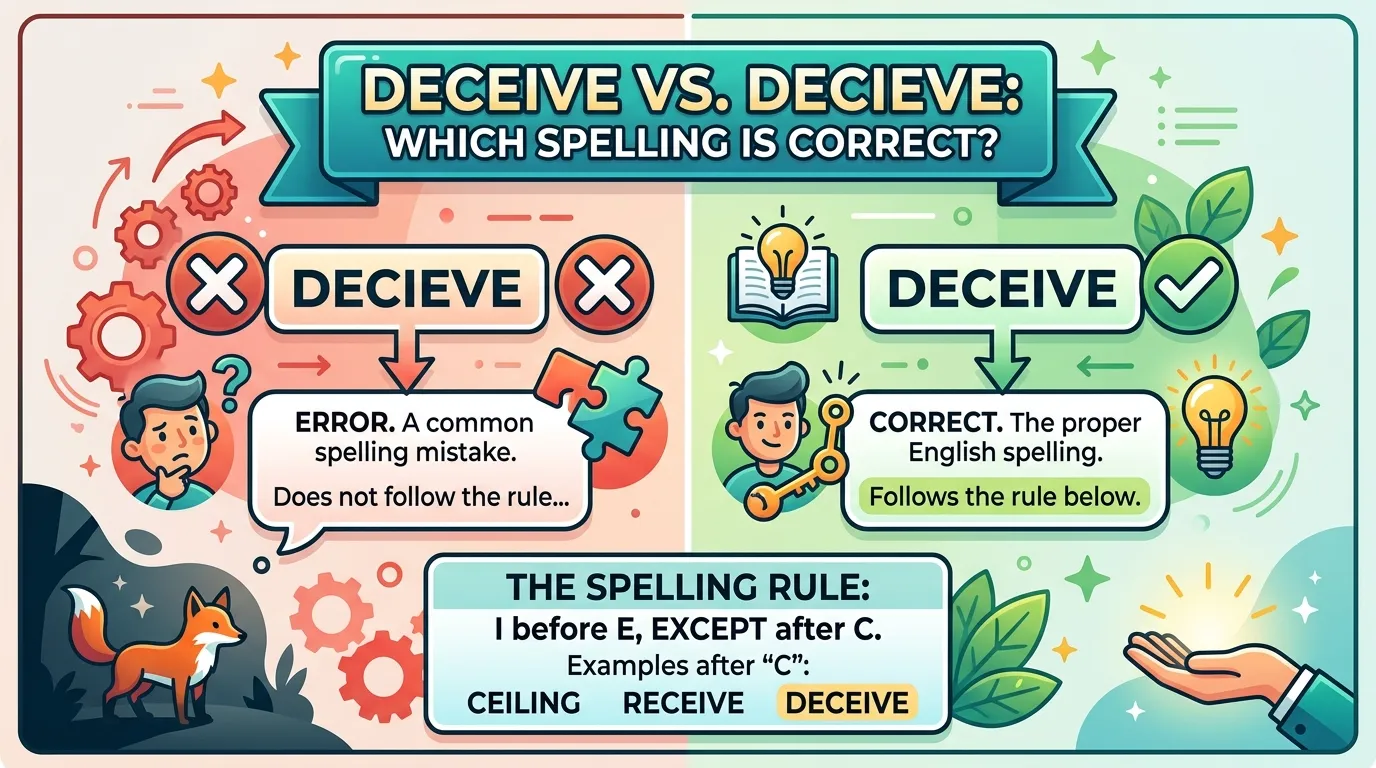
Have you ever typed decieve and wondered whether it looked right? You are not alone. The spelling deceive vs decieve is a common source of confusion because both forms look similar, sound almost identical, and contain the same letters arranged in a slightly different order.
The correct spelling is deceive.
Decieve is a misspelling and should not be used in standard American English, British English, academic writing, business communication, journalism, or formal documents.
The confusion usually happens because English has several words in which ie appears after a consonant, such as believe, field, and piece. However, deceive follows a different spelling pattern: ei after c.
In this guide, you will learn the difference between deceive and decieve, what deceive means, how to pronounce it, why the spelling is confusing, where the word comes from, how to use it naturally, and how to remember the correct spelling permanently.
Quick Answer: Deceive or Decieve?
Deceive is correct. Decieve is incorrect.
| Spelling | Correct? | Meaning |
|---|---|---|
| deceive | ✅ Yes | To deliberately make someone believe something that is not true |
| decieve | ❌ No | Incorrect spelling of deceive |
Correct example
The salesman tried to deceive the customer.
Incorrect example
The salesman tried to decieve the customer.
The easiest way to remember it is:
de + ceive = deceive
Not:
de + cieve = decieve
The ei comes after the c:
deceive → c-e-i-v-e
What Does Deceive Mean?
Deceive is a verb meaning to deliberately cause someone to believe something that is false, misleading, or untrue.
In simple terms, if someone deceives another person, they intentionally lead that person to believe something that is not accurate.
Dictionary-style definition
Deceive
Verb
To deliberately mislead someone or cause someone to believe something false.
The word usually suggests intentional dishonesty. A person who deceives someone generally knows the truth but presents information in a misleading way.
Examples
- He tried to deceive his parents about where he had been.
- The advertisement was designed to deceive customers.
- She realized that her business partner had deceived her.
- The criminal attempted to deceive investigators.
- Do not let appearances deceive you.
The word can describe small acts of dishonesty or much more serious forms of fraud and manipulation.
Why Do People Spell Deceive as Decieve?
The spelling decieve is a common spelling error because English spelling does not always follow one simple rule.
Many English learners remember the familiar pattern:
I before E
This can lead people to write cieve instead of ceive.
For example:
- believe
- achieve
- piece
- field
- chief
These words contain ie.
However, English has many exceptions and special spelling patterns. After c, the correct spelling in deceive is ei.
Compare:
- deceive
- receive
- perceive
- conceive
- ceiling
The spelling pattern is easier to see when these related words are grouped together.
A useful pattern
c + ei + ve
- deceive
- receive
- perceive
- conceive
So when you see c followed by this sound and word pattern, ei may be the spelling you need.
Deceive vs Decieve: The Key Difference
There is actually only one meaningful difference between the two forms:
Deceive is the correct word. Decieve is a spelling mistake.
They are not two different English words with different meanings.
| Feature | Deceive | Decieve |
|---|---|---|
| Standard English word | Yes | No |
| Correct spelling | Yes | No |
| Part of speech | Verb | None |
| Meaning | To mislead or trick | No standard meaning |
| American English | Correct | Incorrect |
| British English | Correct | Incorrect |
| Academic writing | Correct | Incorrect |
| Business writing | Correct | Incorrect |
| Casual writing | Correct | Still incorrect |
Therefore, there is no real meaning difference between deceive and decieve.
The issue is simply correct versus incorrect spelling.
How Do You Pronounce Deceive?
Deceive is usually pronounced:
dih-SEEV
The pronunciation can be represented approximately as:
/dɪˈsiːv/
The stress falls on the second syllable.
Break it into parts
de-ceive
The first part sounds like dih, while the second part sounds like seev.
Example
Don’t let appearances deceive you.
The word deceive rhymes closely with words such as:
- receive
- perceive
- believe
- achieve
However, spelling should not be determined only by pronunciation because several English words can have similar sounds but different spellings.
Is Deceive a Verb?
Yes.
Deceive is a verb.
It describes an action involving misleading, tricking, or causing someone to accept something false.
Common forms of deceive
| Form | Example |
|---|---|
| Base form | deceive |
| Third-person singular | deceives |
| Present participle | deceiving |
| Past tense | deceived |
| Past participle | deceived |
Examples
Present:
He often tries to deceive people.
Third person:
She deceives customers with false promises.
Past tense:
The company deceived its investors.
Present participle:
They were deceiving the public.
Past participle:
He had deceived everyone around him.
Deceive in Different Contexts
The meaning of deceive remains generally consistent, but the context can change the seriousness and tone of the action.
Everyday conversation
In casual situations, deceive can mean simply to fool or mislead someone.
I thought you were joking. You completely deceived me!
However, in everyday conversation, people may use simpler words such as fool, trick, or mislead.
Business
In business writing, deceive can describe deliberate dishonesty involving customers, employees, investors, or competitors.
The company was accused of attempting to deceive customers.
This usage can sound serious and may carry legal or ethical implications.
Academic writing
The word works well in academic writing when discussing misinformation, psychology, ethics, communication, or human behavior.
People may deceive others to protect their social status.
Journalism
Journalists may use deceive when reporting alleged dishonesty.
Investigators said the organization attempted to deceive the public.
In responsible journalism, the wording should distinguish between an established fact and an allegation.
Politics
The word can appear in political discussions when someone is accused of deliberately misleading voters or the public.
Critics accused the campaign of trying to deceive voters.
Political use is often emotionally charged, so writers should use the word carefully when making factual claims.
Sports
Sports writing may use deceive in both literal and figurative ways.
The quarterback deceived the defense with a clever fake.
A player can also deceive an opponent through movement, feints, or changes in direction.
Technical writing
In technical contexts, deceive generally retains its ordinary meaning.
For example:
A misleading interface could deceive users about the status of a transaction.
Technical writers may prefer more precise alternatives such as mislead, misrepresent, or provide inaccurate information, depending on the situation.
Literal and Figurative Uses of Deceive
The literal meaning involves deliberately misleading someone.
The seller deceived the buyer about the condition of the car.
But the word can also be used figuratively.
Literal use
He deceived his employer by providing false documents.
The person intentionally misled another person.
Figurative use
Appearances can deceive.
Here, appearances are not necessarily intentionally lying. The expression means that what something looks like may not reflect reality.
This is an important distinction.
A person can deceive someone intentionally, but something can also deceive the eye by creating a misleading impression.
More examples
- The photograph can deceive the eye.
- The simple design may deceive you about how complicated the system is.
- His calm expression deceived everyone about how nervous he felt.
Common Collocations With Deceive
A collocation is a group of words that naturally appear together.
Learning common collocations can make your writing sound more natural.
Common combinations include:
- deceive someone
- deceive people
- deceive customers
- deceive the public
- deceive yourself
- deceive others
- attempt to deceive
- try to deceive
- deliberately deceive
- intentionally deceive
- deceive the eye
- deceive the senses
- be deceived by appearances
- be deceived into doing something
Examples
He tried to deceive the public.
She was deceived by appearances.
Don’t deceive yourself about the situation.
The advertisement was intended to deceive customers.
Common Phrases With Deceive
Several expressions involving deceive are common in English.
Let appearances deceive you
This expression warns that appearances may not reflect reality.
Don’t let appearances deceive you. The small building contains a huge library.
Deceive yourself
This means to refuse to accept reality or to convince yourself that something is true when it is not.
You are only deceiving yourself if you think the problem will disappear on its own.
Deceive the eye
This means something creates a misleading visual impression.
The painting uses perspective to deceive the eye.
Be deceived by
This structure means being misled by something.
Don’t be deceived by the product’s attractive packaging.
Deceive vs Mislead
Deceive and mislead are close synonyms, but they are not always interchangeable.
Deceive usually emphasizes deliberate dishonesty.
Mislead can also involve intentional dishonesty, but it can sometimes happen without a deliberate intention to lie.
Compare:
He deliberately deceived the customer.
This strongly suggests intentional dishonesty.
The confusing instructions misled the customer.
The instructions may have been confusing without anyone deliberately trying to trick the customer.
Comparison
| Word | Main idea | Usually intentional? |
|---|---|---|
| Deceive | Make someone believe something false | Yes |
| Mislead | Lead someone toward a wrong conclusion | Often, but not always |
| Trick | Fool someone using a strategy | Usually |
| Fool | Cause someone to believe something false | Often |
| Misrepresent | Present something inaccurately | Usually |
| Cheat | Act dishonestly for an advantage | Usually |
Deceive vs Cheat
These words are related but have different meanings.
Deceive focuses on misleading someone.
Cheat often involves breaking rules or acting dishonestly to gain an advantage.
He deceived his friend about the situation.
He cheated on the exam.
Someone can cheat without directly deceiving another person, and someone can deceive another person without cheating.
Deceive vs Lie
A lie is a false statement presented as true.
To deceive someone is broader.
A person can deceive someone through:
- words
- actions
- omissions
- misleading information
- false appearances
- carefully designed behavior
For example:
He lied about his qualifications.
That is a specific false statement.
He deceived the employer about his qualifications.
This describes the broader act of misleading the employer.
Deceive vs Deceiving
These forms are related but serve different grammatical purposes.
Deceive is the base verb.
Don’t deceive people.
Deceiving is the present participle or gerund.
He is deceiving his customers.
It can also function like a noun:
Deceiving people is unethical.
Deceive vs Deceived
Deceived is the past tense and past participle of deceive.
She deceived her friends.
The word can also appear with helping verbs.
They had been deceived.
I was deceived by the advertisement.
Important spelling point
The correct forms are:
- deceive
- deceives
- deceived
- deceiving
Never:
- decieve
- decieves
- decieved
- decieving
The incorrect spelling decieve often causes additional mistakes in related forms.
How to Spell Deceive Correctly
The spelling is:
D E C E I V E
A useful visual breakdown is:
DE + CEIVE
The tricky part is:
CEI
not:
CIE
So:
✅ deceive
❌ decieve
Spelling family
Learning related words can make the spelling easier:
- deceive
- deceives
- deceived
- deceiving
- deception
- deceptive
- deceptively
Notice that the related noun deception does not contain the same ei sequence. This is another reason English spelling requires attention to individual word forms rather than relying on sound alone.
A Simple Memory Trick for Deceive
Here is an easy spelling trick:
Remember: C comes before EI
Think:
C + EI = CEI
Then add the rest:
DE + CEI + VE = DECEIVE
Another useful trick is to connect it with:
receive → perceive → conceive → deceive
These words share the -ceive spelling pattern.
Memory sentence
I receive what I perceive, but I should not deceive.
The repeated -ceive ending makes the correct spelling easier to remember.
Common Mistakes With Deceive
Mistake 1: Writing decieve
❌ He tried to decieve me.
✅ He tried to deceive me.
Mistake 2: Writing decieved
❌ She was decieved by the advertisement.
✅ She was deceived by the advertisement.
Mistake 3: Writing decieves
❌ The company decieves its customers.
✅ The company deceives its customers.
Mistake 4: Writing decieving
❌ He was decieving everyone.
✅ He was deceiving everyone.
The spelling changes because the final e is dropped before -ing:
deceive → deceiving
Awkward vs Natural Examples
Understanding natural usage is just as important as spelling.
Awkward
The advertisement deceived me that the product was free.
Natural
The advertisement deceived me into believing that the product was free.
The structure deceive someone into doing something is natural and useful.
Awkward
He deceived the truth.
Natural
He concealed the truth.
Or:
He deceived people about the truth.
You normally deceive a person, not the truth itself.
Awkward
She deceived a lie.
Natural
She told a lie.
Or:
She deceived her friend by lying.
Useful Sentence Patterns With Deceive
Learning sentence patterns can help you use the word correctly.
Deceive + person
He deceived his friend.
Deceive + someone + into + -ing
They deceived customers into buying unnecessary products.
Be deceived by + noun
She was deceived by the false advertisement.
Do not let + noun + deceive you
Do not let appearances deceive you.
Deceive yourself
You are deceiving yourself if you ignore the evidence.
Synonyms for Deceive
Depending on the context, you can replace deceive with several related words.
Common synonyms
- mislead
- trick
- fool
- dupe
- hoodwink
- misrepresent
- delude
- cheat
- manipulate
- con
- deceive
- defraud
These words are not perfect substitutes in every sentence.
For example, defraud usually involves financial or property-related deception.
The company was accused of defrauding investors.
Hoodwink is more informal and often playful.
He tried to hoodwink his competitors.
Misrepresent is common in professional, legal, and formal writing.
The report misrepresented the available evidence.
Antonyms of Deceive
Words with opposite or contrasting meanings include:
- inform
- tell the truth
- clarify
- explain
- reveal
- disclose
- enlighten
- be honest
- communicate openly
Examples
Instead of deceiving customers, the company should inform them.
She decided to tell the truth.
The report clarified the misunderstanding.
Word History and Etymology of Deceive
The word deceive has a long history in English and ultimately comes from Latin.
It developed through Old French from the Latin verb decipere, meaning to ensnare, deceive, or take in.
The English word became established during the Middle English period.
Its historical development helps explain why its spelling may look less predictable than a modern learner might expect. English adopted many words from French and Latin, and their spelling patterns became part of English vocabulary over time.
The related words deception and deceptive come from the same broader word family.
Related forms
- deceive
- deception
- deceptive
- deceptively
- deceiver
Understanding the word family can improve both vocabulary and spelling.
Is Deceive Formal or Informal?
Deceive is neutral to formal.
It is completely acceptable in everyday English, but it can sound more formal than simple alternatives such as trick or fool.
Casual
He tricked me.
Neutral
He deceived me.
Formal
He deliberately misled the participants.
Very formal or professional
The organization was accused of misrepresenting material information.
The best choice depends on the audience and context.
American vs British English: Is the Spelling Different?
No.
Both American and British English use:
deceive
The misspelling decieve is not a standard British spelling or an American spelling.
Therefore, there is no regional spelling difference to remember here.
| Variety | Correct spelling |
|---|---|
| American English | deceive |
| British English | deceive |
| Canadian English | deceive |
| Australian English | deceive |
| International English | deceive |
Unlike words such as color/colour or center/centre, deceive does not have a standard regional spelling variation.
Deceive in Academic and Professional Writing
In formal writing, deceive is useful when the writer needs to describe deliberate misleading behavior.
Examples include:
The study examined why individuals attempt to deceive others.
The company must not deceive consumers through misleading claims.
The evidence suggests that the witness deliberately deceived investigators.
However, writers should be careful with accusations.
Calling someone deceptive or accusing someone of deceiving others can imply serious misconduct. In professional or journalistic writing, make sure the wording accurately reflects the evidence.
Instead of making an unsupported statement:
The company deceives its customers.
A more cautious sentence may be:
The company was accused of misleading its customers.
This distinction is especially important in business, journalism, legal writing, and public communication.
Deceive in Blogging and Online Writing
For blogs, websites, and social media content, deceive is useful when discussing:
- misleading advertisements
- online scams
- misinformation
- fake reviews
- deceptive marketing
- misleading headlines
- digital fraud
- online privacy
- social media manipulation
Examples
A misleading headline can deceive readers.
Fake reviews may deceive shoppers.
Some websites use confusing designs to deceive visitors into clicking advertisements.
In user-focused writing, simpler words such as mislead may sometimes be clearer than deceive.
Deceptive vs Deceive
These words are related but have different grammatical roles.
Deceive is a verb.
The advertisement may deceive customers.
Deceptive is an adjective.
The advertisement is deceptive.
This distinction is important in professional writing.
Compare
The company tried to deceive customers.
The company’s marketing was deceptive.
Both sentences describe misleading behavior, but one uses a verb and the other uses an adjective.
Deception vs Deceive
Deception is a noun.
The investigation uncovered widespread deception.
Deceive is a verb.
The company attempted to deceive customers.
Word family
| Word | Part of speech | Example |
|---|---|---|
| deceive | Verb | They tried to deceive us. |
| deceived | Verb form | We were deceived. |
| deceiving | Verb form | He was deceiving them. |
| deceptive | Adjective | The advertisement was deceptive. |
| deception | Noun | The deception was discovered. |
| deceiver | Noun | He was described as a deceiver. |
Deceive Yourself: A Special Usage
One particularly common expression is deceive yourself.
It means to convince yourself of something that is not true, often because accepting reality is uncomfortable.
You are deceiving yourself if you think the problem will solve itself.
This usage does not always involve another person.
It can describe self-deception, where someone avoids accepting an uncomfortable fact.
Related expression
self-deception means believing or accepting something that conflicts with reality, often because doing so is emotionally easier.
Does Deceive Have a Slang Meaning?
No widely accepted modern slang meaning has replaced the standard meaning of deceive.
The word remains a standard English verb meaning to mislead, trick, or cause someone to believe something false.
In casual speech, people are more likely to say:
- trick
- fool
- lie to
- con
- mess with
- mislead
Some of these expressions can have additional slang meanings depending on context, but deceive itself remains a standard vocabulary word.
Deceive in Common Expressions
Here are several useful expressions to remember:
- deceive someone
- deceive yourself
- deceive others
- deceive the public
- deceive customers
- deceive the eye
- be deceived by appearances
- be deceived into doing something
- attempt to deceive
- deliberately deceive
- intentionally deceive
- allow yourself to be deceived
Example paragraph
Do not allow attractive packaging to deceive you. A product may look impressive while offering little value. Read the details carefully before making a purchase.
How to Choose Between Deceive and Simpler Alternatives
Choose deceive when you want to emphasize intentional misleading.
Choose mislead when the focus is on causing someone to reach the wrong conclusion.
Choose trick when the situation is informal or involves a deliberate strategy.
Choose fool when the language is conversational.
Choose misrepresent when writing formally about inaccurate or misleading information.
Choose defraud when the deception involves financial or property-related wrongdoing.
Quick guide
| Situation | Best choice |
|---|---|
| Everyday conversation | trick, fool |
| Neutral writing | deceive, mislead |
| Academic writing | deceive, mislead |
| Business writing | deceive, mislead, misrepresent |
| Legal or financial context | defraud, misrepresent |
| Casual storytelling | fool, trick |
| Formal analysis | deceive, mislead |
| Marketing discussion | deceptive, mislead, deceive |
10 Quick Examples of Correct Deceive Usage
- The magician tried to deceive the audience.
- Don’t let appearances deceive you.
- He deceived his friends about his plans.
- The company was accused of trying to deceive customers.
- She was deceived by the advertisement.
- They tried to deceive investors.
- He was deceiving himself about the situation.
- The design can deceive the eye.
- The seller deceived the buyer about the product.
- You cannot deceive everyone forever.
10 Incorrect Examples and Their Corrections
| Incorrect | Correct |
|---|---|
| decieve | deceive |
| decieved | deceived |
| decieves | deceives |
| decieving | deceiving |
| He tried to decieve me. | He tried to deceive me. |
| She was decieved. | She was deceived. |
| The company decieves customers. | The company deceives customers. |
| He is decieving them. | He is deceiving them. |
| Don’t let appearances decieve you. | Don’t let appearances deceive you. |
| They had decieved everyone. | They had deceived everyone. |
A Final Spelling Test
If you are unsure whether to write deceive or decieve, ask yourself:
Does the word end with -ceive?
If yes, write:
DECEIVE
Do not switch the e and i.
Remember:
CEIVE, not CIEVE
This one small visual reminder can prevent most spelling errors involving the word.
Frequently Asked Questions About Deceive vs Decieve
Is deceive or decieve correct?
Deceive is correct. Decieve is a misspelling and is not a standard English word. The correct spelling is d-e-c-e-i-v-e.
What is the difference between deceive and decieve?
There is no meaning difference. Deceive is the correct English spelling, while decieve is an incorrect spelling of the same word.
How do you spell deceive correctly?
The correct spelling is:
D-E-C-E-I-V-E
Remember the sequence CEI, not CIE.
What does deceive mean?
Deceive means to deliberately mislead someone or cause someone to believe something false.
For example:
The seller tried to deceive the customer.
Is deceive a verb?
Yes. Deceive is a verb. Its main forms include deceive, deceives, deceived, and deceiving.
How do you pronounce deceive?
Deceive is pronounced approximately dih-SEEV, with the main stress on the second syllable.
Is decieve a word?
No. Decieve is not the standard spelling of an English word. It is a common misspelling of deceive.
Is deceive spelled differently in British English?
No. Deceive is spelled the same in American, British, Canadian, Australian, and other major varieties of standard English.
What is the difference between deceive and mislead?
Deceive generally suggests deliberately causing someone to believe something false. Mislead means causing someone to form a wrong impression or conclusion and does not always require deliberate dishonesty.
What is the easiest way to remember deceive?
Remember the ending -ceive. Think of related words such as receive, perceive, conceive, and deceive. The correct spelling contains ei after c.
Conclusion
When comparing deceive vs decieve, the answer is simple: deceive is the correct spelling, and decieve is incorrect.
The word deceive is a verb meaning to deliberately mislead, trick, or cause someone to believe something false. It is used in everyday English as well as academic, business, journalistic, professional, and technical writing.
The most common mistake is switching ei to ie and writing decieve. The same error can appear in related forms such as decieved, decieves, and decieving. The correct forms are deceived, deceives, and deceiving.
A simple memory trick is to remember CEIVE:
de + ceive = deceive
There is also no American versus British spelling difference. Both varieties use deceive.
If you are writing an email, essay, article, report, social media post, or business document, always choose deceive. When in doubt, remember the spelling family receive, perceive, conceive, deceive.
Deceive is correct. Decieve is a spelling mistake.


