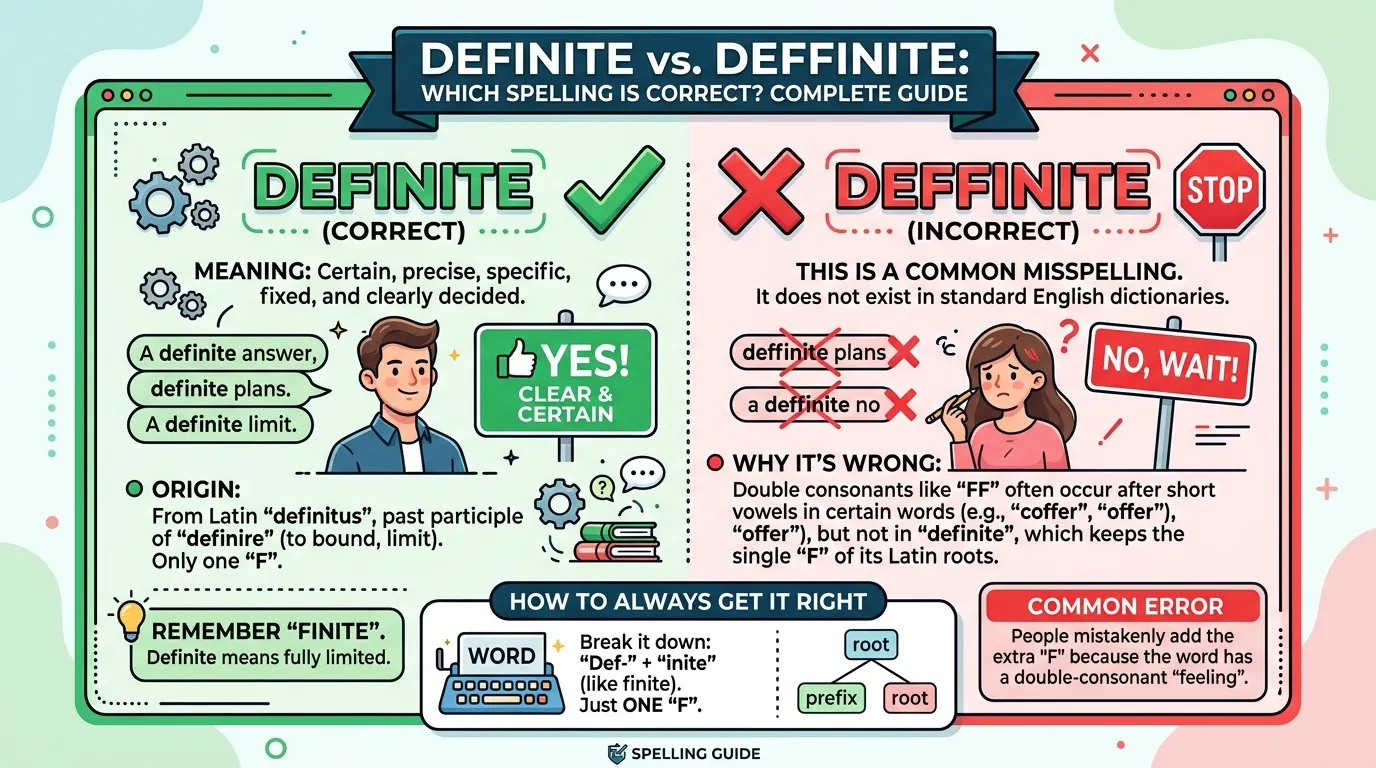
If you are wondering about definite vs deffinite, the answer is simple: definite is the correct English spelling. Deffinite is a misspelling and should not be used in standard American or British English.
The confusion is understandable because definite contains sounds that can make writers expect a double f. However, the standard spelling has only one f: D-E-F-I-N-I-T-E.
In this guide, you will learn the difference between definite and deffinite, what definite means, how to pronounce it, why people spell it incorrectly, and how to use it naturally in everyday, academic, professional, business, and formal writing. We will also cover related words such as definitely, definition, definitive, and indefinite.
Quick Answer: Definite or Deffinite?
Definite is the correct spelling.
Deffinite is incorrect in standard English.
| Spelling | Correct? | Meaning |
|---|---|---|
| definite | ✅ Yes | Clear, certain, fixed, or specific |
| deffinite | ❌ No | Common misspelling of definite |
| definitely | ✅ Yes | Certainly; without doubt |
| definitive | ✅ Yes | Conclusive, authoritative, or final |
| indefinite | ✅ Yes | Not clearly defined, fixed, or certain |
Correct examples
- We need a definite answer by Friday.
- She gave me a definite time for the meeting.
- I will definitely be there.
- The report provides a definitive explanation.
Incorrect example
- We need a deffinite answer.
The corrected version is:
- We need a definite answer.
What Does Definite Mean?
Definite is an adjective that describes something that is clear, certain, specific, fixed, or clearly identified.
Depending on the context, it can describe an idea, answer, decision, amount, time, object, plan, or result.
Dictionary-style definition
Definite (adjective): Clearly stated, known, determined, or distinguishable; not vague, uncertain, or indefinite.
For example:
We need a definite decision before moving forward.
Here, definite means the decision should be clear and settled rather than uncertain.
Another example:
There is a definite improvement in her writing.
In this sentence, definite means the improvement is clear and noticeable.
What Does Deffinite Mean?
Deffinite is not a standard English word.
It is generally a spelling error caused by accidentally doubling the f in definite.
You may encounter deffinite in:
- Text messages
- Social media posts
- Online comments
- Informal writing
- Student writing
- Search queries
- User-generated content
However, its appearance online does not make it a correct spelling.
If you are writing something that needs correct English, use definite.
Incorrect
I need a deffinite answer.
Correct
I need a definite answer.
Why Do People Confuse Definite and Deffinite?
The most common reason is pronunciation and spelling patterns.
English spelling does not always allow you to predict the exact letters from the sounds you hear. When people say definite, the middle consonant sound can make the word feel as if it should contain two f letters.
There is also a common spelling pattern involving doubled consonants in English.
For example:
- different
- difficult
- effective
- official
- sufficient
Because many familiar words contain repeated consonants, writers may incorrectly assume that definite follows a similar pattern.
It does not.
The correct spelling is:
definite
not:
deffinite
The Key Difference Between Definite and Deffinite
There is actually no difference in meaning because deffinite is not a recognized standard spelling.
The important distinction is:
- Definite = correct English word
- Deffinite = misspelling
This makes the comparison straightforward.
| Feature | Definite | Deffinite |
|---|---|---|
| Standard English word | Yes | No |
| Correct spelling | Yes | No |
| Part of speech | Adjective | — |
| Common meaning | Certain, clear, specific | — |
| Used in formal writing | Yes | No |
| Used in dictionaries | Yes | No |
| Recommended spelling | Yes | No |
Definite Meaning in Different Contexts
The meaning of definite can change slightly depending on how it is used.
Definite meaning “certain”
She is definite that she wants to accept the offer.
More naturally, you could say:
She is definite about accepting the offer.
Here, definite relates to certainty.
Definite meaning “specific”
Do you have a definite date for the event?
This means:
Do you have a specific and confirmed date?
Definite meaning “clear”
There was a definite change in his attitude.
The change was clear or noticeable.
Definite meaning “fixed”
We need a definite plan before the project begins.
The plan needs to be settled rather than uncertain.
Definite meaning “clearly identified”
The article makes a definite distinction between the two terms.
The distinction is clear and specific.
How to Pronounce Definite
In standard American English, definite is commonly pronounced approximately:
/ˈdɛfənət/
It sounds roughly like:
DEF-uh-nit
The first syllable receives the main stress.
Break it down
DEF + uh + nit
Avoid trying to pronounce every written letter separately.
The word definite is not normally pronounced as though it contains a strongly emphasized second i.
Related pronunciation
Definitely is commonly pronounced:
/ˈdɛfənətli/
Approximately:
DEF-uh-nit-lee
This pronunciation may help you remember the spelling family:
- definite
- definitely
- definition
- definitive
Is Definite an Adjective?
Yes. Definite is primarily an adjective.
An adjective describes or modifies a noun.
Examples
- a definite answer
- a definite plan
- a definite reason
- a definite date
- a definite improvement
- a definite possibility
- a definite advantage
In each example, definite provides information about the noun.
Definite as a Grammatical Term
The word definite also has an important role in grammar.
The most familiar example is the definite article:
the
The word the is called the definite article because it generally identifies a particular person, place, thing, or group.
Compare:
I saw a dog.
This does not identify a particular dog to the listener.
Now compare:
I saw the dog.
This refers to a specific dog that the listener can identify from the context.
Definite article vs indefinite articles
English has one definite article:
the
English has two indefinite article forms:
a and an
| Article | Type | Example |
|---|---|---|
| the | Definite article | The book is on the desk. |
| a | Indefinite article | I bought a book. |
| an | Indefinite article | She ate an apple. |
This grammatical meaning is closely connected to the basic idea of definite: specific or identifiable.
Definite vs Indefinite
One of the most useful comparisons is definite vs indefinite.
These words are opposites in many contexts.
Definite means clear, specific, fixed, or certain.
Indefinite means unclear, unspecified, uncertain, or not fixed.
Examples
We have a definite deadline.
The deadline is known and fixed.
We have an indefinite deadline.
The deadline has not been clearly established.
Another example:
He gave a definite answer.
His answer was clear.
He gave an indefinite answer.
His answer was vague or uncertain.
Comparison table
| Definite | Indefinite |
|---|---|
| Certain | Uncertain |
| Specific | Unspecified |
| Clear | Unclear |
| Fixed | Not fixed |
| Identifiable | Not specifically identified |
Definite vs Definitely
Another common source of confusion is definite vs definitely.
They are related words, but they have different grammatical roles.
Definite
Definite is an adjective.
We need a definite answer.
Definitely
Definitely is an adverb.
It means certainly, without doubt, or surely.
I will definitely attend the meeting.
Easy comparison
| Word | Part of Speech | Meaning |
|---|---|---|
| definite | Adjective | Certain, clear, specific |
| definitely | Adverb | Certainly, without doubt |
Common spelling mistake
A frequent error is:
I will deffinitely call you.
Correct:
I will definitely call you.
Notice that the correct spelling is definitely, not deffinitely.
Definite vs Definitive
Definite and definitive are closely related, but they are not always interchangeable.
Definite
Means clear, certain, specific, or fixed.
We have a definite plan.
Definitive
Often means conclusive, authoritative, final, or serving as the most reliable version or explanation.
The study provides a definitive answer to the question.
A definitive answer generally carries a stronger sense of authority or finality.
Compare
She gave a definite response.
Her response was clear.
The report provides a definitive response.
The report provides a response regarded as authoritative or conclusive.
Definite vs Definition
These words belong to the same word family but serve different grammatical purposes.
Definite
An adjective:
The instructions are definite.
Definition
A noun describing the meaning or explanation of a word or concept:
What is the definition of this term?
Related forms
- definite — adjective
- definitely — adverb
- definition — noun
- define — verb
- definitive — adjective
- indefinite — adjective
- indefinitely — adverb
Understanding the word family can make the spelling easier to remember.
Common Collocations With Definite
A collocation is a group of words that naturally occur together.
Some common combinations with definite include:
- definite answer
- definite decision
- definite date
- definite plan
- definite proof
- definite evidence
- definite reason
- definite possibility
- definite advantage
- definite improvement
- definite change
- definite increase
- definite decrease
- definite idea
- definite conclusion
- definite purpose
- definite period
- definite time
Examples
We need a definite date before we book the venue.
The company has a definite advantage in this market.
There is a definite improvement in the latest version.
The evidence provides a definite indication of what happened.
Common Phrases With Definite
Here are several natural expressions using definite.
A definite answer
The customer wants a definite answer today.
A definite plan
We do not have a definite plan yet.
A definite possibility
This expression may seem contradictory, but it means something is clearly possible or realistically expected.
A promotion is a definite possibility next year.
A definite improvement
Your pronunciation shows a definite improvement.
For a definite period
This means for a clearly specified amount of time.
The equipment will be unavailable for a definite period.
Is Definite Formal or Informal?
Definite is neutral in tone.
It works well in almost every variety of English writing.
You can use it in:
- Casual conversation
- Text messages
- Emails
- Business writing
- Academic writing
- Journalism
- Technical writing
- Government documents
- Reports
- Blogging
- Professional communication
However, the exact expression may change depending on the level of formality.
Casual
Do you have a definite time yet?
Professional
Please provide a definite completion date.
Academic
The findings provide definite evidence of a relationship between the variables.
American English vs British English
There is no meaningful spelling difference between American and British English for definite.
Both varieties use:
definite
Not:
deffinite
The same applies to the related word:
definitely
Both American and British English use this spelling.
Example
American English:
We need a definite answer.
British English:
We need a definite answer.
The spelling remains the same.
Definite in Academic Writing
Definite can be useful in academic writing when you need to describe something as clear, specific, or established.
Examples
The researchers identified a definite pattern in the data.
There is no definite evidence that the treatment caused the change.
The study does not provide a definite explanation for the result.
However, academic writers should avoid using definite when the evidence is actually uncertain.
For example, saying:
The study proves a definite causal relationship.
may be too strong if the research only shows correlation.
A more precise statement might be:
The study provides evidence of a possible causal relationship.
Good academic writing depends on matching your wording to the strength of the evidence.
Definite in Business Writing
In business communication, definite often appears when discussing schedules, decisions, agreements, and expectations.
Natural examples
We need a definite delivery date.
Please provide a definite timeline.
The client has not given us a definite response.
We need a definite commitment before beginning production.
Better business communication
Instead of:
Tell me the time.
You could write:
Please provide a definite meeting time.
The second version makes it clear that you want a specific, confirmed time.
Definite in Technical Writing
Technical writing values precision, so definite can be useful when describing something clearly established.
Examples include:
The device requires a definite voltage range.
The test produced a definite change in temperature.
The procedure must be completed within a definite time period.
However, technical writers should use exact measurements whenever possible.
Instead of:
The machine operates for a definite period.
a more precise version may be:
The machine operates for 30 minutes.
When a specific number is available, the number usually communicates more information.
Definite in Journalism
Journalists may use definite when describing confirmed information, although careful reporting often prefers more precise language.
Example
Officials have not yet announced a definite date for the opening.
This tells readers that the date remains unconfirmed.
Another example:
The team has shown a definite improvement since the beginning of the season.
Here, definite emphasizes a noticeable change.
Definite in Sports
In sports writing, definite commonly describes clear changes, decisions, or possibilities.
Examples
The rookie has made a definite impact this season.
The team showed a definite improvement after halftime.
A playoff appearance is still a definite possibility.
The coach has not made a definite decision about the starting lineup.
The word is not sports slang. It is ordinary English used in a sports context.
Definite in Politics
Political writing can use definite when discussing policies, positions, decisions, or dates.
For example:
The candidate has not announced a definite policy on the issue.
Or:
The administration has not set a definite date for the announcement.
Again, definite simply means clear, specific, or settled.
There is no special political definition of the word.
Definite in Casual Conversation
In everyday speech, definite is completely natural.
Examples:
Is that a definite yes?
Do we have a definite time?
That’s a definite possibility.
I need a definite answer.
There’s been a definite change.
One particularly common expression is:
a definite yes
It means a clear and confident agreement.
Is Sarah coming?
It’s a definite yes.
Common Mistakes With Definite
Mistake: Deffinite
❌ We need a deffinite answer.
✅ We need a definite answer.
Mistake: Deffinitely
❌ I will deffinitely call you.
✅ I will definitely call you.
Mistake: Definate
Another common misspelling is:
❌ definate
Correct:
✅ definite
Mistake: Defenite
You may also see:
❌ defenite
Correct:
✅ definite
The correct spelling
Remember:
DEFINITE
It contains:
- one f
- one n
- one i before the final te
Awkward vs Natural Examples
Sometimes a sentence is grammatically possible but does not sound natural.
Awkward
Give me a definite exact answer.
More natural
Give me a definite answer.
The word definite already conveys the idea of something being clear or specific.
Awkward
We need a definite confirmed date.
More natural
We need a confirmed date.
Here, confirmed already communicates the relevant idea.
Natural
We need a definite date.
This is also correct when the emphasis is on having a specific date rather than a tentative one.
How to Remember the Spelling of Definite
A simple memory trick is:
DEFINITE has one F
Think:
DE-FIN-ITE
Do not add another f.
You can also connect it with the word finite.
The spelling contains:
de + finite
Although this is not a complete modern morphological explanation of the word, it can be a useful spelling aid:
DEFINITE → FINITE → one F
Another useful strategy is to memorize the word family together:
define → definite → definitely → definition → definitive
Seeing these words repeatedly makes the spelling more familiar.
Definite Synonyms
The best synonym depends on the context.
Synonyms for “certain”
- certain
- sure
- assured
- confident
- established
Example:
We have a definite answer.
Possible alternative:
We have a certain answer.
However, certain may sound more natural in some contexts.
Synonyms for “specific”
- specific
- particular
- precise
- exact
- clearly identified
Example:
Do you have a definite date?
Alternative:
Do you have a specific date?
Synonyms for “clear”
- clear
- obvious
- unmistakable
- distinct
- evident
Example:
There was a definite change.
Alternative:
There was a clear change.
Definite Antonyms
Depending on context, possible antonyms include:
- indefinite
- uncertain
- unclear
- vague
- ambiguous
- doubtful
- unspecified
- tentative
- undecided
Example
We need a definite answer.
Opposite:
We have only a tentative answer.
Definite and Indefinite Articles
The grammatical concept deserves special attention because it appears frequently in English.
Definite article: The
Use the when the listener or reader can identify the particular noun.
Please close the door.
The speaker expects the listener to know which door is meant.
Indefinite article: A or An
Use a or an when referring to something not specifically identified.
Please close a door.
This does not necessarily identify a particular door.
Another example
I saw a movie last night.
The movie is being introduced.
The movie was excellent.
Now the movie has been identified.
Word History and Etymology of Definite
Definite ultimately traces back through French and Latin.
It is related to the Latin word dēfīnītus, meaning something like bounded, determined, or defined. It comes from the Latin verb dēfīnīre, meaning to define, determine, or set boundaries.
This history helps explain why modern English words such as these are related:
- define
- definition
- definite
- definitive
- indefinite
The central idea involves setting something apart, determining it, or giving it clear boundaries.
Over time, definite developed its modern meanings involving certainty, specificity, and clarity.
Is Deffinite Ever Correct?
In standard modern English, no.
If you are writing:
- an essay
- a resume
- an email
- a report
- a blog post
- a school assignment
- a business document
- an academic paper
- a professional message
use definite.
You might see deffinite online because people make spelling mistakes. It can also appear in discussions about misspellings, but that does not make it a standard word.
Real-World Examples of Definite
Here are practical examples across different situations.
Everyday life
I need a definite answer before I make plans.
School
The teacher gave us a definite deadline for the assignment.
Workplace
The manager wants a definite completion date.
Business
The customer has requested a definite delivery time.
Academic
The evidence does not provide a definite conclusion.
Journalism
Officials have not announced a definite date.
Sports
The team has shown a definite improvement.
Technology
The update caused a definite change in system performance.
Travel
Do you have a definite departure time?
Personal plans
Saturday is not a definite plan yet.
Formal and Informal Alternatives to Definite
Sometimes another word may sound more natural.
| Meaning | Definite | Alternative |
|---|---|---|
| Certain | definite | certain |
| Specific | definite | specific |
| Clear | definite | clear |
| Fixed | definite | fixed |
| Confirmed | definite | confirmed |
| Exact | definite | exact |
| Final | definite | final |
Example
We need a definite date.
Depending on the context, you might say:
We need a specific date.
or:
We need a confirmed date.
or:
We need an exact date.
The best choice depends on exactly what you mean.
When Should You Use Definite?
Use definite when you want to communicate that something is:
- clearly known
- specific
- certain
- established
- fixed
- unmistakable
- clearly identified
Before using it, ask yourself:
Am I describing something that is clear or settled rather than vague or uncertain?
If yes, definite may be the right word.
When Should You Avoid Definite?
Avoid definite when you actually mean something weaker.
For example, if something is merely possible, do not call it definite.
Too strong
There is a definite chance that the company will close.
This could be understood as a strong or clearly realistic possibility, but depending on context, it may sound contradictory.
More precise
There is a possibility that the company will close.
Or:
There is a significant possibility that the company will close.
Choosing words according to the strength of your evidence makes your writing more accurate.
A Simple Definite vs Deffinite Test
When proofreading, use this quick test:
Which spelling appears in standard dictionaries?
The answer is:
definite
Then ask:
Does it have two Fs?
No.
Correct:
D-E-F-I-N-I-T-E
Incorrect:
D-E-F-F-I-N-I-T-E
If you remember only one thing from this article, remember:
Definite has one F.
Frequently Asked Questions About Definite vs Deffinite
Is definite or deffinite correct?
Definite is correct. Deffinite is a misspelling and is not accepted as the standard spelling of the English word.
What is the meaning of definite?
Definite means clear, certain, specific, fixed, or clearly identified. For example, a definite answer means an answer that is clear and not uncertain.
Why do people spell definite as deffinite?
People often write deffinite because they incorrectly double the f, possibly influenced by other English words that contain doubled consonants. The correct spelling has only one f.
Is deffinite a real word?
No. Deffinite is not a standard English word. It is generally treated as a spelling error for definite.
How do you spell definite?
The correct spelling is:
D-E-F-I-N-I-T-E
It has one F.
What is the difference between definite and definitely?
Definite is an adjective meaning clear, certain, or specific. Definitely is an adverb meaning certainly or without doubt.
We need a definite answer.
I will definitely come.
What is the opposite of definite?
The most direct opposite is indefinite. Other possible opposites include uncertain, unclear, vague, and unspecified, depending on the context.
Is definite spelled the same in American and British English?
Yes. Both American and British English use definite. Deffinite is not the standard spelling in either variety.
Is definite a formal word?
Yes, but it is not especially formal. Definite is a neutral English word that works in casual conversation, business writing, academic writing, journalism, and professional communication.
What is the difference between definite and definitive?
Definite generally means clear, certain, or specific. Definitive often means authoritative, conclusive, or final.
We have a definite plan.
The study provides a definitive answer.
Conclusion: Definite vs Deffinite
When comparing definite vs deffinite, there is one clear winner: definite.
Definite is the correct standard English spelling. It is an adjective meaning clear, certain, specific, fixed, or clearly identified. It can be used naturally in everyday conversation as well as academic, business, technical, journalistic, and professional writing.
Deffinite is simply a misspelling. It should be corrected whenever you see it in formal or edited writing.
The easiest way to remember the difference is simple:
Definite = one F.
Also remember the related forms:
- definite — clear or certain
- definitely — certainly
- definition — an explanation of meaning
- define — to explain or establish meaning
- definitive — authoritative or conclusive
- indefinite — unclear, unspecified, or uncertain
If you are unsure which spelling to use, choose definite every time. That spelling is correct in both American and British English and is appropriate for virtually any standard English context.


