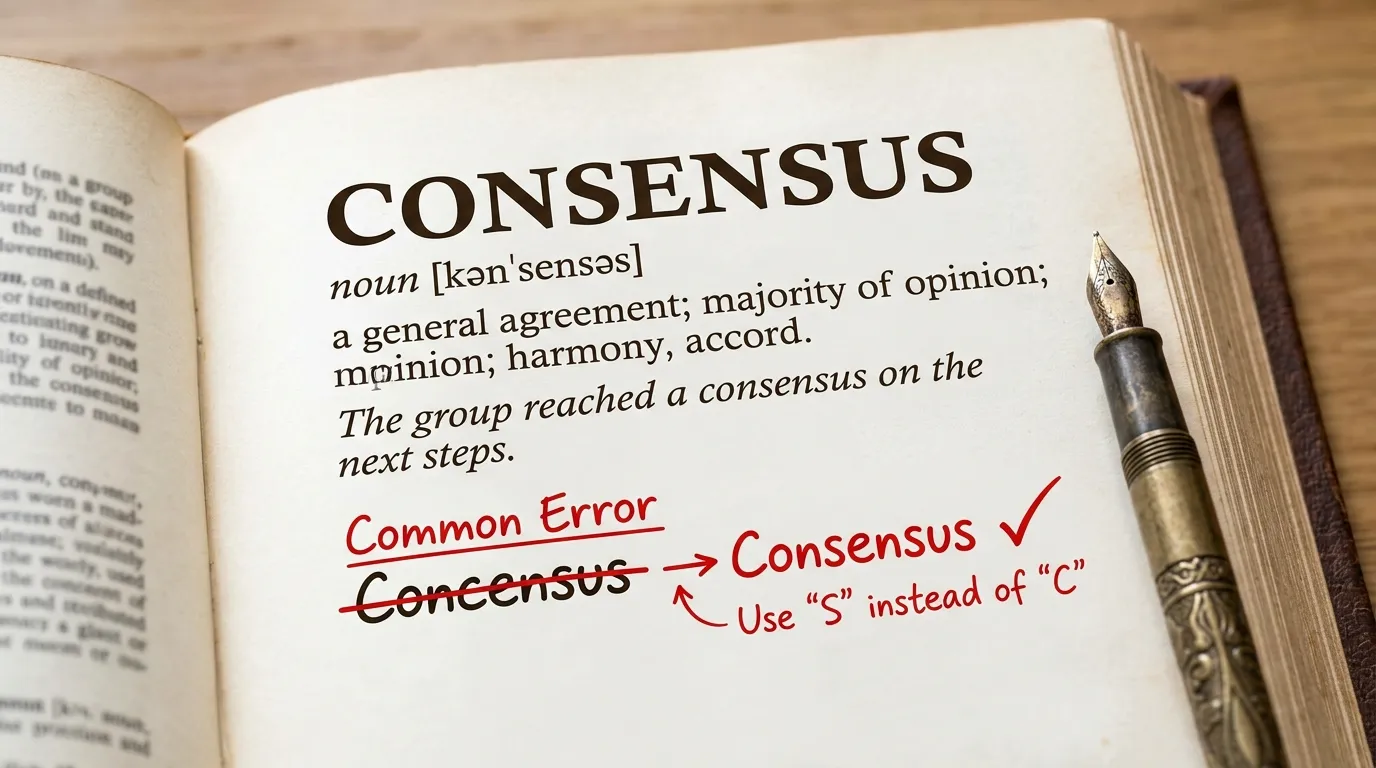
If you have ever hesitated between consensus and concensus, you are not alone. These two spellings look almost identical, but only one is correct in standard English.
The correct spelling is consensus. Concensus is a common misspelling and does not appear as the standard spelling of the word in modern American English or British English.
Consensus means general agreement or a shared opinion among a group of people. You will see it frequently in academic writing, business communication, politics, journalism, science, sports, and everyday conversation.
This guide explains the difference between consensus vs concensus, including pronunciation, meaning, etymology, grammar, common mistakes, regional usage, collocations, examples, and practical memory tricks.
Quick Answer: Consensus or Concensus?
Consensus is the correct spelling.
Concensus is incorrect in standard English.
| Spelling | Correct? | Meaning |
|---|---|---|
| consensus | ✅ Yes | General agreement or shared opinion |
| concensus | ❌ No | Common misspelling of consensus |
Example
Correct: The committee reached a consensus after a long discussion.
Incorrect: The committee reached a concensus after a long discussion.
The key point is simple: spell it consensus, not concensus.
What Does Consensus Mean?
Consensus is a noun meaning general agreement among members of a group.
It does not necessarily mean that every person agrees completely. Instead, it usually suggests that enough people share the same view or accept a decision for the group to move forward.
Dictionary-style definition
Consensus: A general agreement or shared understanding among a group of people.
Examples
- The team reached a consensus on the new strategy.
- There is broad consensus that the policy needs improvement.
- The scientists reached a consensus after reviewing the evidence.
- After several meetings, the board finally reached a consensus.
- The two sides failed to reach consensus.
The word is especially useful when you are talking about collective decisions, opinions, judgments, or beliefs.
Why Is Concensus Incorrect?
The spelling concensus is usually created because people pronounce or mentally divide consensus incorrectly.
The beginning of the word can sound as though it contains con + c + ensus, which may lead someone to insert an extra c.
However, the standard spelling is:
C-O-N-S-E-N-S-U-S
Not:
C-O-N-C-E-N-S-U-S
There is only one c in the correct spelling, and it appears at the beginning.
Correct spelling
consensus
Common misspelling
concensus
This is similar to other English spelling mistakes in which pronunciation encourages writers to add or remove a letter.
Consensus vs Concensus: The Key Difference
The difference between consensus and concensus is not a difference in meaning.
It is a difference between a correct spelling and an incorrect spelling.
| Feature | Consensus | Concensus |
|---|---|---|
| Standard English | Yes | No |
| Correct spelling | Yes | No |
| Part of speech | Noun | Not standard |
| Meaning | General agreement | No standard meaning |
| American English | Correct | Misspelling |
| British English | Correct | Misspelling |
| Academic writing | Appropriate | Avoid |
| Business writing | Appropriate | Avoid |
| Formal writing | Appropriate | Avoid |
Therefore, you should use consensus regardless of whether you are writing in American English, British English, Canadian English, Australian English, or another standard variety of English.
How Do You Pronounce Consensus?
Consensus is commonly pronounced:
kuhn-SEN-sus
In phonetic form, it is approximately:
/kənˈsensəs/
The stress falls on the second syllable:
con-SEN-sus
The pronunciation can help explain why some people spell the word incorrectly. The word does not clearly sound like it contains another hard c after the first syllable.
Say it naturally
consensus
Not:
con-census
Breaking the word into its spoken rhythm can make the correct spelling easier to remember:
con + SEN + sus
Is Consensus a Noun or an Adjective?
Consensus is a noun.
It names an idea, condition, or result involving general agreement.
Noun examples
- The group reached a consensus.
- There was no consensus on the proposal.
- The scientific consensus has changed over time.
- A consensus emerged during the meeting.
You should not normally use consensus as an adjective.
For example:
Natural: The committee reached a consensus decision.
Less natural: The consensus members discussed the issue.
When you need an adjective, expressions such as consensual, agreed, or widely accepted may be more appropriate depending on the context.
Consensus Meaning in Simple English
In simple terms, consensus means agreement within a group.
Imagine five coworkers discussing where to hold a team event.
One person wants a restaurant. Another prefers a park. Others suggest different places.
After discussing the options, four people agree that the park is the best choice, and everyone accepts the decision.
The group has reached a consensus.
Consensus does not always mean:
Everyone has exactly the same opinion.
It can instead mean:
The group has reached enough agreement to accept a decision or position.
This distinction is important in professional and academic writing.
Does Consensus Mean Everyone Agrees?
No.
Consensus does not necessarily mean unanimous agreement.
There is an important difference between consensus and unanimity.
Consensus
A general agreement exists, although some individuals may still have reservations or different views.
Unanimity
Everyone agrees.
| Word | Meaning |
|---|---|
| Consensus | General or broad agreement |
| Unanimity | Complete agreement by everyone |
| Majority | More than half of a group |
| Compromise | An agreement involving concessions |
For example:
The board reached a consensus despite some members having reservations.
This sentence means that the board generally agreed, but not necessarily that every member completely supported the decision.
Consensus vs Agreement
Consensus and agreement are closely related, but they are not always interchangeable.
Agreement is the broader term. It can describe agreement between two people, two organizations, or many people.
Consensus usually emphasizes a broader shared position within a group.
Compare these examples
Agreement:
Sarah and James reached an agreement.
Consensus:
The entire committee reached a consensus.
The second example highlights collective agreement.
Useful distinction
Use agreement when you simply mean that people agree.
Use consensus when you want to emphasize general agreement within a group.
Common Collocations With Consensus
Learning common word combinations is one of the easiest ways to use consensus naturally.
Reach a consensus
This is one of the most common expressions.
The negotiators reached a consensus.
Build consensus
This means to encourage people to develop a shared position.
The leader worked hard to build consensus among the departments.
Seek consensus
This means to try to find a position that a group can generally accept.
The committee is seeking consensus before voting.
Broad consensus
This means widespread agreement.
There is broad consensus that the proposal should be revised.
General consensus
This means a generally shared opinion.
The general consensus was that the product needed improvement.
Scientific consensus
This refers to the broad agreement among scientists regarding a particular subject based on available evidence.
The report discusses the current scientific consensus.
Political consensus
This refers to broad agreement among political groups or representatives.
The parties struggled to find political consensus.
Public consensus
This describes a broadly shared public view.
There is little public consensus on the issue.
Common Phrases With Consensus
Here are some natural expressions you may encounter:
- reach a consensus
- achieve consensus
- build consensus
- develop consensus
- seek consensus
- find consensus
- create consensus
- establish consensus
- form a consensus
- gain consensus
- broad consensus
- general consensus
- widespread consensus
- scientific consensus
- political consensus
- international consensus
- professional consensus
- public consensus
- emerging consensus
- growing consensus
- strong consensus
- lack of consensus
Example sentences
The researchers reached a consensus after reviewing the data.
The manager tried to build consensus among the team members.
There is growing consensus that the process needs to change.
The international group failed to achieve consensus.
Consensus in Academic Writing
Consensus is particularly common in academic and research writing.
It allows writers to describe a broad agreement among experts, researchers, scholars, or members of a professional community.
Examples
The current academic consensus supports this interpretation.
Researchers have not reached a consensus on the cause.
The findings challenge the existing consensus.
A growing consensus has emerged among experts.
Academic writers should be careful not to use consensus when they actually mean that every expert agrees.
For greater precision, use terms such as:
- broad agreement
- majority view
- prevailing view
- dominant interpretation
- general agreement
- widely accepted position
Consensus in Business Writing
In business communication, consensus often describes agreement among managers, executives, teams, departments, or stakeholders.
Examples
The leadership team reached consensus on the project timeline.
We need to build consensus before making a final decision.
The department is seeking consensus on the proposed changes.
The meeting ended without a clear consensus.
The word can make business writing sound precise and professional without being unnecessarily complicated.
Consensus in Politics
Political writing frequently uses consensus to describe broad agreement among political parties, lawmakers, governments, or voters.
Examples
The lawmakers failed to reach consensus.
The proposal received support from both parties, creating a broader political consensus.
There is little consensus among voters on the issue.
Political consensus does not necessarily mean complete agreement. It usually describes a broad area of shared support or understanding.
Consensus in Science and Research
The phrase scientific consensus is especially important.
It refers to the broad position held by the scientific community based on accumulated evidence and research.
For example:
The scientific consensus is based on evidence from many studies.
The term should be used carefully. A single study, researcher, or expert opinion does not automatically establish a scientific consensus.
Similarly, disagreement among researchers does not automatically mean that no useful evidence exists.
Consensus in Sports
Consensus can also appear in sports writing.
Sports analysts may discuss a consensus pick, consensus ranking, or consensus opinion.
Examples
The player was a consensus choice for the award.
The team entered the season as a consensus favorite.
There was no consensus among analysts about the final ranking.
In this context, consensus usually means that many analysts, voters, coaches, or experts independently reached a similar conclusion.
Consensus in Journalism
Journalists use consensus when reporting on broad agreement among experts, officials, organizations, or the public.
Examples
Experts have reached a broad consensus on the issue.
There is no clear consensus among economists.
The consensus view has changed over the past decade.
Journalistic writing should avoid exaggerating the level of agreement. If only a small group agrees, calling it a broad consensus may be misleading.
Consensus in Technical and Professional Writing
The word is common in technology, engineering, medicine, finance, law, management, and other professional fields.
Technology
The developers reached consensus on the software architecture.
Engineering
The engineers reached a consensus about the proposed design.
Finance
The market consensus expects moderate growth.
Management
The team needs consensus before implementing the plan.
Law and policy
The committee could not reach consensus on the proposed regulation.
In technical contexts, consensus often describes collective professional judgment rather than complete agreement.
Consensus vs Concensus: Common Mistakes
The most common mistake is simply adding an unnecessary c.
Mistake 1
❌ The group reached a concensus.
✅ The group reached a consensus.
Mistake 2
❌ There is a general concensus among experts.
✅ There is a general consensus among experts.
Mistake 3
❌ We need to build concensus before proceeding.
✅ We need to build consensus before proceeding.
Mistake 4
❌ The scientific concensus supports the conclusion.
✅ The scientific consensus supports the conclusion.
The solution is simple: whenever you are unsure, remember that the correct word contains only one c.
Consensus vs Concensus Memory Trick
A useful spelling trick is:
CON + SENSUS = CONSENSUS
Think of sense.
The word consensus contains the sequence:
SENS
You can remember it as:
Consensus makes sense.
That gives you:
con + sense + us
This is not the actual historical construction of the modern English word, but it is a useful spelling aid.
Another quick trick is:
Consensus has one C.
If you see concensus, stop and remove the second c.
Consensus Word History and Etymology
The word consensus comes from Latin consensus, meaning agreement, accord, or concurrence.
It is related to the Latin verb consentire, meaning to agree or feel together.
The Latin elements are associated with ideas of feeling or thinking together.
English adopted consensus as a term for agreement or shared judgment.
This history also helps explain its meaning today. When a group reaches a consensus, its members have arrived at a broadly shared position.
Consensus Synonyms
Several words can replace consensus, depending on context.
Common synonyms
- agreement
- accord
- harmony
- unity
- concurrence
- understanding
- common ground
- shared view
- shared opinion
- general agreement
However, these words are not perfect substitutes in every sentence.
Example
The committee reached a consensus.
Possible alternatives include:
The committee reached an agreement.
The committee found common ground.
The committee reached an accord.
Each alternative has a slightly different tone and emphasis.
Consensus is often the best choice when several people or groups gradually arrive at a shared position.
Consensus Antonyms
Words that can contrast with consensus include:
- disagreement
- conflict
- division
- dispute
- opposition
- dissent
- disagreement
- discord
- controversy
For example:
The committee reached consensus.
versus:
The committee remained divided.
Consensus and dissent
Dissent is especially useful when describing someone who disagrees with the prevailing opinion.
The report reflects a broad consensus, although some researchers expressed dissent.
This shows that consensus can coexist with disagreement from a minority.
Consensus vs Majority Opinion
These concepts are related but different.
A majority opinion means the opinion held by more than half of a group.
A consensus means general agreement or a shared position.
A consensus may develop through discussion, negotiation, compromise, and acceptance.
For example, a group could vote 51 percent to 49 percent in favor of a proposal. That creates a majority decision, but it may not represent a strong consensus.
Consensus vs Unanimous
These words are sometimes confused.
Unanimous means everyone agrees.
Consensus means there is general agreement.
Compare
The decision was unanimous.
Everyone agreed.
The decision reflected a consensus.
The group generally agreed, although some people may have had reservations.
Therefore, do not automatically replace consensus with unanimous agreement.
Formal vs Informal Alternatives
Consensus is suitable in both formal and everyday English, although it can sound somewhat more formal than agreement.
Formal
The committee reached a consensus regarding the proposed policy.
Neutral
The team reached a consensus on the plan.
Informal
Everyone was pretty much on the same page.
The phrase on the same page is a casual alternative to expressing shared understanding or agreement.
Other informal alternatives
- everyone agreed
- we all agreed
- we saw eye to eye
- everyone was on board
- we found common ground
Choose the expression based on your audience.
Awkward vs Natural Examples
Awkward
The employees reached a unanimous consensus.
This can be redundant because unanimous means everyone agrees, while consensus already describes general agreement.
More natural
The employees reached a consensus.
Or:
The employees reached a unanimous decision.
Awkward
The consensus agreement was accepted by everyone.
More natural
The consensus was accepted by everyone.
Or:
Everyone agreed with the decision.
Awkward
The group made consensus.
Natural
The group reached consensus.
Or:
The group reached a consensus.
The expression reach consensus is especially common in professional writing.
Should You Say “Reach Consensus” or “Reach a Consensus”?
Both can be found in standard English.
Reach a consensus
The committee reached a consensus.
This is extremely natural and widely understood.
Reach consensus
The committee reached consensus.
This is also standard, particularly in formal, institutional, business, and academic contexts.
The choice can depend on style and regional preference, but neither should be confused with the incorrect spelling concensus.
Is “General Consensus” Redundant?
Sometimes.
Because consensus already means general agreement, the phrase general consensus can be considered somewhat repetitive.
However, it is extremely common in real-world English and is not generally treated as an unacceptable expression.
For example:
The general consensus is that the plan needs revision.
This sounds natural to most English speakers.
If you want maximum precision and concision, you could simply write:
The consensus is that the plan needs revision.
Both versions work.
Is “Consensus of Opinion” Redundant?
It can be.
The word consensus already describes a shared opinion or judgment, so consensus of opinion may be more wordy than necessary.
Instead of:
There was a consensus of opinion among the experts.
You can write:
There was a consensus among the experts.
Or:
The experts broadly agreed.
Still, consensus of opinion appears in established English usage and is understandable.
Regional Differences: American vs British English
There is no major spelling difference between American and British English for this word.
Both use:
consensus
Not:
concensus
Therefore, you do not need to change the spelling based on the variety of English you are using.
American English
The committee reached a consensus.
British English
The committee reached a consensus.
International English
The committee reached a consensus.
The spelling remains consistent.
Is Consensus Used in Casual Conversation?
Yes, although people may choose simpler expressions in everyday speech.
For example:
We reached a consensus.
is perfectly natural.
But in casual conversation, someone might say:
We all agreed.
or:
We were all on the same page.
Consensus becomes especially common when discussing groups, organizations, decisions, policies, or professional opinions.
When Should You Use Consensus?
Use consensus when you want to emphasize:
- general agreement
- shared opinion
- collective judgment
- group decision-making
- common understanding
- broad support
- agreement among experts
- agreement among organizations
- agreement among stakeholders
Strong examples
The research team reached a consensus.
The board could not reach consensus.
There is broad consensus among economists.
The parties are trying to build consensus.
The report reflects the current scientific consensus.
When Should You Use Agreement Instead?
Choose agreement when the idea is simpler or more specific.
For example:
John and Maria reached an agreement.
There is no need to use consensus simply because it sounds more formal.
Good writing uses the word that most accurately communicates the idea.
Consensus in Blogging and Online Writing
For blogs, websites, and online articles, consensus is useful when discussing:
- expert opinions
- research findings
- industry standards
- public opinion
- community decisions
- professional recommendations
For example:
The current consensus among language experts is that the spelling is incorrect.
However, avoid phrases such as everyone agrees unless you genuinely mean everyone. Consensus is often more accurate because it allows for some disagreement.
Consensus in SEO and Content Writing
When writing about language, grammar, spelling, or terminology, consensus can naturally appear in phrases such as:
- consensus among linguists
- general consensus
- expert consensus
- current consensus
- broad consensus
- scholarly consensus
- industry consensus
- consensus view
Do not force these phrases into content simply for search optimization. Use them only when they accurately describe the subject.
Good SEO writing prioritizes clarity and usefulness over repeating the same keyword.
Consensus-Related Words
Understanding related vocabulary can improve your writing.
Consensual
Consensual is an adjective meaning based on agreement or consent.
The decision was consensual.
Consent
Consent is permission or agreement to something.
The participants gave their consent.
Consenting
Consenting describes someone who agrees to something.
The parties were consenting participants.
Consensus
Consensus refers to general agreement within a group.
The group reached a consensus.
These words are related but should not be treated as interchangeable.
Common Search Queries About Consensus vs Concensus
People often search for this spelling question in several forms:
- consensus or concensus
- is it consensus or concensus
- correct spelling of consensus
- concensus meaning
- consensus meaning
- how to spell consensus
- consensus definition
- consensus pronunciation
- consensus spelling
- consensus vs concensus meaning
- consensus correct spelling
- is concensus a word
- consensus in a sentence
The answer remains the same: consensus is the standard spelling.
Practical Writing Recommendations
Use these guidelines whenever you are writing the word.
For American English
Use consensus.
For British English
Use consensus.
For academic writing
Use consensus when describing broad agreement among researchers or scholars.
For business writing
Use consensus for collective decisions and stakeholder agreement.
For journalism
Use consensus when the evidence genuinely supports describing a broad agreement.
For technical writing
Use consensus when describing shared professional or technical judgment.
For sports writing
Use consensus for shared rankings, predictions, or expert selections.
For blogging
Use consensus naturally when discussing broad opinions or expert agreement.
For casual writing
Use consensus, although simpler alternatives such as agreement or we all agreed may sound more conversational.
Quick Checklist for Remembering the Correct Spelling
Before publishing your writing, check these points:
- ✅ Write consensus.
- ❌ Do not write concensus.
- ✅ Remember that consensus is a noun.
- ✅ Use it for general or broad agreement.
- ✅ Use reach consensus or reach a consensus naturally.
- ✅ Use consensual when you need the related adjective.
- ✅ Use unanimous only when everyone agrees.
- ✅ Use agreement when a simpler word is more appropriate.
Consensus vs Concensus: Final Comparison
| Category | Consensus | Concensus |
|---|---|---|
| Spelling | Correct | Incorrect |
| Standard English | Yes | No |
| Part of speech | Noun | None in standard usage |
| Definition | General agreement | No standard definition |
| Pronunciation | kuhn-SEN-sus | Not a standard word |
| American English | Used | Avoid |
| British English | Used | Avoid |
| Academic writing | Recommended | Incorrect |
| Business writing | Recommended | Incorrect |
| Formal writing | Recommended | Incorrect |
| Informal writing | Acceptable | Incorrect |
Frequently Asked Questions
Is consensus or concensus correct?
Consensus is correct. Concensus is a common misspelling. The standard English spelling is consensus, with only one c.
Is concensus a real word?
Concensus is not the standard spelling of the English word. It is generally considered a misspelling of consensus. In formal, academic, professional, and published writing, use consensus.
What does consensus mean?
Consensus means general agreement among members of a group. It does not necessarily mean that every person agrees completely. It often describes a shared position reached through discussion or consideration.
How do you spell consensus?
The correct spelling is:
C-O-N-S-E-N-S-U-S
A useful memory aid is consensus has one C.
What is the difference between consensus and agreement?
Agreement is a broad term for people having the same opinion or accepting the same terms. Consensus usually emphasizes general agreement within a group. Consensus can also suggest that people have worked toward a shared position.
Does consensus mean everyone agrees?
No. Consensus means general agreement, not necessarily unanimous agreement. Some members of a group may have reservations while still accepting the group’s overall position.
What is the plural of consensus?
The standard plural is consensuses. In many contexts, however, writers may simply restructure the sentence to avoid the plural if it sounds awkward.
For example:
Several consensuses developed among the different groups.
Depending on the context, a more natural alternative may be:
Different groups reached different forms of consensus.
Can you say “reach a consensus”?
Yes. Reach a consensus is a common and natural expression.
For example:
After several meetings, the committee reached a consensus.
You can also say reach consensus, particularly in formal or institutional writing.
Is “general consensus” correct?
Yes, general consensus is widely used and easily understood. Some editors consider it slightly repetitive because consensus already involves general agreement, but it is common in standard English.
Is consensus formal or informal?
Consensus works in both formal and neutral contexts. It is especially common in academic, professional, political, scientific, and organizational writing. In very casual conversation, expressions such as we all agreed or we were on the same page may sound more natural.
Conclusion
When comparing consensus vs concensus, there is no spelling choice to make. Consensus is the correct standard English word, while concensus is a common misspelling.
Consensus is a noun meaning general agreement or a shared position among a group of people. It is widely used in American and British English and is appropriate for academic, business, political, scientific, technical, journalistic, sports, and everyday writing.
Remember the simple rule:
Consensus has one C.
Use expressions such as reach a consensus, build consensus, seek consensus, broad consensus, and scientific consensus when they accurately describe the situation.
Also remember that consensus does not necessarily mean unanimous agreement. It usually means that a group has reached a broadly shared position, even if some individuals still have reservations.
If you are ever unsure whether to write consensus or concensus, choose consensus. It is the correct spelling in standard English.


