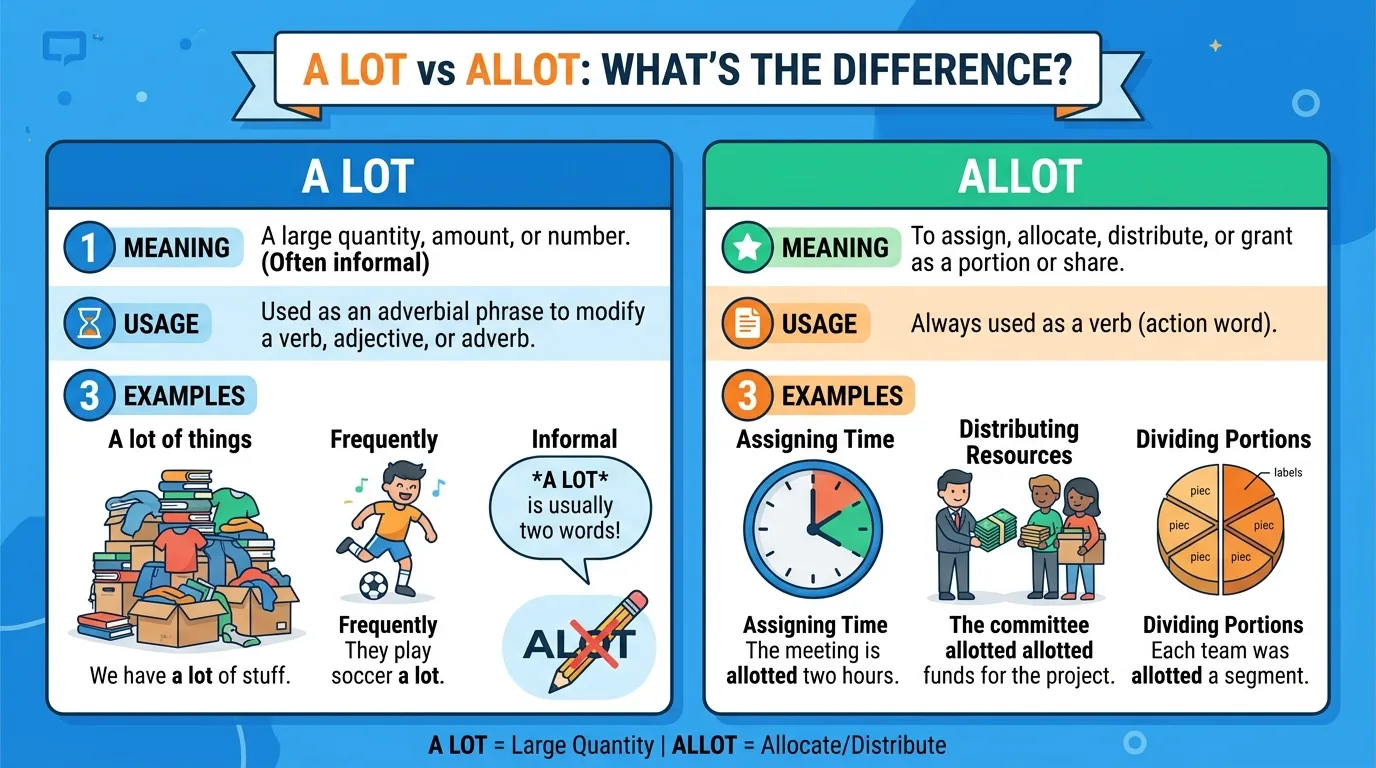
If you are wondering whether a lot or allot is the correct word, the answer depends on what you mean. A lot is a two-word phrase that means a large amount or a large number. Allot is a verb that means to distribute, assign, or give a share of something to someone.
For example:
- I have a lot of homework tonight.
- The teacher will allot each student ten minutes.
These words look and sound similar, which is why they are often confused. However, they have completely different meanings and grammatical roles. One describes quantity, while the other describes the act of distributing or assigning something.
In this guide, you will learn the difference between a lot vs allot, how to use each correctly, their pronunciation, grammar, word history, common mistakes, synonyms, formal alternatives, and plenty of everyday examples.
Quick Answer: A Lot vs Allot
The simplest way to remember the difference is:
| Word | Meaning | Grammar | Example |
|---|---|---|---|
| a lot | A large amount or number | Noun phrase/adverbial phrase | She has a lot of friends. |
| allot | To distribute or assign something | Verb | We will allot five minutes to each speaker. |
Use a lot when you mean:
- many
- much
- a large amount
- a large number
- very much
Example:
I travel a lot for work.
Use allot when you mean:
- distribute
- assign
- allocate
- give someone a portion
Example:
The manager will allot tasks to each employee.
Is “alot” correct?
In standard English, alot is generally not considered a correct spelling of the phrase meaning “a large amount.”
Write:
I have a lot of work. ✅
Not:
I have alot of work. ❌
What Does “A Lot” Mean?
A lot is an informal expression used to describe a large quantity, amount, or number.
It can refer to countable or uncountable things.
A lot with countable nouns
Use a lot of with plural countable nouns when you mean many.
- We have a lot of customers.
- She owns a lot of books.
- There were a lot of people at the event.
- He has a lot of questions.
A lot with uncountable nouns
Use a lot of with uncountable nouns when you mean much.
- I have a lot of work.
- She drinks a lot of water.
- We need a lot of information.
- They spent a lot of money.
The basic structure is:
a lot of + noun
For example:
We have a lot of time.
She bought a lot of apples.
What Does “Allot” Mean?
Allot is a verb meaning to give, assign, or distribute a particular amount of something to a person, group, purpose, or activity.
It usually involves dividing something into portions.
For example:
The committee will allot funds to each department.
This means the committee will distribute or assign funds to the departments.
Another example:
The teacher allotted ten minutes for the exercise.
Here, ten minutes were specifically assigned to the exercise.
Dictionary-style definition of allot
Allot (verb): to distribute, assign, or designate a particular share or amount of something for a person, group, activity, or purpose.
Common forms of allot
| Form | Example |
|---|---|
| Base form | allot |
| Third-person singular | allots |
| Past tense | allotted |
| Past participle | allotted |
| Present participle | allotting |
Notice the spelling in the past and present participle:
- allotted
- allotting
The final consonant is doubled before adding -ed or -ing.
The Key Difference Between A Lot and Allot
The most important distinction is grammatical and semantic.
A lot expresses quantity.
Allot expresses distribution or assignment.
Compare these sentences:
She has a lot of money.
This tells us that she has a large amount of money.
She will allot money to each department.
This tells us that she will distribute money among different departments.
The two expressions may sound similar, but they perform different jobs.
Think of the difference this way
A lot = how much/how many
Allot = give or assign a share
That simple distinction will prevent most mistakes.
A Lot vs Allot vs Alot
These three forms are especially easy to confuse.
| Form | Standard English? | Meaning |
|---|---|---|
| a lot | Yes | A large amount or number |
| allot | Yes | To distribute or assign |
| alot | No, in standard usage | Usually an incorrect spelling of “a lot” |
Correct
I learned a lot from the course.
Correct
The company will allot resources to the project.
Incorrect
I learned alot from the course.
The incorrect form alot often appears in informal online writing, but it should be avoided in school, professional, academic, business, and edited writing.
Why Do People Confuse A Lot and Allot?
There are several reasons these words are commonly mixed up.
They sound similar
In ordinary speech, a lot and allot can sound nearly identical.
This can make it difficult to distinguish them when writing.
They share similar letters
The phrases contain almost the same letters:
a lot
allot
The difference is mainly the space and the meaning.
“A lot” is extremely common
Because a lot appears frequently in everyday English, writers sometimes incorrectly combine it into alot.
English spelling is not always predictable
English contains many words whose pronunciation does not perfectly reveal their spelling. That makes sound-based spelling errors common.
A Lot: Grammar and Usage
A lot can work in more than one grammatical role.
“A lot of” as a determiner phrase
When it comes before a noun, a lot of indicates a large quantity or number.
Examples:
- She has a lot of experience.
- We saw a lot of birds.
- They need a lot of patience.
- There are a lot of reasons to stay.
“A lot” as an adverbial expression
A lot can also modify a verb and mean frequently or very much.
Examples:
- I exercise a lot.
- She smiles a lot.
- They travel a lot.
- He talks a lot.
In these examples, a lot does not directly modify a noun.
Allot: Grammar and Usage
Allot is a transitive verb. It normally takes an object because something is being assigned or distributed.
Common patterns include:
allot + something + to + someone/something
The school allotted funds to the library.
Or:
allot + someone + something
The manager allotted each employee two hours.
Another common structure is:
allot + time/resources/money/space
Examples:
- allot time
- allot resources
- allot money
- allot space
- allot funds
- allot responsibilities
- allot tasks
- allot points
Common Collocations With “A Lot”
Some combinations with a lot occur very naturally in English.
A lot of time
We have a lot of time before the meeting.
A lot of money
The project requires a lot of money.
A lot of people
A lot of people attended the concert.
A lot of work
I have a lot of work today.
A lot of information
The website provides a lot of information.
A lot of experience
She has a lot of experience in marketing.
Like a lot
I like this restaurant a lot.
Think a lot
He thinks a lot about his future.
Common Collocations With “Allot”
Allot tends to appear in more formal contexts than a lot.
Common combinations include:
- allot time
- allot resources
- allot funds
- allot money
- allot space
- allot responsibilities
- allot tasks
- allot points
- allot seats
- allot shares
- allot a portion
- allot a certain amount
Examples:
The coach allotted each player a specific role.
The organization allotted funds for research.
Please allot enough time for questions.
The government agency allotted resources to the program.
A Lot vs Allot: Pronunciation
The pronunciation of a lot and allot can be very similar.
A lot
In American English, a lot is commonly pronounced approximately:
/ə ˈlɑːt/
Allot
Allot is commonly pronounced:
/ə ˈlɑːt/
Because their pronunciation can be nearly identical, spelling and context are especially important.
You cannot reliably choose between them based only on sound.
Instead, ask yourself:
Am I talking about a large quantity, or am I talking about assigning something?
Is “A Lot” Formal or Informal?
A lot is standard English, but it is generally more conversational than some alternatives.
For everyday writing, it is perfectly acceptable.
We received a lot of applications.
In highly formal or academic writing, alternatives such as many, numerous, substantial, or a significant amount of may sometimes sound more precise.
Compare:
Conversational:
A lot of people support the idea.
More formal:
Many people support the idea.
More formal and specific:
A significant number of participants supported the proposal.
This does not mean a lot is incorrect or unprofessional. It simply has a more conversational tone in some contexts.
Is “Allot” Formal?
Allot is a standard word and is often associated with formal, administrative, academic, organizational, or professional contexts.
For example:
The committee allotted funds for the project.
You may see allot in:
- business writing
- government documents
- academic writing
- project management
- budgeting
- administration
- sports planning
- event organization
In casual conversation, people often use give, set aside, or assign instead.
Formal vs Informal Alternatives
Alternatives for “a lot”
| “A lot” alternative | Typical use |
|---|---|
| many | Countable nouns |
| much | Uncountable nouns |
| numerous | Formal |
| plenty of | Neutral/conversational |
| numerous amounts | Usually avoid; use “large amounts” |
| a large number of | Formal |
| a large amount of | Formal |
| a significant number of | Formal |
| a substantial amount of | Formal |
Alternatives for “allot”
| Allot | Alternative |
|---|---|
| allot time | allocate time |
| allot funds | allocate funds |
| allot tasks | assign tasks |
| allot resources | distribute resources |
| allot space | designate space |
| allot a share | give a share |
A Lot vs Many vs Much
These expressions are related but not interchangeable in every situation.
A lot of
Works with both countable and uncountable nouns.
A lot of students joined.
A lot of water was used.
Many
Usually works with plural countable nouns.
Many students joined.
Much
Usually works with uncountable nouns, particularly in questions and negative sentences.
We don’t have much time.
In positive everyday sentences, a lot of often sounds more natural:
We have a lot of time.
rather than:
We have much time.
A Lot vs Lots of
Lots of also means a large amount or number.
We have lots of time.
She has lots of friends.
Both a lot of and lots of are common in everyday English.
However, lots of is generally more conversational.
Compare the tone
We have a lot of options.
Neutral.
We have lots of options.
More casual and conversational.
A Lot vs Plenty of
Plenty of means more than enough.
We have plenty of food.
This does not simply mean a large quantity. It often carries the idea that the amount is sufficient or abundant.
Compare:
We have a lot of food.
This emphasizes quantity.
We have plenty of food.
This emphasizes that there is enough.
A Lot vs Allot: Context Makes the Meaning Clear
Consider these sentences:
The company has a lot of employees.
The company has many employees.
The company will allot employees to different departments.
Employees are being assigned to departments.
The first sentence is about quantity.
The second is about assignment.
This distinction remains the same in almost every context.
Business and Professional Writing
Both expressions can appear in business writing, but they serve different purposes.
A lot in business writing
We received a lot of applications.
This is understandable and natural, although a more polished version might be:
We received many applications.
Or:
We received a large number of applications.
Allot in business writing
The company will allot resources to the new department.
This is natural and professional.
Another example:
The project manager allotted two weeks for testing.
Here, allotted clearly means assigned or set aside.
Academic Writing
In academic writing, a lot is grammatically correct but may sometimes sound too informal.
Instead of:
A lot of research has been conducted on this topic.
You might write:
Extensive research has been conducted on this topic.
Or:
Numerous studies have examined this issue.
However, allot can be perfectly appropriate:
Researchers allotted equal time to each experimental condition.
Journalism and Blogging
Journalistic writing often favors concise and precise language.
Instead of:
A lot of residents attended the meeting.
A news article might say:
Hundreds of residents attended the meeting.
If the exact number is unknown:
Many residents attended the meeting.
Blogging is more flexible. A lot is common in friendly, conversational blog writing.
For example:
There are a lot of ways to improve your writing.
That style can feel natural for an audience reading an explanatory article.
Technical and Professional Usage
Allot is useful when discussing the distribution of limited resources.
Examples include:
- computing resources
- storage capacity
- memory
- bandwidth
- testing time
- project hours
- budgets
- personnel
- equipment
Example:
The system automatically allots memory to each process.
Here, allot means that a specific share is assigned.
Using a lot would completely change the meaning.
Sports Usage
Both expressions can occur in sports writing.
A lot
The team has a lot of experience.
Allot
The coach allotted each player a specific amount of training time.
In sports contexts, allot can be useful when discussing playing time, practice time, positions, equipment, or resources.
Political and Government Usage
Government and political writing often uses allot when discussing budgets and resources.
Examples:
The agency allotted funds for infrastructure.
The legislature allotted additional money to the program.
Here, allot has a formal administrative meaning.
A lot, meanwhile, simply indicates quantity:
A lot of voters participated in the election.
The two words are not interchangeable.
Word History and Etymology
The history of these expressions helps explain why they look alike even though their meanings differ.
A lot
The noun lot has a long history in English. It was associated with an object or method used to determine a person’s share, portion, or fate.
Over time, lot developed several meanings, including a share or portion and later a parcel of land.
The phrase a lot eventually developed its modern use for a large quantity or number.
Allot
Allot developed from the idea of assigning something as someone’s portion or share.
The word is related to lot in the historical sense of a share or portion.
That connection makes the modern meaning of allot easier to understand:
allot = assign a share
The modern meanings of the two expressions have diverged, even though their histories are connected.
Synonyms and Antonyms
Synonyms for “a lot”
Depending on context, alternatives include:
- many
- much
- numerous
- plenty
- loads of
- tons of
- a great deal of
- a large number of
- a large amount of
- abundant
- considerable
- substantial
Some are more formal than others.
Antonyms or contrasting expressions
Depending on the context:
- few
- little
- hardly any
- not many
- not much
- a small amount
- a small number
Example:
There are a lot of choices.
Opposite idea:
There are few choices.
Synonyms for “allot”
Depending on context:
- allocate
- assign
- distribute
- designate
- apportion
- grant
- give
- set aside
- earmark
The exact choice depends on what is being distributed and how formal the context is.
Common Mistakes With A Lot and Allot
Mistake: Writing “alot”
❌ I have alot of homework.
✅ I have a lot of homework.
The phrase requires a space.
Mistake: Using “allot” to mean “many”
❌ Allot of people attended.
✅ A lot of people attended.
Allot is a verb. It does not mean many.
Mistake: Using “a lot” when you mean assign
❌ The manager will a lot five hours for the task.
✅ The manager will allot five hours to the task.
Mistake: Treating “allot” as a noun
❌ Each student received an allot of time.
Better:
✅ Each student received an allocation of time.
Or:
✅ The teacher allotted each student ten minutes.
Awkward vs Natural Examples
Quantity
Awkward:
I have allot of books.
Natural:
I have a lot of books.
Assignment
Awkward:
The manager will a lot money to the project.
Natural:
The manager will allot money to the project.
Academic writing
Less formal:
A lot of studies discuss this issue.
More formal:
Numerous studies discuss this issue.
Casual conversation
Natural:
I like this movie a lot.
This is completely normal conversational English.
A Simple Memory Trick
Here is an easy way to remember the difference:
A LOT = A LARGE AMOUNT
Think:
a lot = many or much
I have a lot of work.
ALLOT = ASSIGN A SHARE
Think:
allot = allocate
Both allot and allocate begin with the idea of assigning something.
The manager will allot time to each task.
A useful mental test is:
Can I replace the word with “many” or “much”?
If yes, use a lot.
Can I replace it with “allocate” or “assign”?
If yes, use allot.
When Should You Use “A Lot”?
Use a lot when you want to communicate:
- a large quantity
- a large number
- frequent action
- strong degree or intensity
Examples:
She reads a lot.
We have a lot of work.
There are a lot of opportunities.
He cares about the project a lot.
When Should You Use “Allot”?
Use allot when something is deliberately assigned, divided, or distributed.
Examples:
We allotted three hours for the meeting.
The school allotted funds to the program.
Each team was allotted ten points.
The organizer allotted seats to each group.
Natural Examples From Everyday English
Here are additional examples to reinforce the difference.
A lot
- I spend a lot of time reading.
- She has a lot of energy.
- We met a lot of interesting people.
- They eat out a lot.
- He knows a lot about computers.
- There is a lot of traffic today.
- I learned a lot from that experience.
- She has a lot of patience.
Allot
- The teacher allotted twenty minutes for the test.
- The company allotted money for training.
- Each participant was allotted a seat.
- The coach allotted extra practice time.
- The committee allotted funds to several projects.
- The manager allotted tasks among the employees.
- We need to allot enough space for equipment.
- The budget allots money for maintenance.
Regional Variations: American vs British English
The distinction between a lot and allot does not significantly change between American and British English.
Both varieties use:
- a lot for a large quantity or number
- allot for assigning or distributing something
For example, both American and British speakers can say:
There are a lot of people here.
And:
The committee allotted funds to the project.
One regional consideration is style. British English may use some alternatives or constructions more frequently in particular contexts, but the fundamental difference between a lot and allot remains the same.
Should You Use “A Lot” in Formal Writing?
Yes, but consider the context.
There is nothing grammatically wrong with a lot. However, formal writing often benefits from more precise alternatives.
Instead of:
A lot of evidence supports this argument.
Consider:
Substantial evidence supports this argument.
Instead of:
A lot of students participated.
Consider:
Many students participated.
The best choice depends on your audience, purpose, and desired tone.
Should You Use “Allot” in Casual Writing?
You can, but it may sound more formal than necessary.
For example:
I allotted myself an hour to clean the house.
This is grammatically correct.
In casual conversation, however, many people might naturally say:
I gave myself an hour to clean the house.
Or:
I set aside an hour to clean the house.
Allot is not wrong; it simply has a more formal or deliberate feel.
Quick Comparison Table
| Feature | A lot | Allot |
|---|---|---|
| Meaning | Large amount/number | Assign or distribute |
| Spelling | Two words | One word |
| Part of speech | Phrase | Verb |
| Pronunciation | /ə ˈlɑːt/ | /ə ˈlɑːt/ |
| Countable nouns | Yes | Not applicable |
| Uncountable nouns | Yes | Not applicable |
| Formality | Neutral to conversational | Neutral to formal |
| Common synonym | many/much | allocate/assign |
| Example | A lot of people came. | We allotted each person a seat. |
| Common error | alot | Using it to mean many |
A Lot vs Allot: Which One Is Correct?
Both are correct words, but they are not interchangeable.
Use a lot when you mean a large amount or number.
She has a lot of friends.
Use allot when you mean to assign or distribute something.
The organizer will allot seats to each group.
If you mean a large quantity, do not write alot in standard English.
The correct form is:
a lot
Final Usage Recommendations
For everyday American English, follow these simple rules:
- Use a lot to describe quantity.
- Use a lot of before nouns.
- Use a lot after verbs when it means very much or frequently.
- Use allot when assigning or distributing something.
- Never use alot as the standard spelling of the phrase meaning a large quantity.
- Use many, much, numerous, or substantial when a more formal style is appropriate.
- Use allocate, assign, or distribute when you want an alternative to allot.
- Remember that a lot and allot can sound almost identical, so context matters more than pronunciation.
Frequently Asked Questions
Is “a lot” one word or two words?
A lot is two words when it means a large amount or number.
Correct:
I have a lot of work.
The spelling alot is not standard for this meaning.
Is “allot” a real word?
Yes. Allot is a standard English verb meaning to assign, distribute, or give a particular share of something.
Example:
The teacher allotted ten minutes to each activity.
What is the difference between a lot and allot?
A lot means a large amount or number, while allot means to assign or distribute something.
We have a lot of food.
We will allot food to each group.
Is “alot” grammatically correct?
No, not when you mean a large amount or number. In standard English, the correct spelling is a lot.
Can “a lot” mean “very much”?
Yes. When used after a verb, a lot can mean very much.
I like this song a lot.
She misses her family a lot.
Can “allot” mean “a lot”?
No. Allot does not mean a large amount. It means to assign or distribute something.
Is “a lot” formal English?
A lot is standard English and can be used in many situations. However, in highly formal or academic writing, alternatives such as many, numerous, substantial, or a significant amount may sometimes be more appropriate.
Is “allot” more formal than “a lot”?
Generally, allot has a more formal or administrative tone because it is often used for assigning time, money, resources, responsibilities, or space. A lot is very common in everyday conversation.
What is an easy way to remember a lot vs allot?
Remember:
A LOT = MANY OR MUCH
ALLOT = ASSIGN
If you are describing quantity, choose a lot. If you are giving someone or something a specific share, choose allot.
Conclusion
The difference between a lot vs allot is simple once you focus on meaning.
A lot is a two-word expression used to describe a large amount or number. It can also mean very much when it modifies a verb.
I have a lot of work.
I enjoy reading a lot.
Allot is a verb meaning to assign, distribute, or give a specific share of something.
The manager will allot time to each task.
The most common spelling mistake is writing alot when you mean a lot. In standard English, keep the words separate.
The easiest memory trick is:
A lot = many or much.
Allot = assign or allocate.
Once you connect each form with its meaning, choosing the correct word becomes straightforward in casual conversation, professional communication, academic writing, journalism, blogging, and everyday English.


