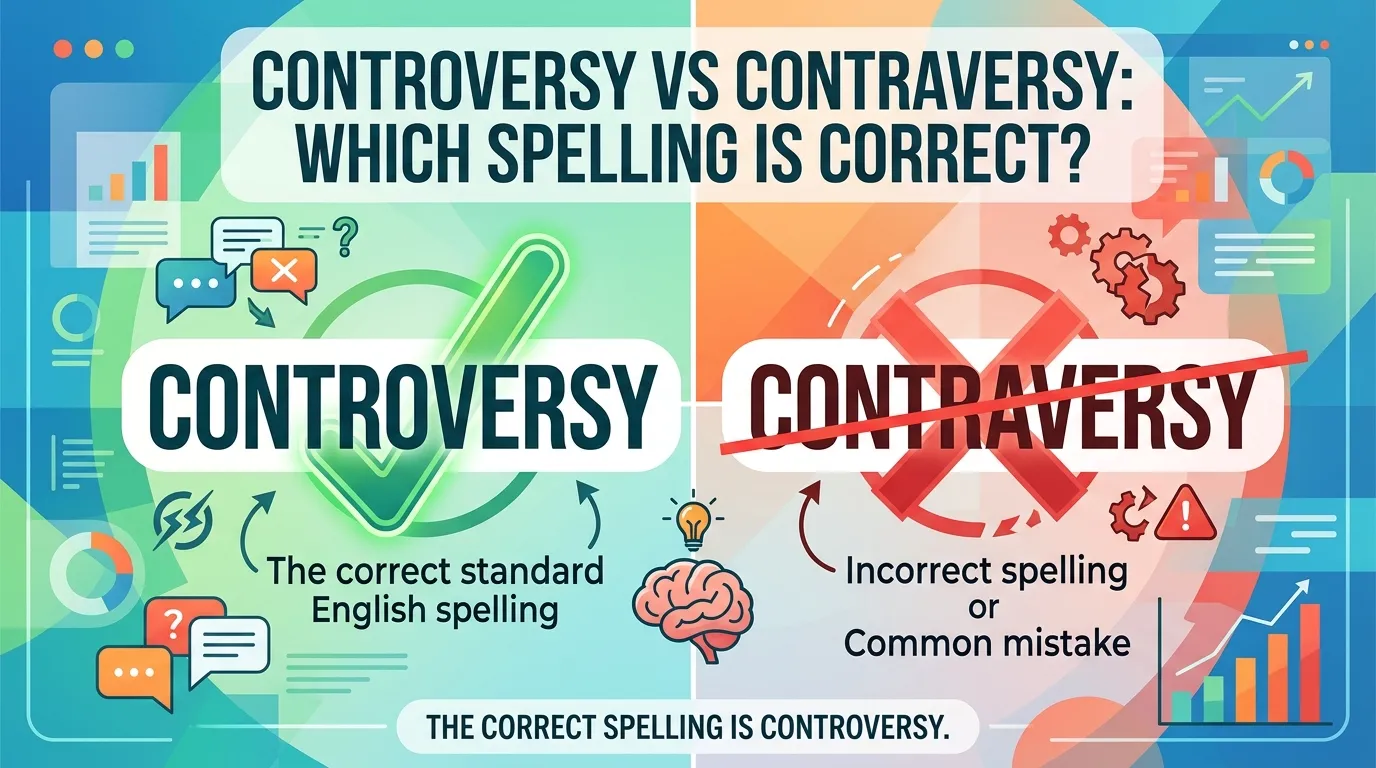
If you are wondering about controversy vs contraversy, the answer is simple: controversy is the correct spelling in standard English. Contraversy is a misspelling and should not be used in formal, academic, professional, or polished everyday writing.
The confusion is understandable because the word controversy is not spelled exactly the way many people expect it to sound. Some speakers pronounce it with a sound that can make the middle of the word seem closer to -versy or -varsy. That pronunciation can lead people to write contraversy, even though the standard spelling contains contro- and -versy.
In this guide, you will learn the difference between controversy and contraversy, the meaning and pronunciation of controversy, its history, common collocations, synonyms, examples, formal and informal alternatives, regional pronunciation differences, and the most common spelling mistakes.
Quick Answer: Controversy vs Contraversy
Controversy is the correct English spelling.
Contraversy is incorrect and is generally a spelling mistake.
| Word | Correct? | Meaning |
|---|---|---|
| controversy | Yes | A public disagreement, dispute, or debate about an issue |
| contraversy | No | A common misspelling of controversy |
Correct example
The decision caused a major controversy.
Incorrect example
The decision caused a major contraversy.
The safest rule is easy to remember:
If you mean a public disagreement or disputed issue, spell it controversy.
What Does Controversy Mean?
Controversy is a noun that refers to a situation in which people strongly disagree about a subject, decision, idea, action, or person.
A controversy usually involves different opinions, public disagreement, or debate. It can happen in politics, sports, business, entertainment, science, education, religion, social issues, or everyday life.
Dictionary-style definition
Controversy
noun
A public or serious disagreement involving opposing opinions about a particular subject.
Simple meaning
In simple English, a controversy is a matter that causes people to disagree.
For example:
The new school policy became a controversy among parents.
This means that parents had different and possibly strong opinions about the policy.
Another example:
The athlete was involved in a controversy after the controversial decision.
Here, controversy describes the disagreement or public dispute surrounding the athlete or event.
Is Contraversy a Correct Word?
No. Contraversy is not the standard spelling of the English word.
When someone writes contraversy, they almost always mean controversy.
This is a spelling error rather than a different word with a separate meaning.
Incorrect
The politician was involved in a political contraversy.
Correct
The politician was involved in a political controversy.
The incorrect spelling can appear online because people often spell words according to how they think those words sound. Search engines, spell checkers, and writing tools may recognize the intended meaning, but that does not make contraversy a standard spelling.
For essays, resumes, business writing, journalism, websites, reports, and academic work, always use controversy.
Why Do People Spell Controversy as Contraversy?
The main reason is pronunciation.
English spelling and pronunciation do not always match perfectly. Controversy is one of the words that can cause uncertainty because different speakers may pronounce it somewhat differently.
When people hear the word, they may focus on the sound near the middle:
controversy
Some people hear or produce a pronunciation that makes the word seem as though it should contain an a:
contraversy
But pronunciation does not change the standard spelling.
Another reason is that English contains many words with similar-looking patterns. People may unconsciously connect controversy with words such as:
- contrary
- contrast
- conversation
- controversial
That can contribute to spelling confusion.
The important point is that controversy has a fixed standard spelling even though pronunciation can vary.
Controversy vs Contraversy: Key Difference
The difference is primarily one of correct spelling.
Controversy is the established English noun.
Contraversy is a misspelling.
There is no standard semantic distinction between them.
| Feature | Controversy | Contraversy |
|---|---|---|
| Standard spelling | Yes | No |
| Standard English word | Yes | No |
| Part of speech | Noun | None in standard English |
| Meaning | Public disagreement or dispute | No separate standard meaning |
| Suitable for formal writing | Yes | No |
| Suitable for academic writing | Yes | No |
| Suitable for business writing | Yes | No |
| Suitable for journalism | Yes | No |
| Recommended spelling | Controversy | Avoid |
So this is not a case like color vs colour, where both spellings are accepted in different varieties of English.
It is also not like theater vs theatre, where regional preferences matter.
Instead, controversy is the standard spelling across major varieties of English.
Controversy Meaning in Simple English
The word can be explained in several simple ways:
- A public disagreement
- A disputed issue
- A subject that causes strong disagreement
- A debate involving opposing opinions
- A situation that attracts conflicting views
For example:
The decision created controversy.
This means the decision caused disagreement or debate.
The movie sparked controversy.
This means the movie caused people to express strong or opposing opinions.
The controversy continued for several weeks.
This means the disagreement or disputed issue remained active.
Is Controversy a Noun or a Verb?
Controversy is a noun.
It names a disagreement, dispute, or disputed issue.
Noun
The controversy attracted national attention.
You cannot normally use controversy as a verb.
Instead, English uses related verbs such as:
- debate
- dispute
- challenge
- question
- criticize
- oppose
- contest
Compare
The decision caused controversy.
Critics challenged the decision.
The first sentence uses the noun controversy. The second uses a verb.
What Is the Adjective Form of Controversy?
The most common adjective related to controversy is controversial.
Controversial means causing disagreement, debate, or strong opposing opinions.
Examples
The decision was controversial.
She made a controversial statement.
The proposal remains highly controversial.
The relationship is:
controversy → controversial
Do not write:
contraversial
The correct spelling is:
controversial
This is another common spelling mistake because people who incorrectly spell controversy may carry the same error into controversial.
Controversy Pronunciation
The pronunciation of controversy can vary between speakers and regions.
In American English, a common pronunciation is approximately:
KON-truh-vur-see
It is often represented in dictionaries using phonetic notation similar to:
/ˈkɑːntrəvɜːrsi/
The exact vowel sounds can vary depending on accent.
British English also has pronunciation variation. Some British speakers use a pronunciation closer to:
KON-truh-vur-see
while another traditional pronunciation places more emphasis differently within the word.
These pronunciation differences do not create a spelling difference.
Important distinction
Pronunciation can vary.
The standard spelling remains controversy.
Controversy vs Controversial
These words are closely related but have different grammatical roles.
| Word | Part of Speech | Meaning |
|---|---|---|
| controversy | Noun | A disagreement or disputed issue |
| controversial | Adjective | Causing disagreement or debate |
Examples
The issue became a controversy.
The issue became controversial.
The first sentence names the dispute.
The second describes the issue.
More examples
The controversy attracted attention.
The controversial policy attracted attention.
Both sentences are grammatically correct, but they emphasize different things.
Controversy vs Dispute
Controversy and dispute are synonyms in some contexts, but they are not always interchangeable.
A dispute often refers to a disagreement between people, groups, organizations, or parties.
A controversy often suggests a matter that attracts wider public discussion or conflicting opinions.
Examples
The two companies became involved in a legal dispute.
The new law created a national controversy.
A dispute can be private.
A controversy is often more public.
However, the two words can overlap.
The decision led to a dispute.
The decision led to controversy.
Both can be correct depending on the context.
Controversy vs Debate
These words are also related but have different meanings.
A debate is usually a structured discussion in which opposing views are presented.
A controversy is the disagreement or disputed subject itself.
Example
The candidates held a debate about immigration policy.
The debate is the discussion.
Immigration policy remains a controversial subject.
The controversy concerns the disagreement surrounding the subject.
A controversy can produce debates, but not every debate becomes a controversy.
Common Synonyms for Controversy
Depending on context, useful synonyms include:
- dispute
- disagreement
- debate
- conflict
- argument
- contention
- disagreement
- contention
- dispute
- question
- issue
- disagreement
- public dispute
- heated debate
- contentious issue
The best synonym depends on the sentence.
Example
Instead of:
The proposal caused controversy.
You could write:
The proposal caused disagreement.
Or:
The proposal sparked debate.
Or:
The proposal became a contentious issue.
These sentences are similar, but their tone differs slightly.
Antonyms of Controversy
There is no single perfect opposite for controversy, but contextually related opposites include:
- agreement
- consensus
- harmony
- acceptance
- accord
- unity
- approval
For example:
The proposal initially caused controversy.
Opposite idea:
The proposal received broad agreement.
Or:
The two groups reached a consensus.
Common Collocations With Controversy
A collocation is a combination of words that naturally appear together.
Learning collocations can help you use controversy naturally.
Common combinations include:
- spark controversy
- cause controversy
- create controversy
- generate controversy
- attract controversy
- fuel controversy
- stir controversy
- avoid controversy
- face controversy
- become a controversy
- be surrounded by controversy
- be at the center of controversy
- be involved in controversy
- settle a controversy
- ongoing controversy
- public controversy
- political controversy
- legal controversy
- major controversy
- heated controversy
- growing controversy
- widespread controversy
- international controversy
Natural examples
The announcement sparked controversy.
The decision caused controversy.
The company faced controversy over its advertising campaign.
The issue remains at the center of controversy.
The politician became involved in controversy.
These are natural combinations for everyday and professional English.
Common Expressions With Controversy
Several expressions occur frequently in journalism, business, politics, and general writing.
Spark controversy
Means to cause disagreement or debate.
The new policy sparked controversy.
Stir controversy
Means to create or encourage disagreement.
His comments stirred controversy.
Fuel controversy
Means to make an existing controversy stronger.
The new statement fueled the controversy.
Avoid controversy
Means to prevent involvement in a disputed issue.
The company changed its wording to avoid controversy.
Be at the center of controversy
Means to be the main subject of public disagreement.
The new rule is at the center of controversy.
A source of controversy
Means something that causes disagreement.
The decision became a source of controversy.
Controversy in Politics
The word controversy is especially common in political writing.
Political controversy may involve:
- elections
- government policies
- public spending
- laws
- political statements
- campaign decisions
- international relations
- immigration
- public officials
- court decisions
- social policy
Examples
The proposed law sparked political controversy.
The senator faced controversy after the statement.
The policy remains controversial among voters.
In political journalism, controversy is often used to describe disagreement without automatically stating that one side is correct.
That makes it useful for neutral reporting.
Controversy in Sports
Sports writing frequently uses the word when discussing disputed decisions, rules, player behavior, officiating, or organizational decisions.
Examples
The referee’s decision caused controversy.
The match ended in controversy.
The athlete faced controversy after the incident.
The new rule has generated controversy among fans.
Sports writers may also use related expressions such as:
- controversial decision
- disputed call
- heated debate
- public criticism
- officiating controversy
- rules controversy
Controversy in Business and Professional Writing
In business writing, controversy is appropriate when describing a public dispute involving a company, product, policy, executive, or organization.
Examples
The company became involved in a controversy over its advertising campaign.
The product launch generated controversy.
Management addressed the controversy in a public statement.
However, professional writers should avoid using the word when a simpler term is more precise.
For example, if two departments simply disagree, disagreement may be better:
The departments had a disagreement about the budget.
Calling an ordinary workplace disagreement a major controversy may exaggerate the situation.
Controversy in Academic Writing
Controversy is perfectly acceptable in academic writing, but academic writers should define the specific disagreement when possible.
Less precise
There is controversy about the topic.
More precise
Researchers continue to debate the effectiveness of the treatment.
The second version tells readers exactly what the disagreement concerns.
Useful academic alternatives include:
- ongoing debate
- scholarly disagreement
- contested issue
- disputed question
- competing interpretations
- conflicting evidence
Academic writing usually benefits from precision rather than dramatic wording.
Controversy in Journalism
Journalists often use controversy because it efficiently describes a public disagreement.
Examples include:
The decision has sparked controversy.
The controversy intensified after the announcement.
Officials responded to the growing controversy.
The organization released a statement addressing the controversy.
However, responsible journalism should avoid using controversy simply to make an ordinary disagreement sound dramatic.
The word should describe a genuine public or significant dispute.
Controversy in Casual Conversation
You can use controversy in everyday speech.
For example:
That movie caused a lot of controversy.
What’s all the controversy about?
The decision is still controversial.
In casual conversation, simpler alternatives may sound more natural:
Why is everyone arguing about it?
What’s the big disagreement?
Why are people upset about this?
The choice depends on your audience and tone.
Formal vs Informal Alternatives
| Formal | Neutral | Informal |
|---|---|---|
| controversy | disagreement | argument |
| disputed issue | debate | fight |
| contentious matter | disagreement | big disagreement |
| public dispute | conflict | drama |
| scholarly debate | discussion | back-and-forth |
Be careful with drama. It is informal and does not always mean a serious controversy.
Formal
The proposal remains a contentious issue.
Neutral
The proposal remains controversial.
Informal
The proposal has caused a lot of drama.
All three communicate related ideas, but they are appropriate in different situations.
American vs British English: Is the Spelling Different?
No major spelling difference exists between American and British English for this word.
Both use:
controversy
The main regional difference concerns pronunciation, not spelling.
| Variety | Standard Spelling |
|---|---|
| American English | controversy |
| British English | controversy |
| Canadian English | controversy |
| Australian English | controversy |
| International English | controversy |
So if you are writing for an American, British, Canadian, Australian, or international audience, controversy is the safe standard spelling.
Is Controversy a Slang Word?
No. Controversy is not slang.
It is a standard English noun and can appear in:
- formal writing
- academic writing
- journalism
- business communication
- professional reports
- everyday conversation
- online articles
Its tone is generally neutral to formal.
Informal speakers may choose words such as argument, fight, drama, or beef, depending on the context.
For example:
The celebrity became involved in a controversy.
More casually:
The celebrity got caught up in some drama.
The second sentence is much more informal.
Is Controversy a Negative Word?
Not necessarily.
The word itself is relatively neutral. It describes disagreement without automatically telling you which side is right.
For example:
The scientific discovery generated controversy.
This does not necessarily mean the discovery was wrong or harmful.
Likewise:
The proposal sparked controversy.
This simply means people disagreed about it.
However, because controversies often involve criticism, conflict, or strong emotions, the word can carry a negative feeling depending on context.
Common Mistakes With Controversy
Mistake: Writing contraversy
Incorrect:
The decision caused contraversy.
Correct:
The decision caused controversy.
Mistake: Writing controversary
Another occasional error is:
controversary
The correct form is:
controversy
Mistake: Writing contraversial
Incorrect:
It was a contraversial decision.
Correct:
It was a controversial decision.
Mistake: Adding unnecessary endings
Do not invent forms such as:
controversied
Use established forms such as:
caused controversy
became controversial
generated controversy
Awkward vs Natural Examples
Awkward
The new rule made a controversy.
Natural
The new rule caused controversy.
Awkward
There was a big controversy disagreement.
Natural
There was a major disagreement.
Awkward
The issue is controversy.
Natural
The issue is controversial.
Awkward
The decision made many controversies.
Natural
The decision caused a great deal of controversy.
Awkward
People controversy about the decision.
Natural
People debated the decision.
These examples show an important point: knowing the spelling is only part of using the word correctly. You also need to understand its grammatical role and common sentence patterns.
How to Remember the Correct Spelling
A simple memory trick can help.
Break the word into parts:
CON + TRO + VERSY
Think:
controversy = controversy
Do not insert an a after contr.
Another useful connection is the adjective:
controversy → controversial
If you remember controversial, it can help you remember the spelling of controversy.
Memory sentence
A controversy can become controversial, but neither word is spelled with a after contr.
A Simple Spelling Test
When you are unsure, ask yourself:
Am I talking about disagreement or public debate?
If yes, the word you want is:
controversy
Not:
contraversy
For example:
The announcement caused controversy.
The announcement was controversial.
Both contain the contro spelling pattern.
Word History and Etymology of Controversy
The history of controversy helps explain why its spelling may look unusual.
The English word comes through French and Latin sources and is ultimately related to the Latin controversia, meaning a dispute or disagreement.
The Latin elements are connected with ideas of:
- opposition
- turning against
- disagreement
- dispute
The word entered English centuries ago and developed into the modern form controversy.
Its long history is one reason it should not be spelled simply according to modern pronunciation.
English contains many words whose historical spellings do not perfectly reflect their current pronunciation. Controversy is one example.
Controversy Related Words
Knowing related words can expand your vocabulary.
Controversial
Causing disagreement.
The decision was controversial.
Controversially
In a controversial manner or in a way that causes disagreement.
The rule was controversially changed.
Controvert
A rare and formal verb meaning to dispute or argue against something.
The claim was controverted by later evidence.
Controversialist
A person who frequently engages in controversy or argumentative debate.
This word is less common in everyday English.
For most writers, controversy and controversial are the most useful forms.
Controversy vs Issue
These words are sometimes confused.
An issue is a subject, problem, or matter under consideration.
A controversy specifically involves disagreement or debate.
Compare
Climate change is an important issue.
This does not necessarily say anything about disagreement.
Climate change has been the subject of political controversy.
This specifically highlights disagreement or debate.
Therefore, not every issue is a controversy.
Controversy vs Conflict
A conflict usually involves opposing interests, people, groups, goals, or forces.
A controversy is more specifically associated with disagreement over an issue, question, idea, action, or decision.
Example
The workers and management were involved in a conflict.
The new contract created controversy.
These concepts can overlap, but they are not identical.
How to Use Controversy Correctly in a Sentence
Here are several useful sentence patterns.
Cause + controversy
The announcement caused controversy.
Spark + controversy
The decision sparked controversy.
Generate + controversy
The proposal generated controversy.
Face + controversy
The company faced controversy.
Be involved in + controversy
The organization became involved in controversy.
Be surrounded by + controversy
The project was surrounded by controversy.
At the center of + controversy
The policy is at the center of controversy.
A source of + controversy
The decision became a source of controversy.
Learning these patterns makes the word easier to use naturally.
Real-World Writing Recommendations
For American English
Use controversy.
Avoid contraversy.
For British English
Use controversy.
Pronunciation may differ, but the spelling does not.
For academic writing
Use controversy when describing a genuine scholarly or public disagreement. Be specific about the competing views.
For journalism
Use controversy when a subject has generated meaningful public disagreement. Avoid exaggerating minor disputes.
For business writing
Use controversy for significant public disputes involving an organization, product, policy, or executive.
For technical writing
Use the word only when disagreement or debate is genuinely relevant. If you mean a technical problem, use more precise terms such as issue, error, conflict, or dispute.
For sports writing
Controversy is common for disputed calls, player incidents, rule changes, and officiating decisions.
For blogging
The word is useful in headlines and articles, especially when discussing disputed public topics. However, avoid using it merely as clickbait.
For casual writing
You can use controversy, but simpler words such as argument, disagreement, or drama may fit a relaxed conversation better.
Controversy vs Contraversy: Final Comparison
| Question | Controversy | Contraversy |
|---|---|---|
| Is it spelled correctly? | Yes | No |
| Is it a standard English word? | Yes | No |
| Does it mean public disagreement? | Yes | Intended meaning, but misspelled |
| Can it be used in academic writing? | Yes | No |
| Can it be used in business writing? | Yes | No |
| Can it be used in journalism? | Yes | No |
| Is it slang? | No | No |
| Does regional spelling change? | No | No |
| Common adjective | controversial | Incorrect: contraversial |
| Recommended form | controversy | Avoid |
Frequently Asked Questions
Is controversy or contraversy correct?
Controversy is correct. Contraversy is a misspelling. Use controversy when referring to a disagreement, dispute, or disputed public issue.
Why do people spell controversy as contraversy?
The mistake is usually caused by pronunciation. Some people hear the word in a way that makes the middle sound seem as though it contains an a. However, the standard spelling is controversy.
What does controversy mean?
Controversy means a public or significant disagreement about a particular subject, decision, idea, person, or action.
Is controversy a noun?
Yes. Controversy is a noun. It names a disagreement or disputed issue.
For example:
The decision caused controversy.
What is the adjective form of controversy?
The adjective is controversial.
For example:
The new policy is controversial.
Is controversy spelled differently in British English?
No. Both American and British English normally spell the word controversy. Pronunciation can vary by region, but the standard spelling remains the same.
Is contraversy ever correct?
No. Contraversy is not the standard spelling of the word. If you mean a disagreement or disputed issue, use controversy.
What is a synonym for controversy?
Depending on context, synonyms include dispute, disagreement, debate, contention, conflict, and public dispute. The best choice depends on the exact situation.
Is controversy a negative word?
Not inherently. Controversy is mainly a neutral word for disagreement or public debate. However, because controversies often involve criticism or conflict, the word can have a negative tone in some contexts.
What is the easiest way to remember the spelling?
Remember:
controversy → controversial
Both words begin with contro, not contr a.
Conclusion
When choosing between controversy vs contraversy, there is only one standard spelling you should use: controversy.
Controversy is a noun meaning a disagreement, dispute, or subject that creates opposing opinions. It is widely used in American and British English and is appropriate for casual conversation, journalism, business writing, academic work, sports reporting, blogging, and professional communication.
Contraversy is a common spelling mistake, usually caused by the way people hear or pronounce the word. It does not represent a separate meaning, regional spelling, slang term, or alternative form.
The related adjective is controversial, and useful expressions include spark controversy, cause controversy, fuel controversy, face controversy, and be at the center of controversy.
The simplest rule is worth remembering:
Write controversy, not contraversy.
If you are writing an email, essay, article, report, social media post, or professional document, choose controversy every time. Correct spelling makes your writing clearer, more credible, and easier for readers to trust.


