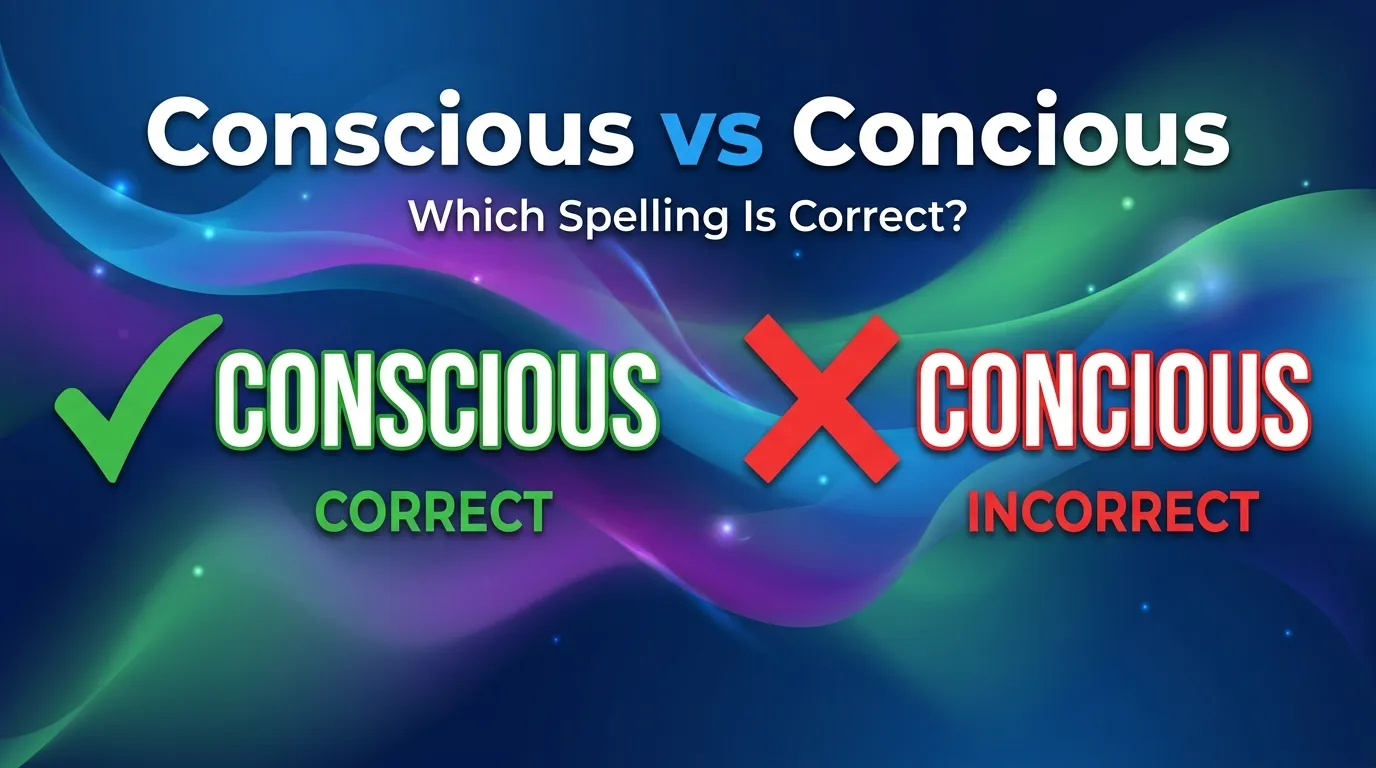
If you are wondering whether “conscious” or “concious” is the correct spelling, the answer is simple: conscious is the correct English spelling. Concious is a common misspelling, not a standard English word.
The word conscious can mean being awake and aware, noticing something, or deliberately thinking about an action or choice. For example, you might say, “She was conscious of the noise,” or “He made a conscious decision to save money.”
The confusion is understandable because the pronunciation does not make every letter obvious, and English contains many words with unusual spelling patterns. In conscious, the letters sc appear before ious, which can make it tempting to leave out the s and write concious.
This guide explains conscious vs concious in detail, including their meanings, pronunciation, grammar, history, synonyms, common phrases, examples, and the easiest ways to remember the correct spelling.
Quick Answer: Conscious or Concious?
Conscious is correct. Concious is incorrect.
| Spelling | Correct? | Meaning |
|---|---|---|
| conscious | ✅ Yes | Awake, aware, or deliberately aware of something |
| concious | ❌ No | Common misspelling of conscious |
Correct examples
- I was conscious of everyone watching me.
- She remained conscious after the accident.
- He made a conscious effort to listen.
- Are you conscious of how loud you are speaking?
Incorrect examples
- I was concious of everyone watching me.
- She remained concious after the accident.
- He made a concious effort to listen.
The correct spelling always contains “sci”:
conscious
A useful visual reminder is:
con + sci + ous = conscious
Not:
con + ci + ous = concious
What Does Conscious Mean?
Conscious is an adjective that generally describes a person who is awake, aware, or mentally alert.
It can also describe something done intentionally or deliberately.
For example:
The patient was conscious after the operation.
Here, conscious means awake and responsive.
But consider:
She made a conscious choice to apologize.
Here, conscious means deliberate or intentional.
So the word has several closely related uses.
Main meanings of conscious
- Awake and able to respond
- The driver was still conscious.
- Aware of something
- He was conscious of the cold.
- Aware of one’s own thoughts or actions
- She became conscious of her mistake.
- Deliberate or intentional
- They made a conscious effort to improve.
- Related to the conscious mind
- The thought entered his conscious awareness.
The exact meaning depends on context.
Why Is “Concious” Incorrect?
Concious is usually created by accidentally dropping the s from conscious.
The correct spelling contains:
c-o-n-s-c-i-o-u-s
The incorrect form is:
c-o-n-c-i-o-u-s
The missing s is the key problem.
This mistake often happens because people pronounce conscious without clearly hearing every letter. In normal speech, the spelling does not sound as obvious as it looks.
English spelling also contains many words where pronunciation and spelling do not perfectly match. As a result, someone who has mainly heard the word spoken may reasonably guess the spelling as concious.
However, concious is not an accepted standard spelling in modern American English or standard British English.
Conscious vs Concious: Key Difference
The simplest distinction is:
Conscious = correct spelling
Concious = misspelling
There is no meaningful difference in definition, tone, or grammatical function because concious is not a standard alternative spelling.
Comparison
| Feature | Conscious | Concious |
|---|---|---|
| Standard English word | Yes | No |
| Correct spelling | Yes | No |
| Used in American English | Yes | No |
| Used in British English | Yes | No |
| Used in academic writing | Yes | No |
| Used in business writing | Yes | No |
| Used in journalism | Yes | No |
| Can appear in dictionaries as a standard word | Yes | No |
| Meaning | Awake, aware, deliberate | None as a standard word |
If you are writing an essay, email, report, article, résumé, website, or professional document, always use conscious.
Conscious: Dictionary-Style Definition
conscious
Part of speech: Adjective
Pronunciation: /ˈkɑːn.ʃəs/ in American English
Basic definition:
Having awareness of one’s surroundings, thoughts, feelings, or actions; awake and mentally responsive.
Additional definition:
Done deliberately or with awareness.
Examples
- The patient was conscious but unable to speak.
- I am conscious of the time.
- She is very conscious of her appearance.
- We made a conscious effort to reduce waste.
How Do You Pronounce Conscious?
In American English, conscious is commonly pronounced approximately:
KON-shus
The first syllable sounds similar to con, while the second syllable sounds like shus.
The spelling contains more letters than you may hear clearly:
con-scious
This is one reason the spelling can be difficult.
Does conscious sound like “concious”?
In speech, the two spellings would normally be pronounced the same if someone wrote concious as a spelling mistake.
That does not make concious correct.
English spelling is not always predictable from pronunciation. A word can sound one way while retaining letters that are not strongly heard.
Why Do People Confuse Conscious and Concious?
Several factors contribute to the mistake.
1. The “sc” spelling is easy to overlook
The middle of the word is:
sci
People sometimes remember only the sound and write:
ci
instead.
2. Pronunciation hides the spelling
The word is pronounced approximately KON-shus, not “con-ski-ous.”
Because the s is not pronounced as a separate strong sound, it is easy to forget.
3. English has inconsistent spelling patterns
English contains many words whose spellings cannot be predicted perfectly from pronunciation.
For example:
- knowledge
- enough
- through
- psychology
- conscious
Learning the standard spelling is often more reliable than trying to spell the word purely from sound.
4. The ending “-ious” creates uncertainty
Words such as:
- curious
- serious
- obvious
- delicious
- various
end in -ious.
This can make people expect conscious to follow the simpler pattern con + cious.
It does not.
The correct form is:
con + sci + ous
The Easiest Memory Trick for Conscious
Here is a simple spelling trick:
Remember “SCI” in conscious
Think:
You need SCIence to remember your conscious mind.
The word conscious contains SCI:
con + SCI + ous
Another useful trick is to break it visually into parts:
CON-SCI-OUS
Whenever you are unsure whether the middle contains an s, remember:
conscious has SCI inside it.
A second memory trick
Think of:
“I am conscious, so I can see.”
The word see can remind you of SCI.
It is not a linguistic rule, but it is a useful spelling aid.
Conscious as an Adjective
Conscious is primarily an adjective.
It describes a person’s state of awareness or something done intentionally.
Examples
- He was fully conscious.
- She remained conscious throughout the procedure.
- I am conscious of the risks.
- They made a conscious decision.
- He became conscious of the problem.
Because conscious is an adjective, it commonly appears before a noun or after a linking verb.
Before a noun
She made a conscious decision.
After a linking verb
She was conscious of the problem.
Conscious vs Aware
Conscious and aware are closely related, but they are not always interchangeable.
Conscious
Often emphasizes a state of awareness or deliberate thought.
He was conscious of the danger.
Aware
Usually emphasizes knowing or recognizing something.
He was aware of the danger.
Both sentences are natural.
However, conscious can also refer to being awake:
The patient is conscious.
You generally would not use aware in exactly the same way.
Conscious vs Unconscious
The most direct opposite of conscious is unconscious.
| Conscious | Unconscious |
|---|---|
| Awake | Not awake |
| Aware | Unaware |
| Deliberate | Not deliberate |
| Mentally responsive | Not mentally responsive |
Examples
The injured man was conscious.
The injured man was unconscious.
The word can also describe mental processes.
She made a conscious decision.
His reaction seemed unconscious.
Conscious vs Conscience
Another word frequently confused with conscious is conscience.
These words are related historically, but they have different meanings.
Conscious
Means aware, awake, or deliberate.
I am conscious of my responsibilities.
Conscience
Means a person’s inner sense of right and wrong.
His conscience told him to return the money.
Easy way to remember
Think:
- conscious = awareness
- conscience = morality
Compare
She was conscious of the mistake.
This means she knew about the mistake.
Her conscience bothered her after she lied.
This refers to her moral feelings.
Conscious vs Subconscious
Subconscious refers to mental processes that are not fully within conscious awareness.
Conscious
I consciously chose to walk home.
The person deliberately made the choice.
Subconscious
A subconscious fear influenced his decision.
The influence was not fully recognized or deliberate.
The related terms conscious, subconscious, and unconscious are often discussed in psychology and everyday descriptions of thought.
Consciousness: The Related Noun
The noun form of conscious is consciousness.
Conscious
She was conscious after the accident.
Consciousness
The doctors monitored her consciousness.
Consciousness refers broadly to the state or quality of being aware.
It can also refer to awareness of a particular issue.
For example:
Environmental consciousness has increased among consumers.
Consciously: The Adverb
The adverb form is consciously.
It means deliberately, intentionally, or with awareness.
Examples
- He consciously avoided the topic.
- She consciously changed her tone.
- They consciously chose a simpler design.
- I consciously tried to remain calm.
Word family
| Word | Part of speech | Example |
|---|---|---|
| conscious | Adjective | She is conscious of the problem. |
| consciously | Adverb | She consciously avoided it. |
| consciousness | Noun | His consciousness returned. |
| unconscious | Adjective | He was unconscious. |
| unconsciously | Adverb | She unconsciously copied his gesture. |
Common Collocations With Conscious
A collocation is a combination of words that commonly appear together.
Here are several natural collocations with conscious.
Conscious effort
She made a conscious effort to speak clearly.
This means a deliberate attempt.
Conscious decision
He made a conscious decision to leave early.
Conscious choice
Buying locally was a conscious choice.
Conscious awareness
The change entered her conscious awareness.
Conscious thought
The idea never entered his conscious thought.
Conscious mind
The memory was still present in her conscious mind.
Conscious of
He was conscious of the audience.
Self-conscious
She felt self-conscious during the presentation.
Common Phrases With Conscious
Several everyday expressions contain conscious.
Be conscious of
Means to be aware of something.
Be conscious of your surroundings.
Become conscious of
Means to begin noticing or understanding something.
He became conscious of the noise outside.
Make a conscious effort
Means to deliberately try to do something.
I made a conscious effort to arrive early.
Make a conscious decision
Means to decide deliberately.
She made a conscious decision to change careers.
Conscious of one’s surroundings
Means aware of what is happening around you.
Hikers should remain conscious of their surroundings.
Self-conscious
Means overly aware of yourself, especially because you feel nervous or embarrassed.
He became self-conscious when everyone looked at him.
Conscious and Self-Conscious: What Is the Difference?
These words look similar but have different uses.
Conscious means aware.
I am conscious of the problem.
Self-conscious often means uncomfortable because you are overly aware of yourself or how others might perceive you.
She felt self-conscious about speaking in public.
Someone can be conscious without being self-conscious.
For example:
He was conscious during the entire interview but did not feel self-conscious.
Conscious in Formal and Informal Writing
Conscious is a standard word suitable for virtually every variety of English.
Academic writing
Researchers examined participants’ conscious awareness of the stimulus.
Business writing
We should be conscious of the customer’s needs.
Journalism
The athlete remained conscious after the collision.
Technical writing
The system is designed to remain conscious of changes in operating conditions.
Blogging
Be conscious of how your word choices affect readers.
Casual conversation
I wasn’t conscious of the time.
The word itself is neither slang nor unusually formal.
American vs British English
There is no major spelling difference between American and British English for conscious.
Both standard varieties use:
conscious
Not:
concious
So whether you are writing for readers in the United States, United Kingdom, Canada, Australia, or elsewhere, conscious is the standard spelling.
The pronunciation may vary slightly by region, but the spelling remains the same.
Conscious in Academic Writing
The word is common in academic discussions involving:
- psychology
- philosophy
- neuroscience
- medicine
- sociology
- education
- behavioral science
Examples:
Conscious awareness plays an important role in the study.
The researchers examined conscious decision-making.
The distinction between conscious and unconscious processes remains an important topic.
In academic writing, use conscious when you mean awareness or deliberate thought.
Do not replace it with the misspelling concious.
Conscious in Medicine and Health Writing
In medical contexts, conscious can describe whether someone is awake and responsive.
For example:
The patient was conscious and responsive.
Another common phrase is:
The patient regained consciousness.
Here, consciousness is the noun.
Related medical expressions
- conscious patient
- conscious and alert
- loss of consciousness
- regain consciousness
- level of consciousness
- remain conscious
The exact meaning depends on the medical context, but the spelling remains conscious.
Conscious in Psychology and Philosophy
The concept of consciousness has a much broader meaning in psychology and philosophy.
It can involve:
- awareness
- perception
- thoughts
- sensations
- self-awareness
- intentional attention
- mental experience
For example:
Philosophers have debated the nature of conscious experience for centuries.
The adjective remains conscious, while the noun is consciousness.
Conscious in Business and Professional Writing
Professionals often use conscious to describe deliberate choices or awareness.
Examples
We are conscious of the need to reduce costs.
The company made a conscious effort to improve customer service.
Managers should be conscious of employee workload.
The design reflects a conscious decision to simplify navigation.
A more direct alternative may sometimes be preferable.
Instead of:
We are conscious of the importance of efficiency.
You could write:
We recognize the importance of efficiency.
Both are grammatical, but recognize may sound more direct in some professional contexts.
Conscious in Environmental Writing
The expression environmentally conscious is common.
It describes someone who is aware of environmental effects and tries to make environmentally responsible choices.
Examples
- environmentally conscious consumers
- environmentally conscious brands
- environmentally conscious products
- environmentally conscious decisions
Example:
More environmentally conscious consumers are looking for products with less packaging.
The phrase is widely used in marketing, journalism, business, and everyday writing.
Conscious in Sports Writing
The word is also common in sports contexts.
Physical awareness
The player remained conscious after the collision.
Deliberate strategy
The team made a conscious effort to control possession.
Awareness of performance
The athlete became more conscious of her footwork.
Sports writing therefore uses both major meanings of conscious: awake/alert and deliberate/aware.
Conscious in Political and Social Writing
The word may also appear in discussions of social awareness.
Examples include:
- socially conscious
- politically conscious
- class-conscious
- culturally conscious
- environmentally conscious
For example:
The campaign appealed to socially conscious voters.
These expressions generally describe awareness of a particular social, political, cultural, or ethical issue.
The word itself is not inherently political. Its meaning comes from the noun or adjective that accompanies it.
Synonyms for Conscious
The best synonym depends on the intended meaning.
When conscious means awake
Possible alternatives include:
- awake
- alert
- responsive
- sentient
Example:
The patient was conscious.
Possible rewrite:
The patient was awake and responsive.
When conscious means aware
Possible alternatives include:
- aware
- mindful
- informed
- attentive
- cognizant
Example:
She was conscious of the risk.
Possible rewrite:
She was aware of the risk.
When conscious means deliberate
Possible alternatives include:
- deliberate
- intentional
- purposeful
- considered
- planned
Example:
It was a conscious decision.
Possible rewrite:
It was a deliberate decision.
Antonyms of Conscious
Depending on the meaning, antonyms include:
- unconscious
- unaware
- oblivious
- unintentional
- accidental
- inattentive
These are not perfect opposites in every context.
For example:
He was conscious of the danger.
The opposite could be:
He was unaware of the danger.
But:
She made a conscious decision.
The opposite might be:
She made an unconscious or unintentional choice.
Common Mistakes With Conscious
Mistake 1: Writing “concious”
❌ He was concious of the problem.
✅ He was conscious of the problem.
Mistake 2: Confusing conscious with conscience
❌ My conscious bothered me after I lied.
✅ My conscience bothered me after I lied.
Mistake 3: Confusing conscious with consciousness
❌ His conscious returned.
✅ His consciousness returned.
Mistake 4: Using aware when you mean awake
❌ The patient was aware after the accident.
This can mean something different from being awake and responsive.
Better:
✅ The patient was conscious after the accident.
Awkward vs Natural Examples
Seeing the word in context makes the distinction easier.
Awkward
She made a concious decision to leave.
Natural
She made a conscious decision to leave.
Awkward
I wasn’t concious of the noise.
Natural
I wasn’t conscious of the noise.
Awkward
He lost his conscious.
Natural
He lost consciousness.
Awkward
His conscious bothered him.
Natural
His conscience bothered him.
Real-World Examples of Conscious
Here are natural examples across different contexts.
Everyday English
I wasn’t conscious of how late it had become.
School
She made a conscious effort to improve her writing.
Workplace
We need to be conscious of the deadline.
Business
The company made a conscious decision to simplify its pricing.
Health
The patient remained conscious throughout the examination.
Psychology
The study examined conscious awareness.
Environment
Consumers are becoming more environmentally conscious.
Sports
The coach made a conscious effort to give younger players more time.
Social discussion
He became more socially conscious after volunteering.
Journalism
The athlete was conscious and speaking with reporters afterward.
Is “Concious” Ever Correct?
In standard modern English, no.
If you are writing in English, treat concious as a spelling error and correct it to conscious.
You may occasionally see concious in:
- social media posts
- informal messages
- comments
- user-generated websites
- search queries
- student writing
- poorly edited documents
Its appearance does not make it a legitimate alternative spelling.
Is Conscious a Difficult Word to Spell?
For many learners, yes.
The difficulty comes mainly from the relationship between its spelling and pronunciation.
Instead of trying to spell it from sound, memorize the visual pattern:
CON-SCI-OUS
The important section is SCI.
Spell it aloud
C-O-N-S-C-I-O-U-S
Practicing the complete sequence can help make the spelling automatic.
A Simple Rule for Remembering Conscious
When you need the word, ask:
“Does it contain SCI?”
If the answer is yes, you have the correct spelling:
conscious
If you write:
concious
you have dropped the s.
One-line memory rule
Conscious has “SCI” in the middle.
That is the easiest spelling rule to remember.
Conscious vs Concious: Final Comparison
| Question | Conscious | Concious |
|---|---|---|
| Is it correctly spelled? | ✅ Yes | ❌ No |
| Is it a standard English word? | ✅ Yes | ❌ No |
| Means awake? | ✅ Yes | — |
| Means aware? | ✅ Yes | — |
| Means deliberate? | ✅ Yes | — |
| Used in American English? | ✅ Yes | ❌ No |
| Used in British English? | ✅ Yes | ❌ No |
| Suitable for academic writing? | ✅ Yes | ❌ No |
| Suitable for business writing? | ✅ Yes | ❌ No |
| Suitable for casual writing? | ✅ Yes | ❌ No |
| Contains “sci”? | ✅ Yes | ❌ No |
Word History and Etymology of Conscious
Conscious ultimately comes from Latin conscius, meaning roughly “knowing with” or “knowing together.”
It is related to the Latin elements associated with knowledge and knowing. The word developed through French and entered English centuries ago.
Its historical connection to knowledge helps explain its modern meanings.
Today, being conscious of something means being aware of or mentally informed about it.
The related noun consciousness developed to describe the state or quality of being conscious.
Although English spelling has changed over time, the standard modern form is:
conscious
The misspelling concious does not represent a separate historical English form that should be used today.
Frequently Asked Questions About Conscious vs Concious
1. Is it conscious or concious?
Conscious is the correct spelling. Concious is a common misspelling.
Example:
She was conscious of the mistake.
2. What is the difference between conscious and concious?
There is no standard meaning difference because conscious is the correct English word, while concious is a misspelling.
Use conscious in all standard English writing.
3. How do you spell conscious correctly?
The correct spelling is:
C-O-N-S-C-I-O-U-S
A useful way to remember it is:
CON-SCI-OUS
The middle contains SCI.
4. Why do people spell conscious as concious?
People often omit the s because the pronunciation does not clearly reveal every letter. The word sounds approximately like KON-shus, making the spelling easy to guess incorrectly.
5. Is concious a word in English?
Concious is not a standard English spelling. It is generally considered a misspelling of conscious.
6. Does conscious mean awake?
Yes. Conscious can mean awake and mentally responsive.
For example:
The patient was conscious after the accident.
It can also mean aware or deliberate.
7. What is the difference between conscious and conscience?
Conscious means aware, awake, or deliberate.
Conscience refers to a person’s inner sense of right and wrong.
For example:
I was conscious of the problem.
My conscience bothered me.
8. What is the opposite of conscious?
The most direct opposite is unconscious.
Depending on context, other opposites may include unaware, oblivious, or unintentional.
9. What is the noun form of conscious?
The noun is consciousness.
Example:
The patient regained consciousness.
10. Is conscious spelled the same in American and British English?
Yes. Conscious has the same standard spelling in both American and British English.
There is no standard regional spelling concious.
Conclusion: Conscious vs Concious
When choosing between conscious vs concious, there is no difficult spelling debate: conscious is correct, and concious is a misspelling.
The correct word is spelled:
C-O-N-S-C-I-O-U-S
It commonly means awake, aware, or deliberate.
You can use conscious in everyday conversation, academic writing, business communication, journalism, technical writing, sports reporting, blogging, and professional documents. The spelling does not change between standard American and British English.
The biggest spelling challenge is the middle of the word. Many writers accidentally remove the s because the pronunciation sounds roughly like “KON-shus.” The easiest solution is to remember the sequence:
CON-SCI-OUS
Think SCI whenever you need to spell conscious.
Also keep conscious separate from related but different words:
- conscious = aware, awake, deliberate
- consciousness = the state of being conscious
- conscience = an inner sense of right and wrong
- consciously = deliberately or with awareness
- unconscious = not conscious or not deliberate
- subconscious = mental activity outside ordinary conscious awareness
So, if you are writing a sentence such as “She was ___ of the problem,” the correct answer is:
She was conscious of the problem.
Never concious.
When in doubt, remember the simple rule: conscious has “SCI” in the middle.


