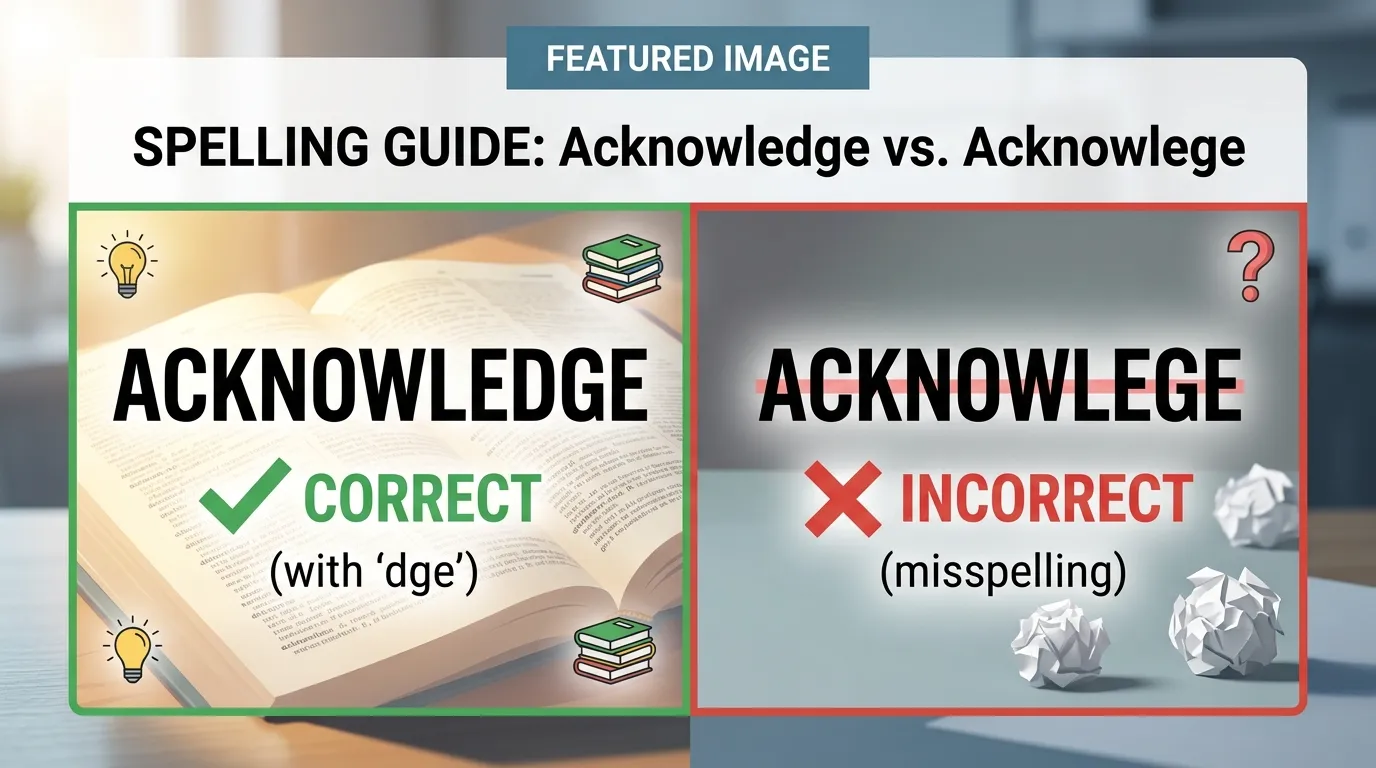
If you are unsure whether the correct spelling is acknowledge or acknowlege, the answer is simple: acknowledge is the correct spelling in standard English. Acknowlege is a common misspelling and should not be used in formal or edited writing.
The confusion happens because the word is pronounced in a way that can make the spelling difficult to remember. The letters dg in acknowledge are also easy to overlook when typing quickly.
In this guide, you will learn the difference between acknowledge and acknowlege, what acknowledge means, how to pronounce it, where the word comes from, how to use it in everyday and professional English, and how to avoid the spelling mistake permanently.
Quick Answer: Acknowledge vs. Acknowlege
Acknowledge is the correct spelling.
Acknowlege is incorrect.
| Spelling | Correct? | Meaning |
|---|---|---|
| acknowledge | ✅ Yes | To recognize, accept, admit, or show that you are aware of something |
| acknowlege | ❌ No | Common misspelling of acknowledge |
Correct examples
- I acknowledge your concerns.
- She acknowledged that she had made a mistake.
- Please acknowledge receipt of this email.
- The company acknowledged the customer’s complaint.
- He nodded to acknowledge her presence.
Incorrect example
- I acknowlege your concerns. ❌
The correct version is:
- I acknowledge your concerns. ✅
A useful spelling pattern to remember is:
acknow + ledge = acknowledge
The ending is -ledge, not -lege.
What Does “Acknowledge” Mean?
The verb acknowledge has several closely related meanings. At its most basic level, it means to recognize or accept something as true, real, valid, or known.
Depending on the context, it can also mean to show that you have noticed someone or something.
Dictionary-style definition
Acknowledge (verb):
- To recognize or admit that something is true or exists.
- To show that you have noticed or received something.
- To express recognition or appreciation.
- To accept responsibility for something.
- To confirm receipt of something, especially in formal communication.
Examples
Recognize something:
The manager acknowledged the problem.
This means the manager recognized or admitted that the problem existed.
Admit something:
He acknowledged that he was wrong.
Here, acknowledged means he admitted the truth.
Show awareness:
She smiled to acknowledge her friend.
Here, the person showed that she noticed her friend.
Confirm receipt:
Please acknowledge receipt of the documents.
This means the recipient should confirm that the documents were received.
Express appreciation:
The author acknowledged the help of her research team.
Here, acknowledged means the author publicly recognized the team’s contribution.
Why Do People Confuse “Acknowledge” and “Acknowlege”?
The main reason is that acknowledge is not spelled exactly the way many people expect it to sound.
When spoken quickly, the middle of the word can be difficult to hear clearly. The pronunciation may make the spelling appear closer to acknowlege, even though the correct spelling contains d.
The correct word is:
a-c-k-n-o-w-l-e-d-g-e
The incorrect form is:
a-c-k-n-o-w-l-e-g-e
The important difference is the d before g.
Compare the endings
- acknowledge ✅
- acknowlege ❌
The ending -ledge is the part that many writers forget.
This is similar to other English words where pronunciation does not provide a perfect guide to spelling.
Acknowledge vs. Acknowlege: The Key Difference
There is actually no difference in meaning between the two forms because acknowlege is not a standard English word.
The distinction is simply one of correctness.
Acknowledge
Correct standard English spelling.
We acknowledge your request.
Acknowlege
Incorrect spelling.
We acknowlege your request.
If you see acknowlege in a message, essay, website, email, or document, it is almost certainly a spelling error rather than an alternative form of the word.
How to Spell Acknowledge Correctly
The spelling can look intimidating, but breaking it into parts makes it easier.
Acknowledge
ACK + NOW + LEDGE
Or think of it as:
acknow + ledge
The final part is spelled:
ledge
Just like the word ledge:
The bird landed on the window ledge.
So you can remember:
Acknowledge ends with LEDGE.
Not:
Acknowlege
Letter-by-letter spelling
A-C-K-N-O-W-L-E-D-G-E
There are 10 letters in acknowledge.
Pronunciation of “Acknowledge”
In American English, acknowledge is commonly pronounced approximately like:
ak-NOL-ij
The first syllable is stressed:
ACK-now-ledge
The pronunciation does not strongly emphasize every letter in the written form. This is one reason people may leave out the d when spelling it.
The final part sounds approximately like “lij”, but it is spelled -ledge.
Pronunciation vs. spelling
| Part | Spelling | Approximate sound |
|---|---|---|
| First | ack | ack |
| Middle | now | nol |
| Ending | ledge | lij |
Do not use pronunciation alone to reconstruct the spelling. Remember the written ending -ledge.
Is “Acknowledge” a Verb?
Yes. Acknowledge is a verb.
It describes an action such as recognizing, admitting, confirming, or showing awareness.
Common forms of the verb
| Form | Example |
|---|---|
| Base form | acknowledge |
| Third-person singular | acknowledges |
| Past tense | acknowledged |
| Present participle | acknowledging |
| Past participle | acknowledged |
Examples
Present:
I acknowledge the importance of your point.
Third person:
She acknowledges that the situation is difficult.
Past tense:
He acknowledged his mistake.
Present participle:
They are acknowledging the concerns of their customers.
Past participle:
The issue has been acknowledged by management.
Acknowledge in Different Contexts
The exact meaning of acknowledge changes slightly depending on context.
1. Acknowledge a Fact
This means to accept or recognize something as true.
The report acknowledges that the project experienced delays.
Here, the report recognizes the fact.
Another example:
She acknowledged that the original estimate was incorrect.
This means she admitted the estimate was wrong.
2. Acknowledge a Mistake
This is one of the most common uses.
He acknowledged his mistake and apologized.
The phrase suggests honesty and acceptance of responsibility.
You might also say:
- acknowledge an error
- acknowledge a mistake
- acknowledge responsibility
- acknowledge a problem
- acknowledge a failure
Example
The company acknowledged the error and promised to correct it.
This sounds professional and neutral.
3. Acknowledge Someone’s Presence
Here, acknowledge means to show that you have noticed someone.
She waved to acknowledge her neighbor.
You can also acknowledge someone with:
- a nod
- a smile
- a wave
- eye contact
- a greeting
Example
The speaker acknowledged the audience with a brief smile.
4. Acknowledge Receipt
This is particularly common in business and formal communication.
Please acknowledge receipt of this letter.
It means:
Please confirm that you received this letter.
You may see similar expressions such as:
- acknowledge receipt of an email
- acknowledge receipt of payment
- acknowledge receipt of documents
- acknowledge receipt of an application
- acknowledge receipt of a request
Business example
We acknowledge receipt of your application and will contact you after the review process.
This is formal and appropriate for professional communication.
5. Acknowledge Someone’s Contribution
The word can also mean to give credit or recognition.
The researcher acknowledged the contributions of her colleagues.
Authors often acknowledge people who helped with:
- research
- writing
- editing
- funding
- technical assistance
- organization
This is why books and academic papers often contain an Acknowledgments section.
Acknowledgment vs. Acknowledgement
Once you learn acknowledge, another spelling question may appear:
acknowledgment or acknowledgement?
Both forms are recognized in English, but there is an important regional difference.
American English
acknowledgment is the preferred spelling.
British English
acknowledgement is commonly used.
| Word | American English | British English |
|---|---|---|
| acknowledge | ✅ | ✅ |
| acknowledgment | ✅ Preferred | Less common |
| acknowledgement | Used, but less preferred | ✅ Common |
The verb itself remains:
acknowledge
There is no standard American spelling acknowlege.
Acknowledge in American English
For American English, use:
acknowledge
Examples:
We acknowledge your request.
The company acknowledged the issue.
I acknowledge receipt of your email.
For the noun, American writers generally prefer:
acknowledgment
Example:
The book includes an acknowledgment section.
If you are writing for an American audience, consistency is more important than mixing regional conventions.
Acknowledge in British English
British English also uses:
acknowledge
The main difference often appears in the noun:
acknowledgement
For example:
The report included an acknowledgement of the team’s contribution.
The extra e is associated with the noun form, not with the verb.
Therefore, do not conclude that acknowlege is a British spelling. It is not.
Important distinction
British:
acknowledge ✅
American:
acknowledge ✅
Incorrect:
acknowlege ❌
Formality and Tone of “Acknowledge”
Acknowledge is a neutral-to-formal word. It is widely accepted in everyday, academic, business, legal, technical, and professional English.
It can sometimes sound more formal than simpler alternatives such as:
- notice
- admit
- accept
- recognize
- confirm
Compare the tone
Casual:
I know you have a point.
Neutral:
I recognize your point.
More formal:
I acknowledge your point.
All three can work, but the last one has a more formal and deliberate tone.
Acknowledge vs. Recognize
These words are often synonyms, but they are not always interchangeable.
Acknowledge
Usually emphasizes accepting, admitting, or showing awareness.
She acknowledged that the plan had problems.
Recognize
Often emphasizes identifying, understanding, or appreciating something.
She recognized the warning signs.
You can often use either word, but the emphasis may change.
Compare
The manager acknowledged the complaint.
This suggests the manager recognized or accepted that the complaint existed.
The manager recognized the employee’s achievement.
This emphasizes appreciation or credit.
Acknowledge vs. Admit
These words overlap when someone accepts that something is true.
Admit
Often suggests accepting something that may be unfavorable, embarrassing, or previously denied.
He admitted that he had lied.
Acknowledge
Usually sounds more neutral.
He acknowledged that the information was incomplete.
Acknowledge does not necessarily imply guilt or wrongdoing.
Acknowledge vs. Confirm
These words are also closely related.
Confirm
Means to verify or establish that something is correct or true.
Please confirm your appointment.
Acknowledge
Can simply mean that you have received or noticed something.
Please acknowledge receipt of the appointment details.
The second sentence focuses on receipt, while confirm can suggest verification.
Common Collocations With “Acknowledge”
A collocation is a group of words that commonly appear together.
Learning collocations can make your English sound more natural.
Common combinations
- acknowledge a mistake
- acknowledge an error
- acknowledge a problem
- acknowledge a concern
- acknowledge a fact
- acknowledge the truth
- acknowledge responsibility
- acknowledge receipt
- acknowledge a request
- acknowledge an email
- acknowledge someone’s contribution
- acknowledge someone’s efforts
- acknowledge someone’s presence
- acknowledge a debt
- acknowledge a limitation
- acknowledge a weakness
- acknowledge a difference
- acknowledge a need
- acknowledge an achievement
- acknowledge the importance of something
Examples
The author acknowledged the limitations of the study.
The company acknowledged customer concerns.
She acknowledged his efforts.
We acknowledge receipt of your message.
The team acknowledged the importance of preparation.
Common Phrases With “Acknowledge”
Here are several useful expressions containing acknowledge.
Acknowledge receipt
Please acknowledge receipt of the attached documents.
Acknowledge responsibility
The organization acknowledged responsibility for the mistake.
Acknowledge a mistake
It takes courage to acknowledge a mistake.
Acknowledge someone’s efforts
The manager acknowledged the team’s efforts.
Acknowledge the importance of
The report acknowledges the importance of accurate data.
Acknowledge the fact that
She acknowledged the fact that the deadline had passed.
The phrase “acknowledge the fact that” is grammatical, but it can sometimes be wordy. In many cases, simply using “acknowledge that” is cleaner.
Instead of:
He acknowledged the fact that he was late.
You can write:
He acknowledged that he was late.
Common Mistakes With “Acknowledge”
Mistake 1: Writing “Acknowlege”
❌ I acknowlege your message.
✅ I acknowledge your message.
Why? The correct ending is -ledge.
Mistake 2: Removing the “d”
❌ Acknowlege
✅ Acknowledge
The d belongs in the spelling.
Mistake 3: Adding an unnecessary extra letter
Writers sometimes create forms such as:
❌ acknowladge
❌ acknowlidge
❌ acknowlege
The standard spelling is:
✅ acknowledge
Mistake 4: Confusing “Acknowledgment” With “Acknowlege”
The noun may be spelled:
acknowledgment
or, especially in British English:
acknowledgement
But neither changes the spelling of the verb.
Awkward vs. Natural Examples
Sometimes the issue is not spelling but word choice.
Awkward
I acknowledge to you that your email was received.
More natural
I acknowledge receipt of your email.
Or:
I confirm that I received your email.
Awkward
She acknowledged him that he was correct.
Natural
She acknowledged that he was correct.
Or:
She acknowledged his point.
Awkward
He acknowledged about the problem.
Natural
He acknowledged the problem.
Or:
He acknowledged that there was a problem.
The verb acknowledge usually does not require about in these structures.
Everyday Examples of “Acknowledge”
You do not have to use acknowledge only in formal writing.
At work
I acknowledge your request and will review it today.
In conversation
She nodded to acknowledge me.
In an argument
I acknowledge that you have a valid point.
In school
The student acknowledged the teacher’s feedback.
In customer service
We acknowledge your complaint and are investigating the issue.
In sports
The player acknowledged the crowd after scoring.
On social media
The organization acknowledged the public response to its announcement.
Formal vs. Informal Alternatives
Sometimes acknowledge is the best word. Other times, a simpler word sounds more natural.
| Formal | Neutral | Informal |
|---|---|---|
| acknowledge | recognize | notice |
| acknowledge receipt | confirm receipt | got it |
| acknowledge an error | admit an error | admit the mistake |
| acknowledge a concern | recognize a concern | understand the concern |
| acknowledge someone’s presence | greet someone | say hi |
Professional example
We acknowledge receipt of your application.
Simpler version
We received your application.
Both are correct. The second is more direct.
Acknowledge in Business Writing
Acknowledge is especially useful in professional communication because it can sound respectful without automatically accepting blame.
For example:
We acknowledge your concerns and are reviewing the matter.
This does not necessarily mean:
We agree with everything you said.
It means the concerns have been recognized.
Useful business phrases
- We acknowledge your request.
- We acknowledge receipt of your email.
- We acknowledge your concerns.
- We acknowledge the delay.
- We acknowledge the error.
- We acknowledge the importance of this matter.
- We acknowledge your contribution.
- We acknowledge your continued support.
Acknowledge in Academic Writing
Academic writers frequently use acknowledge when discussing limitations, opposing views, evidence, or contributions.
Examples
The study acknowledges several limitations.
Researchers acknowledge that additional evidence is needed.
The author acknowledges the influence of earlier studies.
This analysis acknowledges alternative interpretations of the data.
It is useful because it allows writers to recognize another position without necessarily agreeing with it.
Acknowledge in Journalism
Journalistic writing may use acknowledge when reporting what a person, organization, official, or institution has admitted or recognized.
Examples:
Officials acknowledged that the system had experienced problems.
The company acknowledged the allegations but denied wrongdoing.
The coach acknowledged that the team had struggled in the second half.
In journalism, the word often signals that a fact or criticism has been publicly recognized.
Acknowledge in Technical Writing
Technical documentation can use acknowledge to describe confirmation, recognition, or system behavior.
For example:
The device sends a signal to acknowledge receipt of the command.
Or:
The server acknowledges the request before processing the next operation.
In technical contexts, acknowledgment may refer to a confirmation message or signal.
For example:
The system waits for an acknowledgment from the server.
Acknowledge in Sports
Sports writing commonly uses the word in the sense of recognizing fans, opponents, achievements, mistakes, or difficult circumstances.
Examples:
The player acknowledged the fans after the final whistle.
The coach acknowledged the team’s poor first half.
The captain acknowledged the opponent’s strong defense.
The athlete acknowledged the support of her teammates.
Here, acknowledge can mean recognize, admit, or show appreciation depending on the sentence.
Does “Acknowledge” Have a Slang Meaning?
No major standard slang meaning is associated with acknowledge.
It is primarily a standard English verb used in everyday and formal communication.
In casual speech, people may use shorter alternatives such as:
- know
- notice
- admit
- accept
- recognize
- see
- get
For example:
I acknowledge your point.
may become:
I see your point.
or:
I get your point.
The shorter versions are more conversational.
Can “Acknowledge” Be Used Figuratively?
Yes. Acknowledge can be used in broader or figurative contexts when someone recognizes an idea, influence, importance, or reality.
For example:
We must acknowledge the importance of education.
Nobody is physically recognizing an object. The sentence means we must recognize or accept its importance.
Another example:
The industry has acknowledged the changing role of technology.
This means the industry has recognized that the change is real and important.
Word History and Etymology of “Acknowledge”
The history of acknowledge helps explain why its spelling is not as simple as its pronunciation.
The word developed in Middle English and is related to the older expression acknow or know, with the sense of recognizing or admitting knowledge of something.
The modern spelling evolved over time and eventually became acknowledge.
The word is historically connected with the idea of recognizing something as known or accepted.
This explains why its meanings today include:
- recognize
- admit
- accept
- confirm
- show awareness
- give credit
English spelling often preserves historical forms even when pronunciation changes. That is one reason acknowledge cannot simply be spelled according to how it sounds.
Synonyms for “Acknowledge”
The best synonym depends on the intended meaning.
When you mean “recognize”
- recognize
- notice
- identify
- perceive
When you mean “admit”
- admit
- accept
- concede
- confess
When you mean “confirm”
- confirm
- verify
- validate
- certify
When you mean “give credit”
- recognize
- credit
- appreciate
- honor
When you mean “show awareness”
- notice
- recognize
- signal
- respond to
Be careful: these words are not perfect replacements in every sentence.
Antonyms of “Acknowledge”
Possible opposites include:
- deny
- ignore
- reject
- disregard
- overlook
- conceal
- dispute
- refuse
- dismiss
Again, the correct antonym depends on the context.
For example:
He acknowledged the problem.
The opposite could be:
He denied the problem.
But if acknowledge means noticing someone, the opposite could be:
He ignored the person.
Related Words
Several common English words come from the same word family.
Acknowledge
We acknowledge the problem.
Acknowledged
The problem was acknowledged.
Acknowledging
She is acknowledging the concerns.
Acknowledgment
The report contains an acknowledgment of the contribution.
Acknowledgement
The British spelling is commonly used in British English.
Acknowledger
This form exists but is uncommon and usually unnecessary in ordinary writing.
Memory Tricks for “Acknowledge”
If you repeatedly type acknowlege, use one of these memory tricks.
Memory Trick 1: Think “ledge”
The word ends with:
LEDGE
Just like:
window ledge
So:
acknow + ledge
Memory Trick 2: Remember “D before G”
The difficult section is:
DG
Think:
Acknowle-D-G-e
The D comes before the G.
Memory Trick 3: Break It Into Parts
Write it mentally as:
ACK + NOW + LEDGE
This makes the spelling easier than trying to memorize all ten letters at once.
Memory Trick 4: Use a Related Sentence
I acknowledge the ledge.
It is a silly sentence, but it can help you remember the -ledge ending.
Acknowledge vs. Acknowlege: Quick Comparison
| Feature | Acknowledge | Acknowlege |
|---|---|---|
| Standard English | ✅ Yes | ❌ No |
| Correct spelling | ✅ | ❌ |
| Verb | ✅ | ❌ |
| Meaning | Recognize, admit, confirm, show awareness | No standard meaning |
| American English | ✅ | ❌ |
| British English | ✅ | ❌ |
| Formal writing | ✅ | ❌ |
| Academic writing | ✅ | ❌ |
| Business writing | ✅ | ❌ |
| Casual writing | ✅ | ❌ |
| Pronunciation | Commonly “ack-NOL-ij” | Not a standard word |
Which Spelling Should You Use?
Use acknowledge in virtually every standard English context.
Use “acknowledge” in:
- emails
- essays
- reports
- academic papers
- business documents
- websites
- blogs
- applications
- journalism
- technical documentation
- legal writing
- social media
- everyday messages
Do not use:
acknowlege
unless you are deliberately discussing the misspelling itself.
For example:
Many learners accidentally spell acknowledge as acknowlege.
That is perfectly acceptable because you are referring to the incorrect spelling as an object of discussion.
How to Correct “Acknowlege” in Your Writing
If you find acknowlege in a document, replace it with:
acknowledge
Before
We acknowlege your concerns.
After
We acknowledge your concerns.
Before
The author acknowleges several limitations.
After
The author acknowledges several limitations.
Before
They acknowleged the problem.
After
They acknowledged the problem.
Notice that the -ed and -s forms also depend on the correct spelling of the base verb.
Frequently Asked Questions
1. Is “acknowlege” a correct spelling?
No. Acknowlege is a misspelling. The correct spelling is acknowledge, with d before g.
2. Is it “acknowledge” or “acknowlege”?
The correct spelling is acknowledge.
I acknowledge your message. ✅
I acknowlege your message. ❌
3. Why is “acknowledge” spelled with a D?
The spelling reflects the historical development of the word and its -ledge ending. Although the d may not be strongly noticeable in pronunciation, it is part of the standard spelling.
4. How do you pronounce “acknowledge”?
In American English, it is commonly pronounced approximately ack-NOL-ij, with the stress on the first syllable.
5. What does “acknowledge” mean?
It can mean to recognize, admit, accept, confirm, show awareness of, or give credit for something, depending on the context.
For example:
She acknowledged her mistake.
This means she admitted or recognized her mistake.
6. Is “acknowledgement” spelled correctly?
Yes. Acknowledgement is a standard spelling, especially in British English. In American English, acknowledgment is generally preferred.
The verb, however, is always:
acknowledge
7. Is “acknowledge” formal or informal?
Acknowledge is generally neutral to formal. It is common in professional, academic, business, and everyday English. In casual conversation, simpler words such as know, notice, admit, or recognize may sound more natural depending on the context.
8. What is a synonym for “acknowledge”?
Common synonyms include recognize, admit, accept, confirm, notice, concede, appreciate, and credit. The best choice depends on the intended meaning.
9. What is the opposite of “acknowledge”?
Possible opposites include deny, ignore, reject, disregard, overlook, and dismiss. The appropriate antonym depends on whether acknowledge means recognizing a fact, noticing someone, accepting responsibility, or confirming receipt.
10. How can I remember the spelling of “acknowledge”?
Remember that acknowledge ends in “ledge,” just like “window ledge.”
Think:
ACK + NOW + LEDGE = ACKNOWLEDGE
This helps prevent the common misspelling acknowlege.
Conclusion
When choosing between acknowledge vs. acknowlege, there is no real contest: acknowledge is the correct standard English spelling, while acknowlege is a misspelling.
The easiest way to remember the difference is to focus on the ending:
acknow-ledge
The d belongs before the g.
Acknowledge is a versatile verb that can mean recognize, admit, accept, confirm, notice, or give credit, depending on the context. It works naturally in American English as well as British and international English.
For American writing, use:
acknowledge
And for the noun, prefer:
acknowledgment
British English commonly uses:
acknowledgement
But do not confuse either noun form with the incorrect verb spelling acknowlege.
Whether you are writing an email, academic essay, business report, blog post, technical document, news article, or casual message, the safest rule is simple:
Always spell the verb “acknowledge” with the “d.”
If you remember “acknowledge ends with LEDGE,” you will be much less likely to make this common spelling mistake.


