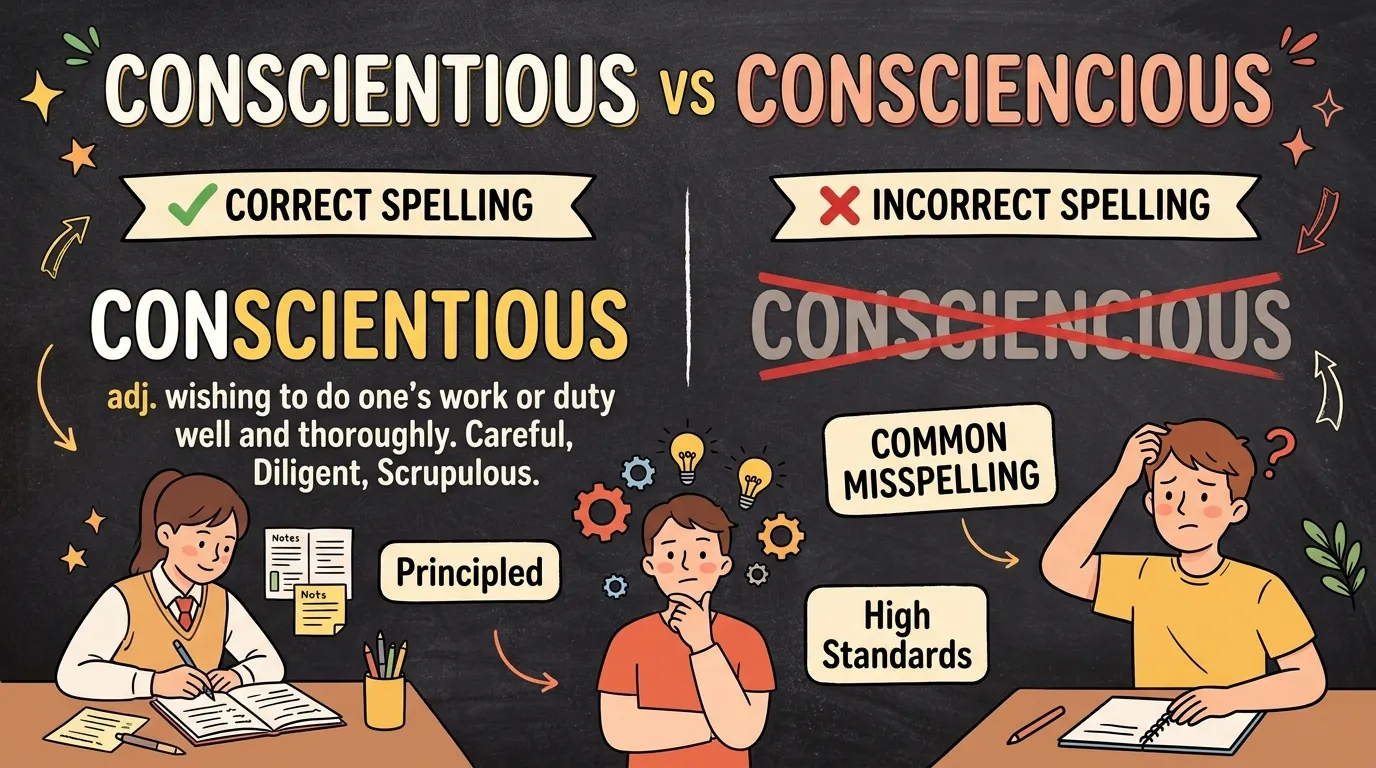
If you are wondering whether “conscientious” or “consciencious” is the correct spelling, the answer is simple: conscientious is correct. Consciencious is a misspelling and should not be used in standard American English.
The confusion is understandable because the word is closely related to conscience, and many people naturally expect the spelling to contain an extra c: consciencious. However, the correct adjective is conscientious, spelled:
C-O-N-S-C-I-E-N-T-I-O-U-S
Conscientious means careful, responsible, thorough, and guided by a strong sense of duty or what is right.
For example:
- She is a conscientious employee who always checks her work.
- He is conscientious about meeting deadlines.
- The student was conscientious and prepared for every exam.
In this guide, you will learn why conscientious is correct, why consciencious is commonly misspelled, how to pronounce the word, how to use it naturally, and how it differs from related words such as conscious, conscience, careful, diligent, and responsible.
Quick Answer: Conscientious or Consciencious?
Conscientious is the correct spelling.
Consciencious is incorrect in standard English.
| Spelling | Correct? | Meaning |
|---|---|---|
| conscientious | ✅ Yes | Careful, responsible, thorough, and guided by duty |
| consciencious | ❌ No | Common misspelling of conscientious |
Correct example
Maria is a conscientious worker who pays close attention to every detail.
Incorrect example
Maria is a consciencious worker. ❌
The correct form is:
Maria is a conscientious worker. ✅
If you only remember one thing, remember this:
There is no “c” after “conscien” in conscientious.
What Does Conscientious Mean?
Conscientious is an adjective describing someone who takes their responsibilities seriously and makes a careful effort to do things properly.
A conscientious person usually:
- pays attention to details,
- follows through on responsibilities,
- works carefully,
- tries to do the right thing,
- takes obligations seriously,
- avoids careless mistakes, and
- puts consistent effort into their work.
Dictionary-style definition
Conscientious (adjective):
Careful, responsible, and thorough in carrying out one’s duties or obligations, especially because of a strong sense of responsibility or what is morally right.
Examples
She is a conscientious student who completes her assignments on time.
The doctor is known for being conscientious and attentive to patients.
He made a conscientious effort to correct the mistake.
The word can describe a person’s general character or a particular action.
For example:
- He is a conscientious employee.
This describes his character or work habits. - She made a conscientious effort to help.
This describes a particular effort.
Why Is “Consciencious” Wrong?
The spelling consciencious looks logical because of the noun conscience.
Consider these words:
- conscience
- conscious
- conscientious
Because conscience contains -science, it is easy to assume that conscientious should be spelled consciencious.
But English spelling does not always work by simply adding a suffix to the spelling of a related word.
The correct spelling is:
conscientious
Not:
consciencious
The sequence to remember is:
con-sci-en-ti-ous
A useful way to see it is:
con + scient + ious
rather than:
con + science + ious
This spelling difference is the main reason people frequently type or write consciencious.
Conscientious vs Consciencious: The Key Difference
There is really only one spelling choice here because consciencious is not a standard alternative spelling.
Conscientious
Correct.
It means:
- careful,
- diligent,
- responsible,
- thorough,
- attentive to duty,
- morally careful.
Consciencious
Incorrect.
It is a spelling error caused mainly by confusion with conscience.
Simple comparison
| Feature | Conscientious | Consciencious |
|---|---|---|
| Standard spelling | Yes | No |
| Standard American English | Yes | No |
| Standard British English | Yes | No |
| Adjective | Yes | No |
| Meaning | Careful and responsible | None as a standard word |
| Appropriate in formal writing | Yes | No |
| Appropriate in academic writing | Yes | No |
So, if you are writing an essay, résumé, business email, report, application, article, or professional document, always use conscientious.
How Do You Pronounce Conscientious?
Conscientious is commonly pronounced approximately:
kon-shee-EN-shus
The stress usually falls on the third syllable:
con-sci-EN-tious
A phonetic representation is approximately:
/ˌkɑːnʃiˈɛnʃəs/
The exact pronunciation can vary somewhat by accent.
Why pronunciation causes confusion
The spelling contains several letters that are not pronounced exactly as a reader might expect.
The ending -tious sounds like “shus”.
For example:
- conscientious → con-shee-EN-shus
- ambitious → am-BISH-us
- cautious → CAW-shus
Do not try to pronounce every letter separately. Saying something like con-see-en-tee-us will sound unnatural in ordinary English.
Conscientious vs Conscious
Another common source of confusion is conscious.
These words look similar but have different meanings.
Conscious
Conscious means awake, aware, or mentally aware of something.
She was conscious of the noise outside.
The patient remained conscious after the accident.
Conscientious
Conscientious means careful, responsible, and thorough.
She is a conscientious nurse who carefully follows procedures.
Compare:
He was conscious of his mistake.
This means he was aware of his mistake.
He was conscientious about correcting his mistake.
This means he was careful and responsible about correcting it.
Easy distinction
Conscious = aware
Conscientious = careful and responsible
Conscientious vs Conscience
These words are related, but they have different grammatical roles.
Conscience
Conscience is a noun. It refers to a person’s inner sense of right and wrong.
His conscience would not allow him to lie.
She felt guilty because her conscience bothered her.
Conscientious
Conscientious is an adjective. It describes someone who behaves carefully and responsibly, often because of a strong sense of duty.
He is a conscientious person.
Compare them
| Word | Part of speech | Meaning | Example |
|---|---|---|---|
| conscience | Noun | Inner sense of right and wrong | My conscience bothered me. |
| conscious | Adjective | Aware or awake | She was conscious of the problem. |
| conscientious | Adjective | Careful and responsible | He is a conscientious worker. |
Understanding these three words makes the spelling of conscientious much easier to remember.
Conscientious: Meaning and Usage
The word conscientious is often used when someone makes a serious effort to fulfill a responsibility.
It can describe:
- employees,
- students,
- teachers,
- doctors,
- managers,
- parents,
- researchers,
- athletes,
- volunteers,
- writers,
- professionals, and
- anyone who takes duties seriously.
At work
Daniel is a conscientious employee who rarely misses a deadline.
The company needs conscientious workers who can handle important tasks independently.
At school
A conscientious student reviews her notes before every examination.
In professional settings
The engineer was conscientious about checking the calculations before submitting the report.
In everyday life
He is conscientious about keeping his promises.
The word usually carries a positive tone.
Calling someone conscientious is generally a compliment.
Conscientious vs Careful
These words are similar but not identical.
Careful is a broad and common word. It can describe attention, caution, or avoidance of mistakes.
Conscientious suggests something deeper: a strong sense of responsibility and a serious commitment to doing something properly.
Compare:
Be careful when you cross the road.
This means be cautious.
She is a conscientious employee.
This means she consistently takes her responsibilities seriously.
In simple terms
Careful = paying attention to avoid problems.
Conscientious = consistently doing one’s duties carefully and responsibly.
Conscientious vs Diligent
Diligent and conscientious are close synonyms.
Diligent emphasizes persistent and hardworking effort.
Conscientious emphasizes responsibility, care, and attention to duty.
For example:
The diligent researcher worked for several hours to complete the analysis.
This emphasizes hard work and persistence.
The conscientious researcher carefully checked every result.
This emphasizes care and responsibility.
A person can be both:
She is a diligent and conscientious researcher.
Conscientious vs Responsible
These words overlap, but responsible is broader.
A responsible person can be trusted to do what is expected.
A conscientious person goes further by being especially careful and thorough in fulfilling those responsibilities.
He is responsible for managing the department.
This describes his duty.
He is conscientious about managing the department.
This describes the careful way he performs that duty.
Conscientious vs Meticulous
Meticulous means extremely careful about small details.
Conscientious focuses more on responsibility and doing one’s duty properly.
The editor was meticulous about punctuation.
The editor was conscientious about producing an accurate article.
Someone can be conscientious without being extremely meticulous.
Common Synonyms for Conscientious
Depending on context, useful synonyms include:
- responsible
- diligent
- careful
- thorough
- attentive
- hardworking
- reliable
- dutiful
- painstaking
- scrupulous
- dedicated
- disciplined
- methodical
- dependable
However, these words are not perfect substitutes in every sentence.
Example
She is a conscientious employee.
Possible alternatives:
She is a responsible employee.
She is a diligent employee.
She is a reliable employee.
She is a dedicated employee.
Each version changes the emphasis slightly.
Antonyms of Conscientious
Common opposites include:
- careless
- irresponsible
- negligent
- thoughtless
- reckless
- inattentive
- careless
- unreliable
- negligent
For example:
He is conscientious about his work.
Opposite:
He is careless about his work.
Or:
The conscientious employee checked the figures twice.
Opposite:
The careless employee submitted the figures without checking them.
Common Collocations With Conscientious
A collocation is a combination of words that commonly appear together.
Some natural collocations include:
Conscientious employee
She is a conscientious employee who takes her responsibilities seriously.
Conscientious worker
The manager values conscientious workers.
Conscientious student
He has always been a conscientious student.
Conscientious effort
They made a conscientious effort to improve customer service.
Conscientious objector
This is a more specific expression. A conscientious objector is someone who refuses to participate in certain activities, especially military service, because of deeply held moral or ethical beliefs.
Conscientious approach
The team took a conscientious approach to reviewing the evidence.
Conscientious decision
She made a conscientious decision after considering the consequences.
Common Phrases With Conscientious
Here are some natural expressions:
- a conscientious employee
- a conscientious student
- a conscientious worker
- a conscientious effort
- a conscientious approach
- a conscientious person
- conscientious about one’s work
- conscientious about one’s responsibilities
- conscientious in one’s duties
- conscientious attention to detail
Examples:
He is conscientious about meeting deadlines.
She takes a conscientious approach to her studies.
The team made a conscientious effort to avoid errors.
Is Conscientious Formal or Informal?
Conscientious is neutral to formal in tone.
It works well in:
- everyday conversation,
- workplace communication,
- academic writing,
- résumés,
- job applications,
- journalism,
- business reports,
- professional evaluations,
- essays, and
- formal correspondence.
It may sound somewhat more formal than simply saying careful or responsible.
Casual
He’s really careful with his work.
Neutral
He’s very responsible with his work.
More formal
He’s a conscientious worker who consistently produces high-quality work.
All three can be natural, depending on the context.
Conscientious in American English
Conscientious is standard in American English.
There is no American spelling change to consciencious.
For American readers and writers, use:
conscientious
This applies to:
- school assignments,
- college essays,
- professional documents,
- business communication,
- résumés,
- cover letters,
- websites,
- news writing, and
- everyday writing.
Conscientious in British English
British English also uses conscientious.
The spelling does not normally change between American and British English.
Therefore:
- American English → conscientious
- British English → conscientious
- Canadian English → conscientious
- Australian English → conscientious
The incorrect spelling consciencious should not be treated as a British or American variant.
Is “Consciencious” Ever Correct?
In standard modern English, no.
If you encounter consciencious, it is almost certainly a spelling mistake.
It may appear in:
- informal online writing,
- social media posts,
- student work,
- user-generated content,
- search queries, or
- documents containing typographical errors.
Its appearance does not make it an accepted spelling.
If you are editing someone else’s writing, correct:
consciencious
to:
conscientious
Why Do People Spell Conscientious Incorrectly?
There are several reasons.
1. Confusion with “conscience”
The word conscience is spelled:
c-o-n-s-c-i-e-n-c-e
That makes people expect:
consciencious
But the adjective is:
conscientious
2. The pronunciation is not obvious
The pronunciation does not clearly reveal every letter in the spelling.
When people hear the word, they may not know whether the middle section contains -t-, -c-, or another letter.
3. English spelling is not completely phonetic
English contains many words whose spelling cannot be predicted perfectly from pronunciation.
4. Similar-looking words interfere
Words such as:
- conscience
- conscious
- conscientious
are visually similar but have different spellings and meanings.
Memory Tricks for Spelling Conscientious
Here are several ways to remember the correct spelling.
Memory Trick 1: Think “scient”
Break it into:
con + scient + ious
The middle is scient, not scienc.
So:
conscientious ✅
Memory Trick 2: Remember “T before I”
A common mistake is adding c after conscien.
Instead, remember:
conscien + tious
That gives:
conscientious
Memory Trick 3: Link It to “conscientious effort”
Memorize the phrase:
conscientious effort
If you can remember this common combination, the spelling becomes easier.
Memory Trick 4: Separate it from conscience
Remember:
conscience = inner moral sense
conscientious = careful and responsible
Common Misspellings of Conscientious
Besides consciencious, you may encounter other incorrect forms.
Examples include:
- consciencious ❌
- conscentious ❌
- conscientous ❌
- conscientous ❌
- consciencous ❌
- consientious ❌
- conscientous ❌
The standard spelling is:
conscientious ✅
A spelling checker may catch many of these errors, but knowing the correct spelling is still important.
Common Mistakes and Corrections
Mistake 1
She is a consciencious worker. ❌
Correct:
She is a conscientious worker. ✅
Mistake 2
He is very conscientous about his responsibilities. ❌
Correct:
He is very conscientious about his responsibilities. ✅
Mistake 3
The conscientious student always does his homework. ✅
This sentence uses the word correctly.
Mistake 4: Confusing “conscious” with “conscientious”
She is conscious about completing her work.
This can sound unnatural if the intended meaning is that she is careful and responsible.
Better:
She is conscientious about completing her work.
Awkward vs Natural Examples
Awkward
He is conscientious to his work.
Natural
He is conscientious about his work.
Awkward
She is conscientious for every detail.
Natural
She is conscientious about every detail.
Or:
She is attentive to every detail.
Awkward
He did a conscientious work.
Natural
He did conscientious work.
Or:
He made a conscientious effort.
Natural
She is conscientious about meeting deadlines.
Natural
He is conscientious in carrying out his duties.
These patterns are especially useful for formal and professional writing.
Grammatical Role of Conscientious
Conscientious is an adjective.
It normally modifies a noun or appears after a linking verb.
Before a noun
a conscientious employee
a conscientious student
a conscientious approach
After a linking verb
She is conscientious.
He seems conscientious.
The team remained conscientious throughout the project.
The related adverb is conscientiously.
Conscientiously
She conscientiously checked every document.
This means she checked every document carefully and responsibly.
The related noun is conscientiousness.
His conscientiousness made him a valuable member of the team.
Conscientious, Conscientiously, and Conscientiousness
These three forms are worth learning together.
| Word | Part of speech | Example |
|---|---|---|
| conscientious | Adjective | She is conscientious. |
| conscientiously | Adverb | She worked conscientiously. |
| conscientiousness | Noun | Her conscientiousness was impressive. |
Examples
He is a conscientious manager.
He conscientiously reviews each report.
His conscientiousness has earned the team’s trust.
Real-World Examples of Conscientious
Workplace
A conscientious employee checks important information before sending it to a client.
Education
A conscientious student does more than simply complete assignments; they try to understand the material.
Healthcare
A conscientious healthcare professional pays careful attention to procedures and patient needs.
Business
The company hired her because she was conscientious, dependable, and organized.
Research
The researchers took a conscientious approach to documenting their findings.
Writing
A conscientious editor checks facts, grammar, punctuation, and clarity before publication.
Sports
The conscientious athlete follows the training plan even when progress is slow.
In sports writing, the word is usually about discipline and responsibility rather than a technical sports term.
Is Conscientious a Technical or Medical Term?
No. Conscientious is a general English adjective rather than a specialized technical or medical term.
However, it can appear naturally in professional and technical contexts.
For example:
The technician was conscientious about following safety procedures.
The researcher maintained a conscientious record of the experimental results.
The meaning remains essentially the same: careful, responsible, and thorough.
Is Conscientious Used in Politics?
It can appear in political and public-policy writing, but it is not itself a political term.
A particularly established expression is:
conscientious objector
This refers to someone who refuses to participate in a particular activity because doing so would conflict with their deeply held moral or ethical beliefs.
Outside this expression, conscientious can simply describe responsible behavior in political or public settings.
For example:
The official presented himself as a conscientious public servant.
Conscientious in Academic Writing
Conscientious is appropriate in academic writing when describing careful work or responsible behavior.
Examples:
The researcher took a conscientious approach to data collection.
Conscientious students often review their work before submitting it.
However, academic writers should avoid using the word merely as praise without explanation.
Instead of:
She is a conscientious researcher.
You could write:
She is a conscientious researcher who carefully documents each stage of the study.
The second version gives readers evidence of the quality being described.
Conscientious in Business Writing
The word can be useful in:
- performance reviews,
- recommendation letters,
- job applications,
- résumés,
- employee evaluations,
- business reports, and
- professional profiles.
For example:
He is a conscientious professional who consistently meets deadlines and maintains accurate records.
This is stronger than simply saying:
He is a good worker.
because conscientious communicates a specific quality: responsibility and careful attention to duties.
Formal vs Informal Alternatives
Depending on the audience, you may replace conscientious with a simpler word.
| Formal/precise | Simpler alternative |
|---|---|
| conscientious | careful |
| conscientious | responsible |
| conscientious | hardworking |
| conscientious | reliable |
| conscientious | thorough |
| conscientious | dedicated |
| conscientious | attentive |
Formal
She is a conscientious professional who takes her responsibilities seriously.
More conversational
She’s a really responsible person who takes her work seriously.
Both are correct. The best choice depends on tone and audience.
When Should You Use Conscientious?
Use conscientious when you want to emphasize that someone is:
- careful about responsibilities,
- serious about doing things properly,
- dependable,
- thorough,
- attentive to duties, or
- guided by a strong sense of responsibility.
Good situations
a conscientious teacher
a conscientious employee
a conscientious approach
a conscientious effort
conscientious about details
conscientious about responsibilities
It is especially useful when you want a more precise description than simply good, nice, or careful.
When Should You Avoid Conscientious?
Avoid it when you simply mean awake or aware.
Use conscious instead.
Incorrect choice
I was conscientious of the problem.
If you mean you were aware of the problem, say:
I was conscious of the problem.
If you mean you carefully considered or handled the problem, you might say:
I was conscientious about addressing the problem.
The difference depends on the intended meaning.
Conscientious vs Consciencious: A Simple Rule
If you are unsure, use this rule:
The correct spelling has “scient” in the middle: conscientious.
Think:
con + scient + ious
Not:
con + scienc + ious
Correct
conscientious
Incorrect
consciencious
This simple spelling pattern can prevent one of the most common errors involving this word.
Word History and Etymology of Conscientious
Conscientious is related to conscience and ultimately traces back to Latin roots connected with knowledge and awareness.
The English word developed from the idea of acting according to one’s conscience or sense of what is right. Over time, its meaning broadened to describe someone who is careful, responsible, and diligent in fulfilling duties.
The related English word conscience comes through French from Latin conscientia, associated with knowledge, awareness, and moral awareness.
This connection helps explain why the meanings of conscience and conscientious are related.
However, their modern grammatical functions differ:
- conscience → noun
- conscientious → adjective
- conscientiously → adverb
- conscientiousness → noun
The historical connection is also one reason the spelling can be confusing.
Related Words You Should Know
Learning related words can make the distinction easier.
Conscience
A person’s inner sense of right and wrong.
Her conscience would not let her ignore the problem.
Conscious
Aware or awake.
He was conscious of the risks.
Conscientious
Careful and responsible.
She is a conscientious employee.
Conscientiously
In a careful and responsible way.
He conscientiously followed the instructions.
Conscientiousness
The quality of being conscientious.
Her conscientiousness made her a trusted team member.
Quick Comparison: Conscience, Conscious, and Conscientious
| Word | Meaning | Example |
|---|---|---|
| conscience | Inner moral sense | My conscience bothered me. |
| conscious | Aware or awake | She was conscious of the mistake. |
| conscientious | Careful and responsible | She is a conscientious worker. |
| conscientiously | In a careful, responsible way | He worked conscientiously. |
| conscientiousness | Quality of being conscientious | His conscientiousness was appreciated. |
This is one of the most useful comparisons to memorize.
SEO and Writing Tip: Don’t Copy the Common Misspelling
People sometimes search for “consciencious vs conscientious” because they are unsure which form is correct.
If you are writing online content, do not repeatedly use the incorrect spelling just to target searches.
A natural explanation is enough:
Conscientious is the correct spelling; consciencious is a common misspelling.
Use the correct word throughout the rest of your content.
This applies to:
- blog posts,
- articles,
- product descriptions,
- professional websites,
- educational content,
- business pages, and
- social media posts.
Frequently Asked Questions About Conscientious vs Consciencious
1. Is it conscientious or consciencious?
Conscientious is the correct spelling. Consciencious is a common misspelling and is not the standard form.
2. What does conscientious mean?
Conscientious means careful, responsible, thorough, and serious about fulfilling one’s duties or obligations.
For example:
She is a conscientious employee who always completes her work carefully.
3. Is consciencious a real word?
Consciencious is not the standard spelling of an English word. It is generally a misspelling of conscientious.
4. Why is conscientious so hard to spell?
It is often confused with conscience, which contains the sequence -science. This can lead people to incorrectly spell the adjective as consciencious.
5. How do you pronounce conscientious?
It is commonly pronounced approximately kon-shee-EN-shus, with the main stress on the third syllable.
6. Is conscientious a positive word?
Yes. Conscientious is normally positive. It describes someone who is careful, responsible, dependable, and serious about doing their duties properly.
7. What is the difference between conscious and conscientious?
Conscious means aware or awake. Conscientious means careful and responsible.
For example:
I was conscious of the problem. = I was aware of it.
I was conscientious about solving the problem. = I handled it carefully and responsibly.
8. What is the difference between conscience and conscientious?
Conscience is a noun referring to a person’s inner sense of right and wrong. Conscientious is an adjective describing someone who is careful and responsible.
His conscience bothered him.
He is a conscientious person.
9. What is a synonym for conscientious?
Depending on context, synonyms include careful, responsible, diligent, thorough, reliable, attentive, dedicated, dutiful, and hardworking.
The best synonym depends on the specific meaning you want to emphasize.
10. Is conscientious used in American English?
Yes. Conscientious is standard in American English and is also used in British, Canadian, Australian, and other varieties of standard English. There is no standard regional spelling consciencious.
Conclusion
When choosing between conscientious and consciencious, there is no real spelling contest: conscientious is correct, while consciencious is a misspelling.
The word conscientious is an adjective meaning careful, responsible, thorough, and serious about fulfilling duties. It is appropriate in everyday English as well as professional, academic, business, journalistic, and formal writing.
The biggest reason people misspell it is its connection to conscience. Because conscience contains the letters -cienc-, writers sometimes incorrectly transfer that spelling into conscientious. The safest memory trick is to remember:
con + scient + ious = conscientious
It is also important to keep conscientious, conscience, and conscious separate:
- conscience = inner sense of right and wrong
- conscious = aware or awake
- conscientious = careful and responsible
For American English, British English, academic writing, professional communication, business documents, résumés, journalism, blogging, and everyday writing, use conscientious consistently.
So if you are proofreading a sentence and see consciencious, correct it to conscientious.
Correct: She is a conscientious worker.
Incorrect: She is a consciencious worker.
When in doubt, remember the middle of the word: scient. That small spelling detail is the key to getting conscientious right every time.


