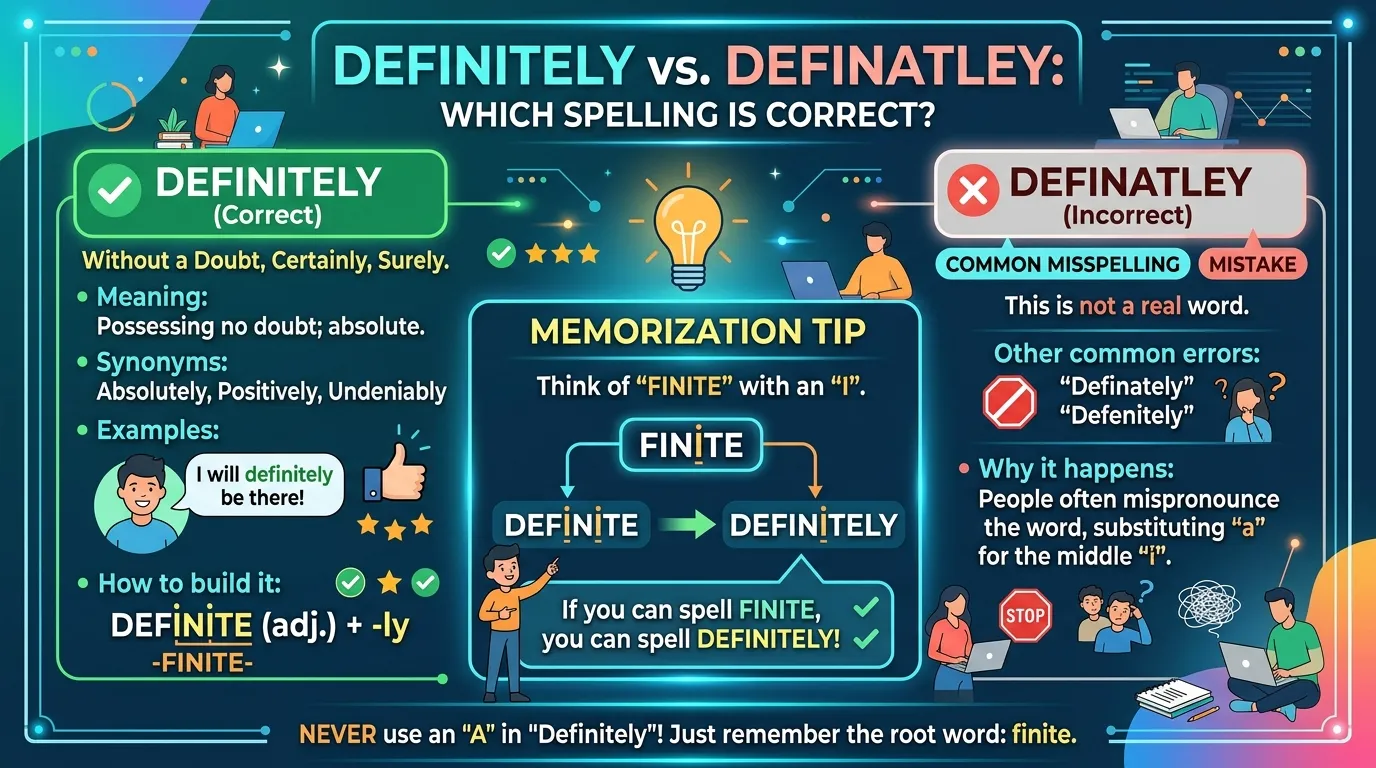
If you have ever paused while typing “definitely” and wondered whether “definatley” is correct, you are not alone. This is one of the most common spelling mistakes in modern English, especially in emails, school assignments, text messages, and online writing.
The correct spelling is definitely. Definatley is a misspelling and should not be used in standard English.
The confusion happens because the word contains several sounds and letters that are easy to rearrange. Many writers remember the pronunciation but struggle to recall the exact order of -ite-, -ly, and the letters in the middle of the word.
In this guide, you will learn the difference between definitely vs definatley, what definitely means, how to pronounce and use it, why definatley is wrong, common spelling mistakes, useful synonyms, natural examples, formal alternatives, and simple memory tricks that can help you spell the word correctly every time.
Quick Answer: Definitely or Definatley?
Definitely is the correct spelling.
Definatley is incorrect.
| Spelling | Correct? | Meaning |
|---|---|---|
| Definitely | ✅ Yes | Certainly; without doubt |
| Definatley | ❌ No | Common misspelling of “definitely” |
Examples
- Correct: I will definitely call you tomorrow.
- Incorrect: I will definatley call you tomorrow.
- Correct: She definitely knows the answer.
- Incorrect: She definatley knows the answer.
The word definitely means certainly, surely, or without doubt.
Memory tip: Think finite is inside definite:
de + finite + ly = definitely
Do not add an extra a before the l.
What Does “Definitely” Mean?
Definitely is an adverb used to show certainty. It tells the reader or listener that something is considered true, certain, or very likely without reasonable doubt.
Dictionary-style definition
Definitely (adverb):
In a certain or definite way; certainly; without doubt.
For example:
- I will definitely attend the meeting.
- That is definitely the right answer.
- We should definitely visit that restaurant.
- He is definitely interested in the job.
In each sentence, definitely strengthens the speaker’s confidence.
Simple meaning
You can usually understand definitely as:
- certainly
- surely
- without doubt
- unquestionably
- clearly
- absolutely
- for certain
The exact substitute depends on the sentence and level of formality.
Why Is “Definatley” Wrong?
Definatley is not a standard English word. It is simply a misspelling of definitely.
The mistake usually happens because writers pronounce the word quickly and then try to spell it according to how it sounds.
The correct structure is:
D-E-F-I-N-I-T-E-L-Y
A common incorrect version is:
D-E-F-I-N-A-T-L-E-Y
Notice the problem: the letters have been rearranged, and an a has been inserted.
Correct spelling breakdown
definite + ly = definitely
The adjective definite becomes the adverb definitely.
Compare:
- definite → definitely
- finite → finitely
- complete → completely
- absolute → absolutely
Although spelling rules have exceptions in English, keeping the base word definite in mind makes definitely much easier to remember.
Definitely vs Definatley: Key Difference
There is really only one standard spelling to choose from.
| Feature | Definitely | Definatley |
|---|---|---|
| Standard English | ✅ Yes | ❌ No |
| Dictionary word | ✅ Yes | ❌ No |
| Part of speech | Adverb | — |
| Meaning | Certainly; without doubt | — |
| Suitable for formal writing | ✅ Yes | ❌ No |
| Suitable for academic writing | ✅ Yes | ❌ No |
| Suitable for business writing | ✅ Yes | ❌ No |
| Suitable for texting | ✅ Yes | ❌ No |
| Pronunciation | /ˈdɛfɪnətli/ | Not a standard pronunciation |
| Recommended usage | Use it | Avoid it |
So if you are deciding between definitely and definatley, the answer is simple:
Always use “definitely.”
How Do You Pronounce “Definitely”?
In American English, definitely is commonly pronounced approximately:
DEF-uh-nit-lee
IPA:
/ˈdɛfɪnətli/
The word has four main sound sections:
def + i + nite + ly
The pronunciation can make the spelling seem confusing because the written form contains letters that are not strongly emphasized in normal speech.
Example
I definitely want to go.
A natural speaker may say the word quickly, making it sound closer to:
DEF-uh-nit-lee
This is one reason some people write definatley, definately, or other incorrect forms.
However, pronunciation should not be used as the only guide to spelling.
Why Do People Confuse “Definitely” and “Definatley”?
Several factors contribute to this spelling error.
1. The word is often pronounced quickly
When people speak naturally, unstressed vowels can become less noticeable. As a result, the spelling may not seem obvious from the pronunciation.
2. The word contains several similar letter patterns
The sequence in definitely can be difficult to remember:
definite + ly
People may accidentally rearrange the letters.
3. People associate the word with “definately”
The misspelling is extremely common online. Seeing an incorrect form repeatedly can make it look familiar.
4. Typing quickly causes letter transposition
When typing quickly, people may accidentally produce:
- definatley
- definately
- definitly
- definetly
- definitley
These are spelling errors rather than alternative spellings.
5. English spelling does not always match pronunciation
English contains many words whose spelling cannot be reliably predicted from pronunciation alone.
For example:
- definitely
- separate
- necessary
- pronunciation
- maintenance
Learning the correct visual pattern is often more reliable than trying to spell these words phonetically.
Definitely vs Definately vs Definatley
There are several common misspellings of definitely.
| Word | Status |
|---|---|
| Definitely | ✅ Correct |
| Definately | ❌ Incorrect |
| Definatley | ❌ Incorrect |
| Definitly | ❌ Incorrect |
| Definetly | ❌ Incorrect |
| Definitley | ❌ Incorrect |
| Definatly | ❌ Incorrect |
The most important distinction is that definitely contains the sequence -ite- before -ly.
Correct:
definitely
Incorrect:
definately
Incorrect:
definatley
If you are unsure, return to the base word:
definite → definitely
What Part of Speech Is “Definitely”?
Definitely is an adverb.
An adverb can modify a verb, adjective, another adverb, or an entire statement.
In the sentence:
She will definitely come.
Definitely modifies the verb phrase will come by expressing certainty.
More examples
- He definitely understands the problem.
- That movie was definitely worth watching.
- You should definitely try this recipe.
- The team will definitely need more practice.
- This is definitely better than the previous version.
It can appear in different positions depending on the sentence.
How to Use “Definitely” Correctly
1. To express certainty
I definitely remember meeting him.
This means the speaker is certain that the event happened.
2. To confirm a decision
Yes, I will definitely be there.
Here, the word reinforces a commitment.
3. To emphasize an opinion
This is definitely the best option.
The speaker strongly believes the option is best.
4. To agree with someone
“Should we order pizza?”
“Definitely!”
Here, definitely works as a short response meaning certainly or absolutely.
5. To emphasize a recommendation
You should definitely read this book.
The speaker strongly recommends the book.
Definitely in Formal and Informal Writing
Definitely is grammatically acceptable in both formal and informal English.
However, the surrounding sentence determines whether the overall expression sounds appropriate.
Casual
I’ll definitely come!
Neutral
I will definitely attend the event.
Professional
We will definitely review the proposal before Friday.
Academic
The findings definitely indicate a need for further investigation.
The word itself is not informal slang. It is a standard English adverb.
Definitely in American English
Definitely is standard in American English.
It is commonly used in:
- conversations
- text messages
- emails
- business communication
- school writing
- journalism
- academic writing
- websites
- social media
- professional reports
There is no American alternative spelling such as definatley.
American English examples
I definitely need to finish this today.
She definitely deserves the award.
The results definitely support the main argument.
We definitely should leave early.
Definitely in British English
British English also uses definitely with the same spelling and meaning.
For example:
I definitely agree with you.
She definitely knows what happened.
There is no British spelling difference between definitely and American definitely.
Unlike words such as:
- color / colour
- center / centre
- organize / organise
the spelling definitely remains the same in both major varieties of English.
Is “Definitely” Formal or Informal?
Definitely is neutral.
It can be used in casual conversation as well as formal writing.
However, in highly formal or technical writing, alternatives such as certainly, clearly, or conclusively may sometimes be more precise.
Casual
I definitely want to go.
Professional
We definitely need additional staff.
More formal
The evidence clearly indicates that additional staff are required.
The choice should depend on context, not simply on whether definitely is considered formal or informal.
Synonyms for Definitely
Depending on context, several words can replace definitely.
Common synonyms
- certainly
- surely
- absolutely
- unquestionably
- undoubtedly
- clearly
- assuredly
- positively
- indisputably
- categorically
These words are not always interchangeable in every sentence.
Example
I will definitely attend.
Possible alternatives:
I will certainly attend.
I will absolutely attend.
I will surely attend.
The first two sound natural in many contexts. Surely can sometimes express surprise or expectation rather than simple certainty.
Antonyms of Definitely
Because definitely expresses certainty, its opposite concepts involve uncertainty or doubt.
Related opposites include:
- possibly
- perhaps
- maybe
- probably
- uncertainly
- doubtfully
Compare:
She will definitely come.
with:
She might come.
The first expresses strong certainty. The second expresses possibility.
Related Words: Definite, Definitely, Definition, Definitive
Several words look similar, which can create additional spelling confusion.
Definite
Definite is an adjective meaning clear, certain, or specific.
We need a definite answer.
Definitely
Definitely is an adverb meaning certainly or without doubt.
We definitely need an answer.
Definition
Definition is a noun referring to the meaning or explanation of a word or concept.
What is the definition of this term?
Definitive
Definitive is an adjective meaning authoritative, conclusive, or final.
The study provides a definitive answer.
These words share the definit- family, which can help you remember their spelling.
Word History and Etymology of “Definitely”
Definitely comes from the adjective definite, which ultimately traces back to Latin dēfīnītus, meaning something that has been bounded, determined, or defined.
The English word definite developed the sense of something clear, fixed, or certain.
Adding the adverb-forming suffix -ly gives:
definite + ly → definitely
The broader word family includes:
- define
- defined
- definite
- definitely
- definition
- definitive
Understanding this family provides a useful spelling connection.
If you remember definite, you can more easily remember definitely.
Common Collocations With “Definitely”
A collocation is a combination of words that commonly appear together.
Some natural combinations with definitely include:
- definitely agree
- definitely want
- definitely need
- definitely know
- definitely think
- definitely recommend
- definitely worth it
- definitely possible
- definitely true
- definitely going
- definitely better
- definitely important
- definitely the best
- definitely should
- definitely will
Examples
I definitely recommend this restaurant.
This book is definitely worth reading.
We definitely need more time.
She definitely knows the answer.
That is definitely possible.
These combinations sound natural because definitely frequently works as an emphasis or certainty marker.
Common Phrases With “Definitely”
Some everyday expressions use definitely as a strong confirmation.
“Definitely not”
This means certainly not.
I am definitely not going to miss the deadline.
“Definitely worth it”
This means something is strongly considered valuable or worthwhile.
The trip was definitely worth it.
“Definitely yes”
This is an emphatic way to say yes.
Would you do it again?
Definitely yes.
In ordinary conversation, simply “Definitely!” often sounds more natural.
“Most definitely”
This is an emphatic expression meaning very certainly.
I will most definitely remember that.
It can sound stronger or more dramatic than simply definitely.
Is “Most Definitely” Correct?
Yes.
Most definitely is a standard English expression used for strong emphasis.
For example:
I most definitely agree with your point.
However, it can sound more emphatic than necessary in formal writing.
For professional or academic writing, certainly or a more precise statement may sometimes be preferable.
Definitely in Texting and Social Media
People frequently use definitely in texting.
Examples:
“Are you coming tonight?”
“Definitely!”
“Should we get coffee?”
“Definitely 😂”
“You should watch that show.”
“Definitely adding it to my list.”
Because texting is fast, misspellings such as definatley and definately appear frequently. They may still be understood, but they are not correct standard spellings.
If you are writing a public post, professional message, school assignment, or caption, use definitely.
Definitely in Business Writing
Correct spelling matters in business communication because spelling mistakes can affect credibility.
Weak
We will definatley send the report tomorrow.
Correct
We will definitely send the report tomorrow.
More precise professional version
We will send the report by tomorrow.
The third sentence may actually be stronger because it replaces a general expression of certainty with a specific commitment.
Business writing tip
Use definitely when you need to express certainty, but use concrete information whenever possible.
Instead of:
We will definitely finish soon.
Consider:
We expect to finish the project by Friday.
Specific language is usually more useful in professional communication.
Definitely in Academic Writing
There is nothing grammatically wrong with definitely in academic writing.
However, academic writers should avoid making claims stronger than their evidence supports.
For example:
The results definitely prove that the treatment works.
This may be too strong if the research only shows an association.
A more careful statement might be:
The results strongly suggest that the treatment is effective.
Academic writing often favors precise claims over absolute certainty.
So the issue is not that definitely is informal. The issue is whether the degree of certainty is justified.
Definitely in Journalism
Journalistic writing often requires careful wording.
Compare:
The new policy will definitely reduce costs.
with:
The new policy is expected to reduce costs.
The second sentence may be more appropriate if the outcome has not yet been demonstrated.
Definitely is grammatically correct, but responsible writing requires writers to distinguish facts from predictions, opinions, and expectations.
Definitely in Technical Writing
Technical documents usually favor precision.
For example:
The software will definitely fix the problem.
is less useful than:
The update addresses the identified compatibility issue.
In technical writing, replace vague certainty with measurable information whenever possible.
Still, when certainty is genuinely established, definitely can be grammatically correct.
Definitely in Sports Writing
Sports conversations frequently use definitely to express strong opinions.
Examples:
He is definitely one of the best players on the team.
They definitely need better defense.
That was definitely the turning point of the game.
In sports commentary, the word can signal confidence rather than objective proof.
Definitely in Blogging and Online Content
Bloggers commonly use definitely to make recommendations or emphasize important points.
For example:
If you enjoy mystery novels, you should definitely try this series.
This is definitely one of the easiest ways to improve your writing.
It is useful, but overusing it can make writing sound repetitive.
Instead of repeating definitely, vary your language with contextually appropriate words such as:
- certainly
- especially
- clearly
- strongly
- highly
- undoubtedly
Or simply remove the intensifier when the sentence is already clear.
Awkward vs Natural Examples
Example 1
Awkward:
I definitely, without any doubt at all, will definitely attend.
Natural:
I will definitely attend.
The repeated certainty is unnecessary.
Example 2
Awkward:
This is definitely certainly the best option.
Natural:
This is definitely the best option.
Example 3
Incorrect:
I definatley agree.
Correct:
I definitely agree.
Example 4
Incorrect:
She definately knows him.
Correct:
She definitely knows him.
Example 5
Incorrect:
We should definitley leave now.
Correct:
We should definitely leave now.
Common Mistakes With “Definitely”
Mistake 1: Writing “definatley”
❌ I will definatley call you.
✅ I will definitely call you.
Mistake 2: Writing “definately”
❌ She definately wants to come.
✅ She definitely wants to come.
Mistake 3: Writing “definitly”
❌ I definitly remember that.
✅ I definitely remember that.
Mistake 4: Writing “definetly”
❌ He will definetly help us.
✅ He will definitely help us.
Mistake 5: Adding unnecessary certainty
❌ It will definitely certainly happen.
✅ It will definitely happen.
The Best Memory Trick for Definitely
One of the easiest ways to remember the spelling is:
Remember “finite”
Look at the word:
deFINITE + ly
The middle of definitely contains the spelling pattern from finite:
de + finite + ly
Another useful sentence is:
There is a FINITE inside definitely.
Spell it mentally:
DE + FINITE + LY
→ DEFINITELY
This trick is much more reliable than trying to remember the pronunciation.
Another Simple Spelling Trick
Break the word into three pieces:
DE + FINITE + LY
Then combine them:
DE + FINITE + LY = DEFINITELY
Avoid thinking:
DE + FINAT + LEY
That pattern encourages the common misspelling.
Is “Definatley” Ever Correct?
No.
Definatley is not a standard alternative spelling of definitely in American English, British English, or standard international English.
It may appear in:
- social media posts
- informal chats
- comments
- search queries
- user-generated content
- typing errors
But its appearance does not make it an accepted spelling.
If you are writing for school, work, publishing, journalism, business, or professional communication, use definitely.
Can “Definitely” Mean “Absolutely”?
Yes, in many contexts.
For example:
“Do you want to come with us?”
“Definitely!”
Here, definitely can function similarly to absolutely or certainly.
However, the words can have slightly different tones.
| Word | Common effect |
|---|---|
| Definitely | Strong certainty |
| Certainly | Polite or formal certainty |
| Absolutely | Very strong agreement or certainty |
| Surely | Certainty, expectation, or surprise |
| Certainly not | Strong refusal |
| Definitely not | Strong refusal |
Example
“Is this the right address?”
“Definitely.”
This means the speaker is certain.
Definitely vs Certainly
These two words are often interchangeable, but their tone can differ slightly.
Definitely
I definitely agree.
This sounds natural and direct.
Certainly
I certainly agree.
This can sound slightly more formal or polished.
Both are correct.
For everyday American English, definitely is extremely natural.
Definitely vs Absolutely
Absolutely often expresses stronger emotional emphasis.
I definitely want to go.
I absolutely want to go!
The second version may sound more enthusiastic.
In a short response:
“Are you coming?”
“Definitely!”
is natural.
“Are you coming?”
“Absolutely!”
can sound more energetic.
Definitely vs Surely
Surely has additional meanings and uses.
Surely you don’t believe that.
Here, surely may express surprise or expectation rather than simple certainty.
By contrast:
I definitely believe that.
simply communicates strong certainty.
Therefore, definitely and surely should not always be treated as exact substitutes.
Definitely vs “For Sure”
For sure is a common informal expression.
Compare:
I will definitely be there.
with:
I will be there for sure.
Both express certainty, but for sure is more conversational.
For formal writing, definitely or certainly is generally a better choice.
How to Choose the Right Word
Use definitely when:
- you want to express certainty;
- you are confirming something;
- you strongly agree;
- you are emphasizing a recommendation;
- the statement is appropriate for your level of confidence.
Use certainly when:
- you want a slightly more formal tone;
- you are writing a professional response;
- you want a polite expression of agreement.
Use absolutely when:
- you want strong emphasis;
- you are expressing enthusiastic agreement;
- the context is conversational.
Use probably when:
- something is likely but not certain.
Use possibly or maybe when:
- the outcome is uncertain.
Definitely vs Definatley: Final Comparison
| Category | Definitely | Definatley |
|---|---|---|
| Spelling | Correct | Incorrect |
| Word status | Standard English word | Misspelling |
| Part of speech | Adverb | None |
| Meaning | Certainly; without doubt | No standard meaning |
| American English | Standard | Not standard |
| British English | Standard | Not standard |
| Academic writing | Acceptable | Incorrect |
| Business writing | Acceptable | Incorrect |
| Texting | Acceptable | Common typo |
| Formal writing | Acceptable | Avoid |
| Dictionary status | Established word | Not a standard word |
| Recommended? | ✅ Yes | ❌ No |
Practical Recommendations for Writers
Whether you are a student, professional, blogger, journalist, or casual texter, the recommendation is the same:
Always spell it:
definitely
Do not spell it:
definatley
If you frequently make this mistake, add the correct spelling to your personal spelling memory:
DEFINITE → DEFINITELY
When proofreading, search your document for:
- definatley
- definately
- definitly
- definetly
- definitley
- definatly
Replace each incorrect form with definitely.
Modern spell-checkers usually catch these errors, but proofreading is still important because not every typo is detected automatically.
Frequently Asked Questions
1. Is “definitely” or “definatley” correct?
Definitely is correct. Definatley is a misspelling and is not accepted as a standard English spelling.
2. What does “definitely” mean?
Definitely means certainly, surely, or without doubt. It is an adverb used to express a high level of certainty.
3. Why do people spell definitely as definatley?
People often confuse the spelling because definitely is pronounced quickly in normal speech. The letters can also be difficult to remember, leading writers to rearrange them or insert an a.
4. Is “definately” a correct spelling?
No. Definately is another common misspelling of definitely. The correct spelling is definitely.
5. How can I remember how to spell definitely?
Remember the word finite:
de + finite + ly = definitely
This is one of the easiest ways to remember the correct spelling.
6. Is definitely formal or informal?
Definitely is a neutral standard-English adverb. It can be used in casual conversation, texting, business writing, journalism, and academic writing when the level of certainty is appropriate.
7. Is “definitely” spelled differently in British English?
No. Definitely has the same standard spelling in American and British English.
8. Can I use definitely in academic writing?
Yes. Definitely is grammatically correct in academic writing. However, academic writers should make sure that strong claims of certainty are supported by evidence.
9. What is another word for definitely?
Common alternatives include certainly, surely, absolutely, unquestionably, undoubtedly, and clearly. The best synonym depends on the sentence and desired tone.
10. Is “most definitely” grammatically correct?
Yes. Most definitely is a standard expression used for strong emphasis. It means very certainly or without question.
Conclusion
When choosing between definitely vs definatley, there is no real contest: definitely is the correct spelling, while definatley is a common spelling mistake.
Definitely is an adverb meaning certainly, surely, or without doubt. It works naturally in American and British English and can appear in casual, professional, academic, journalistic, and online writing.
The easiest way to remember the spelling is to connect it with definite and finite:
definite + ly = definitely
Do not let the pronunciation trick you into adding an a or rearranging the letters. If you see definatley, definately, or definitly, treat them as misspellings and replace them with definitely.
For clear, professional, and correct English, stick with one form:
Definitely.


