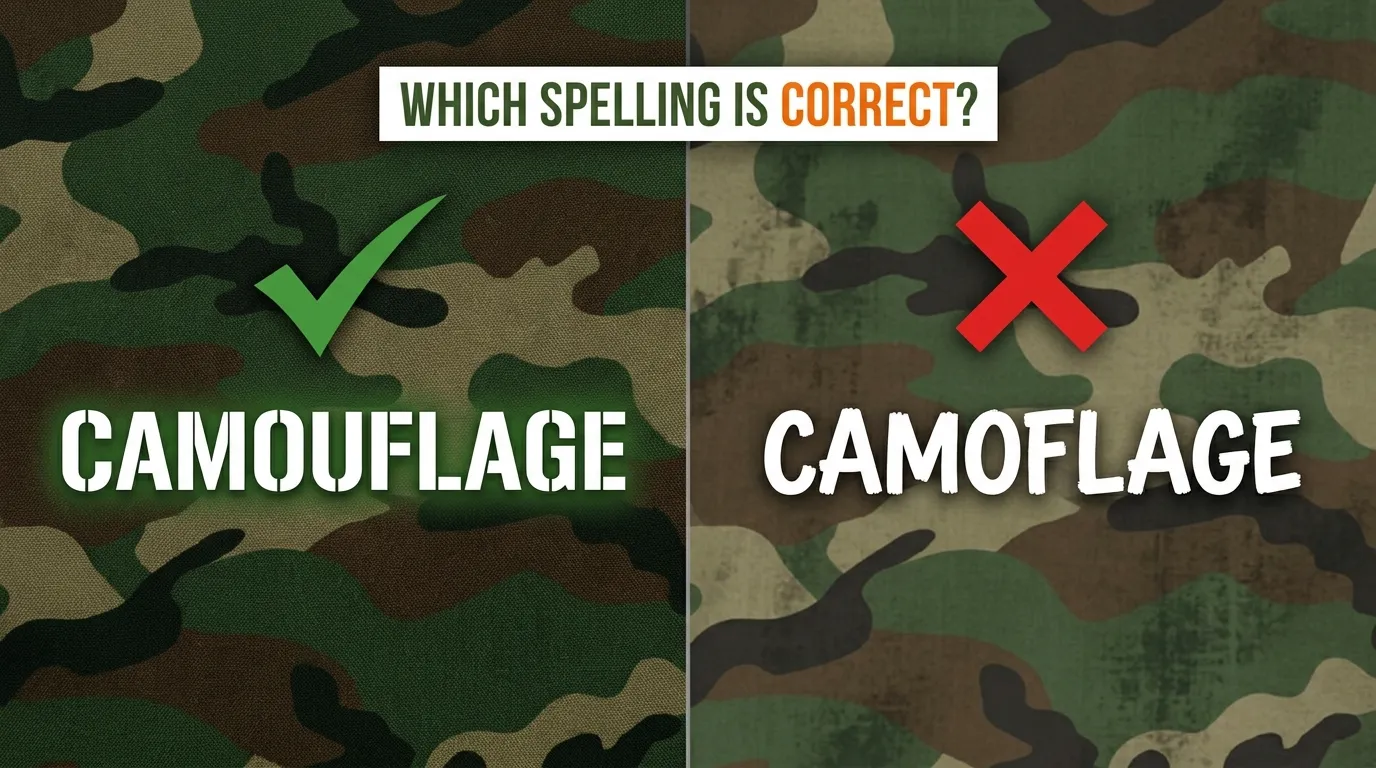
“Camouflage” is the correct spelling. “Camoflage” is a misspelling.
The word camouflage refers to a way of hiding or disguising a person, animal, object, or activity by making it harder to see or recognize. It can be used as a noun or a verb.
- Correct: camouflage
- Incorrect: camoflage
- Pronunciation: /ˈkæməflɑːʒ/ in American English
- Meaning: a method of hiding something by making it blend into its surroundings
- Verb: to camouflage something means to hide or disguise it
For example:
The soldier wore camouflage to blend into the forest.
And:
The lizard uses its coloring to camouflage itself against the rocks.
The spelling camoflage is incorrect because the word contains “camouflage,” including the “ou” before the final “flage.”
If you are writing an essay, article, business document, school assignment, news story, or professional report, always use camouflage.
Camouflage vs Camoflage: What Is the Difference?
The main difference is simple: camouflage is the correct word, while camoflage is a spelling mistake.
Unlike some English spelling pairs, these two forms do not represent different meanings, regional preferences, or different grammatical functions. Camoflage is not an accepted alternative spelling of camouflage in standard American English or standard British English.
| Spelling | Correct? | Meaning | Usage |
|---|---|---|---|
| camouflage | Yes | Hiding or disguising something | Standard English |
| camoflage | No | Intended to mean camouflage | Misspelling |
The confusion usually happens because camouflage is not spelled exactly as it sounds. When people hear the word, they may remember the pronunciation but leave out the “u.”
That produces the common error:
camouflage → camoflage
The correct spelling is:
c-a-m-o-u-f-l-a-g-e
What Does Camouflage Mean?
Camouflage is a method of making something difficult to see, identify, or recognize by helping it blend into its surroundings.
The word has both literal and figurative meanings.
Camouflage as a Noun
As a noun, camouflage means a disguise or method used to hide something.
For example:
- The soldiers wore green camouflage.
- The animal’s camouflage made it difficult to spot.
- The vehicle was painted with camouflage patterns.
- The insect’s natural camouflage protects it from predators.
In these examples, camouflage is the thing or method used for concealment.
Camouflage as a Verb
Camouflage can also be a verb meaning to hide or disguise something.
Examples:
- The soldiers camouflaged their equipment.
- The animal camouflaged itself among the leaves.
- The designer used dark colors to camouflage the stain.
- The bushes helped camouflage the building.
The verb can describe both deliberate and natural concealment.
Dictionary-Style Definition of Camouflage
Camouflage (noun):
A method, pattern, color, material, or appearance used to make a person, animal, object, or structure difficult to see or recognize.
Camouflage (verb):
To hide or disguise something by making it blend with its surroundings or by making its true appearance less noticeable.
Simple Definition
In everyday language:
Camouflage means hiding something by making it look like its surroundings.
This can happen through:
- color
- shape
- pattern
- texture
- movement
- shadows
- clothing
- visual disguise
- misleading appearance
Why Do People Spell Camouflage as “Camoflage”?
The incorrect spelling camoflage is easy to understand because English spelling does not always match pronunciation.
When people say camouflage, the middle sounds can be difficult to connect with the written form.
The correct spelling contains:
cam-ou-flage
But the pronunciation does not clearly emphasize every letter:
CAM-uh-flahzh
Because the “ou” is not pronounced like the “ou” in words such as house, some writers accidentally remove it.
This produces:
❌ camoflage
✅ camouflage
Another reason is visual memory. People may hear the word frequently before they see it written. If they learn the spelling from sound alone, camoflage can seem reasonable.
However, the standard spelling has remained camouflage.
How to Spell Camouflage Correctly
The easiest way to remember the spelling is to divide the word into parts:
CAM + OU + FLAGE
That gives:
CAMOUFLAGE
A useful spelling pattern is:
cam + ou + flage = camouflage
The important part to remember is OU.
Correct Spelling
C A M O U F L A G E
Common Incorrect Spelling
C A M O F L A G E
The incorrect version is missing the U.
Camouflage Pronunciation
In American English, camouflage is commonly pronounced approximately:
KAM-uh-flahzh
The final sound resembles the sound at the end of garage in many American pronunciations.
The spelling may look complicated, but the pronunciation is relatively straightforward once you hear it.
Does Camouflage Have a Silent Letter?
The spelling contains letters that are not pronounced in a simple one-to-one way.
The “ou” combination is particularly important because it does not sound like the combination might suggest to an English learner.
This is one reason spelling mistakes are common.
Is Camouflage Pronounced “Cam-o-flage”?
Not exactly.
The word is generally pronounced closer to:
KAM-uh-flahzh
rather than pronouncing every written letter separately.
Is Camoflage Ever Correct?
No. “Camoflage” is not the standard spelling of the English word.
If you see camoflage in an informal message, social media post, comment, or online discussion, it is almost certainly a spelling error for camouflage.
You should correct it when writing:
- academic assignments
- professional documents
- business communications
- articles
- websites
- resumes
- reports
- news content
- technical documents
- formal correspondence
Example
Incorrect:
The soldiers used camoflage to hide their position.
Correct:
The soldiers used camouflage to hide their position.
Camouflage as a Noun vs Verb
One useful feature of camouflage is that the same spelling can function as both a noun and a verb.
| Form | Grammatical Role | Example |
|---|---|---|
| camouflage | Noun | The animal’s camouflage was effective. |
| camouflage | Verb | The animal camouflaged itself. |
| camouflaged | Past tense/adjective | The vehicle was well camouflaged. |
| camouflaging | Present participle | The soldiers were camouflaging their equipment. |
Camouflage as a Noun
The butterfly’s camouflage made it almost invisible.
Here, camouflage refers to the appearance or method of concealment.
Camouflage as a Verb
The butterfly camouflaged itself against the tree.
Here, camouflage describes the action of hiding.
Camouflaged as an Adjective
The camouflaged vehicle was difficult to see.
Here, camouflaged describes the vehicle.
Literal and Figurative Meanings of Camouflage
The most familiar meaning of camouflage involves physical concealment.
However, the word is also frequently used figuratively.
Literal Camouflage
Literal camouflage involves making something visually difficult to detect.
Examples:
- A soldier wears camouflage clothing.
- A snowshoe hare has seasonal camouflage.
- A military vehicle may be painted in camouflage colors.
- An insect may resemble a leaf as natural camouflage.
Figurative Camouflage
Figuratively, camouflage can describe something that hides a fact, intention, problem, or identity.
For example:
His friendly behavior was camouflage for his real intentions.
Here, camouflage is not physical. It means something that conceals the truth.
Another example:
The complicated language served as camouflage for a weak argument.
The language does not literally hide the argument. Instead, it makes the weakness less obvious.
Common Uses of Camouflage
Camouflage appears in many areas of everyday and professional English.
Military Camouflage
Military camouflage is one of the most familiar uses.
Examples include:
- camouflage uniforms
- camouflage clothing
- camouflage netting
- camouflage paint
- camouflage patterns
- camouflage equipment
Example:
The soldiers wore camouflage uniforms during the exercise.
Animal Camouflage
Animals use camouflage to survive.
They may blend into:
- forests
- grass
- sand
- snow
- rocks
- tree bark
- leaves
- ocean environments
Examples:
The owl’s feathers provide excellent camouflage against tree bark.
The insect’s shape and color act as natural camouflage.
Fashion and Clothing
Camouflage patterns are also common in clothing.
Examples:
- camouflage jacket
- camouflage pants
- camouflage backpack
- camouflage hat
- camouflage print
In fashion, camouflage does not necessarily serve a practical concealment purpose. It can simply be a visual style.
Interior Design and Consumer Products
The word can also describe attempts to make objects less noticeable.
For example:
The cabinet was designed to camouflage the television.
Here, the cabinet makes the television less visually prominent.
Camouflage in Sports
Camouflage can appear in sports, especially when discussing outdoor activities.
It may be associated with:
- hunting
- fishing
- wildlife photography
- outdoor competitions
- paintball
- military-style recreational activities
Example:
The photographer wore camouflage while observing birds in the wetlands.
In sports writing, the word can also be figurative:
The team’s strong defense camouflaged its weakness on offense.
This means the defense helped hide the team’s offensive weakness.
Camouflage in Business and Professional Writing
In professional writing, camouflage is often used figuratively.
For example:
The company’s positive announcement appeared to camouflage its declining sales.
Or:
The report’s technical language may camouflage the underlying problem.
This usage is appropriate when discussing something that conceals a weakness, problem, intention, or reality.
For formal business writing, however, consider whether a simpler word would be clearer.
Instead of:
The complicated report camouflaged the financial problem.
You might write:
The complicated report concealed the financial problem.
Both are grammatically correct, but concealed may be more direct.
Camouflage in Journalism and Academic Writing
Camouflage is perfectly acceptable in journalism and academic writing when it accurately expresses the intended idea.
Journalistic Example
The official explanation appeared to camouflage the deeper dispute.
Academic Example
The organism’s coloration provides effective camouflage against predators.
In academic writing, the literal biological meaning is especially common.
When precision matters, use the word only when the idea of concealment or disguise is genuinely intended.
Regional Differences: American vs British English
There is no major American-versus-British spelling difference between camouflage and camoflage.
Both American and British English use:
camouflage
The misspelling camoflage should not be treated as a British variant or an American variant.
| Variety | Standard Spelling |
|---|---|
| American English | camouflage |
| British English | camouflage |
| Canadian English | camouflage |
| Australian English | camouflage |
| International English | camouflage |
Therefore, changing from American to British English does not change the correct spelling.
Word History and Etymology of Camouflage
The history of camouflage helps explain why its spelling may look unusual in English.
The word entered English from French, where camouflage developed from a term associated with disguising or concealing something.
Its history is connected to the idea of covering, disguising, or making something difficult to recognize.
The spelling therefore reflects its French origin rather than a simple English sound-to-letter pattern.
This is important because English contains many words borrowed from French. Their spellings may preserve patterns that do not behave exactly like native English words.
That helps explain why camouflage may seem harder to spell than words with more predictable spelling.
Synonyms for Camouflage
Depending on context, several words can communicate a similar idea.
Common Synonyms
- disguise
- concealment
- cover
- covering
- concealment
- masking
- hiding
- screen
- deception
- decoy
However, these words are not always interchangeable.
Camouflage vs Disguise
Disguise usually means changing or concealing someone’s or something’s appearance to prevent recognition.
The actor wore a disguise.
Camouflage focuses more strongly on blending into the surrounding environment.
The soldier wore camouflage.
Camouflage vs Concealment
Concealment is broader.
The concealment of the documents was deliberate.
Camouflage often suggests that something is hidden by making it blend in or appear less noticeable.
Camouflage vs Masking
Masking can mean covering or hiding something, including information, symptoms, or visual features.
The software masks sensitive information.
Camouflage is more strongly associated with disguise and concealment.
Antonyms of Camouflage
There is no single perfect opposite for every use of camouflage, but useful opposites include:
- exposure
- revelation
- disclosure
- visibility
- detection
- uncovering
- identification
- transparency
For example:
The camouflage made the animal difficult to detect.
The opposite idea would be:
The animal’s bright markings made it easy to detect.
Common Collocations With Camouflage
A collocation is a group of words that commonly appear together.
Common combinations include:
- camouflage clothing
- camouflage pattern
- camouflage uniform
- camouflage paint
- camouflage netting
- natural camouflage
- military camouflage
- effective camouflage
- camouflage gear
- camouflage design
- camouflage colors
- camouflage technique
- camouflage system
- camouflage material
- camouflage effect
Example Sentences
The photographer used camouflage clothing to get closer to the animals.
The vehicle was covered with a camouflage pattern.
The insect’s natural camouflage protects it from predators.
The researchers studied how camouflage affects survival.
Common Phrases With Camouflage
Several useful expressions use camouflage figuratively.
“Use camouflage”
The soldiers used camouflage to remain difficult to detect.
“Provide camouflage”
The tree’s rough bark provides camouflage for the insect.
“Serve as camouflage”
The bright background served as camouflage for the animal.
“Natural camouflage”
The animal relies on natural camouflage.
“Camouflage the problem”
The positive publicity did little more than camouflage the problem.
“Camouflage the truth”
The complicated explanation seemed designed to camouflage the truth.
Common Mistakes With Camouflage
Mistake 1: Writing “Camoflage”
❌ The soldiers wore camoflage.
✅ The soldiers wore camouflage.
The incorrect version leaves out u.
Mistake 2: Treating Camoflage as an Alternative Spelling
❌ Both camouflage and camoflage are acceptable.
✅ Camouflage is the standard spelling; camoflage is a misspelling.
Mistake 3: Assuming the Pronunciation Determines the Spelling
English spelling often contains letters that are not obvious from pronunciation.
Do not spell the word only according to how it sounds.
Remember:
camouflage
not:
camoflage
Mistake 4: Using “Camouflage” When “Disguise” Is More Precise
These words overlap, but they are not identical.
Awkward:
She wore camouflage so nobody would recognize her at the party.
More natural:
She wore a disguise so nobody would recognize her at the party.
Camouflage would be more appropriate if she were trying to blend into her surroundings.
Awkward vs Natural Examples
| Awkward or Incorrect | Natural or Correct |
|---|---|
| He wore camoflage. | He wore camouflage. |
| The animal has good camoflage. | The animal has good camouflage. |
| They used camoflage paint. | They used camouflage paint. |
| The trees camoflaged the building. | The trees camouflaged the building. |
| Her clothing was camoflaged. | Her clothing was camouflaged. |
Everyday Examples of Camouflage
Here are practical examples showing how the word works naturally.
Nature
The frog’s green skin provides camouflage among the leaves.
Military
The soldiers painted their equipment with camouflage colors.
Clothing
He bought a camouflage jacket for hiking.
Photography
The wildlife photographer wore camouflage to avoid disturbing the animals.
Home Design
The cabinet helps camouflage the television.
Figurative Use
Humor became a way to camouflage his nervousness.
Business
The impressive presentation camouflaged several serious problems.
Technology
The interface was designed to camouflage complicated technical processes from ordinary users.
How to Remember the Correct Spelling
A simple memory trick is:
“Camouflage has OU.”
Think:
CAM + OU + FLAGE
CAMOUFLAGE
You can also remember:
The “U” hides inside camouflage.
That is especially useful because camouflage is about hiding.
Another visual trick:
CAMOU → FLAGE
Put the word together:
CAMOU + FLAGE = CAMOUFLAGE
If you remember OU, you are much less likely to write camoflage.
Camouflage vs Camoflage: Quick Comparison
| Feature | Camouflage | Camoflage |
|---|---|---|
| Standard English | Yes | No |
| Correct spelling | Yes | No |
| Meaning | Concealment or disguise | None as a standard word |
| Noun | Yes | No |
| Verb | Yes | No |
| American English | Correct | Incorrect |
| British English | Correct | Incorrect |
| Formal writing | Recommended | Avoid |
| Academic writing | Recommended | Avoid |
| Pronunciation | KAM-uh-flahzh | Intended as camouflage |
| Dictionary word | Yes | No |
Which Spelling Should You Use?
Use camouflage in virtually every standard English context.
American English
Use:
camouflage
British English
Use:
camouflage
Academic Writing
Use:
camouflage
Business Writing
Use:
camouflage
Journalism
Use:
camouflage
Technical Writing
Use:
camouflage
Blogging
Use:
camouflage
Social Media
Even in casual writing, camouflage is the correct spelling.
A typo in an informal message is understandable, but if you are publishing content, spelling the word correctly improves credibility and readability.
Is Camouflage Formal or Informal?
Camouflage is neutral in tone.
It can appear in casual conversation, professional writing, scientific research, journalism, military contexts, and academic texts.
Examples:
Casual:
I like that camouflage jacket.
Professional:
The design uses color to camouflage the equipment.
Scientific:
The species relies on camouflage to avoid predators.
Figurative:
The humor was camouflage for his anxiety.
The word itself is neither especially formal nor informal.
Can Camouflage Be Used as an Adjective?
Strictly speaking, camouflage is primarily a noun and a verb.
However, it frequently appears before another noun as part of a noun phrase:
- camouflage jacket
- camouflage pattern
- camouflage clothing
- camouflage material
- camouflage paint
In phrases such as camouflage jacket, the first word functions as a noun modifier.
The adjective form camouflaged is also common:
The camouflaged vehicle was difficult to see.
Related Forms of Camouflage
The word has several useful grammatical forms.
| Form | Example |
|---|---|
| camouflage | The animal uses camouflage. |
| camouflages | The pattern camouflages the object. |
| camouflaged | The object was camouflaged. |
| camouflaging | They are camouflaging the equipment. |
Notice that every form keeps the “ou”:
- camouflage
- camouflages
- camouflaged
- camouflaging
Do not remove the u when changing the grammatical form.
Final Writing Advice: Camouflage or Camoflage?
If you are unsure which spelling to use, choose camouflage.
There is no standard English situation in which you should intentionally replace it with camoflage.
For editors, teachers, bloggers, students, journalists, and professional writers, the rule is straightforward:
Always spell the word camouflage.
If you see camoflage, treat it as a spelling error rather than a regional spelling variation.
The most important thing to remember is the middle of the word:
CAM + OU + FLAGE
CAMOUFLAGE
Frequently Asked Questions About Camouflage vs Camoflage
1. Is it camouflage or camoflage?
Camouflage is correct. Camoflage is incorrect. The word camouflage means hiding or disguising something by making it blend with its surroundings.
2. Why do people spell camouflage as camoflage?
People often write camoflage because the pronunciation does not clearly reveal the spelling. The “ou” in camouflage is easy to overlook, especially when someone has mainly learned the word by hearing it.
3. Is camoflage a real word?
No. Camoflage is not the standard spelling of an English word. It is a common misspelling of camouflage.
4. How do you spell camouflage correctly?
The correct spelling is:
C-A-M-O-U-F-L-A-G-E
A useful memory trick is CAM + OU + FLAGE.
5. Is camouflage the same in American and British English?
Yes. Both American and British English use camouflage. There is no standard regional spelling difference that makes camoflage correct.
6. What does camouflage mean?
Camouflage means a method of hiding a person, animal, object, or activity by making it difficult to see or recognize. It can also mean to hide or disguise something.
7. Is camouflage a noun or a verb?
Camouflage can be both a noun and a verb.
As a noun:
The animal uses camouflage.
As a verb:
The animal camouflages itself among the leaves.
8. What is another word for camouflage?
Depending on context, alternatives include disguise, concealment, hiding, masking, covering, and screening. However, these words are not always exact substitutes.
9. How do you pronounce camouflage?
In American English, camouflage is commonly pronounced approximately KAM-uh-flahzh. The final sound is similar to the sound heard at the end of words such as garage in many American pronunciations.
10. Is camouflage a formal word?
Yes. Camouflage is a neutral English word suitable for casual conversation, professional writing, academic work, journalism, technical writing, and scientific contexts.
Conclusion
The difference between camouflage vs camoflage is not a matter of meaning or regional preference. It is a matter of correct spelling.
Camouflage is the standard and correct English word. It can function as both a noun and a verb and refers to hiding, disguising, or blending something into its surroundings. It can describe military clothing, animal coloration, outdoor equipment, visual patterns, and figurative forms of concealment.
Camoflage, on the other hand, is a misspelling. It is usually created by leaving out the “u” in the middle of camouflage. Although the error is common, it should be avoided in standard written English.
The easiest way to remember the correct spelling is:
CAM + OU + FLAGE = CAMOUFLAGE
The word is spelled the same in standard American and British English, so you do not need to choose between regional versions.
For schoolwork, professional documents, websites, blogs, journalism, academic writing, business communication, and other polished content, use camouflage every time.
Correct: The animal uses camouflage to hide from predators.
Incorrect: The animal uses camoflage to hide from predators.
When in doubt, remember that the “U” is hiding inside camouflage—just like the thing camouflage is designed to hide.


