Category: English Grammar & Word Differences
Focus Keyword: buoyant vs bouyant
Estimated Reading Time: 14–17 minutes
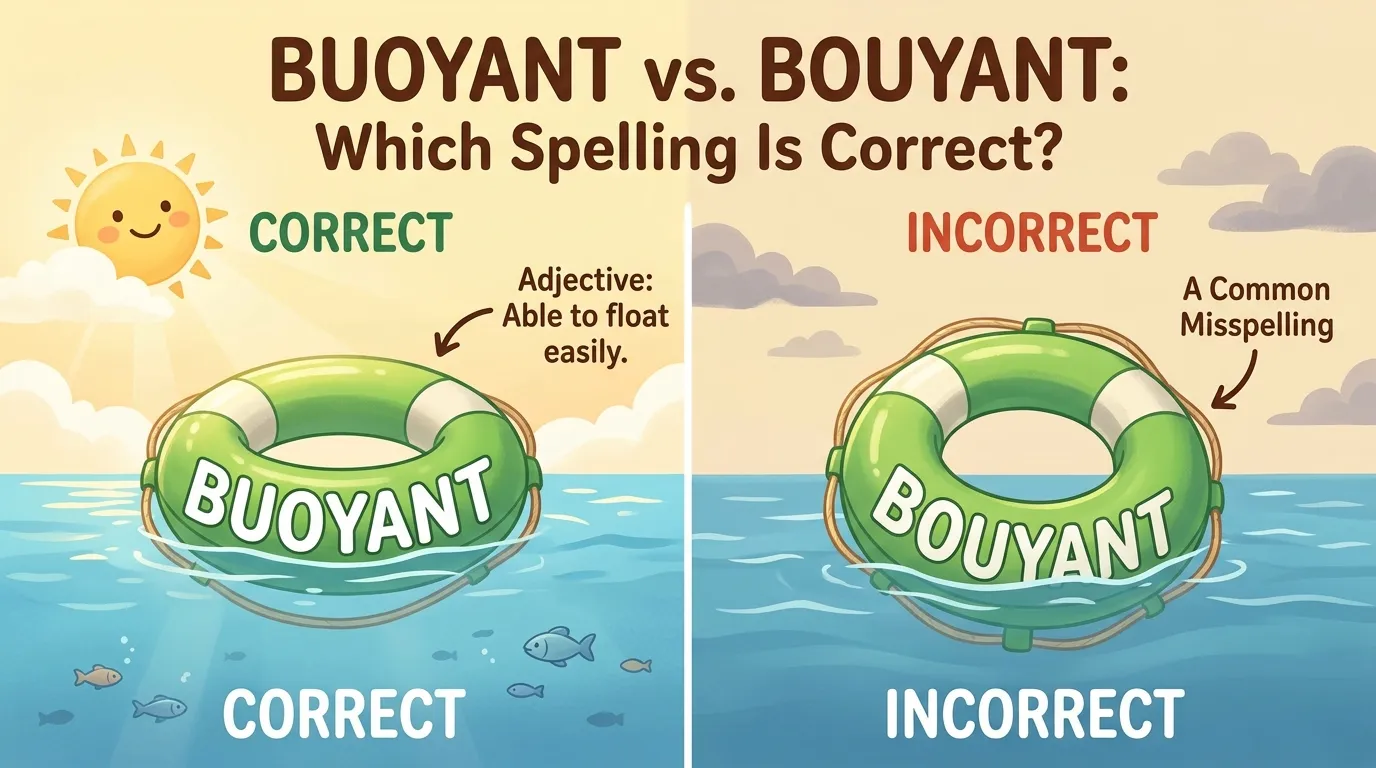
When comparing buoyant vs bouyant, the short answer is simple: buoyant is the correct spelling, while bouyant is a common misspelling. Although both forms may appear in online searches, dictionaries, books, academic writing, and professional publications recognize only buoyant as the standard English word.
The confusion usually happens because the word buoy is spelled differently from how many people expect, and English pronunciation doesn’t always match spelling. Since buoyant is pronounced BOY-uhnt, many writers accidentally rearrange the letters and type bouyant instead.
In this guide, you’ll learn exactly why buoyant is correct, why bouyant is incorrect, how to remember the proper spelling, and how to use buoyant confidently in everyday conversations, business writing, journalism, technical documents, and academic papers.
Quick Answer
| Word | Correct? | Meaning |
|---|---|---|
| Buoyant | ✅ Yes | Able to float; cheerful; optimistic; strong or successful |
| Bouyant | ❌ No | Misspelling of buoyant |
Always use “buoyant.” Never use “bouyant” in formal or professional writing.
Is Buoyant or Bouyant Correct?
The correct spelling is buoyant.
The spelling bouyant is simply a typo or spelling mistake caused by reversing the letters u and o.
Correct:
- The life jacket keeps swimmers buoyant.
- Investors remain buoyant despite market uncertainty.
- She stayed buoyant during difficult times.
Incorrect:
- ❌ The boat remained bouyant.
- ❌ He felt bouyant after hearing the news.
Spell checkers, dictionaries, and grammar tools all identify bouyant as an error.
Why Do People Misspell Buoyant?
Several reasons explain this common mistake.
The Word “Buoy”
People know the word buoy, but when adding -ant, many naturally write:
bouy + ant
instead of
buoy + ant
The letters become reversed.
Unusual English Spelling Patterns
English contains many words where pronunciation doesn’t clearly match spelling.
Examples include:
- Colonel
- Yacht
- Queue
- Rhythm
- Buoyant
Because buoyant is pronounced BOY-uhnt, writers often assume a different spelling.
Typing Errors
Fast typing frequently causes:
- bouyant
- buyoant
- buoyent
- buoyent
Only buoyant is correct.
Dictionary Definition of Buoyant
Buoyant (adjective)
Definition 1
Able to float or remain floating in water or another liquid.
Example:
The inflatable raft is highly buoyant.
Definition 2
Cheerful, optimistic, and confident.
Example:
She remained buoyant after losing the competition.
Definition 3
Strong, active, or successful.
Example:
The economy remained buoyant throughout the year.
Pronunciation
Buoyant
IPA (American English):
/ˈbɔɪənt/
Pronounced:
BOY-uhnt
Notice that the spelling contains:
buoy
not
bouy
Parts of Speech
| Form | Part of Speech |
|---|---|
| Buoyant | Adjective |
| Buoyancy | Noun |
| Buoyantly | Adverb |
| Buoy | Noun / Verb |
| Buoyed | Verb |
Examples:
- The cork is buoyant.
- The object has excellent buoyancy.
- She smiled buoyantly.
- Good news buoyed everyone’s spirits.
What Does Buoyant Mean?
The word has several related meanings.
Physically Floating
Something stays on the surface of water.
Examples:
- Wood is naturally buoyant.
- Foam is highly buoyant.
- Life jackets are designed to be buoyant.
Emotionally Positive
Someone feels hopeful and energetic.
Examples:
- She remained buoyant after the interview.
- His buoyant personality inspires everyone.
Economically Strong
Markets, industries, or businesses perform well.
Examples:
- Consumer spending remains buoyant.
- Tourism stayed buoyant all summer.
Buoyant in Different Contexts
Science
In physics, buoyant describes the ability to float because of buoyancy.
Example:
The submarine controls its buoyancy using ballast tanks.
Business
Companies often describe markets as buoyant.
Example:
The housing market remains buoyant.
Finance
Examples include:
- buoyant economy
- buoyant stock market
- buoyant demand
- buoyant sales
Sports
Sports journalists frequently use the word.
Examples:
- The team remained buoyant after halftime.
- Fans stayed buoyant despite the loss.
Everyday Conversation
Examples:
- Stay buoyant.
- She’s surprisingly buoyant today.
- Keep a buoyant attitude.
Buoyant vs. Bouyant Comparison
| Feature | Buoyant | Bouyant |
|---|---|---|
| Correct spelling | ✅ Yes | ❌ No |
| Dictionary word | Yes | No |
| Academic writing | Yes | No |
| Business writing | Yes | No |
| Journalism | Yes | No |
| Professional communication | Yes | No |
| Search typo | Occasionally | Yes |
Word History and Etymology
The word buoyant comes from the noun buoy, which refers to a floating object used to mark locations or hazards in water.
The noun buoy entered English through Old French and Dutch influences connected with navigation and floating markers. Over time, buoyant developed to describe not only floating objects but also people, markets, and emotions that seem to “rise above” difficulties.
Today, both literal and figurative meanings are common.
Literal vs. Figurative Meaning
Literal
Describes floating.
Examples:
- The raft is buoyant.
- The rubber duck remains buoyant.
Figurative
Describes optimism.
Examples:
- She remained buoyant despite criticism.
- Investors are feeling buoyant.
Common Collocations
Native English speakers often pair buoyant with certain words.
Physical
- buoyant force
- buoyant material
- buoyant object
- buoyant foam
- buoyant platform
Emotional
- buoyant mood
- buoyant spirit
- buoyant personality
- buoyant attitude
- buoyant outlook
Business
- buoyant economy
- buoyant market
- buoyant sales
- buoyant demand
- buoyant growth
Synonyms
Depending on context, synonyms include:
Floating
- floating
- afloat
- unsinkable
- light
Cheerful
- optimistic
- cheerful
- upbeat
- positive
- hopeful
- lively
- energetic
Successful
- thriving
- flourishing
- robust
- healthy
- prosperous
Antonyms
For floating:
- sinking
- submerged
For emotion:
- discouraged
- depressed
- gloomy
- pessimistic
- downhearted
For business:
- weak
- sluggish
- declining
- struggling
Regional Differences
American English
The spelling is:
Buoyant
British English
The spelling is also:
Buoyant
Unlike words such as:
- color/colour
- organize/organise
there is no British variant called bouyant.
Formal vs. Informal Usage
| Situation | Recommended |
|---|---|
| Academic papers | Buoyant |
| Business reports | Buoyant |
| News articles | Buoyant |
| Scientific writing | Buoyant |
| Technical manuals | Buoyant |
| Blogs | Buoyant |
| Emails | Buoyant |
| Social media | Buoyant |
The spelling never changes.
Common Expressions Using Buoyant
Examples include:
- remain buoyant
- keep spirits buoyant
- buoyant economy
- buoyant market
- buoyant mood
- buoyant personality
- buoyant confidence
- buoyant sales
- buoyant demand
- buoyant outlook
Real-World Examples
Science
The foam keeps the kayak buoyant.
Business
The company remains buoyant despite inflation.
School
Students stayed buoyant before the exam results.
Sports
The coach praised the team’s buoyant attitude.
Everyday Conversation
She always sounds buoyant, even on difficult days.
Common Mistakes
Mistake 1
❌ bouyant
✅ buoyant
Mistake 2
❌ buoyent
✅ buoyant
Mistake 3
❌ buyoant
✅ buoyant
Mistake 4
❌ booyant
✅ buoyant
Awkward vs. Natural Examples
| Awkward | Natural |
|---|---|
| The company stayed bouyant. | The company stayed buoyant. |
| His bouyant attitude helped everyone. | His buoyant attitude helped everyone. |
| The life vest is bouyant. | The life vest is buoyant. |
| Markets are bouyant today. | Markets are buoyant today. |
Everyday Example Sentences
- Cork is naturally buoyant.
- Oil is more buoyant than water.
- She has a buoyant personality.
- His confidence remained buoyant.
- The local economy looks buoyant.
- Sales stayed buoyant this quarter.
- Investors became more buoyant.
- The raft remained buoyant throughout the trip.
- Children were buoyant after hearing the good news.
- Tourism has remained buoyant for several years.
Academic Writing
Correct:
Researchers examined the buoyant properties of marine materials.
Incorrect:
Researchers examined the bouyant properties.
Business Writing
Correct:
Demand remains buoyant across international markets.
Journalism
Examples:
- A buoyant economy
- Buoyant consumer confidence
- Buoyant retail sales
- Buoyant hiring market
Technical Writing
Engineers often discuss:
- buoyant force
- buoyant stability
- buoyant structures
- buoyant materials
These are standard engineering terms.
Sports Writing
Examples:
The captain kept morale buoyant.
The crowd remained buoyant throughout the match.
Blogging and Casual Writing
Examples:
- Keep your spirits buoyant.
- The vacation left everyone feeling buoyant.
- I love her buoyant personality.
Memory Trick
A simple way to remember the correct spelling is to focus on the word buoy.
Think:
Buoy + ant = Buoyant
If you remember how to spell buoy, you’ll naturally spell buoyant correctly.
Another trick is this phrase:
A buoy keeps things afloat, and buoyant keeps the same spelling.
Avoid switching the u and o.
Should You Ever Use “Bouyant”?
No.
There is no situation where bouyant is considered correct English.
It is not:
- a British spelling
- an American spelling
- an Australian spelling
- a Canadian spelling
- an accepted alternative
- an old spelling
Whenever you write bouyant, replace it with buoyant.
Best Usage Recommendations
| Writing Type | Recommendation |
|---|---|
| American English | Use buoyant |
| British English | Use buoyant |
| Academic writing | Use buoyant |
| Business writing | Use buoyant |
| Journalism | Use buoyant |
| Scientific writing | Use buoyant |
| Technical writing | Use buoyant |
| Legal writing | Use buoyant |
| Marketing | Use buoyant |
| Blogging | Use buoyant |
| Social media | Use buoyant |
| International English | Use buoyant |
Frequently Asked Questions
Is buoyant or bouyant the correct spelling?
Buoyant is the correct spelling. Bouyant is a common misspelling and should not be used.
Is bouyant a real word?
No. Standard English dictionaries do not recognize bouyant as a valid word.
Why do people spell buoyant as bouyant?
People often reverse the letters u and o because the pronunciation (BOY-uhnt) doesn’t clearly reflect the spelling, and the base word buoy has an unusual letter order.
Is buoyant used only for floating objects?
No. It can describe physical floating, a cheerful or optimistic attitude, and strong economic or business performance.
Is buoyant a noun or an adjective?
Buoyant is an adjective. Related forms include the noun buoyancy and the adverb buoyantly.
Is buoyant the same in American and British English?
Yes. Both American and British English use the spelling buoyant.
What is the opposite of buoyant?
The opposite depends on the context. For floating objects, opposites include sinking or submerged. For emotions, gloomy, discouraged, or pessimistic are common antonyms. For markets, sluggish or declining are suitable opposites.
Can I use buoyant in business writing?
Absolutely. It is commonly used to describe healthy markets, strong demand, rising sales, and positive investor confidence.
How do you pronounce buoyant?
In American English, buoyant is typically pronounced BOY-uhnt (/ˈbɔɪənt/).
How can I remember the correct spelling?
Remember the base word buoy. Since buoyant comes from buoy, keep the same letter order: b-u-o-y, then add -ant.
Conclusion
When comparing buoyant vs. bouyant, the choice is clear: buoyant is the only correct spelling in modern English. It is accepted in American, British, Canadian, Australian, and international English, while bouyant is simply a misspelling caused by the unusual spelling of buoy and the way the word is pronounced.
Whether you’re describing an object that floats, a person with an optimistic outlook, or a thriving economy, buoyant is the word to use. Keeping the base word buoy in mind is an easy way to remember the correct spelling and avoid a common writing mistake. By using buoyant consistently in academic papers, business reports, journalism, technical documents, and everyday communication, you’ll write with greater accuracy, professionalism, and confidence.


