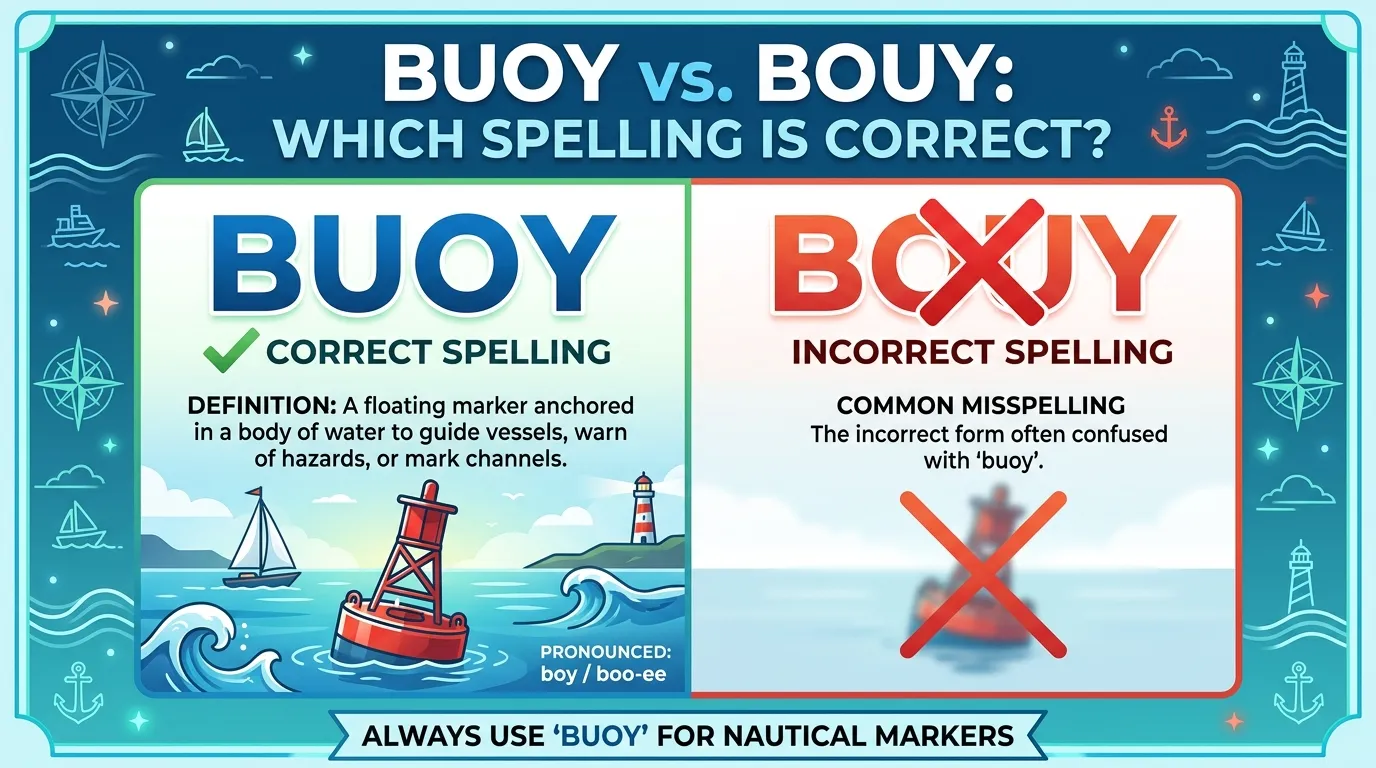
When comparing buoy vs bouy, the short answer is simple: buoy is the correct spelling, while bouy is a misspelling. Although many people accidentally write bouy, it does not appear as a standard English word in dictionaries.
This spelling mistake is common because English pronunciation does not always match spelling. The word buoy has an unusual letter order and can be pronounced differently depending on the variety of English. As a result, many writers accidentally switch the o and u, creating the incorrect spelling bouy.
In this guide, you’ll learn:
- Which spelling is correct
- Why people confuse buoy and bouy
- The meaning of buoy
- How to pronounce it
- Examples of correct usage
- Common mistakes to avoid
- Helpful memory tricks
- American vs British pronunciation
- Frequently asked questions
By the end, you’ll know exactly when and how to use buoy correctly in every type of writing.
Quick Answer
| Word | Correct? | Meaning |
|---|---|---|
| Buoy | ✅ Yes | A floating object used to mark locations or aid navigation; also a verb meaning to support or keep afloat. |
| Bouy | ❌ No | Incorrect spelling of buoy. |
Always use “buoy.”
Never use “bouy” in formal, academic, professional, or everyday writing.
Is It Buoy or Bouy?
The correct spelling is buoy.
The spelling bouy is simply a typo or spelling error. It is not recognized as a proper English word.
Correct
- The red buoy marks the entrance to the harbor.
- Lifeguards spotted the buoy from shore.
- Positive news helped buoy investor confidence.
Incorrect
- The boat passed the red bouy.
- The swimmer grabbed the bouy.
- The yellow bouy floated nearby.
Whenever you see bouy, replace it with buoy.
What Does Buoy Mean?
The word buoy has two main uses.
As a Noun
A buoy is a floating object placed in water.
It can:
- Mark safe routes
- Warn of underwater hazards
- Indicate fishing areas
- Show diving locations
- Mark channels and harbors
Examples
- The captain steered around the green buoy.
- The diver surfaced beside the buoy.
- A warning buoy marked the shallow rocks.
As a Verb
As a verb, buoy means:
- To keep something floating
- To lift someone’s mood
- To support or encourage
- To strengthen confidence
Examples
- Strong sales buoyed the company’s profits.
- Her encouraging words buoyed his confidence.
- Life jackets buoy swimmers in deep water.
Why Do People Misspell Buoy as Bouy?
There are several reasons.
The Letters Look Reversed
Many English words place ou together.
Examples include:
- loud
- found
- cloud
- round
People naturally expect bouy to follow this familiar pattern.
Instead, English uses the unusual order:
buoy
The Pronunciation Is Unexpected
Many words are spelled how they sound.
Not buoy.
The pronunciation changes depending on the variety of English.
This confuses many learners.
Fast Typing
Sometimes writers simply reverse two letters while typing.
Examples include:
- recieve instead of receive
- freind instead of friend
- bouy instead of buoy
How to Pronounce Buoy
Pronunciation varies between American and British English.
| English Variety | Common Pronunciation | IPA |
|---|---|---|
| American English | BOO-ee | /ˈbuːi/ |
| British English | BOY | /bɔɪ/ |
Both pronunciations are correct.
Only the spelling stays the same.
Buoy vs Bouy Comparison
| Feature | Buoy | Bouy |
|---|---|---|
| Correct spelling | ✅ Yes | ❌ No |
| Dictionary word | Yes | No |
| Used in professional writing | Yes | No |
| Used in books | Yes | No |
| Accepted in exams | Yes | No |
| Standard English | Yes | No |
Dictionary Definition of Buoy
Noun
A floating object anchored in water to mark channels, hazards, locations, or navigation routes.
Verb
To keep afloat, support, encourage, or improve someone’s confidence or mood.
Grammatical Role
Buoy works as both:
- noun
- verb
Noun Examples
- The buoy floated offshore.
- Every buoy has a unique color.
Verb Examples
- Good weather buoyed tourism.
- Investors were buoyed by strong earnings.
Why the Spelling Looks Strange
English borrowed buoy from Old French.
The spelling stayed mostly unchanged over hundreds of years.
Many modern English words were simplified over time.
Buoy kept its historic spelling.
That is why it seems unusual today.
The History of the Word
The word traces back through:
- Old French
- Middle English
- Maritime navigation
Originally, it referred to floating markers that helped ships avoid danger.
Later, writers began using buoy as a verb to describe emotional or financial support.
Examples:
- buoy confidence
- buoy morale
- buoy the economy
Common Uses of Buoy
Maritime Navigation
- Channel buoy
- Harbor buoy
- Warning buoy
- Marker buoy
Example:
The sailboat passed the navigation buoy.
Swimming
Rescue teams often use buoys.
Examples:
- Rescue buoy
- Lifebuoy
- Safety buoy
Finance
Businesses often use the verb.
Examples:
- Strong demand buoyed profits.
- Lower inflation buoyed markets.
News Reporting
Journalists frequently write:
- Markets were buoyed by positive data.
- The announcement buoyed investor confidence.
Sports
Examples:
- The early goal buoyed the team.
- Fans buoyed the players throughout the match.
American vs British English
Interestingly, the spelling never changes.
Only pronunciation differs.
| Feature | American English | British English |
|---|---|---|
| Spelling | Buoy | Buoy |
| Pronunciation | BOO-ee | BOY |
| Meaning | Same | Same |
Unlike words such as:
- color/colour
- center/centre
Buoy has identical spelling worldwide.
Contextual Differences
Literal Meaning
Something floating on water.
Example:
The fishing boat tied itself to the buoy.
Figurative Meaning
Providing encouragement or support.
Example:
The successful launch buoyed employee morale.
Common Collocations
People often pair buoy with these words.
Noun Collocations
- navigation buoy
- marker buoy
- warning buoy
- red buoy
- green buoy
- anchor buoy
- weather buoy
- rescue buoy
- mooring buoy
- floating buoy
Verb Collocations
- buoy confidence
- buoy morale
- buoy spirits
- buoy optimism
- buoy markets
- buoy prices
- buoy growth
- buoy demand
- buoy investors
- buoy performance
Related Words
- float
- flotation
- beacon
- marker
- harbor
- channel
- navigation
- mooring
- raft
- lifebuoy
Synonyms
As a Noun
- marker
- float
- beacon
- navigation marker
As a Verb
- encourage
- support
- strengthen
- lift
- improve
- sustain
- inspire
Antonyms
When used as a verb:
- discourage
- depress
- weaken
- sink
- undermine
- lower
Common Expressions
These are commonly used.
- buoy confidence
- buoy spirits
- buoy morale
- buoy investor sentiment
- buoy economic growth
- buoy market performance
Real-World Examples
Maritime
The lighthouse stood behind the red buoy.
Business
Government incentives buoyed small businesses.
Education
Positive feedback buoyed students before exams.
Sports
The captain’s speech buoyed the team.
Everyday Conversation
Your support really buoyed my confidence.
Formal vs Informal Usage
| Situation | Recommended Word |
|---|---|
| Academic writing | Buoy |
| Business writing | Buoy |
| Journalism | Buoy |
| Technical reports | Buoy |
| Sports reporting | Buoy |
| Casual conversation | Buoy |
| Blogging | Buoy |
| Government documents | Buoy |
There is never a situation where bouy is correct.
Common Mistakes
Mistake 1
❌ The bouy floated in the ocean.
✅ The buoy floated in the ocean.
Mistake 2
❌ The news bouyed investors.
✅ The news buoyed investors.
Mistake 3
❌ Rescue bouy
✅ Rescue buoy
Mistake 4
❌ Weather bouy
✅ Weather buoy
Awkward vs Natural Examples
| Awkward or Incorrect | Natural |
|---|---|
| The bouy marked danger. | The buoy marked danger. |
| Her speech bouyed morale. | Her speech buoyed morale. |
| The yellow bouy floated nearby. | The yellow buoy floated nearby. |
| The captain reached the bouy. | The captain reached the buoy. |
Everyday Examples
- We tied the boat to the buoy.
- The buoy rocked with the waves.
- His coach’s advice buoyed his confidence.
- Rescue workers placed a buoy near the swimmer.
- Good grades buoyed her spirits.
- The harbor has dozens of navigation buoys.
- Strong exports buoyed the economy.
- Divers surfaced next to the buoy.
- The warning buoy kept boats away from the reef.
- Positive reviews buoyed book sales.
Academic Writing
Use buoy when discussing:
- marine science
- oceanography
- economics
- psychology
- environmental studies
Example:
Data collected from offshore buoys showed rising sea temperatures.
Business Writing
Examples:
- Strong earnings buoyed investor confidence.
- New contracts buoyed company growth.
- Consumer demand buoyed quarterly revenue.
Journalism
News outlets often write:
- Stocks were buoyed by falling inflation.
- The announcement buoyed financial markets.
- Tourism was buoyed by lower airfare prices.
Technical Writing
Marine engineers commonly use terms such as:
- navigation buoy
- weather buoy
- data buoy
- mooring buoy
Precision matters, so always spell buoy correctly.
Sports Writing
Examples include:
- The victory buoyed the team’s confidence.
- Fans buoyed the athletes throughout the tournament.
- Early momentum buoyed the offense.
Blogging and Casual Writing
Even in informal writing, the spelling should always be buoy.
Examples:
- We kayaked past several colorful buoys.
- That compliment really buoyed my mood today.
Memory Trick to Remember Buoy
A simple trick is to focus on the first three letters:
B-U-O-Y
Think:
U comes before OY in buoy.
Another helpful reminder:
A buoy keeps boats up, so keep the letters in the correct order too.
Repeated exposure will make the unusual spelling easier to remember.
Should You Ever Use Bouy?
No.
Whether you’re writing:
- school assignments
- emails
- articles
- novels
- websites
- business documents
- social media posts
Always write:
✅ buoy
Never write:
❌ bouy
Spell checkers and grammar tools will usually flag bouy as an error.
Final Comparison
| Feature | Buoy | Bouy |
|---|---|---|
| Correct English | ✅ | ❌ |
| Appears in dictionaries | ✅ | ❌ |
| Professional writing | ✅ | ❌ |
| Academic writing | ✅ | ❌ |
| Journalism | ✅ | ❌ |
| Everyday writing | ✅ | ❌ |
| Official documents | ✅ | ❌ |
Frequently Asked Questions
Is buoy or bouy the correct spelling?
Buoy is the correct spelling. Bouy is a misspelling and is not recognized as standard English.
Why do people spell buoy as bouy?
Many people reverse the letters because ou is a more common letter combination in English than uo. The unusual spelling of buoy makes it easy to mistype.
Is bouy a real English word?
No. Bouy does not appear as a standard word in major English dictionaries. It should always be corrected to buoy.
How do Americans pronounce buoy?
In American English, buoy is commonly pronounced BOO-ee (/ˈbuːi/).
How do British speakers pronounce buoy?
In British English, buoy is commonly pronounced BOY (/bɔɪ/).
Can buoy be used as a verb?
Yes. As a verb, buoy means to support, encourage, keep afloat, or strengthen confidence.
What is a buoy used for?
A buoy is used to mark navigation channels, warn of hazards, indicate safe routes, support mooring, collect weather or ocean data, and assist in rescue operations.
What is the past tense of buoy?
The past tense and past participle of buoy is buoyed.
Example:
The encouraging results buoyed the team’s confidence.
Is buoy used outside of boating?
Yes. It is often used figuratively in business, sports, politics, and everyday language to describe something that supports or lifts confidence, morale, markets, or performance.
How can I remember the correct spelling of buoy?
Remember that buoy has the unusual letter order u-o. A simple reminder is: “The buoy keeps boats up, so keep the letters in the right order.” Practicing the word in context also helps reinforce the correct spelling.
Conclusion
When comparing buoy vs bouy, the answer is clear: buoy is the only correct spelling in standard English. It functions as both a noun—a floating marker used in waterways—and a verb meaning to support, encourage, or keep afloat. Bouy is simply a common misspelling caused by the word’s unusual letter order and differing American and British pronunciations.
For academic papers, professional documents, journalism, technical writing, business communication, blogs, and everyday conversation, always use buoy. If you’re ever unsure, remember that while the pronunciation may vary by region, the spelling never does. Mastering this distinction will make your writing more accurate, polished, and credible.


