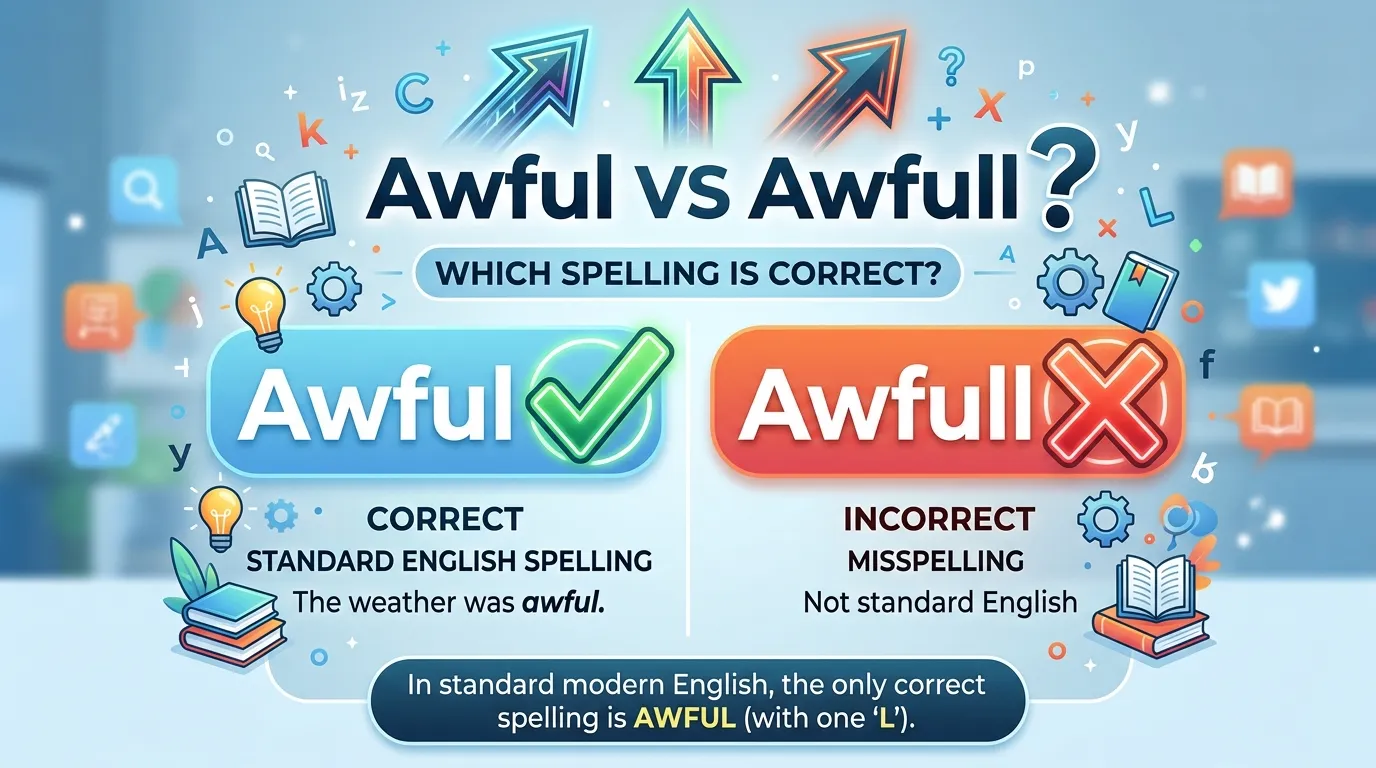
If you’ve ever wondered whether awful or awfull is the correct spelling, you’re not alone. Many English learners, students, writers, and even native speakers occasionally type awfull by mistake because English contains many words ending in -full, such as beautifully, carefully, and helpful. However, when it comes to awful vs awfull, only one spelling is accepted in modern English.
The correct spelling is awful. The spelling awfull is considered a misspelling and does not appear as a standard word in dictionaries. Whether you’re writing an email, school assignment, business report, blog post, social media caption, or academic paper, you should always use awful.
In this guide, you’ll learn the difference between awful vs awfull, why people confuse the two spellings, their meaning, pronunciation, grammar, history, examples, memory tricks, and common mistakes to avoid. By the end, you’ll know exactly which spelling to use in every situation.
Quick Answer
| Word | Correct? | Meaning |
|---|---|---|
| Awful | ✅ Yes | Extremely bad, unpleasant, or terrible |
| Awfull | ❌ No | Incorrect spelling of awful |
Short answer: Always write awful. Never use awfull in standard English.
Is It Awful or Awfull?
The correct spelling is awful.
Although it may seem like awfull should be correct because it looks similar to words ending in -full, English spelling follows historical patterns rather than simple rules.
Examples:
- ✅ The weather was awful yesterday.
- ✅ I feel awful about what happened.
- ✅ That movie was awful.
- ❌ The weather was awfull yesterday.
- ❌ That meal tasted awfull.
Every major English dictionary recognizes awful as the correct spelling.
Why Do People Misspell Awful as Awfull?
There are several reasons this mistake is so common.
Confusion with Words Ending in -full
Many English adjectives really do end with -full.
Examples include:
- careful
- helpful
- hopeful
- cheerful
- thankful
- colorful (American English)
- colourful (British English)
Because of these familiar patterns, people naturally assume awfull should also contain two Ls.
Pronunciation Doesn’t Help
The pronunciation sounds almost identical whether someone imagines one L or two.
Awful
IPA (American English):
/ˈɔːfəl/
Since the final sound doesn’t clearly reveal the spelling, many writers rely on guessing.
Typing Errors
Modern keyboards and smartphones frequently produce accidental double letters.
Fortunately, spell check usually corrects awfull to awful.
What Does Awful Mean?
The adjective awful usually means:
- extremely bad
- very unpleasant
- terrible
- poor in quality
Examples:
- The traffic was awful.
- She had an awful headache.
- That restaurant has awful service.
- We watched an awful movie.
Older Meaning
Historically, awful meant something very different.
Originally, it meant:
- inspiring awe
- worthy of respect
- majestic
- full of awe
Example from older literature:
The awful power of God.
Today, this older meaning is uncommon except in historical, literary, or religious writing.
Dictionary-Style Definition
Awful (adjective)
Definition 1
Very bad or unpleasant.
Example:
The hotel had awful customer service.
Definition 2
Extremely great or severe.
Example:
There was an awful noise outside.
Definition 3 (Historical)
Inspiring awe or reverence.
Example:
The awful majesty of heaven.
Is Awfull a Real Word?
No.
Awfull is not a standard English word.
It is considered:
- a spelling mistake
- a typo
- a misspelling
It should never appear in:
- academic writing
- journalism
- business communication
- professional emails
- books
- websites
- legal documents
Spell-checking software will usually mark it as incorrect.
Why Is Awful Spelled with One L?
The spelling developed over centuries from the phrase:
awe + ful
Originally, -ful was a suffix meaning “full of.”
Over time, English spelling standardized the word as:
awful
instead of
awfull
Many older English words dropped doubled consonants during spelling standardization.
The History and Etymology of Awful
The word comes from:
Old English → awe
plus
the suffix -ful
Originally, awful literally meant:
full of awe
During the 1700s and 1800s, the meaning gradually shifted.
Timeline:
- 1300s: Full of awe
- 1500s: Inspiring reverence
- 1700s: Extremely impressive
- 1800s: Extremely bad
- Modern English: Terrible or unpleasant
This change is an example of semantic shift, where a word changes meaning over time.
Pronunciation
American English
/ˈɔːfəl/
British English
/ˈɔːfəl/
The pronunciation is virtually identical across major English dialects.
Grammatical Role
Awful is mainly an adjective.
Examples:
- awful weather
- awful mistake
- awful smell
- awful behavior
Informally, especially in older American English, awful may function as an adverb.
Example:
The soup is awful hot.
This usage is considered informal or dialectal.
Standard English prefers:
The soup is awfully hot.
Awful vs Awfull Comparison Table
| Feature | Awful | Awfull |
|---|---|---|
| Correct spelling | ✅ Yes | ❌ No |
| Dictionary word | Yes | No |
| Used in writing | Yes | Never |
| Accepted in school | Yes | No |
| Accepted professionally | Yes | No |
| American English | Yes | No |
| British English | Yes | No |
When Should You Use Awful?
Use awful whenever describing something negative.
Examples:
- awful weather
- awful traffic
- awful food
- awful headache
- awful decision
- awful customer service
- awful performance
- awful smell
Common Collocations with Awful
Native speakers often combine awful with these nouns.
Everyday Collocations
- awful day
- awful experience
- awful pain
- awful feeling
- awful mistake
- awful habit
- awful accident
- awful condition
- awful sound
- awful taste
Business
- awful customer support
- awful management
- awful communication
- awful leadership
Education
- awful grades
- awful handwriting
- awful attendance
Healthcare
- awful symptoms
- awful injury
- awful illness
Common Expressions with Awful
Examples include:
- That’s awful.
- I feel awful.
- It smells awful.
- Looks awful.
- Sounds awful.
- Tastes awful.
- What an awful day!
- That’s an awful idea.
Synonyms of Awful
Depending on context:
For Something Bad
- terrible
- horrible
- dreadful
- unpleasant
- miserable
- poor
- dreadful
- unacceptable
- shocking
- disappointing
For Severe
- intense
- severe
- extreme
- serious
Antonyms of Awful
- wonderful
- amazing
- excellent
- fantastic
- pleasant
- enjoyable
- delightful
- outstanding
- superb
- terrific
Related Words
- awfully
- awe
- awesome
- awe-inspiring
- fearful
- dreadful
- horrible
Notice that awesome and awful originally shared similar roots involving awe, but today they have nearly opposite meanings.
Everyday Examples
Correct examples:
- My phone battery is awful.
- The roads were awful after the storm.
- She feels awful today.
- That coffee tastes awful.
- The meeting went awful well. (Dialectal)
- The meeting went awfully well. (Standard English)
Formal Writing Examples
Business
The customer reported an awful experience with delivery.
Academic
The researchers documented the awful living conditions during the disaster.
Journalism
Residents described the flooding as awful.
Technical
The equipment produced awful performance under heavy loads.
Casual Conversation Examples
- That’s awful.
- I feel awful.
- You look awful today.
- This pizza is awful.
- That joke was awful.
- Traffic was awful.
Academic Writing Recommendations
In formal academic writing, awful is acceptable when accurately describing severe negative conditions.
However, more precise words are often better.
Instead of:
The experiment produced awful results.
Use:
- poor results
- unreliable findings
- unsatisfactory outcomes
Precision improves academic writing.
Business Writing Recommendations
Business communication benefits from professionalism.
Instead of:
The service was awful.
You might write:
- The service was unsatisfactory.
- The customer experience did not meet expectations.
- Service quality requires improvement.
These alternatives sound more objective.
Journalism Recommendations
News writing often avoids emotionally loaded words unless quoting someone.
Instead of:
The city’s roads are awful.
A reporter may write:
Residents described the roads as awful.
or
The roads were in poor condition.
Technical Writing Recommendations
Technical documents usually avoid subjective language.
Instead of:
The software is awful.
Write:
- The software contains significant defects.
- System performance is poor.
- Reliability is below acceptable standards.
Sports Writing
Examples:
- The team played awful defense.
- Their passing was awful.
- The referee made an awful call.
More formal alternatives:
- poor
- ineffective
- inaccurate
Blogging and Social Media
Blogs often use awful for emphasis.
Examples:
- I had an awful travel experience.
- This update is awful.
- The ending was awful.
This usage sounds natural and conversational.
American vs British English
There is no spelling difference.
Both American English and British English use:
✅ awful
Neither variety accepts:
❌ awfull
Literal and Figurative Meaning
Literal
The food tasted awful.
The smell was awful.
Figurative
That was an awful decision.
He felt awful after losing his job.
Formal vs Informal Alternatives
| Instead of Awful | More Formal Alternative |
|---|---|
| awful service | inadequate service |
| awful performance | poor performance |
| awful behavior | inappropriate behavior |
| awful results | unsatisfactory results |
| awful conditions | unacceptable conditions |
Common Mistakes
Mistake 1
❌ This movie was awfull.
✅ This movie was awful.
Mistake 2
❌ I feel awfull today.
✅ I feel awful today.
Mistake 3
❌ She made an awfull mistake.
✅ She made an awful mistake.
Mistake 4
❌ That restaurant is awfull.
✅ That restaurant is awful.
Awkward vs Natural Examples
| Awkward | Natural |
|---|---|
| That meal was awfull. | That meal was awful. |
| I had an awfull day. | I had an awful day. |
| Their support is awfull. | Their support is awful. |
| It smells awfull. | It smells awful. |
Memory Trick to Remember the Correct Spelling
A simple way to remember it:
Awful has only one L because it’s already bad enough—it doesn’t need another L!
Another trick:
Think of these pairs:
- awful ✅
- useful ✅
- careful ✅
Not every word ending with -ful keeps two Ls. The suffix -ful normally uses a single l when attached to a base word.
Should Spell Check Correct Awfull?
Yes.
Most writing tools, including Microsoft Word, Google Docs, Grammarly, and browser spell checkers, automatically flag awfull and suggest awful.
Even so, proofreading is important because spell check cannot catch every writing mistake.
Best Practices for Writers
To write clearly and professionally:
- Always spell the word as awful.
- Avoid awfull in every type of writing.
- Choose more precise alternatives in formal documents when appropriate.
- Proofread your work before publishing.
- Use a dictionary if you’re unsure about spelling.
Summary Table
| Question | Answer |
|---|---|
| Is awful correct? | ✅ Yes |
| Is awfull correct? | ❌ No |
| Is awfull in dictionaries? | No |
| Which spelling should I use? | Awful |
| Is there a British spelling? | No, both use awful |
| Is awfully correct? | Yes |
Frequently Asked Questions
Is awful or awfull the correct spelling?
Awful is the only correct spelling. Awfull is a misspelling and should not be used in standard English.
Is awfull ever accepted?
No. Standard dictionaries and style guides do not recognize awfull as a correct word.
Why do people write awfull?
People often confuse it with words ending in -full, such as helpful or careful, or they accidentally type an extra l.
Is awful an adjective?
Yes. Awful is primarily an adjective used to describe something that is extremely bad, unpleasant, or severe.
Can awful be used as an adverb?
In some regional or older informal speech, awful may be used as an adverb (for example, awful cold), but standard English prefers awfully.
Is awful negative?
Almost always. In modern English, awful generally expresses something unpleasant, terrible, or of very poor quality.
Do Americans and British people spell awful differently?
No. Both American English and British English use the spelling awful.
What is the difference between awful and awesome?
Although both words come from awe, their meanings have changed over time. Awful now usually means very bad, while awesome means excellent, impressive, or inspiring admiration.
What are the best synonyms for awful?
Common synonyms include terrible, horrible, dreadful, poor, miserable, unpleasant, and appalling, depending on the context.
Is awful appropriate in professional writing?
Yes, but use it carefully. In formal reports, academic writing, or business communication, more precise terms such as poor, unsatisfactory, inadequate, or substandard are often better choices.
Conclusion
When comparing awful vs awfull, the answer is simple: awful is the only correct spelling in modern English. Whether you’re writing for school, work, journalism, blogging, social media, or everyday conversation, you should always use awful. The spelling awfull is a common typo that stems from confusion with other -ful words, but it is not recognized by dictionaries or style guides.
To write with confidence, remember that awful has one l, not two. If you’re aiming for polished, professional writing, choose awful when describing something extremely bad or unpleasant, and consider more specific alternatives—such as poor, unsatisfactory, or appalling—when the context calls for greater precision. Consistent spelling, careful proofreading, and selecting the right word for your audience will make your writing clearer, more credible, and more effective.


