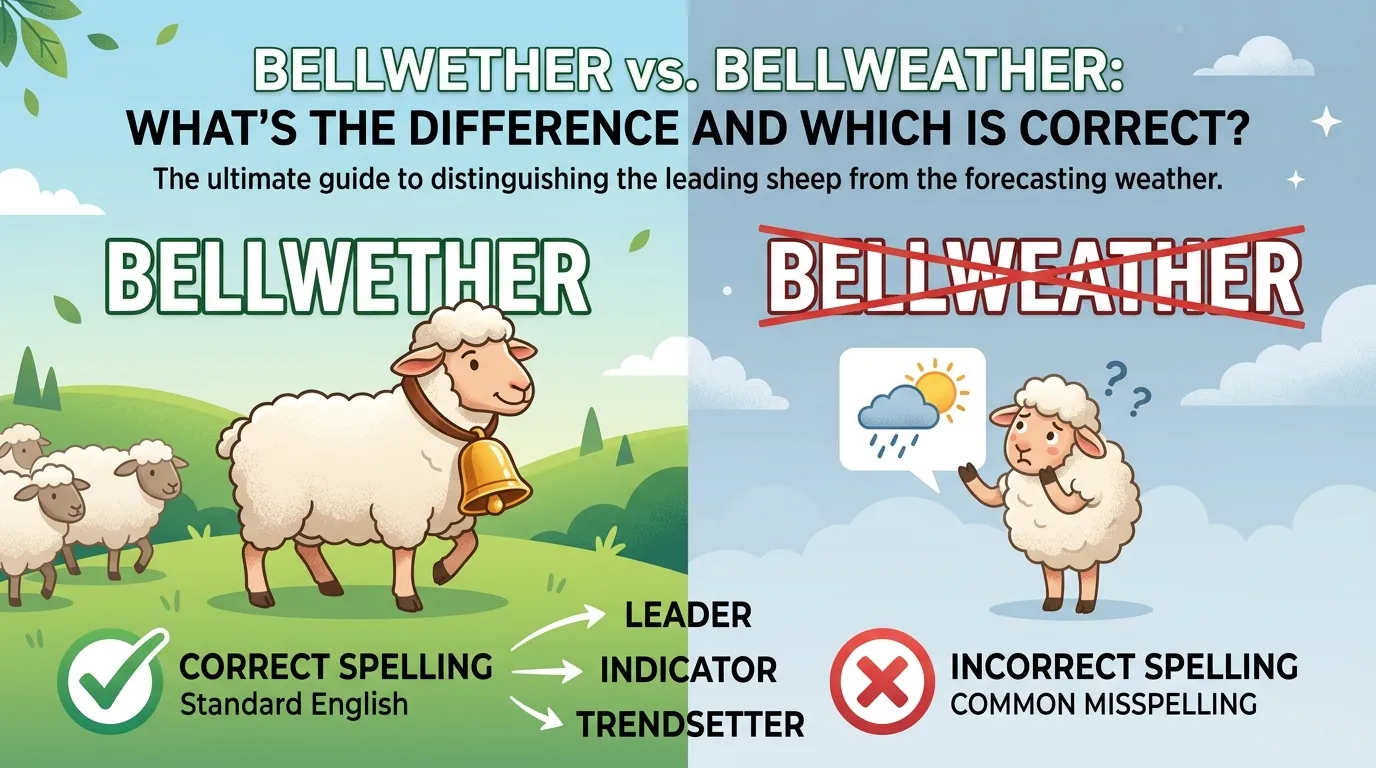
If you’ve ever wondered whether bellwether or bellweather is the correct word, you’re not alone. Many people accidentally write bellweather, especially because it looks similar to the word weather. However, in standard English, only bellwether is correct when referring to a leader, trendsetter, or indicator of future events.
Understanding the difference between bellwether vs bellweather can help you avoid one of the most common spelling mistakes in business writing, journalism, politics, finance, education, and everyday communication. This confusion appears frequently in online articles, social media posts, emails, and even professional documents.
In this complete guide, you’ll learn the meaning of bellwether, why people mistakenly write bellweather, where the word came from, how to pronounce it correctly, and how to use it naturally in different contexts. You’ll also find practical examples, comparison tables, memory tricks, common mistakes, and answers to frequently asked questions.
Quick Answer
| Word | Correct? | Meaning |
|---|---|---|
| Bellwether | ✅ Yes | A leader, trendsetter, or indicator of future developments. |
| Bellweather | ❌ No | A common misspelling of bellwether. It is not a standard English word. |
Short answer: Always use bellwether. Bellweather is simply a spelling mistake.
Is It Bellwether or Bellweather?
The correct spelling is bellwether.
Although bellweather looks logical because it contains the familiar word weather, English dictionaries do not recognize it as a standard word.
Whenever you mean:
- a leader
- a trendsetter
- an indicator
- something that predicts future events
the correct word is always bellwether.
Correct
- The company is a bellwether for the technology industry.
- This election is considered a political bellwether.
- Consumer spending is often a bellwether of economic health.
Incorrect
- The company is a bellweather for the industry.
- Analysts call the stock a bellweather.
- The county is a political bellweather.
Why Do People Confuse Bellwether and Bellweather?
There are several reasons.
The Word “Weather” Is More Familiar
Most people use weather every day.
Words like:
- weather forecast
- bad weather
- weather report
are extremely common.
By comparison, wether is an unfamiliar word that many English speakers have never learned.
They Sound Similar
Many speakers pronounce the words so quickly that:
- bellwether
- bellweather
sound nearly identical.
This leads to spelling mistakes.
Spellcheck Doesn’t Always Catch It
Some writing tools may not immediately identify bellweather if it’s used in certain contexts or if autocorrect has learned the error.
That’s why proofreading is important.
Dictionary Definition of Bellwether
Bellwether (noun)
Definition 1
A leader or person who others follow.
Example
She became the bellwether of the environmental movement.
Definition 2
Something that predicts future trends or events.
Example
Housing sales are often a bellwether of the economy.
Definition 3
An organization, company, region, or industry that indicates the direction others may follow.
Example
California is often considered a bellwether for technology innovation.
What Does Wether Mean?
The second half of the word surprises many people.
A wether is:
A castrated male sheep.
Historically, shepherds placed a bell around the neck of one experienced sheep.
The flock naturally followed that sheep.
That sheep became known as the bellwether.
Over time, the word evolved into a metaphor for leadership and prediction.
The History of Bellwether
The word dates back hundreds of years.
Originally:
- bell referred to the bell worn around the sheep’s neck.
- wether referred to the sheep itself.
Together:
bell + wether = bellwether
The sheep wearing the bell naturally guided the flock.
Eventually, English speakers began using the word figuratively.
Today, it commonly refers to:
- influential people
- market leaders
- political indicators
- economic predictors
- social trends
Bellwether Meaning in Different Contexts
Business
Companies often describe industry leaders as bellwethers.
Examples:
- Apple is a bellwether for consumer technology.
- Walmart is considered a retail bellwether.
Economics
Economists use the word frequently.
Examples:
- Manufacturing is a bellwether of economic growth.
- Employment numbers are an economic bellwether.
Politics
Political analysts often discuss bellwether regions.
Example:
- Ohio was long considered a presidential bellwether because its voting patterns often matched national election results.
Finance
Investors frequently hear this word.
Examples:
- The company’s earnings are viewed as a bellwether for the banking sector.
- Semiconductor sales are a bellwether for technology demand.
Sports
Sports writers sometimes use bellwether to describe:
- leading teams
- championship contenders
- performance indicators
Example:
The defending champions remain the league’s bellwether.
Education
Example:
Test scores became a bellwether of curriculum success.
Journalism
Reporters often write:
- a bellwether county
- a bellwether company
- a bellwether election
- a bellwether stock
Bellwether vs Bellweather Comparison
| Feature | Bellwether | Bellweather |
|---|---|---|
| Correct spelling | ✅ Yes | ❌ No |
| Dictionary word | Yes | No |
| Refers to leadership | Yes | No |
| Means predictor | Yes | No |
| Used professionally | Yes | No |
| Accepted in academic writing | Yes | No |
Pronunciation
Bellwether
Pronunciation:
BEL-WEH-thur
IPA:
/ˈbelˌweðər/
Despite the spelling, it is pronounced much like weather, which contributes to the confusion.
Grammatical Role
Bellwether is a noun.
Examples:
- The startup became a bellwether.
- This indicator serves as a bellwether.
- Their success made them a market bellwether.
Literal vs Figurative Meaning
Literal Meaning
Historically:
A sheep wearing a bell that leads the flock.
Figurative Meaning
Today:
Someone or something that leads or predicts future developments.
Example:
The university became a bellwether for educational reform.
Common Collocations
You’ll often see bellwether paired with these words.
- bellwether company
- bellwether stock
- bellwether county
- bellwether state
- bellwether election
- bellwether industry
- bellwether indicator
- bellwether trend
- bellwether brand
- bellwether institution
- economic bellwether
- political bellwether
- market bellwether
- industry bellwether
Synonyms
Depending on context:
- leader
- pioneer
- trendsetter
- trailblazer
- influencer
- frontrunner
- predictor
- indicator
- benchmark
- signal
- guide
- pathfinder
- forerunner
Antonyms
Possible opposites include:
- follower
- imitator
- outsider
- laggard
- straggler
- late adopter
- underperformer
Related Words
- benchmark
- indicator
- forecast
- predictor
- precedent
- leader
- innovation
- influence
- guidance
- direction
Common Expressions
Although bellwether itself is not an idiom, it commonly appears in expressions such as:
- a bellwether company
- a bellwether stock
- a bellwether election
- the industry’s bellwether
- serves as a bellwether
- considered a bellwether
- remains a bellwether
Real World Usage
Business
Nvidia has become a bellwether for artificial intelligence investment.
Politics
Analysts watched the county because it was a bellwether for national voting trends.
Economics
Consumer confidence remains a bellwether of future spending.
Technology
Smartphone demand often serves as a bellwether for electronics sales.
Healthcare
Hospital admissions became a bellwether of seasonal illness activity.
Formal vs Informal Usage
| Formal | Informal |
|---|---|
| This company is a bellwether for the sector. | Everyone follows this company. |
| The report is a bellwether of market confidence. | The report shows what’s coming next. |
| The region remains a political bellwether. | This area usually predicts the election. |
American vs British English
Both American English and British English use bellwether.
There is no regional spelling difference.
| American English | British English |
|---|---|
| Bellwether | Bellwether |
Neither variety accepts bellweather.
Academic Writing
In academic writing, bellwether is often used when discussing:
- economics
- sociology
- political science
- education
- business research
- public policy
Example:
The region served as a bellwether for demographic change.
Business Writing
Appropriate examples include:
- Our flagship product remains the industry’s bellwether.
- Quarterly earnings are viewed as a bellwether for consumer demand.
Technical Writing
Example:
Processor shipments are considered a bellwether for semiconductor manufacturing.
Journalism
Journalists commonly write:
- bellwether counties
- bellwether stocks
- bellwether companies
- bellwether elections
The word is concise and widely understood by professional readers.
Everyday Conversation
While less common in casual speech, you may hear:
She’s the bellwether of fashion trends in our friend group.
or
That restaurant is a bellwether for new food trends.
Common Mistakes
Mistake 1
❌ Bellweather
✅ Bellwether
Mistake 2
❌ The weather company became the bellweather.
✅ The company became the bellwether.
Mistake 3
❌ Bellwether means weather prediction.
✅ Bellwether means leadership or prediction of trends.
Awkward vs Natural Examples
| Awkward | Natural |
|---|---|
| This brand is the bellweather. | This brand is the bellwether. |
| Bellweather stock rose today. | Bellwether stock rose today. |
| They became the bellweather company. | They became the industry’s bellwether company. |
Memory Trick
Here’s an easy way to remember the correct spelling.
Think of:
Bell + Wether (sheep)
Not:
Bell + Weather (rain)
Remember this sentence:
The sheep wears the bell, not the weather.
Once you connect wether with sheep, the correct spelling becomes much easier to remember.
Should You Ever Use Bellweather?
No.
Unless you’re intentionally discussing a common misspelling, bellweather should never appear in professional writing.
Use bellwether in:
- emails
- reports
- blogs
- journalism
- business documents
- academic papers
- books
- marketing content
Best Recommendations by Writing Context
| Writing Type | Recommended Word |
|---|---|
| American English | Bellwether |
| British English | Bellwether |
| Academic papers | Bellwether |
| Business writing | Bellwether |
| Journalism | Bellwether |
| Political analysis | Bellwether |
| Financial reports | Bellwether |
| Sports reporting | Bellwether |
| Technical documentation | Bellwether |
| Blogs | Bellwether |
| Social media | Bellwether |
| Casual conversation | Bellwether |
Key Takeaways
- Bellwether is the only correct spelling.
- Bellweather is a common misspelling.
- A bellwether originally referred to a sheep wearing a bell that led a flock.
- Today, the word means a leader, trendsetter, or predictor.
- It is widely used in business, politics, finance, journalism, economics, and technology.
- Both American and British English use the same spelling.
Frequently Asked Questions
Is bellweather a real word?
No. Bellweather is not a standard English word. It is a common misspelling of bellwether.
What does bellwether mean?
A bellwether is a leader, trendsetter, or indicator that predicts future developments or influences others.
Why do people spell bellwether as bellweather?
People are much more familiar with the word weather than wether, so they often replace the unfamiliar spelling by mistake.
What is the origin of the word bellwether?
The word comes from shepherding. A wether (a castrated male sheep) wore a bell and led the flock, giving rise to the figurative meaning of a leader or predictor.
Is bellwether used in business?
Yes. Businesses frequently use bellwether to describe companies or industries whose performance signals broader market trends.
Is bellwether formal?
Yes. It is suitable for formal, academic, journalistic, and professional writing, though it can also appear in everyday conversation.
Is bellwether used in politics?
Absolutely. Political analysts often refer to bellwether counties, states, or districts whose election results have historically predicted national outcomes.
Does bellwether mean leader?
Yes, in many contexts it refers to a leader or influential figure that others follow. It can also mean an indicator of future trends.
How do you pronounce bellwether?
It is pronounced BEL-weh-thur (/ˈbelˌweðər/), sounding very similar to “bell weather,” which is one reason the misspelling is so common.
How can I remember the correct spelling?
Remember the phrase: “The sheep wears the bell.” Since a wether is a sheep, bellwether is the correct spelling—not bellweather.
Conclusion
When comparing bellwether vs bellweather, the answer is straightforward: bellwether is the correct spelling, while bellweather is simply a common mistake. The word bellwether has a rich history rooted in shepherding, where a bell-wearing wether led the flock. Today, it has become a powerful metaphor for leaders, trendsetters, and indicators of future change across business, politics, finance, technology, sports, and many other fields.
To write with confidence and credibility, always choose bellwether in professional, academic, journalistic, and everyday writing. Remember its connection to the sheep that guided the flock, and you’ll never be tempted to replace wether with weather again. By using the correct spelling consistently, you’ll communicate more clearly and avoid a mistake that even experienced writers occasionally make.


