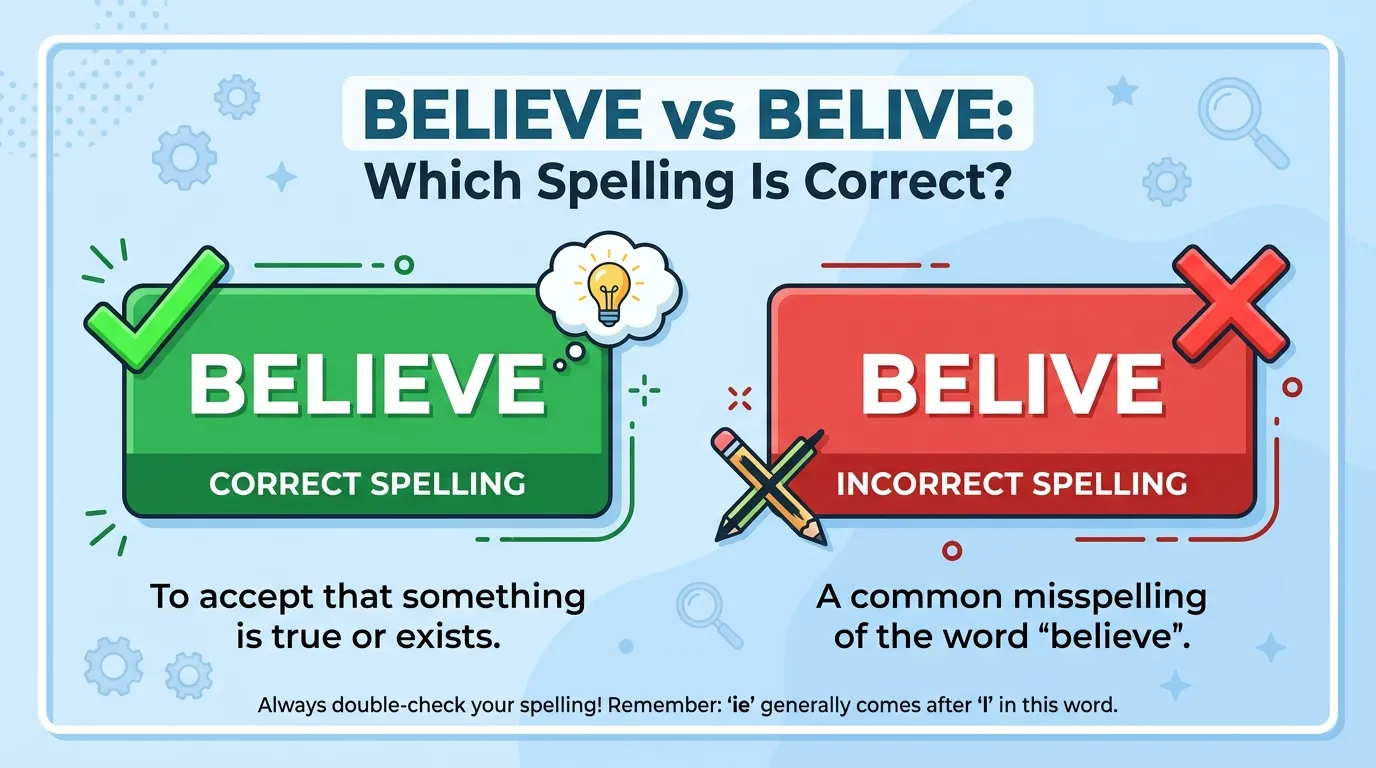
If you’ve searched for believe vs belive, the short answer is simple: believe is the correct spelling, while belive is a misspelling.
Many English learners, students, and even native speakers accidentally write belive because English spelling rules can be confusing. The famous saying “I before E, except after C” helps in many cases, and believe is one of those words where ie appears in the correct order.
In this guide, you’ll learn:
- Which spelling is correct
- Why people confuse believe and belive
- The meaning of believe
- Grammar and pronunciation
- Easy memory tricks
- Common mistakes
- Hundreds of practical usage tips
- Formal and informal writing recommendations
- Regional usage
- Frequently asked questions
By the end of this article, you’ll know exactly when and how to use believe with confidence.
Quick Answer
| Word | Correct? | Meaning |
|---|---|---|
| Believe | ✅ Yes | To accept something as true or have faith in someone or something |
| Belive | ❌ No | Incorrect spelling of believe |
Always use “believe.” The spelling belive does not appear in standard English dictionaries and should be avoided in academic, professional, and everyday writing.
Is “Belive” Ever Correct?
No.
Belive is simply a spelling mistake.
It is not:
- A British spelling
- An American spelling
- An old English spelling
- A regional variation
- A technical term
- A slang word
Spell-check tools, dictionaries, grammar checkers, and style guides all recognize believe as the only correct spelling.
What Does “Believe” Mean?
The verb believe has several closely related meanings.
Dictionary Definition
Believe (verb)
- To accept something as true.
- To think something is likely.
- To trust someone.
- To have faith in someone or something.
- To hold a particular opinion.
Examples
- I believe you.
- She believes the story.
- We believe in hard work.
- They believe tomorrow will be better.
- Many people believe education changes lives.
Why Do People Misspell Believe as Belive?
Several factors make this mistake common.
The Missing “E”
Many people accidentally remove the second e, producing:
❌ belive
instead of
✅ believe
Since both spellings sound nearly identical when spoken quickly, the mistake often goes unnoticed.
Fast Typing
Typing quickly can easily result in skipped letters.
For example:
- belive
- beleive
- beleve
These are all common typing errors.
Confusing English Spelling Rules
English contains many words with ie and ei, including:
- believe
- receive
- achieve
- relief
- ceiling
- deceive
Because these patterns vary, writers often become uncertain.
Believe vs Belive Comparison
| Feature | Believe | Belive |
|---|---|---|
| Correct spelling | ✅ Yes | ❌ No |
| Dictionary word | Yes | No |
| Accepted worldwide | Yes | No |
| Professional writing | Yes | No |
| Academic writing | Yes | No |
| Business communication | Yes | No |
Pronunciation
Believe
IPA (American English)
/bəˈliːv/
Pronunciation:
buh-LEEV
The pronunciation does not change.
Whether you’re speaking American, British, Australian, or Canadian English, the pronunciation remains very similar.
Part of Speech
Believe is primarily a verb.
Examples:
- I believe.
- She believes.
- We believed.
- They are believing.
- Have you believed him?
Verb Forms
| Form | Word |
|---|---|
| Base verb | believe |
| Third person | believes |
| Present participle | believing |
| Past tense | believed |
| Past participle | believed |
How to Use “Believe”
To Accept Something as True
Examples:
- I believe your explanation.
- She believes every word.
- Do you believe the news?
To Have Faith
Examples:
- I believe in God.
- They believe in justice.
- She believes in herself.
To Think Something Is Likely
Examples:
- I believe he’ll arrive soon.
- We believe this solution will work.
- Scientists believe the discovery is significant.
To Express an Opinion
Examples:
- I believe this is the best option.
- We believe the proposal deserves approval.
- I believe everyone should vote.
Common Sentence Patterns
Believe + Object
- I believe you.
- She believes him.
- We believe them.
Believe + That Clause
- I believe that honesty matters.
- They believe that success requires patience.
Believe In
- Believe in yourself.
- Believe in science.
- Believe in kindness.
“Believe” vs “Believe In”
Although related, they are slightly different.
| Expression | Meaning |
|---|---|
| Believe someone | Think they are telling the truth |
| Believe something | Accept it as true |
| Believe in someone | Have confidence in them |
| Believe in something | Have faith or support it |
Examples:
- I believe you.
- I believe your story.
- I believe in you.
- I believe in equality.
Grammar Rules
Believe is a regular verb.
Examples:
Present
- I believe.
- You believe.
- They believe.
Past
- I believed him.
Future
- I will believe you.
Perfect
- I have believed this for years.
Continuous
- She is believing everything she hears.
Although grammatically possible, the continuous form is relatively uncommon because believe usually describes a state rather than an ongoing action.
American vs British English
Good news:
There is no spelling difference.
| American English | British English |
|---|---|
| believe | believe |
Unlike words such as:
- color / colour
- organize / organise
- favorite / favourite
Believe stays exactly the same everywhere.
Formal and Informal Usage
Formal
- We believe the evidence supports the conclusion.
- Researchers believe further testing is necessary.
- The committee believes revisions are appropriate.
Informal
- I believe you.
- Believe me.
- I can’t believe it!
- Do you believe this?
Academic Writing
Correct:
- Researchers believe climate patterns are changing.
- Most scholars believe the manuscript dates from the twelfth century.
Avoid:
❌ Researchers belive…
Business Writing
Professional examples:
- We believe this partnership will benefit both organizations.
- Our team believes customer satisfaction remains our priority.
- We believe the project can be completed ahead of schedule.
Journalism
Journalists often use believe carefully.
Example:
- Police believe the suspect acted alone.
- Experts believe inflation may decline later this year.
Notice that believe shows the information has not yet been confirmed.
Technical Writing
Examples:
- Engineers believe the software update resolved the issue.
- Doctors believe early treatment improves recovery rates.
Sports Writing
Examples:
- Fans believe the team can win the championship.
- Coaches believe discipline creates success.
- Analysts believe the rookie has enormous potential.
Blogging and Casual Writing
Natural examples:
- I can’t believe this happened!
- Believe me—it was worth it.
- You’ll never believe what I found today.
- Believe in yourself every day.
Tone and Meaning
Depending on context, believe can express different ideas.
| Context | Meaning |
|---|---|
| Personal | Trust |
| Religious | Faith |
| Scientific | Current understanding |
| Business | Professional opinion |
| News | Likely conclusion |
| Everyday conversation | Personal opinion |
Word History (Etymology)
The word believe comes from Old English belȳfan, meaning:
- trust
- have confidence
- hold as true
Its roots connect with ancient Germanic languages emphasizing trust and faith.
Over centuries, the spelling evolved into the modern English believe, which has remained standard for hundreds of years.
Synonyms
Depending on context, synonyms include:
- trust
- accept
- think
- suppose
- assume
- expect
- consider
- have faith
- rely on
- be convinced
- credit
- acknowledge
Example:
I believe you.
Possible alternatives:
- I trust you.
- I accept what you’re saying.
- I’m convinced you’re right.
Antonyms
Common opposites include:
- doubt
- question
- distrust
- reject
- deny
- disbelieve
- challenge
- dismiss
Examples:
- I doubt the story.
- She distrusts the rumor.
- They reject the claim.
Related Words
- belief
- believer
- believable
- unbelievably
- disbelief
- unbeliever
- unbelief
- make-believe
- believeable (common misspelling; correct form is believable)
Common Collocations
People naturally combine believe with many words.
Examples include:
- strongly believe
- firmly believe
- honestly believe
- truly believe
- sincerely believe
- believe wholeheartedly
- believe completely
- believe deeply
- believe strongly in
- believe without question
Example sentences:
- I strongly believe education matters.
- They firmly believe in teamwork.
- She truly believes success requires patience.
Common Phrases
Many everyday expressions include believe.
- Believe me.
- Believe it or not.
- Hard to believe.
- Seeing is believing.
- Make believe.
- You better believe it.
- Believe in yourself.
- Would you believe…?
- I can’t believe it.
- You’ll never believe this.
Idioms Using Believe
Seeing Is Believing
Meaning:
Evidence is more convincing than words.
Example:
I wasn’t sure the new technology worked, but seeing is believing.
Believe It or Not
Meaning:
Something surprising is true.
Example:
Believe it or not, the library is open twenty-four hours.
Make Believe
Meaning:
Pretend or imagine.
Example:
Children love make-believe games.
Common Mistakes
Mistake 1
❌ I belive you.
✅ I believe you.
Mistake 2
❌ We belive this is correct.
✅ We believe this is correct.
Mistake 3
❌ She dosn’t belive him.
✅ She doesn’t believe him.
Mistake 4
❌ I cant belive it.
✅ I can’t believe it.
Awkward vs Natural Examples
| Awkward | Natural |
|---|---|
| I belive this report. | I believe this report. |
| We belive in quality. | We believe in quality. |
| She belive me. | She believes me. |
| They belive everything. | They believe everything. |
Memory Tricks
Remember this simple phrase:
I before E in believe.
Another helpful trick:
Think of the word:
Lie
Notice that believe contains lie.
b + lie + ve
Since lie is spelled with ie, it reminds you to keep the ie together.
Real-World Examples
At School
- I believe the answer is correct.
- My teacher believes I can improve.
At Work
- We believe this strategy will succeed.
- Management believes the project is profitable.
At Home
- I believe dinner is ready.
- My parents believe honesty is important.
Online
- I can’t believe this video went viral.
- Believe me, you’ll love this recipe.
Should You Ever Use “Belive”?
No.
Always correct it to:
✅ believe
This applies to:
- Essays
- Emails
- Reports
- Social media
- Books
- News articles
- Business documents
- Academic papers
- Websites
- Job applications
Spell-Check Tips
Most writing software automatically flags belive.
Popular tools that recognize the mistake include:
- Microsoft Word
- Google Docs
- Grammarly
- Apple Pages
- Browser spell-checkers
Still, proofreading is important because typing errors can occasionally slip through.
Best Practices for Different Types of Writing
| Writing Type | Recommended Spelling |
|---|---|
| American English | believe |
| British English | believe |
| Academic papers | believe |
| Research writing | believe |
| Journalism | believe |
| Business emails | believe |
| Technical manuals | believe |
| Legal writing | believe |
| Blogs | believe |
| Social media | believe |
When “Believe” Carries Different Meanings
The word believe changes slightly depending on context.
Religious
- Millions believe in God.
Scientific
- Scientists believe the treatment is effective.
Personal
- I believe you’re honest.
Emotional
- Believe in yourself.
Professional
- We believe this solution offers the best value.
Although the context changes, the spelling never does.
Final Comparison
| Feature | Believe | Belive |
|---|---|---|
| Correct English | ✅ | ❌ |
| Dictionary entry | ✅ | ❌ |
| Used worldwide | ✅ | ❌ |
| Appropriate for exams | ✅ | ❌ |
| Appropriate for business | ✅ | ❌ |
| Appropriate for publishing | ✅ | ❌ |
Frequently Asked Questions
Is “belive” a real English word?
No. Belive is not recognized as a standard English word. It is simply a misspelling of believe.
Which is correct: believe or belive?
Believe is the correct spelling in all forms of English. Belive should always be corrected.
Why do people spell believe as belive?
People often omit the second e because they type quickly, misremember the spelling, or confuse English vowel patterns.
Is “belive” accepted in British English?
No. British English uses believe, just like American, Canadian, Australian, and other major varieties of English.
How do you remember how to spell believe?
A helpful trick is to remember that believe follows the “I before E” pattern. You can also notice that the word contains lie, which is spelled with ie.
Is “believe” a verb or a noun?
Believe is a verb. The related noun is belief.
Example:
- I believe you. (verb)
- My belief never changed. (noun)
What is the past tense of believe?
The past tense is believed.
Example:
- I believed everything she said.
Can I use “believe” in formal writing?
Yes. Believe is appropriate for academic papers, business reports, journalism, legal writing, technical documentation, and everyday communication.
What is the difference between “believe” and “belief”?
Believe is a verb that describes an action or state of accepting something as true. Belief is a noun that refers to the idea, conviction, or trust itself.
Example:
- I believe in honesty.
- Honesty is one of my strongest beliefs.
Does pronunciation change between believe and belive?
No. Since belive is not a valid word, there is no separate accepted pronunciation. The correct pronunciation is bə-LEEV for believe.
Conclusion
When comparing believe vs belive, the answer is straightforward: believe is the only correct spelling, while belive is always an error. The word believe means to accept something as true, trust someone, have confidence, or hold a particular opinion, and it is used consistently across American, British, Canadian, Australian, and other English varieties.
Whether you’re writing an academic essay, a business email, a news article, a blog post, or a casual text message, always choose believe. Remember the simple spelling trick—“I before E”—and think of the word lie inside believe to help you keep the letters in the correct order. By using believe consistently and proofreading your work, you’ll avoid one of the most common English spelling mistakes and write with greater clarity, professionalism, and confidence.


