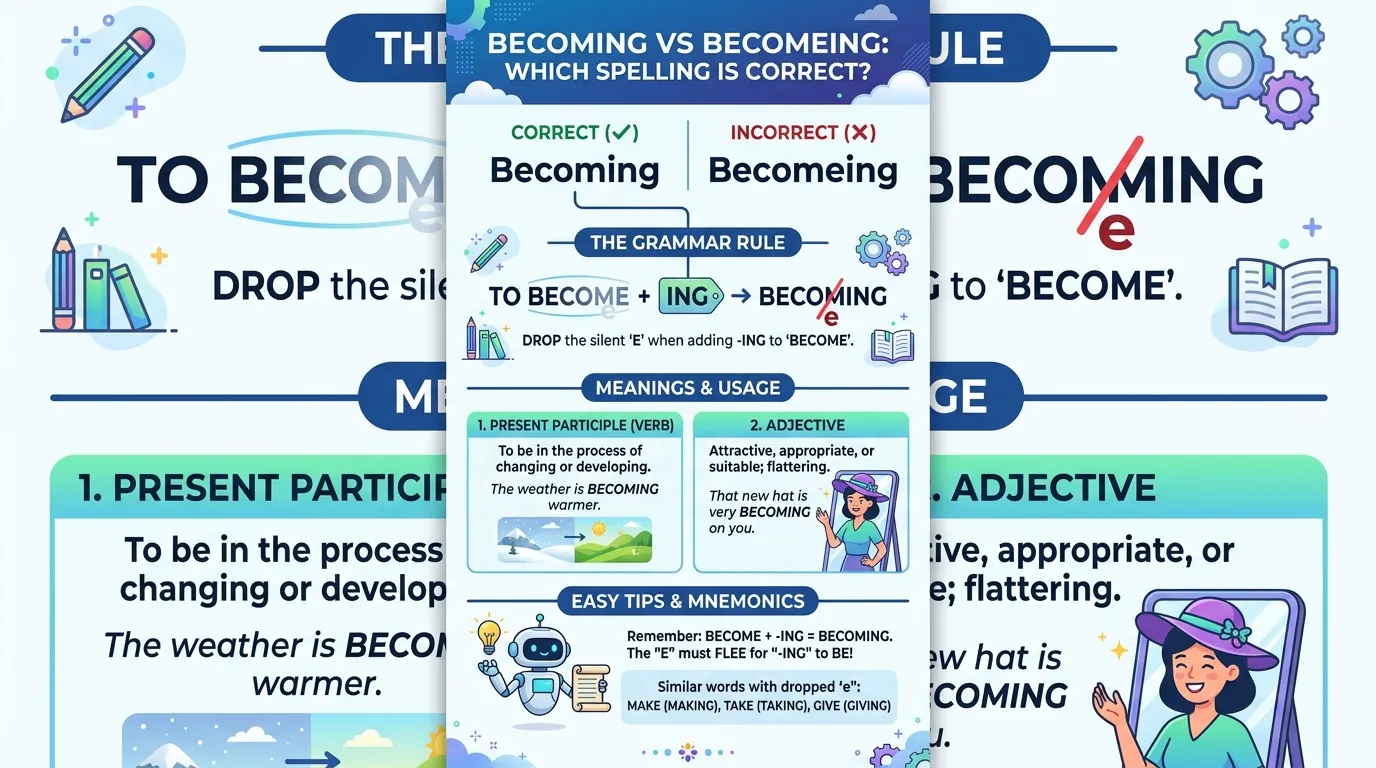
If you’ve ever typed “becomeing” and wondered whether it was correct, you’re not alone. Many English learners and even native speakers pause when adding -ing to the verb become. The extra “e” can seem like it belongs there, but English spelling follows specific rules.
The short answer is simple:
Becoming is the correct spelling. Becomeing is always incorrect.
In this guide, you’ll learn why becoming is spelled without the extra e, the grammar rule behind it, common mistakes to avoid, pronunciation tips, dozens of real-life examples, memory tricks, and practical advice for every type of writing—from school assignments to professional emails.
Whether you’re a student, writer, editor, blogger, or English learner, this guide will help you use becoming confidently every time.
Quick Answer
| Question | Answer |
|---|---|
| Is becoming correct? | ✅ Yes |
| Is becomeing correct? | ❌ No |
| Why? | When adding -ing to verbs ending in a silent e, the final e is usually dropped. |
| Correct example | She is becoming more confident every day. |
| Incorrect example | She is becomeing more confident every day. |
Is It Becoming or Becomeing?
The only correct spelling is becoming.
The word becomeing is a spelling error that appears because many people incorrectly assume they should simply add -ing to the end of the word without changing anything.
English spelling doesn’t work that way.
The verb become follows the standard spelling rule:
- become → becoming ✅
- make → making ✅
- drive → driving ✅
- write → writing ✅
The silent e disappears before adding -ing.
Why Do People Write “Becomeing”?
There are several reasons this mistake happens.
People Simply Add “-ing”
Many learners think every verb becomes a present participle by adding -ing.
For example:
- play → playing
- walk → walking
Since these words don’t change, writers may incorrectly assume:
- become → becomeing ❌
Instead, English requires removing the silent e first.
The Word Looks More Natural
Sometimes becomeing appears visually balanced because become ends with e.
However, appearance doesn’t determine correct spelling.
English spelling follows grammatical rules rather than visual patterns.
Pronunciation Causes Confusion
The pronunciation stays nearly identical whether someone imagines writing becoming or becomeing.
Because the pronunciation doesn’t clearly reveal the spelling, many writers accidentally insert the extra letter.
The Grammar Rule Behind Becoming
The rule is straightforward.
Drop the Silent E Before Adding -ing
If a verb ends with a silent e, remove the e before adding -ing.
Examples include:
| Base Verb | Correct -ing Form |
|---|---|
| become | becoming |
| make | making |
| drive | driving |
| write | writing |
| arrive | arriving |
| leave | leaving |
| smile | smiling |
| hope | hoping |
| dance | dancing |
| save | saving |
Notice that the silent e disappears every time.
Dictionary Definition of Becoming
Becoming (verb)
Becoming is the present participle and gerund form of the verb become.
It means:
- beginning to be
- growing into
- changing into
- developing into
- transforming into
Examples:
- She is becoming stronger.
- The weather is becoming warmer.
- Technology is becoming smarter every year.
Another Meaning of “Becoming”
Interestingly, becoming also functions as an adjective.
As an adjective, it means:
- attractive
- suitable
- flattering
- appropriate
Examples:
- That dress is very becoming.
- His polite behavior was highly becoming.
- The hairstyle is becoming on her.
This adjective has nothing to do with the spelling mistake becomeing.
Pronunciation
Becoming
IPA (American English):
/bɪˈkʌmɪŋ/
Pronounced as:
bih-KUM-ing
There is no extra syllable.
Incorrect spelling does not change pronunciation.
Parts of Speech
| Word | Part of Speech |
|---|---|
| become | Verb |
| becoming | Present participle |
| becoming | Gerund |
| becoming | Adjective |
Meaning of Become
The verb become has several meanings.
It can mean:
- to begin to be
- to grow into
- to change state
- to develop
- to transform
Examples:
- Children become adults.
- Ice becomes water.
- He became famous.
- She became a doctor.
How Becoming Is Used in Sentences
Continuous Tenses
- I am becoming tired.
- She is becoming successful.
- We are becoming friends.
Progressive Actions
- The city is becoming larger.
- The company is becoming more profitable.
- The problem is becoming serious.
As a Gerund
- Becoming a parent changes people.
- Becoming successful requires patience.
- Becoming healthier takes time.
As an Adjective
- That color is becoming on you.
- Her smile is becoming.
- His calm attitude was becoming.
Becoming vs Becomeing Comparison Table
| Feature | Becoming | Becomeing |
|---|---|---|
| Correct spelling | ✅ Yes | ❌ No |
| Found in dictionaries | Yes | No |
| Used in academic writing | Yes | Never |
| Used in business writing | Yes | No |
| Accepted in American English | Yes | No |
| Accepted in British English | Yes | No |
| Accepted internationally | Yes | No |
American vs British English
There is no difference between American and British English.
| Region | Preferred Spelling |
|---|---|
| United States | becoming |
| United Kingdom | becoming |
| Canada | becoming |
| Australia | becoming |
| New Zealand | becoming |
| International English | becoming |
The incorrect spelling becomeing is rejected everywhere.
Formal vs Informal Usage
The spelling stays exactly the same.
| Writing Type | Correct Form |
|---|---|
| Academic | becoming |
| Journalism | becoming |
| Blogging | becoming |
| Business | becoming |
| Government | becoming |
| Technical writing | becoming |
| Legal writing | becoming |
| Emails | becoming |
| Text messages | becoming |
Examples in Everyday English
Here are some natural examples.
- Winter is becoming colder.
- Our neighborhood is becoming safer.
- She is becoming an excellent teacher.
- The children are becoming independent.
- This software is becoming popular.
- Electric cars are becoming more common.
- He is becoming more patient.
- The movie is becoming interesting.
- My English is becoming better.
- Online learning is becoming more effective.
Examples in Academic Writing
- Artificial intelligence is becoming increasingly important.
- Renewable energy is becoming more affordable.
- Urban populations are becoming larger.
- Climate patterns are becoming less predictable.
- Students are becoming more engaged through technology.
Examples in Business Writing
- Our brand is becoming well known.
- Customer satisfaction is becoming a priority.
- Digital marketing is becoming essential.
- The market is becoming more competitive.
- Remote work is becoming standard practice.
Examples in Journalism
- Inflation is becoming a major concern.
- Online education is becoming mainstream.
- The athlete is becoming a fan favorite.
- Tourism is becoming more sustainable.
- Healthcare is becoming increasingly digital.
Examples in Technical Writing
- The system is becoming unstable.
- Memory usage is becoming excessive.
- Data processing is becoming faster.
- Network traffic is becoming congested.
- Security requirements are becoming stricter.
Examples in Sports
- The rookie is becoming a star player.
- The team is becoming stronger.
- Women’s soccer is becoming more popular.
- The championship race is becoming exciting.
- Young athletes are becoming more skilled.
Common Expressions with Becoming
Some common phrases include:
- becoming increasingly difficult
- becoming more popular
- becoming stronger
- becoming successful
- becoming available
- becoming aware
- becoming familiar with
- becoming confident
- becoming clear
- becoming evident
Common Collocations
Writers frequently pair becoming with:
- becoming aware
- becoming successful
- becoming independent
- becoming famous
- becoming stronger
- becoming healthier
- becoming comfortable
- becoming important
- becoming difficult
- becoming common
Synonyms of Becoming (Verb)
Depending on context:
- developing
- growing
- turning into
- changing into
- evolving
- transforming
- progressing
- maturing
- shifting
- advancing
Synonyms of Becoming (Adjective)
- attractive
- flattering
- suitable
- appropriate
- graceful
- elegant
- tasteful
- proper
- fitting
Antonyms
For the verb:
- remaining
- staying
- continuing
- keeping
For the adjective:
- unattractive
- unsuitable
- inappropriate
- unfitting
Word History and Etymology
The verb become comes from Old English becuman, meaning:
- to come to
- happen
- arrive at
- turn into
Over centuries, the meaning expanded to include changing into a new state, which is the meaning most people use today.
The present participle becoming follows standard English spelling rules by dropping the silent e before adding -ing.
Why Spell Checkers Catch “Becomeing”
Modern spelling checkers recognize becoming because it appears in every major English dictionary.
The misspelling becomeing is flagged because it violates English spelling conventions.
Most writing software automatically suggests:
becoming
Common Mistakes
Mistake 1
❌ She is becomeing better.
✅ She is becoming better.
Mistake 2
❌ The economy is becomeing stronger.
✅ The economy is becoming stronger.
Mistake 3
❌ I enjoy becomeing a better writer.
✅ I enjoy becoming a better writer.
Mistake 4
❌ Technology is becomeing smarter.
✅ Technology is becoming smarter.
Mistake 5
❌ He is becomeing famous.
✅ He is becoming famous.
Awkward vs Natural Examples
| Awkward or Incorrect | Natural |
|---|---|
| She is becomeing happier. | She is becoming happier. |
| I’m becomeing tired. | I’m becoming tired. |
| The city is becomeing larger. | The city is becoming larger. |
| They’re becomeing friends. | They’re becoming friends. |
| We are becomeing stronger. | We are becoming stronger. |
Memory Trick
Remember this simple rule:
If a verb ends with a silent e, drop the e before adding -ing.
Think of these examples together:
- make → making
- write → writing
- drive → driving
- become → becoming
The pattern stays consistent.
Similar Spelling Rules
Many English verbs follow exactly the same rule.
| Base Word | Correct Form |
|---|---|
| hope | hoping |
| dance | dancing |
| save | saving |
| smile | smiling |
| love | loving |
| move | moving |
| arrive | arriving |
| leave | leaving |
| become | becoming |
Learning this single rule helps you spell hundreds of English words correctly.
When Should You Use Becoming?
Use becoming whenever you mean:
- changing into something
- gradually developing
- growing toward a new state
- describing an ongoing transformation
- using the present participle of become
Examples:
- She is becoming more experienced.
- The weather is becoming colder.
- Becoming a leader requires patience.
- The software is becoming faster after updates.
Is “Becomeing” Ever Acceptable?
No.
There are no exceptions in:
- American English
- British English
- Australian English
- Canadian English
- Academic English
- Professional writing
- Journalism
- Business communication
- Technical documentation
- Creative writing
It is always considered a spelling mistake.
Best Recommendations for Different Types of Writing
| Writing Style | Recommended Form |
|---|---|
| School essays | becoming |
| College papers | becoming |
| Business reports | becoming |
| Blogs | becoming |
| Newspapers | becoming |
| Technical manuals | becoming |
| Marketing copy | becoming |
| Legal documents | becoming |
| Social media | becoming |
| Emails | becoming |
Key Takeaways
- Becoming is the only correct spelling.
- Becomeing is always incorrect.
- Remove the silent e before adding -ing.
- The pronunciation does not change.
- The rule applies across all major English varieties.
- Spell checkers will flag becomeing as an error.
- The adjective becoming means attractive or suitable, while the verb form refers to changing into a new state.
Frequently Asked Questions
Is becoming or becomeing correct?
Becoming is correct. Becomeing is an incorrect spelling because the silent e is dropped before adding -ing.
Why is the e removed in becoming?
English spelling rules generally require dropping a final silent e before adding -ing, as in make → making and drive → driving.
Is becomeing ever accepted?
No. It is considered a spelling error in every major variety of English.
Is becoming a verb or an adjective?
It can be both. It is the present participle or gerund of become, and it can also function as an adjective meaning attractive or suitable.
How do you pronounce becoming?
It is pronounced bih-KUM-ing (/bɪˈkʌmɪŋ/).
Does British English spell it differently?
No. Both American and British English use becoming.
What is the rule for adding -ing?
If a verb ends with a silent e, remove the e before adding -ing. For example, hope → hoping, write → writing, and become → becoming.
Can becoming be a noun?
Yes. Becoming can act as a gerund, which is a verb form functioning as a noun. For example: Becoming a doctor takes years of study.
What does becoming mean as an adjective?
As an adjective, becoming means flattering, attractive, suitable, or appropriate, especially in reference to appearance or behavior.
How can I remember the correct spelling?
Remember the phrase: “Drop the silent e before adding -ing.” If you can spell making and driving, you can also spell becoming correctly.
Conclusion
When comparing becoming vs becomeing, the answer is clear: becoming is the only correct spelling. The confusion comes from forgetting one of English’s most common spelling rules—drop the final silent e before adding -ing. This rule also applies to verbs like make, write, hope, and drive.
Whether you’re writing an academic paper, a business email, a blog post, or a casual message, always choose becoming. Staying consistent with standard English spelling improves readability, strengthens your credibility, and helps you communicate more effectively. Once you remember the simple drop-the-e rule, you’ll avoid this mistake not only with become but with many other English verbs as well.


