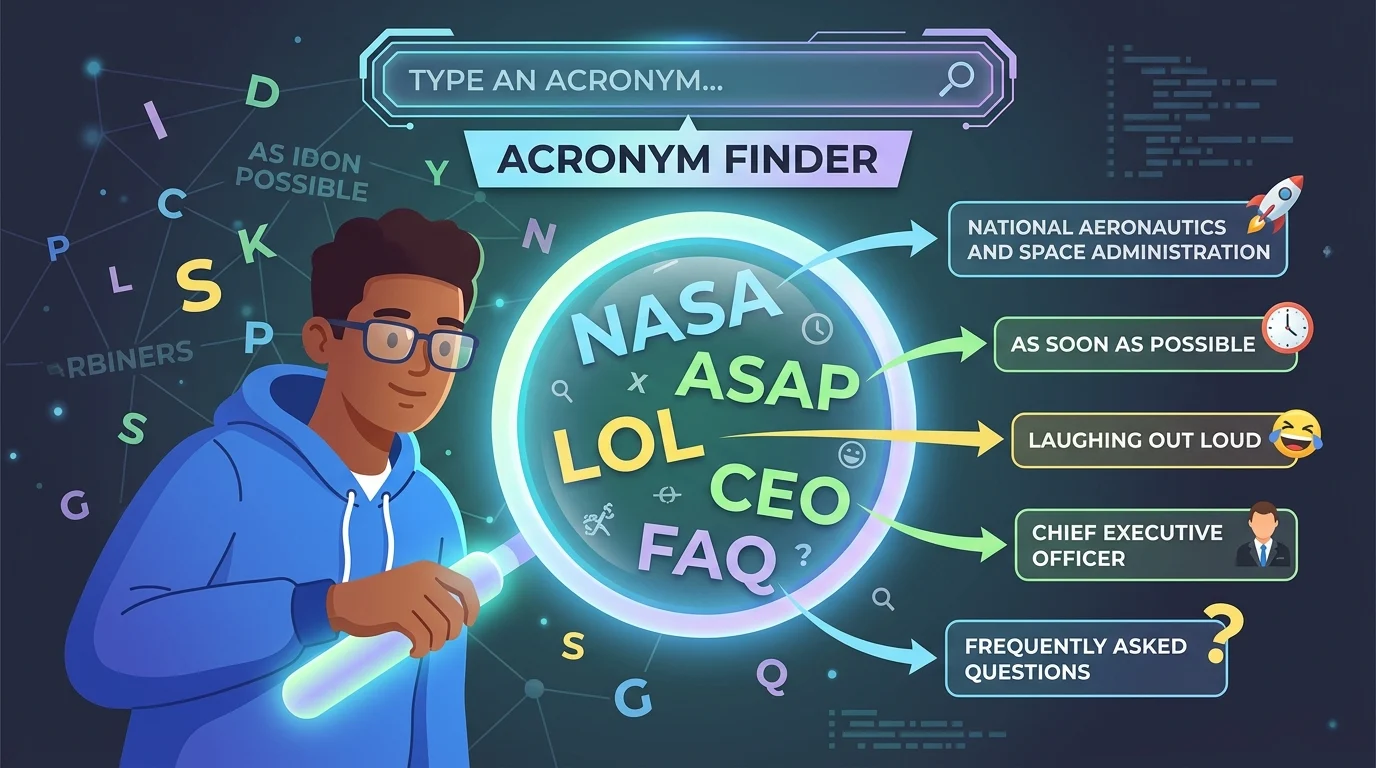
Have you ever come across a group of letters like CEO, NASA, SEO, or FAQ and wondered what they mean? In today’s world, acronyms are everywhere. They appear in business emails, medical reports, government documents, educational materials, technology guides, and everyday conversations. While acronyms can save time and space, they can also create confusion when you do not know their meaning.
This is where an Acronyms Finder becomes incredibly useful. An acronyms finder is a tool or resource designed to help people quickly discover the meaning of abbreviations and acronyms. Instead of spending time guessing or searching through multiple websites, users can enter an acronym and instantly find its definition.
Whether you are a student reading a textbook, a professional reviewing a report, or simply someone trying to understand a term online, an acronyms finder can make information easier to understand. These tools help bridge communication gaps and ensure that important messages are clear.
As industries continue to create new abbreviations and specialized terms, the need for reliable acronym resources continues to grow. In this guide, we will explore what an acronyms finder is, how it works, why it is useful, and how it helps people navigate the modern world of abbreviations.
What Is an Acronyms Finder?
An Acronyms Finder is a search tool that helps users identify the meaning of acronyms, abbreviations, and initialisms.
For example:
- SEO = Search Engine Optimization
- FAQ = Frequently Asked Questions
- NASA = National Aeronautics and Space Administration
- CEO = Chief Executive Officer
Instead of manually searching for each term, users can quickly enter the acronym into an acronyms finder and receive accurate definitions.
These tools are especially valuable because many acronyms have multiple meanings depending on the context.
What Is an Acronym?
Before understanding how an acronyms finder works, it helps to know what an acronym is.
An acronym is a word formed from the first letters of a phrase.
Examples include:
- NASA
- UNICEF
- NATO
- SCUBA
Some abbreviations are pronounced letter by letter, such as:
- FBI
- IRS
- BBC
Although people often use the terms interchangeably, both are commonly included in acronym databases.
Why Acronyms Are So Popular
Acronyms have become an important part of communication because they:
- Save time
- Reduce writing length
- Simplify complex terms
- Improve efficiency
- Make communication faster
For example, saying “SEO” is much easier than repeatedly saying “Search Engine Optimization.”
Businesses, governments, schools, and organizations rely heavily on acronyms for daily communication.
How an Acronyms Finder Works
An acronyms finder uses a large database of abbreviations and their meanings.
The process is simple:
Step 1: Enter the Acronym
Type the abbreviation into the search box.
Step 2: Search the Database
The tool scans thousands of entries.
Step 3: View Results
Definitions and possible meanings appear instantly.
Step 4: Select the Correct Context
If an acronym has multiple meanings, users choose the one that matches their situation.
For example, “CPA” could mean:
- Certified Public Accountant
- Cost Per Acquisition
- Certified Practicing Accountant
Context helps determine the correct definition.
Common Categories Found in Acronyms Finders
Most acronym databases cover a wide range of industries and topics.
Business Acronyms
Examples include:
- CEO
- CFO
- KPI
- ROI
Medical Acronyms
Examples include:
- CPR
- MRI
- ADHD
- ICU
Technology Acronyms
Examples include:
- AI
- CPU
- RAM
- URL
Government Acronyms
Examples include:
- FBI
- CIA
- IRS
- NATO
Educational Acronyms
Examples include:
- GPA
- SAT
- ACT
- ESL
A good acronyms finder includes thousands of terms from various fields.
Benefits of Using an Acronyms Finder
Saves Time
Instead of searching multiple websites, users receive answers quickly.
Improves Understanding
Acronyms become easier to understand within their proper context.
Supports Learning
Students and professionals can learn industry-specific terminology.
Reduces Confusion
Many abbreviations have multiple meanings.
An acronyms finder helps identify the correct one.
Increases Productivity
Fast access to information helps people work more efficiently.
Understanding terminology improves communication and decision-making.
Why Context Matters
One challenge with acronyms is that the same letters can have several meanings.
For example:
IT
Could mean:
- Information Technology
- Income Tax
CRM
Could mean:
- Customer Relationship Management
- Clinical Research Management
AI
Could mean:
- Artificial Intelligence
- Artificial Insemination
This is why context is important when using an acronyms finder.
The surrounding topic usually reveals the intended meaning.
Acronyms Finder for Students
Students often encounter unfamiliar abbreviations while studying.
An acronyms finder can help with:
- Research papers
- Science projects
- Textbooks
- Academic articles
Instead of interrupting their learning process, students can quickly find definitions and continue studying.
Acronyms Finder for Professionals
Professionals in many industries rely on acronyms daily.
Examples include:
- Marketing
- Healthcare
- Finance
- Engineering
- Information Technology
Understanding industry language improves communication and workplace efficiency.
An acronyms finder helps employees stay informed and confident.
Acronyms Finder for Everyday Use
Even outside professional environments, acronyms appear regularly.
Examples include:
- FAQ
- ATM
- PIN
- GPS
- DIY
Many people use these terms without realizing they are acronyms.
An acronyms finder helps explain these common abbreviations and their origins.
Tips for Using an Acronyms Finder Effectively
To get the best results:
- Check the context of the acronym.
- Review all possible meanings.
- Consider the industry or subject area.
- Verify uncommon definitions.
- Use trusted acronym databases.
Following these steps helps ensure accuracy.
The Growing Importance of Acronyms
As technology and communication continue to evolve, new acronyms appear every year.
Fields such as:
- Artificial Intelligence
- Digital Marketing
- Healthcare
- Cybersecurity
Regularly introduce new terminology.
Acronyms finders help people stay current and informed.
The ability to understand abbreviations is becoming an increasingly valuable skill.
Conclusion
An Acronyms Finder is a powerful tool that helps users quickly understand abbreviations, acronyms, and industry-specific terminology. Whether you are a student, professional, researcher, or everyday internet user, these resources make communication clearer and learning easier.
By providing fast access to accurate definitions, an acronyms finder reduces confusion, saves time, and improves understanding across countless fields.
The next time you encounter an unfamiliar abbreviation, remember that an acronyms finder can turn a confusing set of letters into meaningful information within seconds.


