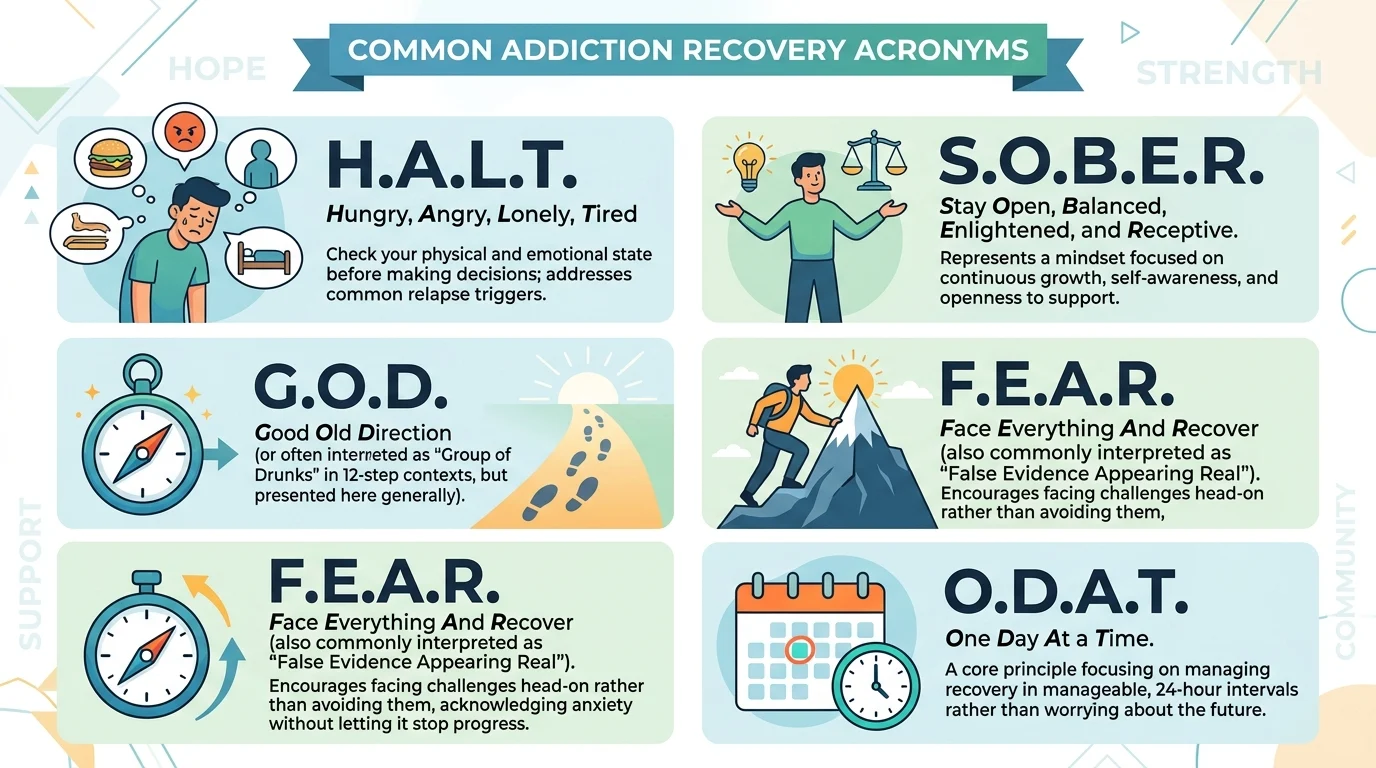
Beginning the journey of addiction recovery can feel overwhelming. Along the way, you may hear people in support groups, counseling sessions, or recovery programs use acronyms that seem confusing at first. Terms like HALT, H.O.W., and F.E.A.R. are commonly used in recovery communities because they provide simple reminders that help people stay focused on healing and sobriety.
Addiction recovery acronyms are more than just shortcuts for words. They often contain powerful lessons that encourage self-awareness, personal responsibility, emotional health, and spiritual growth. Many people in recovery use these acronyms daily because they are easy to remember during challenging moments.
Imagine facing a strong craving or difficult situation. In that moment, recalling a simple acronym can help you pause, think clearly, and make healthier choices. These tools serve as reminders that recovery happens one step, one day, and sometimes one moment at a time.
Whether you are new to recovery, supporting a loved one, or simply learning about addiction treatment, understanding these recovery acronyms can provide valuable insight. They offer practical guidance, encouragement, and hope for anyone seeking a healthier life.
In this guide, we will explore some of the most common addiction recovery acronyms, what they mean, and how they can support lasting recovery.
Why Addiction Recovery Acronyms Matter
Recovery involves learning new ways to think, cope, and respond to life’s challenges.
Acronyms help because they:
- Are easy to remember
- Provide quick guidance during stressful moments
- Reinforce healthy habits
- Encourage personal growth
- Support long-term sobriety
Many recovery programs use acronyms as teaching tools because simple reminders can have a powerful impact.
Sometimes a few letters can help prevent a relapse and encourage a better decision.
HALT: Hungry, Angry, Lonely, Tired
One of the most famous addiction recovery acronyms is HALT.
HALT stands for:
- Hungry
- Angry
- Lonely
- Tired
These four emotional and physical states can increase the risk of relapse.
When people feel one or more of these conditions, they may be more vulnerable to cravings and poor decisions.
How to Use HALT
Ask yourself:
- Am I hungry?
- Am I angry?
- Am I lonely?
- Am I tired?
Addressing these basic needs often improves emotional stability and reduces stress.
HALT reminds people to care for both their physical and emotional well-being.
H.O.W.: Honest, Open, Willing
Recovery often requires change, and change begins with the right mindset.
H.O.W. stands for:
- Honest
- Open
- Willing
Honesty helps individuals acknowledge problems.
Open-mindedness allows them to learn new approaches.
Willingness creates the opportunity for growth.
People who embrace these qualities often find it easier to accept support and make positive changes.
F.E.A.R.: False Evidence Appearing Real
Fear is common during recovery.
People may fear failure, rejection, or life without substances.
A popular recovery acronym defines fear as:
- False
- Evidence
- Appearing
- Real
This acronym encourages individuals to question negative thoughts and assumptions.
Not every fear reflects reality.
Learning to challenge fearful thinking can reduce anxiety and strengthen confidence.
Many fears lose power when they are examined honestly.
S.L.I.P.: Sobriety Loses Its Priority
Relapse rarely happens suddenly.
It often begins when recovery becomes less important.
S.L.I.P. stands for:
- Sobriety
- Loses
- Its
- Priority
Warning signs may include:
- Skipping meetings
- Avoiding support systems
- Neglecting self-care
- Ignoring recovery goals
This acronym reminds people to keep recovery at the center of daily life.
K.I.S.S.: Keep It Simple, Sobriety
Recovery can feel complicated, especially during stressful times.
K.I.S.S. stands for:
- Keep
- It
- Simple
- Sobriety
Some versions use “Keep It Simple, Stupid,” but many recovery groups prefer the more positive phrase.
The lesson is straightforward:
Avoid overthinking.
Focus on today’s goals.
Take one step at a time.
Simple actions practiced consistently often lead to lasting success.
T.H.I.N.K.: Before You Speak
Communication plays an important role in recovery.
T.H.I.N.K. encourages people to consider whether their words are:
- True
- Helpful
- Inspiring
- Necessary
- Kind
Healthy communication strengthens relationships and reduces unnecessary conflict.
This acronym promotes thoughtful and respectful interactions.
P.A.U.S.E.: A Moment for Better Choices
Many recovery professionals encourage people to pause before reacting.
P.A.U.S.E. can represent:
- Pause
- And
- Understand
- Situations
- Effectively
When emotions run high, taking a moment to pause can prevent impulsive decisions.
This simple habit helps individuals respond rather than react.
D.E.N.I.A.L.: Don’t Even Notice I Am Lying
Denial is a common challenge in addiction.
A recovery saying humorously defines denial as:
- Don’t
- Even
- Notice
- I
- Am
- Lying
While lighthearted, the message is serious.
Recovery requires honesty and self-awareness.
Recognizing denial is often the first step toward healing.
O.N.E. D.A.Y. A.T. A. T.I.M.E.
Perhaps the most well-known recovery principle is:
One Day at a Time.
Recovery becomes more manageable when people focus on today rather than worrying about the future.
Questions like:
- Can I stay sober today?
- What healthy choices can I make right now?
Often produce better results than focusing on years ahead.
Recovery happens one day, one choice, and one step at a time.
How Recovery Acronyms Support Long-Term Sobriety
These acronyms are effective because they:
- Encourage self-awareness
- Reduce stress
- Improve decision-making
- Reinforce recovery principles
- Provide quick reminders during difficult moments
Many people write them in journals, place them on mirrors, or save them on their phones for daily encouragement.
Small reminders can make a big difference.
Practical Tips for Using Recovery Acronyms
To get the most benefit from these tools:
- Choose one or two acronyms that resonate with you.
- Practice applying them daily.
- Share them with a sponsor, counselor, or support group.
- Use them during moments of stress or temptation.
- Review them regularly.
Consistency helps turn these reminders into healthy habits.
Conclusion
Addiction recovery acronyms are simple yet powerful tools that help individuals navigate the challenges of sobriety. Acronyms such as HALT, H.O.W., F.E.A.R., and K.I.S.S. provide practical guidance that can be remembered during difficult moments.
While recovery is a personal journey, these reminders offer support, encouragement, and direction along the way. They help people focus on healthy choices, build resilience, and maintain long-term sobriety.
The most important lesson is this:
Recovery does not require perfection. It requires progress, honesty, and a willingness to keep moving forward one day at a time.


