In today’s fast-paced digital world, acronyms have become a normal part of everyday communication. Whether you’re sending a text message, chatting on social media, writing emails, or participating in online communities, abbreviations help people communicate quickly and efficiently.
One acronym that frequently appears in conversations is SUP. Many people search for the SUP acronym because they encounter it in text messages, online chats, gaming communities, or social media posts and want to understand its meaning and proper usage.
Understanding acronyms like SUP is important because they help improve communication across business, education, texting, and digital platforms. Knowing when and how to use them can prevent misunderstandings and help you communicate more naturally in different situations.
In this guide, you’ll learn the meaning of SUP, how it is used, grammar rules related to acronyms, common mistakes to avoid, and practical examples from real-life communication.
What Does SUP Stand For?
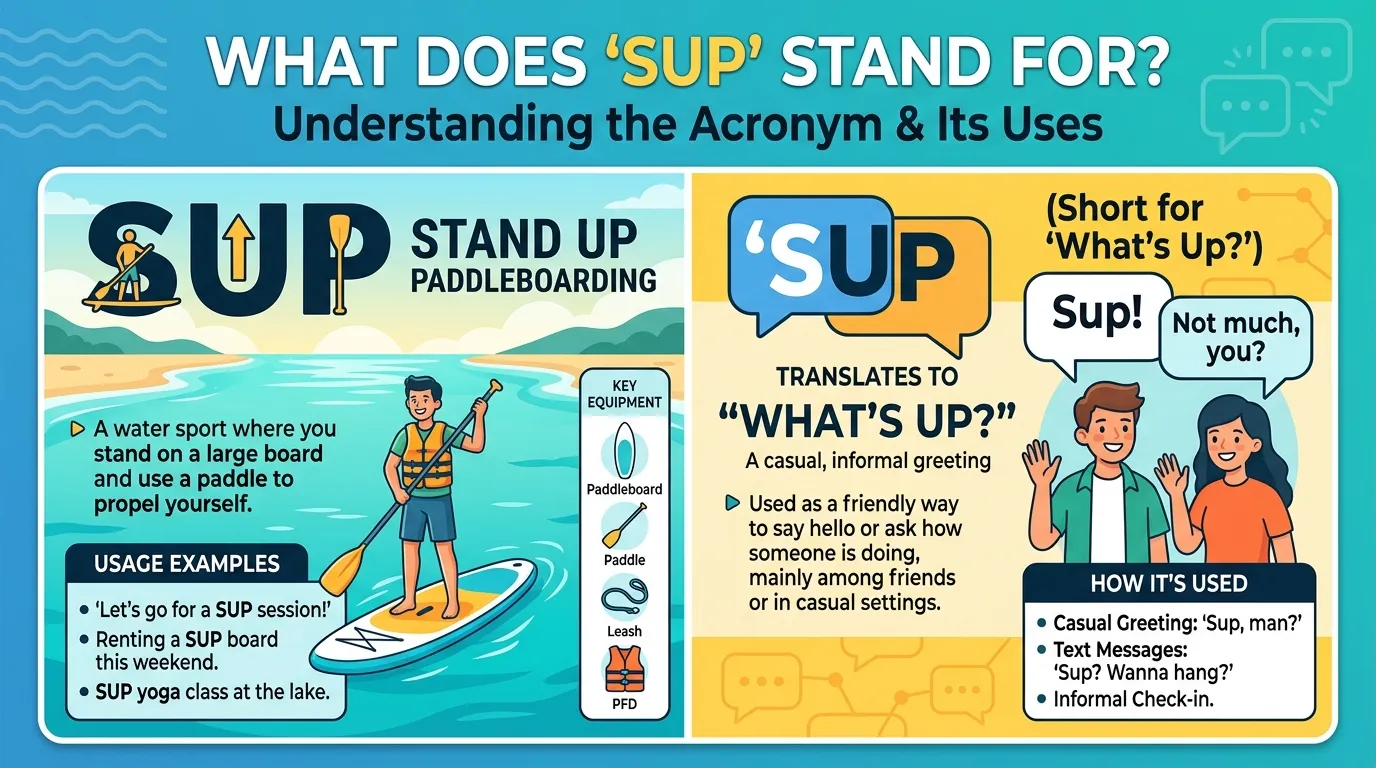
The acronym SUP most commonly stands for:
SUP = What’s Up?
It is a shortened, casual version of the phrase “What’s up?”
People use SUP as a friendly greeting when starting a conversation. It is especially common in texting, social media messaging, online gaming, and informal chats.
Simple Meaning
When someone sends:
“SUP?”
They usually mean:
- How are you?
- What’s going on?
- What are you doing?
- Anything new?
Example
Friend: SUP?
You: Not much, just watching a movie.
In most situations, SUP is not asking for detailed information. It’s simply a casual way to start a conversation.
Understanding Acronyms, Abbreviations, and Initialisms
Many people use these terms interchangeably, but they are not exactly the same.
What Is an Acronym?
An acronym is formed from the first letters of several words and is pronounced as a single word.
Examples:
- NASA = National Aeronautics and Space Administration
- NATO = North Atlantic Treaty Organization
- UNICEF = United Nations Children’s Fund
What Is an Initialism?
An initialism is formed from the first letters of words, but each letter is pronounced separately.
Examples:
- FBI = Federal Bureau of Investigation
- CEO = Chief Executive Officer
- MBA = Master of Business Administration
What Is an Abbreviation?
An abbreviation is any shortened form of a word or phrase.
Examples:
- Dr. = Doctor
- Ave. = Avenue
- Jan. = January
Key Differences
| Term | Example | Pronunciation |
|---|---|---|
| Acronym | NASA | Pronounced as a word |
| Initialism | FBI | Letters pronounced individually |
| Abbreviation | Dr. | Shortened version of a word |
SUP is generally considered an informal abbreviation or internet shorthand rather than a traditional acronym.
Why Are Acronyms So Popular Today?
Acronyms have become essential in modern communication because they:
- Save time
- Reduce typing effort
- Improve texting speed
- Fit character limits on social media
- Create a casual conversational tone
- Help people communicate efficiently online
Common examples include:
- LOL = Laugh Out Loud
- BRB = Be Right Back
- IMO = In My Opinion
- DM = Direct Message
- SUP = What’s Up?
As communication becomes faster, acronym usage continues to grow across personal and professional environments.
SUP Acronym Meaning and Usage Table
| Acronym | Full Form | Meaning | Tone | Common Usage |
|---|---|---|---|---|
| SUP | What’s Up? | Casual greeting | Informal | Texting |
| SUP | What’s Up? | Asking what someone is doing | Informal | Social Media |
| SUP | What’s Up? | Starting a conversation | Informal | Online Chat |
| SUP | What’s Up? | Friendly check-in | Informal | Messaging Apps |
How Is SUP Used in Texting?
Texting is where SUP appears most frequently.
Examples
Example 1
Person A: SUP?
Person B: Just got home from work.
Example 2
Person A: SUP tonight?
Person B: Thinking about watching a game.
Example 3
Person A: Hey, SUP?
Person B: Nothing much. How about you?
The tone is relaxed and friendly.
How Is SUP Used on Social Media?
Social media users often use SUP in comments, direct messages, and posts.
Examples
- SUP everyone?
- SUP guys, how was your weekend?
- SUP fam?
- SUP, long time no talk!
Because social media communication tends to be informal, SUP fits naturally into conversations.
How Is SUP Used in Workplace Communication?
SUP is generally not recommended in formal workplace communication.
Informal Workplace Chat
- SUP, are you joining the team lunch?
- SUP, did you finish the report?
Formal Alternative
Instead of SUP, use:
- Hello
- Good morning
- How are you?
- Hope you’re doing well
Formal emails and business communications should avoid overly casual internet shorthand.
How Is SUP Used in Academic Settings?
Students often use SUP in:
- Group chats
- Study groups
- Student communities
- Campus messaging apps
Example
Student A: SUP? Ready for tomorrow’s exam?
Student B: Almost. Still reviewing Chapter 8.
However, academic papers and assignments should never use SUP.
Grammar Rule: Should You Use “A” or “An” Before Acronyms?
This is one of the most common grammar questions.
The rule depends on pronunciation, not spelling.
Use “An” Before a Vowel Sound
Examples:
- An MBA graduate
- An FBI agent
- An LCD screen
Why?
MBA starts with the sound “Em.”
FBI starts with the sound “Eff.”
Both begin with vowel sounds when spoken.
Use “A” Before a Consonant Sound
Examples:
- A CEO
- A NASA scientist
- A university professor
CEO begins with the sound “See.”
NASA begins with the sound “Nah.”
These start with consonant sounds.
Common Grammar Mistakes with Acronyms
Mistake 1: Looking at the First Letter Only
❌ A MBA graduate
✅ An MBA graduate
The pronunciation starts with “Em.”
Mistake 2: Using “An” for Every Acronym
❌ An CEO
✅ A CEO
CEO begins with a “See” sound.
Mistake 3: Treating Informal Acronyms as Formal Language
❌ Dear Manager, SUP?
✅ Dear Manager, I hope you are doing well.
Context matters.
Real-World Examples of SUP
Text Message
SUP? Haven’t heard from you in a while.
Instagram Message
SUP! Love your latest post.
Gaming Chat
SUP team? Ready to start?
Friend Group Chat
SUP everyone? Movie night tonight?
Campus Chat
SUP guys, when is the assignment due?
Common Mistakes When Using SUP
Overusing Acronyms
Using too many acronyms can confuse readers.
Example:
❌ SUP, IMO TBH IDK LOL
Too many abbreviations reduce clarity.
Cultural Misunderstandings
Not everyone is familiar with internet slang.
Some users may not understand SUP immediately.
Tone Confusion
SUP sounds casual.
Using it in formal situations can appear unprofessional.
Example:
❌ SUP professor?
Better:
✅ Hello Professor, I have a question regarding the assignment.
Assuming Everyone Knows the Meaning
Always consider your audience.
Professional readers may prefer standard language.
When Should You Use Acronyms?
Appropriate Situations
- Text messages
- Social media chats
- Informal conversations
- Online communities
- Gaming platforms
Situations to Avoid
- Business proposals
- Academic papers
- Legal documents
- Formal reports
- Professional presentations
Acronyms in Different Communication Contexts
Digital Communication
Acronyms are extremely common.
Examples:
- SUP
- LOL
- BRB
- DM
Corporate Communication
Use acronyms only when they are widely recognized.
Example:
- CEO
- KPI
- ROI
Always define unfamiliar acronyms the first time they appear.
Academic Writing
Spell out the full term first.
Example:
“Federal Bureau of Investigation (FBI)”
After that, use the acronym consistently.
Practice Exercises
Fill in the Blank
- ______, how’s your day going?
- My friend texted me ______ this morning.
- In casual texting, ______ often means “What’s up?”
Answers
- SUP
- SUP
- SUP
Multiple Choice Questions
1. What does SUP usually mean?
A. Stand Up Please
B. What’s Up?
C. Support User Platform
D. Super User Program
Answer: B
2. Is SUP formal or informal?
A. Formal
B. Informal
C. Academic
D. Legal
Answer: B
3. Which article is correct?
A. A MBA graduate
B. An MBA graduate
C. The MBA graduate
D. Both A and B
Answer: B
Sentence Rewriting Exercise
Rewrite the sentences using an acronym where appropriate.
Original
Hello, what are you doing?
Rewrite
SUP?
Original
Federal Bureau of Investigation agent
Rewrite
FBI agent
Original
Master of Business Administration graduate
Rewrite
MBA graduate
Frequently Asked Questions (FAQ)
What does SUP mean in texting?
SUP usually means “What’s up?” It is a casual greeting used to start a conversation.
Is SUP an acronym or abbreviation?
SUP is generally considered an informal abbreviation or internet shorthand for “What’s up?”
Is SUP professional?
No. SUP is usually too casual for professional communication.
Can I use SUP in emails?
Only in very informal emails with close friends or coworkers. Avoid it in formal business emails.
What is the difference between an acronym and an initialism?
An acronym is pronounced as a word (NASA), while an initialism is pronounced letter by letter (FBI).
Why do we use “an MBA” instead of “a MBA”?
Because MBA starts with the vowel sound “Em,” and article choice depends on pronunciation.
Is SUP popular in 2026?
Yes. SUP remains common in texting, social media conversations, gaming communities, and casual online communication.
Conclusion
The SUP acronym is one of the most common pieces of internet shorthand used in modern digital communication. Most often meaning “What’s up?”, it serves as a quick, friendly way to start conversations in texts, social media messages, and online chats.
Understanding acronyms like SUP helps improve communication efficiency while reducing misunderstandings. However, it’s important to use them appropriately based on context. Casual environments welcome acronyms, while professional and academic settings usually require more formal language.
Remember the key grammar rule: use “a” or “an” based on pronunciation, not spelling. Whether you’re using SUP in a text message or discussing formal acronyms like MBA and FBI, clarity and audience awareness remain the foundation of effective communication.


