In today’s fast-moving world, acronyms help people communicate important information quickly and efficiently. From business meetings and classroom lessons to text messages and emergency procedures, acronyms simplify complex terms into easy-to-remember shortcuts.
One acronym that plays a critical role in workplace and public safety is PASS. Many people search for the PASS fire safety acronym because they want to understand how to use a fire extinguisher correctly during an emergency. Whether you’re a student, employee, safety officer, or simply someone interested in fire prevention, knowing this acronym can help you respond confidently in a dangerous situation.
This guide explains the meaning of PASS, how it is used, how acronyms work in modern communication, common grammar rules, practical examples, and frequently asked questions.
What Does PASS Stand for in Fire Safety?
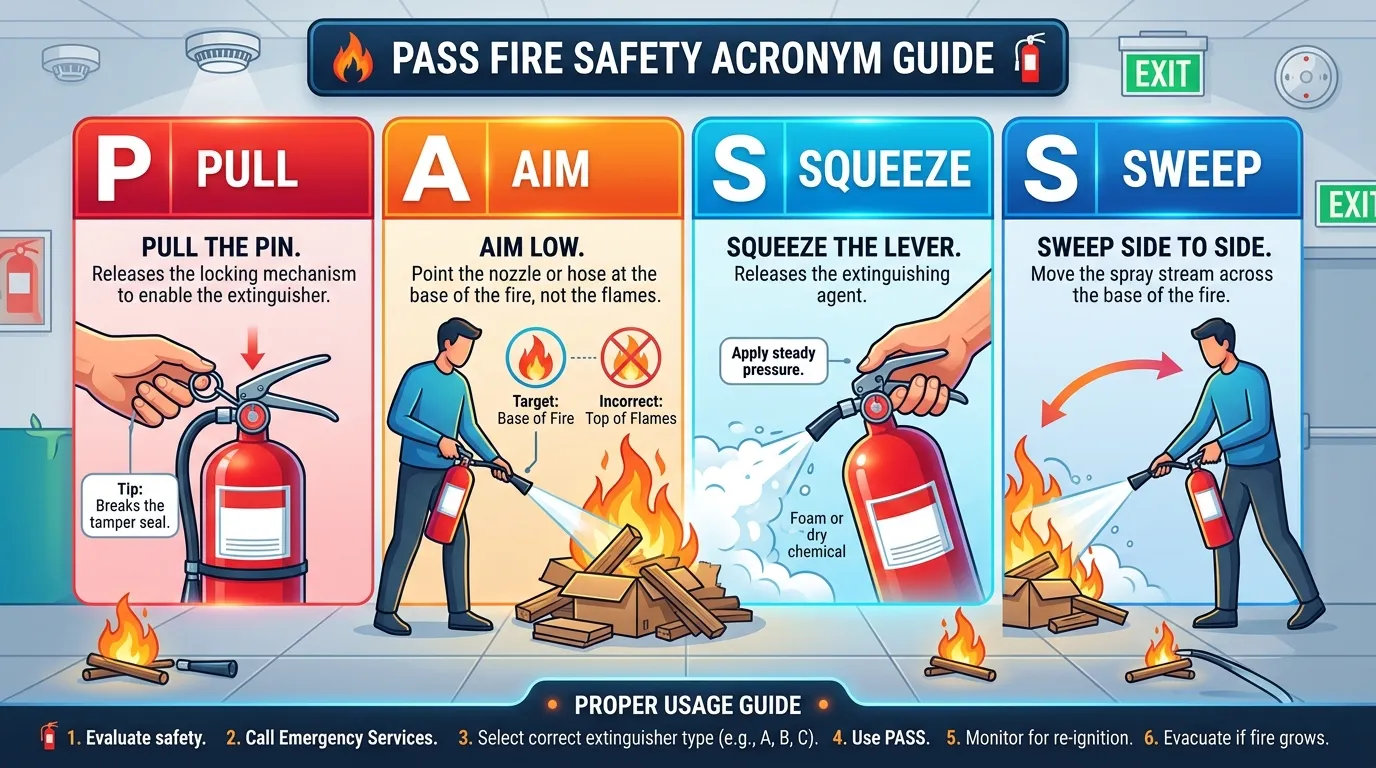
The PASS fire safety acronym stands for:
- P – Pull
- A – Aim
- S – Squeeze
- S – Sweep
These four simple steps explain the correct way to operate a fire extinguisher.
PASS Meaning Explained
P – Pull the Pin
Pull the safety pin from the fire extinguisher. This unlocks the extinguisher and prepares it for use.
A – Aim at the Base of the Fire
Point the nozzle toward the bottom of the flames, not at the flames themselves.
S – Squeeze the Handle
Press the handle to release the extinguishing agent.
S – Sweep Side to Side
Move the nozzle from side to side across the base of the fire until the flames are completely extinguished.
Remembering PASS can help individuals react quickly and safely during small fire emergencies.
Quick PASS Fire Safety Acronym Table
| Acronym | Full Form | Meaning | Tone | Usage Context |
|---|---|---|---|---|
| PASS | Pull, Aim, Squeeze, Sweep | Fire extinguisher operation method | Formal | Fire safety training |
| PASS | Pull, Aim, Squeeze, Sweep | Emergency response instruction | Neutral | Workplace safety |
| PASS | Pull, Aim, Squeeze, Sweep | Easy memory tool for fire emergencies | Educational | Schools and training programs |
What Is an Acronym?
An acronym is a word formed from the first letters of a group of words.
Examples:
- NASA = National Aeronautics and Space Administration
- SCUBA = Self-Contained Underwater Breathing Apparatus
- PASS = Pull, Aim, Squeeze, Sweep
Acronyms make long phrases easier to remember and communicate.
Acronyms vs Abbreviations vs Initialisms
Many people use these terms interchangeably, but they have different meanings.
| Type | Example | Spoken As |
|---|---|---|
| Acronym | PASS | One word |
| Acronym | NASA | One word |
| Initialism | FBI | Letter by letter |
| Initialism | CEO | Letter by letter |
| Abbreviation | Dr. | Shortened word |
| Abbreviation | Ave. | Shortened word |
Acronym
An acronym forms a pronounceable word.
Examples:
- PASS
- NASA
- SCUBA
Initialism
An initialism uses first letters but is pronounced one letter at a time.
Examples:
- FBI
- CEO
- BBC
Abbreviation
An abbreviation is any shortened version of a word.
Examples:
- Prof.
- Dr.
- Ltd.
Why Acronyms Are Widely Used Today
Modern communication values speed and clarity. Acronyms help by:
- Saving time
- Reducing typing effort
- Improving memorization
- Simplifying training materials
- Creating standardized communication
In fire safety training, the PASS acronym allows people to remember critical instructions during stressful situations.
Grammar Rule: Should You Use “A” or “An” Before Acronyms?
Many people think the choice depends on the first letter. Actually, it depends on the sound.
Use “An” Before a Vowel Sound
Examples:
- An MBA graduate
- An FBI agent
- An LCD screen
Why?
Because the first sounds are:
- MBA → “em-bee-ay”
- FBI → “ef-bee-eye”
- LCD → “el-see-dee”
These begin with vowel sounds.
Use “A” Before a Consonant Sound
Examples:
- A CEO
- A PASS procedure
- A NASA employee
The spoken sounds begin with consonant sounds:
- CEO → “see-ee-oh”
- PASS → “pass”
- NASA → “nah-suh”
Common Grammar Mistakes
❌ An CEO
✅ A CEO
❌ A FBI officer
✅ An FBI officer
❌ An PASS fire safety method
✅ A PASS fire safety method
Always listen to the pronunciation, not just the spelling.
How PASS Is Used in Fire Safety Training
Organizations use PASS in:
- Corporate safety programs
- School emergency training
- Industrial safety courses
- Hospital safety procedures
- Government workplace training
The acronym provides a simple memory aid during emergencies when people may feel stressed or overwhelmed.
Real-World Examples of PASS Usage
Workplace Communication
Remember the PASS method before operating any fire extinguisher.
All employees must complete PASS fire safety training annually.
Safety Training Manuals
The PASS technique helps users operate extinguishers safely and effectively.
Review the PASS procedure during every emergency preparedness drill.
Classroom Education
Students learned the PASS acronym during Fire Safety Week.
The teacher demonstrated Pull, Aim, Squeeze, and Sweep using a training extinguisher.
Social Media Posts
Fire safety tip: Remember PASS—Pull, Aim, Squeeze, Sweep.
Knowing PASS could help you react faster during a small fire emergency.
Emergency Preparedness Programs
Safety officers recommend memorizing PASS before an emergency occurs.
Common Mistakes When Using Acronyms
1. Assuming Everyone Knows the Acronym
Not everyone understands specialized terms.
Instead of writing:
Follow PASS.
Write:
Follow PASS (Pull, Aim, Squeeze, Sweep).
At least the first time it appears.
2. Using Too Many Acronyms
Too many acronyms can confuse readers.
Example:
The ERT used PASS during the HSE audit per SOP guidelines.
This may be difficult for new readers.
3. Misinterpretation Across Cultures
Some acronyms may have different meanings in different countries or industries.
Always provide context when communicating internationally.
4. Tone Confusion
Acronyms can sound casual in some situations.
For formal documents, define the acronym before repeatedly using it.
When to Use Acronyms in Professional Writing
Use Acronyms When
✅ The audience understands them
✅ The term appears repeatedly
✅ Space is limited
✅ The acronym is widely recognized
Avoid Acronyms When
❌ The audience is unfamiliar
❌ The acronym appears only once
❌ Clarity is more important than brevity
❌ The meaning may be misunderstood
Acronyms in Different Communication Contexts
Academic Writing
- Define the term first
- Use the acronym afterward
- Maintain consistency
Example:
The PASS (Pull, Aim, Squeeze, Sweep) method is taught during fire safety education.
Corporate Communication
- Commonly accepted safety acronyms are encouraged
- Include definitions in employee training materials
Digital Communication
- Acronyms save space
- Short instructions are easier to remember
- Ideal for emergency reminder posters and digital training modules
Interactive Practice Section
Fill in the Blanks
- PASS stands for Pull, Aim, ________, Sweep.
- The first step in PASS is to ________ the pin.
- Aim at the ________ of the fire.
- PASS is commonly used during fire ________ training.
- After squeezing the handle, ________ side to side.
Answers
- Squeeze
- Pull
- Base
- Safety
- Sweep
Multiple-Choice Questions
1. What does PASS stand for?
A. Pull, Aim, Stop, Sweep
B. Pull, Aim, Squeeze, Sweep
C. Push, Aim, Squeeze, Sweep
D. Pull, Attack, Squeeze, Sweep
Answer: B
2. Where should you aim the extinguisher?
A. At the smoke
B. At the flames
C. At the ceiling
D. At the base of the fire
Answer: D
3. Which article is correct?
A. An PASS procedure
B. A PASS procedure
C. An PASS method
D. Both A and C
Answer: B
Sentence Rewriting Exercise
Rewrite the sentence using the acronym.
Original
Pull the pin, aim at the base of the fire, squeeze the handle, and sweep side to side.
Revised
Follow the PASS method when using a fire extinguisher.
Original
Employees must learn Pull, Aim, Squeeze, and Sweep before handling extinguishers.
Revised
Employees must learn the PASS fire safety procedure before handling extinguishers.
Frequently Asked Questions (FAQs)
What is the PASS fire safety acronym?
PASS stands for Pull, Aim, Squeeze, Sweep, the four steps used to operate a fire extinguisher safely.
Why is PASS important?
It provides a simple memory aid that helps people use fire extinguishers correctly during emergencies.
Is PASS an acronym or an abbreviation?
PASS is an acronym because the letters form a pronounceable word.
Is PASS used worldwide?
Yes. PASS is widely taught in fire safety and workplace safety programs around the world.
How do you pronounce PASS?
It is pronounced like the common English word “pass.”
Do you say “a PASS method” or “an PASS method”?
You say a PASS method because PASS begins with a consonant sound.
Can PASS be used in texting?
Yes, especially when discussing fire safety training, emergency preparedness, or workplace safety topics.
Should I define PASS in formal writing?
Yes. In professional or academic writing, define PASS the first time it appears and then use the acronym afterward.
Are all acronyms pronounced as words?
No. Some are initialisms, such as FBI and CEO, which are pronounced letter by letter.
What is the biggest mistake people make with acronyms?
The most common mistake is assuming everyone already knows what the acronym means.
Conclusion
The PASS fire safety acronym is one of the most important safety acronyms people can learn. Standing for Pull, Aim, Squeeze, Sweep, it provides a simple and memorable method for operating a fire extinguisher during an emergency. Beyond fire safety, understanding how acronyms work helps improve communication in business, education, workplace training, and digital environments.
By learning when to use acronyms, how to define them properly, and how grammar rules like “a” versus “an” depend on pronunciation, you can communicate more clearly and professionally. Whether you’re studying safety procedures or improving your language skills, mastering acronyms is a valuable part of effective modern communication.


