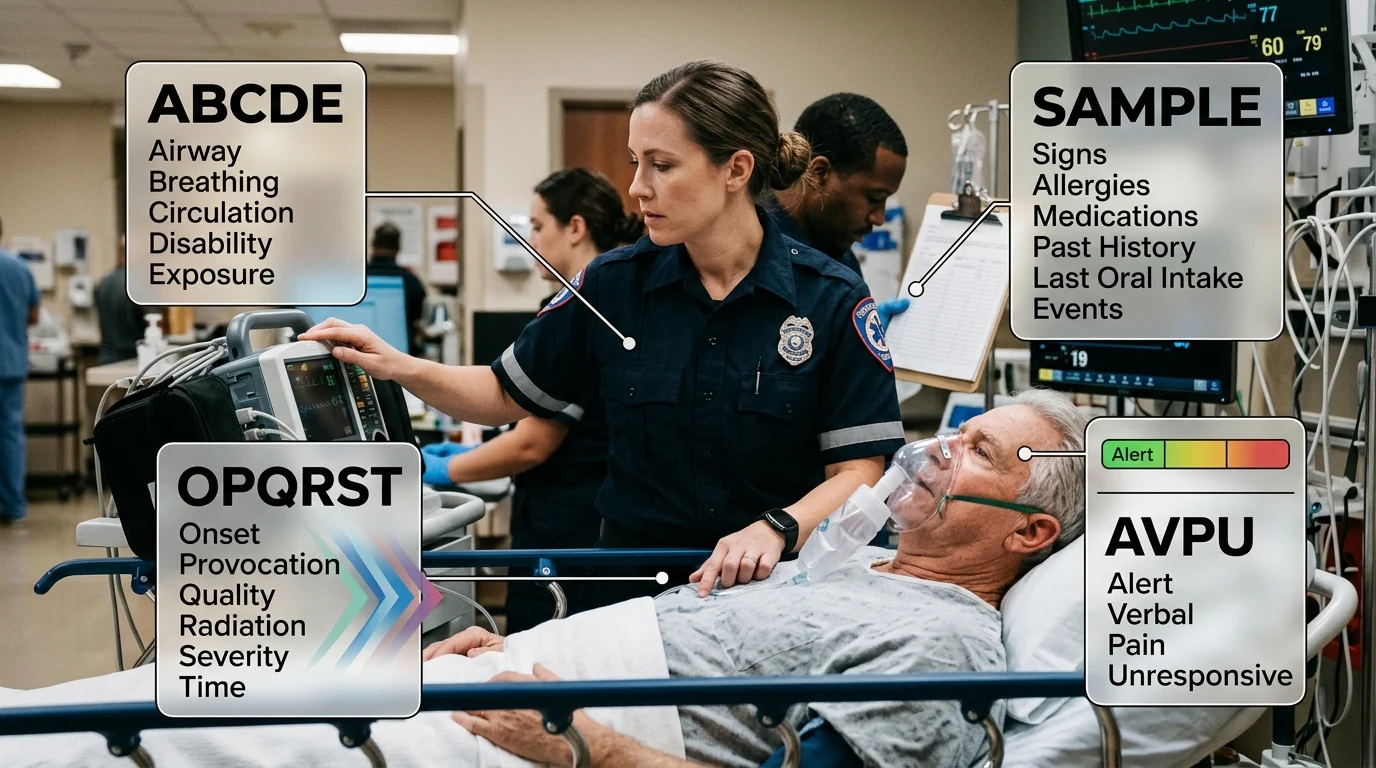
Patient assessment acronyms are widely used in healthcare, nursing, emergency medicine, and paramedic practice to quickly evaluate a patient’s condition. These abbreviations help medical professionals communicate efficiently, especially in urgent or high-pressure situations.
Understanding these acronyms is essential for nurses, EMTs, doctors, and healthcare students.
What Are Patient Assessment Acronyms?
Patient assessment acronyms are shortened medical terms used to guide structured evaluation of a patient’s condition, including airway, breathing, circulation, and neurological status.
They are commonly used in:
- Emergency departments
- Ambulance and pre-hospital care
- Nursing assessments
- Clinical examinations
- Trauma care situations
For example:
- ABC = Airway, Breathing, Circulation
- AVPU = Alert, Voice, Pain, Unresponsive
Common Patient Assessment Acronyms List
| Acronym | Full Form | Meaning |
|---|---|---|
| ABC | Airway, Breathing, Circulation | Primary life-saving assessment |
| ABCDE | Airway, Breathing, Circulation, Disability, Exposure | Systematic patient evaluation |
| AVPU | Alert, Voice, Pain, Unresponsive | Level of consciousness scale |
| GCS | Glasgow Coma Scale | Neurological status scoring |
| OPQRST | Onset, Provocation, Quality, Radiation, Severity, Time | Pain assessment method |
| SAMPLE | Signs/Symptoms, Allergies, Medications, Past history, Last meal, Events | Patient history format |
| DCAP-BTLS | Deformities, Contusions, Abrasions, Punctures, Burns, Tenderness, Lacerations, Swelling | Trauma assessment |
| RACE | Rapid Arterial oCclusion Evaluation | Stroke assessment tool |
| FAST | Face, Arms, Speech, Time | Stroke recognition tool |
| V/S | Vital Signs | Blood pressure, pulse, temperature, respiration |
| LOC | Level of Consciousness | Patient awareness level |
| RR | Respiratory Rate | Breathing rate |
| BP | Blood Pressure | Circulatory measurement |
Primary Assessment Acronyms
ABC (Airway, Breathing, Circulation)
The most critical life-saving assessment used in emergencies.
ABCDE Approach
A structured method used to assess and stabilize patients step-by-step.
Neurological Assessment Acronyms
AVPU Scale
Quick method to check consciousness:
- A = Alert
- V = Responds to Voice
- P = Responds to Pain
- U = Unresponsive
GCS (Glasgow Coma Scale)
Measures brain function based on eye, verbal, and motor response.
Pain and History Assessment Acronyms
OPQRST
Used to evaluate pain:
- Onset
- Provocation
- Quality
- Radiation
- Severity
- Time
SAMPLE
Used to gather patient history:
- Symptoms
- Allergies
- Medications
- Past history
- Last meal
- Events
Trauma Assessment Acronyms
DCAP-BTLS
Used in physical trauma examination:
- Deformities
- Contusions
- Abrasions
- Punctures
- Burns
- Tenderness
- Lacerations
- Swelling
Stroke and Emergency Acronyms
FAST
Used to quickly identify stroke symptoms:
- Face drooping
- Arm weakness
- Speech difficulty
- Time to call emergency services
RACE
Advanced stroke assessment tool used in clinical settings.
Vital Signs Acronyms
V/S (Vital Signs)
Includes:
- Blood Pressure (BP)
- Respiratory Rate (RR)
- Pulse
- Temperature
Why Patient Assessment Acronyms Are Important
These acronyms are important because they:
- Save time in emergencies
- Improve patient safety
- Standardize medical communication
- Reduce clinical errors
- Help with structured assessments
- Support training and education
Common Mistakes in Patient Assessment Acronyms
Skipping ABC steps
Airway and breathing must always be prioritized.
Misinterpreting GCS scores
Incorrect scoring can affect treatment decisions.
Ignoring SAMPLE history
Missing allergy or medication history can be dangerous.
Real-Life Examples
Emergency Scene
“Start ABC assessment immediately.”
Stroke Patient
“FAST positive, call stroke team.”
Trauma Case
“Perform DCAP-BTLS examination.”
Simple Memory Guide
- ABC = Life-saving check
- AVPU = Consciousness level
- SAMPLE = Patient history
- OPQRST = Pain assessment
- FAST = Stroke detection
- GCS = Brain function score
Final Summary
Patient assessment acronyms are essential tools in healthcare and emergency medicine. Terms like ABC, AVPU, GCS, SAMPLE, OPQRST, DCAP-BTLS, and FAST help medical professionals quickly assess patients, make decisions, and provide life-saving care.
Understanding these acronyms improves clinical accuracy, communication, and patient outcomes in all healthcare settings.


