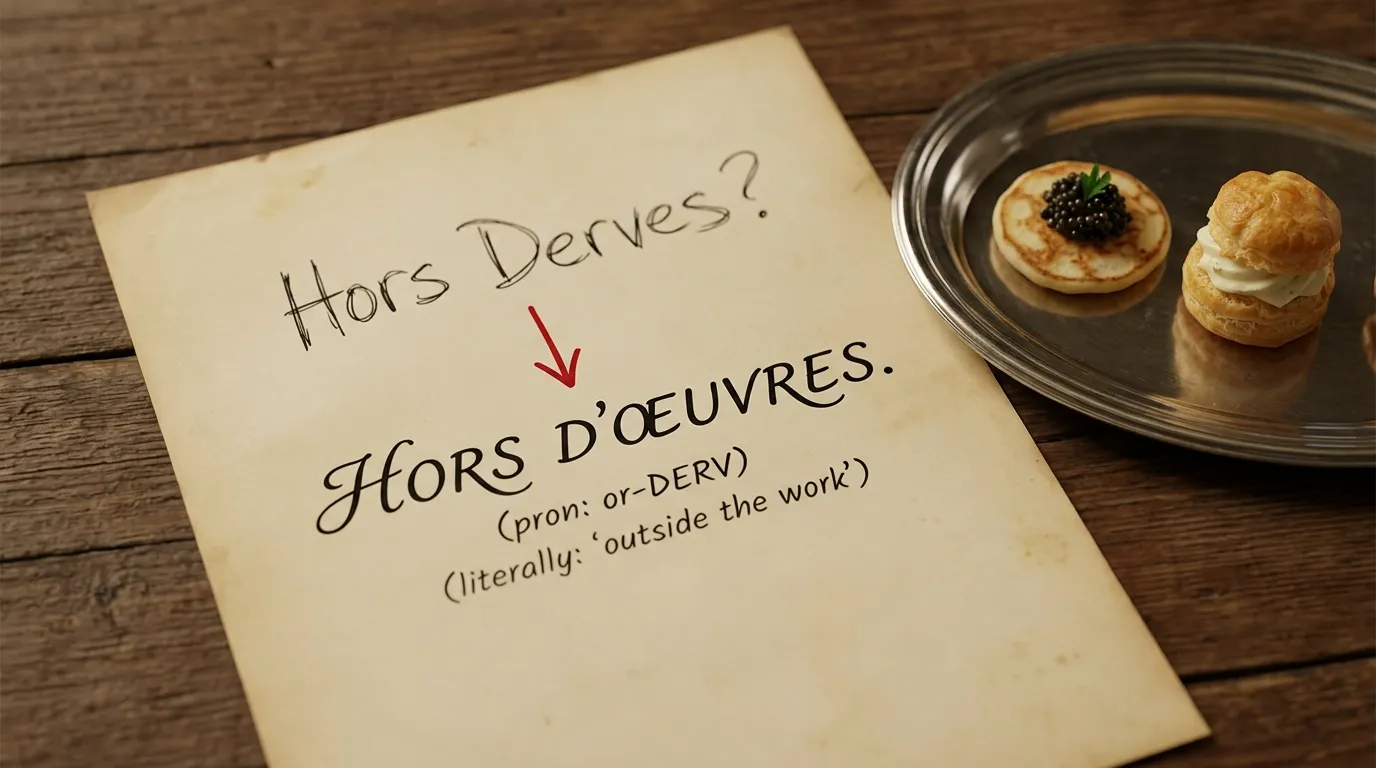
Some English words are difficult to spell because they come from other languages. Hors d’oeuvres is a good example. Many people write hors derves because the original French spelling does not match the way the phrase sounds when spoken.
The correct spelling is hors d’oeuvres. Hors derves is an incorrect spelling.
Hors d’oeuvres refers to small foods served before a main meal. They are often served at parties, weddings, receptions, dinners, and other social events.
What Is the Correct Spelling?
✅ Correct: Hors d’oeuvres
❌ Incorrect: Hors derves
The standard English spelling comes from French:
hors d’oeuvres
The phrase contains an apostrophe in d’oeuvres.
Example
The restaurant served delicious hors d’oeuvres before dinner.
Incorrect:
❌ The restaurant served hors derves before dinner.
What Does “Hors d’oeuvres” Mean?
Hors d’oeuvres are small portions of food served before the main course.
They can include:
- Small sandwiches
- Cheese
- Crackers
- Mini pastries
- Vegetables
- Seafood
- Meatballs
- Stuffed mushrooms
- Small appetizers
Examples
Guests enjoyed several hors d’oeuvres during the reception.
The waiter brought out hors d’oeuvres before dinner.
Hors d’oeuvres vs. Hors Derves
| Term | Correct? | Meaning |
|---|---|---|
| Hors d’oeuvres | ✅ Yes | Small foods served before a main meal |
| Hors derves | ❌ No | Incorrect spelling |
Why Is “Hors d’oeuvres” So Difficult to Spell?
The phrase comes from French, and its spelling is very different from its pronunciation.
English speakers often pronounce it approximately:
or-DERVZ
Because the pronunciation is much shorter than the written form, people may spell it phonetically as:
❌ hors derves
However, the standard spelling remains:
✅ hors d’oeuvres
What Does “Hors d’oeuvre” Mean?
Hors d’oeuvre is the singular form.
Singular
The chef prepared one hors d’oeuvre.
Plural
The chef prepared several hors d’oeuvres.
In English, hors d’oeuvres is commonly used as a plural term.
Hors d’oeuvres vs. Appetizers
These terms are closely related.
Hors d’oeuvres
Usually refers to small foods served before a meal, often at social events or receptions.
Appetizers
A broader everyday term for food served before the main course.
For example:
We ordered several appetizers at the restaurant.
The wedding guests enjoyed hors d’oeuvres during the reception.
In many situations, the terms can overlap.
Pronunciation
Hors d’oeuvres is commonly pronounced approximately:
or-DERVZ
The pronunciation can vary slightly by accent.
The spelling is much more complex than the pronunciation, which is why this phrase is frequently misspelled.
How to Remember the Spelling
The best strategy is to remember the phrase as a complete expression:
HORS D’OEUVRES
Don’t try to spell it exactly as it sounds.
A useful reminder is:
Hors d’oeuvres = French spelling, “or-DERVZ” pronunciation.
Hors d’oeuvres in Everyday English
Examples:
- We served hors d’oeuvres at the party.
- The guests enjoyed delicious hors d’oeuvres.
- The hotel offers complimentary hors d’oeuvres.
- Several hors d’oeuvres were placed on the table.
Hors d’oeuvres in Professional Writing
The phrase is common in event planning, hospitality, catering, restaurant, and wedding-related writing.
Examples:
The reception will include a selection of hors d’oeuvres.
Our catering package includes hot and cold hors d’oeuvres.
Guests will be served hors d’oeuvres upon arrival.
Common Mistakes
Mistake 1: Hors Derves
❌ hors derves
✅ hors d’oeuvres
The incorrect version tries to spell the word according to its pronunciation.
Mistake 2: Hors D’oeuvre for a Plural
When referring to multiple items, use:
✅ hors d’oeuvres
For one item:
✅ hors d’oeuvre
Mistake 3: Removing the Apostrophe
The traditional spelling includes:
d’oeuvres
The apostrophe is part of the original French expression.
Practice Exercises
Fill in the Blanks
- The guests enjoyed delicious ________ before dinner.
- The caterer prepared several ________.
- One small ________ was placed on each plate.
Answers
- hors d’oeuvres
- hors d’oeuvres
- hors d’oeuvre
Multiple-Choice Questions
Which spelling is correct?
A. Hors derves
B. Hors d’oeuvres
C. Hors deuvres
D. Hors doerves
✅ Answer: B. Hors d’oeuvres
Which is the singular form?
A. Hors d’oeuvre
B. Hors d’oeuvres
✅ Answer: A. Hors d’oeuvre
Sentence Rewriting Practice
Incorrect
The restaurant served hors derves before dinner.
Correct
The restaurant served hors d’oeuvres before dinner.
Incorrect
We ordered several hors d’oeuvre.
Correct
We ordered several hors d’oeuvres.
Frequently Asked Questions
Is “hors d’oeuvres” the correct spelling?
Yes. Hors d’oeuvres is the standard spelling.
Is “hors derves” a word?
No. Hors derves is an incorrect spelling based on the pronunciation.
What does hors d’oeuvres mean?
It means small foods served before a main meal.
How do you pronounce hors d’oeuvres?
It is commonly pronounced approximately “or-DERVZ.”
What is the singular of hors d’oeuvres?
The singular is hors d’oeuvre.
Is hors d’oeuvres French?
Yes. The phrase comes from French and literally refers to food served outside the main course.
Are hors d’oeuvres the same as appetizers?
They are very similar. In many everyday contexts, hors d’oeuvres and appetizers can be used interchangeably, although the terms can have slightly different traditional uses.
Quick Summary
| Feature | Answer |
|---|---|
| Correct spelling | Hors d’oeuvres |
| Incorrect spelling | Hors derves |
| Origin | French |
| Meaning | Small foods served before a meal |
| Singular | Hors d’oeuvre |
| Plural | Hors d’oeuvres |
| Pronunciation | Approximately “or-DERVZ” |
| Common context | Parties, receptions, restaurants, catering |
Conclusion
The correct spelling is hors d’oeuvres, not hors derves. The incorrect spelling is common because the French phrase has a pronunciation that is very different from its written form.
Hors d’oeuvres refers to small portions of food served before a main meal. They are commonly found at parties, weddings, receptions, restaurants, and catered events.
The easiest way to avoid the spelling mistake is to remember the phrase as a complete expression rather than trying to spell it phonetically:
Hors d’oeuvres = Correct
Hors derves = Incorrect
If you are referring to one item, use hors d’oeuvre. If you are referring to several, use hors d’oeuvres.


