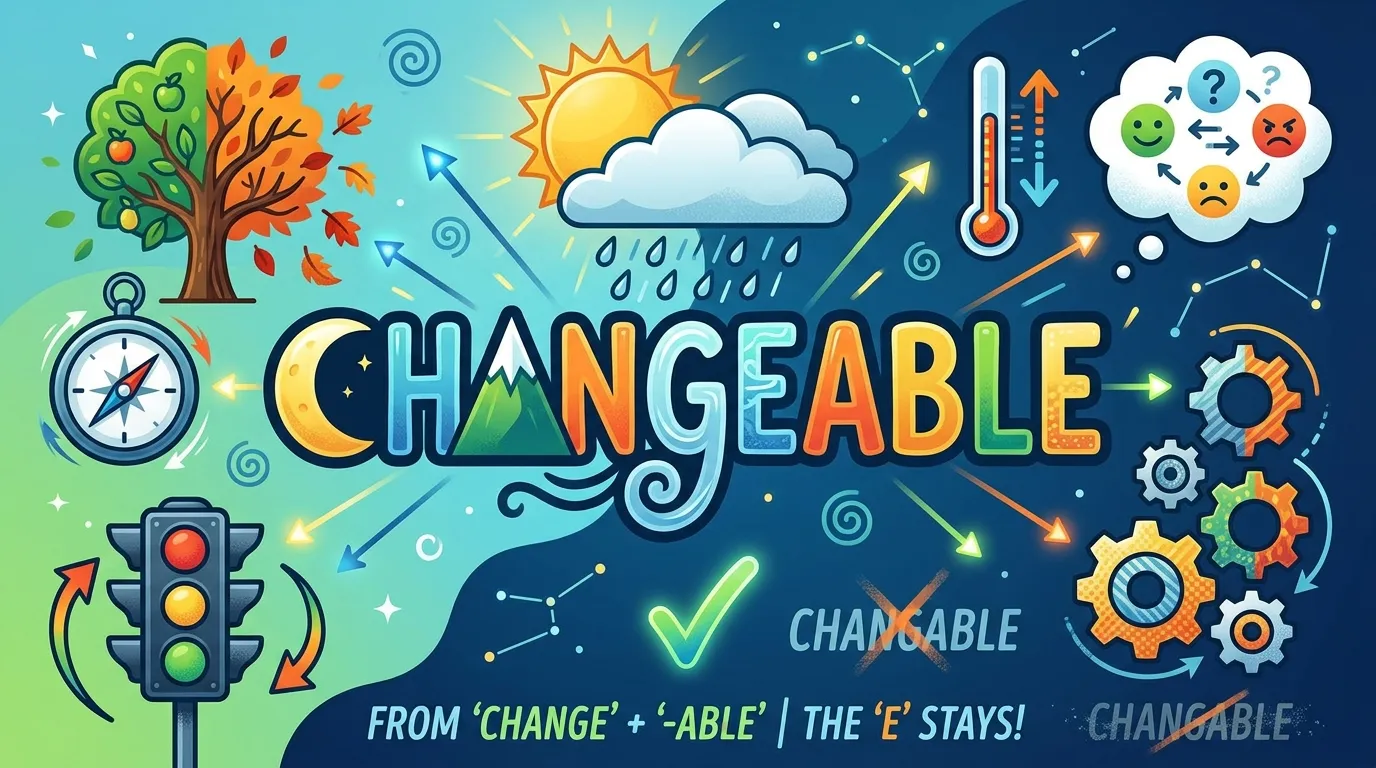
If you are unsure whether the correct spelling is changeable or changable, the answer is simple: changeable is the correct spelling in standard English. Changable is a common misspelling and should generally be avoided in formal, academic, professional, and published writing.
The confusion happens because the word comes from change + -able, and English spelling rules are not always as predictable as they seem. When people pronounce the word, the second e in changeable may be easy to overlook, leading them to write changable.
In this guide, you will learn the difference between changeable and changable, what changeable means, how to pronounce it, why the spelling causes confusion, how it is used in American and British English, and which alternatives work best in different situations.
Quick Answer: Changeable or Changable?
Changeable is the correct spelling.
❌ Changable — incorrect spelling
✅ Changeable — correct spelling
The word changeable is an adjective meaning able to be changed, likely to change, or not constant.
Examples
- The weather is very changeable this time of year.
- Her plans are changeable, so we should confirm before making reservations.
- The settings are changeable from the control panel.
- His mood can be quite changeable.
Although changable may appear in informal writing, online posts, or spelling mistakes, it is not the standard spelling you should use.
What Does Changeable Mean?
Changeable is an adjective formed from the verb change and the suffix -able.
It generally describes something that:
- Can be changed
- Is likely to change
- Does not remain constant
- Varies from one time or situation to another
The exact meaning depends on context.
Meaning 1: Able to Be Changed
When changeable means something can be modified, replaced, or adjusted, it describes an object, setting, condition, or arrangement that is not fixed.
Examples:
- The appointment time is changeable.
- These preferences are changeable in your account settings.
- The software includes changeable display options.
- The seating arrangement is changeable.
Here, changeable means capable of being changed.
Meaning 2: Likely to Change
Changeable can also describe something that frequently changes or cannot be relied upon to remain the same.
Examples:
- The mountain weather is extremely changeable.
- Her attitude toward the proposal has been changeable.
- The political situation remains changeable.
- Spring weather is often changeable.
In these sentences, the word means variable, unpredictable, or inconsistent.
Why Is Changable Incorrect?
The spelling changable looks logical at first glance because the base word is change and the suffix is -able.
However, removing the final e from change produces the incorrect spelling:
change + able → changeable
Not:
change + able → changable
The spelling changeable preserves the e from change.
This is one of those English spelling patterns that can seem inconsistent because suffix rules vary depending on the word.
Compare These Words
Notice that English does not always handle the final e in exactly the same way:
- change → changeable
- notice → noticeable
- service → serviceable
- peace → peaceable
- manage → manageable
- use → usable
This is why it is safer to learn changeable as the established spelling rather than trying to construct it from a spelling rule alone.
Changeable vs Changable: Key Difference
The most important difference is that one is standard and the other is not.
| Word | Correct? | Part of Speech | Meaning |
|---|---|---|---|
| Changeable | ✅ Yes | Adjective | Able or likely to change |
| Changable | ❌ No | — | Common misspelling of changeable |
There is therefore no meaningful difference in definition between the two forms. Changable is simply a misspelling of changeable.
If you are writing an essay, email, report, article, résumé, application, business document, or academic paper, always choose changeable.
How Do You Pronounce Changeable?
The pronunciation of changeable can vary slightly depending on accent and speaking style.
A common American English pronunciation is approximately:
CHAYN-juh-bul
You may hear it pronounced with three syllables:
change-a-ble
The important point is that the spelling contains the full change element.
Why Pronunciation Causes Confusion
In normal speech, the vowel sounds in the middle of changeable can become weak. As a result, the word may sound less like:
change + able
and more like a compact spoken form.
That can encourage people to write changable, even though the standard written form is changeable.
Is Changeable an Adjective?
Yes. Changeable is an adjective.
It modifies a noun by describing its ability, tendency, or likelihood to change.
Examples
- changeable weather
- changeable conditions
- changeable settings
- changeable plans
- changeable behavior
- changeable prices
- changeable circumstances
- changeable moods
In Sentences
- We are dealing with changeable weather.
- The schedule is changeable.
- The device has several changeable components.
- His opinions are surprisingly changeable.
Changeable as a Descriptive Word
One useful feature of changeable is that it can describe both physical things and abstract ideas.
Physical Uses
- changeable batteries
- changeable lenses
- changeable parts
- changeable settings
- changeable clothing
Abstract Uses
- changeable moods
- changeable opinions
- changeable policies
- changeable circumstances
- changeable attitudes
This makes the word useful in everyday, professional, technical, and academic writing.
Changeable vs Changeable: Two Common Meanings
Although there is only one correct spelling, changeable has two closely related meanings.
1. Capable of Being Modified
Something is changeable when someone can alter it.
Example:
The font size is changeable.
This means the font size can be changed.
2. Frequently or Easily Changing
Something is changeable when it tends not to stay the same.
Example:
The weather is changeable.
This means the weather varies frequently or unpredictably.
Compare
| Sentence | Meaning |
|---|---|
| The settings are changeable. | The settings can be modified. |
| The weather is changeable. | The weather frequently varies. |
| Her plans are changeable. | Her plans may be altered. |
| His mood is changeable. | His mood varies frequently. |
Context tells you which sense is intended.
Why Do People Spell Changeable as Changable?
Several factors contribute to the mistake.
1. The Word Looks Like It Should Drop the E
People often learn that a final e disappears before certain suffixes.
For example:
- make + ing → making
- write + ing → writing
- use + able → usable
Because of this pattern, someone may assume:
change + able → changable
But the established spelling is changeable.
2. The E Can Be Hard to Hear
The spelling contains changeable, but ordinary pronunciation does not emphasize every letter equally.
The weak middle sound can make the written word seem shorter than it actually is.
3. People Spell by Sound
English contains many words whose pronunciation does not perfectly reveal their spelling.
If someone writes words exactly as they hear them, changable can seem reasonable.
4. Autocomplete and Informal Writing
People frequently type quickly on phones and computers. A misspelled word can also be copied, reposted, or repeated online.
Repeated exposure does not make changable correct.
Changeable in American English
Changeable is standard in American English.
American writers should use it in:
- School assignments
- College papers
- Business writing
- Emails
- Reports
- Websites
- News writing
- Technical documentation
- Professional communication
American English Examples
The weather in this region is highly changeable.
The meeting schedule is changeable depending on the client’s availability.
These settings are changeable at any time.
There is no standard American spelling changable.
Changeable in British English
British English also uses changeable.
There is no major British-American spelling difference here.
This is important because some English words genuinely have regional spelling differences, such as:
- color / colour
- favorite / favourite
- organize / organise
- traveled / travelled
But changeable / changable is not such a case.
Correct in Both Major Varieties
🇺🇸 American English: changeable
🇬🇧 British English: changeable
So you do not need to switch spellings based on your audience.
Is Changable Ever Acceptable?
In standard modern English, changable should not be used as an alternative spelling.
You may encounter it:
- In social media posts
- In comments
- In user-generated content
- In old or poorly edited documents
- In spelling exercises
- In search queries
- On websites containing errors
However, seeing a misspelling online does not establish it as an accepted variant.
For polished writing, use changeable.
Dictionary-Style Definition of Changeable
Changeable
Adjective
Definition
- Capable of being changed or modified.
- Likely to change frequently or unpredictably.
- Variable rather than fixed or constant.
Example
The region experiences changeable weather throughout the year.
Related Forms
- change — verb/noun
- changed — adjective/past participle
- changing — adjective/present participle
- changeable — adjective
- changeability — noun
- changeably — adverb
Word History and Etymology of Changeable
The word changeable is built from the verb change plus the adjective-forming suffix -able.
The word change ultimately has a long history connected to ideas of exchange, alteration, and transformation. English inherited it through French from Latin roots associated with exchanging or replacing one thing with another.
The suffix -able is widely used in English to create adjectives meaning capable of, suitable for, or worthy of being something.
For example:
- read → readable
- understand → understandable
- accept → acceptable
- predict → predictable
- change → changeable
The historical development of the word helps explain why its spelling has become established as changeable.
Changeable vs Changing
These words are related but not always interchangeable.
Changeable
Means capable of changing or likely to change.
The weather is changeable.
Changing
Means currently undergoing change.
The weather is changing.
Compare:
The company has changeable policies.
This suggests the policies can or may change.
The company is changing its policies.
This means the company is actively modifying them.
Changeable vs Variable
These words often overlap.
Variable usually emphasizes variation rather than the possibility of modification.
The patient’s heart rate was variable.
The weather is changeable.
Both can indicate a lack of consistency, but changeable often highlights the tendency or ability to change.
In Technical Writing
Variable may be preferable when discussing measurable quantities.
- variable temperature
- variable pressure
- variable speed
- variable costs
Changeable is often more natural when describing something that can be altered.
- changeable settings
- changeable preferences
- changeable plans
Changeable vs Flexible
Flexible often has a more positive or practical meaning.
We have a flexible schedule.
This suggests that adjustments are easy and acceptable.
We have a changeable schedule.
This suggests that the schedule may change.
Therefore, flexible and changeable are not always exact synonyms.
Synonyms for Changeable
Depending on context, useful synonyms include:
- variable
- shifting
- fluctuating
- unstable
- inconsistent
- unpredictable
- adjustable
- adaptable
- modifiable
- alterable
- mutable
- fluid
- evolving
- flexible
Choosing the Right Synonym
For physical settings:
adjustable, modifiable
For weather:
variable, unpredictable, fluctuating
For opinions:
shifting, inconsistent, changeable
For plans:
flexible, adjustable, changeable
For conditions:
variable, shifting, unpredictable
Antonyms of Changeable
Common opposites include:
- fixed
- constant
- stable
- permanent
- unchanging
- consistent
- rigid
- immutable
- predictable
- steady
Examples
The schedule is changeable.
The schedule is fixed.
Her mood is changeable.
His attitude is constant.
The best antonym depends on the context.
Common Collocations With Changeable
A collocation is a group of words that naturally occur together.
Some common combinations with changeable include:
- changeable weather
- changeable conditions
- changeable mood
- changeable behavior
- changeable plans
- changeable schedule
- changeable circumstances
- changeable climate
- changeable settings
- changeable prices
- changeable environment
- changeable situation
- changeable nature
- changeable pattern
- changeable attitude
Example Sentences
We experienced changeable weather during our trip.
Because of the changeable conditions, the event may be delayed.
His changeable mood made it difficult to predict his reaction.
The software provides changeable settings for advanced users.
Common Phrases Using Changeable
While changeable is not typically part of many fixed idioms, it appears naturally in several descriptive expressions.
Changeable Weather
The area’s changeable weather makes outdoor planning difficult.
Changeable Conditions
Drivers should be prepared for changeable road conditions.
Changeable Mood
Her changeable mood made the conversation unpredictable.
Changeable Plans
Our changeable plans mean we should avoid booking anything nonrefundable.
Changeable Circumstances
The decision may depend on changeable circumstances.
Common Mistakes With Changeable
Mistake 1: Writing Changable
❌ The schedule is changable.
✅ The schedule is changeable.
Mistake 2: Using Changeable as a Verb
❌ We need to changeable the settings.
✅ We need to change the settings.
Changeable is an adjective, not a verb.
Mistake 3: Confusing Changeable With Changing
❌ The weather is changing, so it is currently changeable.
This is not necessarily wrong, but the intended meaning matters.
Better:
The weather is changing rapidly.
If you mean the weather frequently varies:
The weather is changeable.
Awkward vs Natural Examples
Example 1
❌ Awkward: The plan is changable.
✅ Natural: The plan is changeable.
Example 2
❌ Awkward: The software has changable options.
✅ Natural: The software has changeable options.
Example 3
❌ Awkward: The weather was changable all week.
✅ Natural: The weather was changeable all week.
Example 4
❌ Awkward: These rules are not changable.
✅ Natural: These rules are not changeable.
Example 5
❌ Awkward: Her opinion is very changable.
✅ Natural: Her opinion is very changeable.
Everyday Examples of Changeable
Here are natural examples you might encounter in daily life:
- My travel plans are changeable.
- The weather has been extremely changeable.
- The price is changeable without notice.
- The settings are changeable from the menu.
- His schedule is changeable this week.
- The design has several changeable elements.
- Our meeting time is changeable.
- These conditions are highly changeable.
Changeable in Business Writing
In professional writing, changeable can describe schedules, requirements, prices, plans, policies, or conditions.
Examples
Project deadlines may be changeable depending on client feedback.
The contract contains several changeable terms.
Pricing is changeable based on market conditions.
However, sometimes a more precise word is better.
Instead of:
The deadline is changeable.
You might write:
The deadline is subject to change.
The phrase subject to change is especially common in formal business and public-facing communication.
Changeable in Academic Writing
Academic writing often favors precise language.
For example:
Climate conditions are highly variable.
may be more precise than:
Climate conditions are highly changeable.
But changeable is still grammatically correct when it accurately expresses the intended meaning.
Academic Alternatives
Depending on context, consider:
- variable
- dynamic
- evolving
- fluctuating
- mutable
- adaptable
- subject to change
Choose the word that expresses the exact idea rather than simply selecting a more complicated term.
Changeable in Technical Writing
Technical writing often uses changeable to describe components, configurations, parameters, or settings.
Examples include:
- changeable configuration
- changeable settings
- changeable parameters
- changeable components
- changeable values
- changeable display modes
However, technical documentation may prefer more specific terms such as:
- configurable
- adjustable
- customizable
- modifiable
- user-defined
For example:
The interface includes customizable settings.
may be clearer than:
The interface includes changeable settings.
Changeable in Journalism
Journalists may use changeable when describing uncertain or evolving conditions.
Examples
Officials warned that changeable weather conditions could affect travel.
The political landscape remains changeable ahead of the election.
Consumer preferences are increasingly changeable.
Journalistic writing generally benefits from specificity, so terms such as volatile, uncertain, shifting, or fluid may sometimes communicate the situation more accurately.
Changeable in Sports
Sports writing can use changeable for weather, game conditions, strategies, or player performance.
Examples
The team had to adapt to changeable weather conditions.
The coach used a changeable defensive strategy.
The player’s role became more changeable as the season progressed.
In sports journalism, words such as flexible, adaptable, shifting, and fluid may be more natural depending on the context.
Changeable in Blogging and Casual Writing
Changeable is perfectly acceptable in blogs, social posts, and everyday communication.
For example:
Spring weather is so changeable!
Or:
My plans are pretty changeable this weekend.
For casual writing, you may also use simpler phrases:
- can change
- keeps changing
- not fixed
- flexible
- up in the air
For example:
My plans are up in the air.
This sounds much more conversational than:
My plans are changeable.
Formal vs Informal Alternatives
| Context | Formal/Natural Choice | Casual Alternative |
|---|---|---|
| Plans | subject to change | might change |
| Schedule | adjustable | can be changed |
| Weather | variable/changeable | keeps changing |
| Settings | configurable | can be changed |
| Opinion | changeable/shifting | keeps changing |
| Conditions | variable/changeable | can change |
| Policy | subject to revision | might change |
The best word depends on your audience and intended meaning.
Grammatical Forms Related to Change
Understanding related forms can make the spelling easier to remember.
Change
Verb: to make something different
We need to change the schedule.
Noun: an alteration or difference
The company announced a change.
Changed
Usually describes something that has already been altered.
The changed schedule was sent by email.
Changing
Describes something currently undergoing change.
The changing weather affected the event.
Changeable
Describes something capable of or likely to change.
The weather is changeable.
Changeability
The noun form describes the quality of being changeable.
The changeability of the market makes long-term predictions difficult.
Changeably
This adverb is uncommon but grammatically possible.
The conditions shifted changeably throughout the period.
In ordinary writing, a more natural construction is usually available.
A Simple Memory Trick for Changeable
If you repeatedly forget the spelling, use this trick:
Remember: CHANGE stays intact.
Think:
CHANGE + ABLE = CHANGEABLE
The word change remains visible inside changeable.
Do not turn it into:
CHANGE → CHANG → CHANGABLE ❌
Instead, remember:
CHANGE → CHANGEABLE ✅
Another useful memory sentence is:
If it can CHANGE, it is CHANGEABLE.
The repeated change pattern can help reinforce the spelling.
How to Remember the Correct Spelling
Use these three steps:
Step 1: Spot the Base Word
The base word is:
change
Step 2: Add the Suffix
The adjective-forming suffix is:
-able
Step 3: Remember the Established Form
Together:
change + able = changeable
Even though English suffix spelling can be complicated, this is the standard form you should memorize.
Is Changeable a Common Word?
Yes. Changeable is a standard English adjective used in many contexts.
It is especially common when describing:
- Weather
- Conditions
- Plans
- Moods
- Settings
- Circumstances
- Attitudes
- Policies
- Environments
- Preferences
Its usefulness comes from its broad meaning: something is either capable of being changed or likely to change.
Is Changeable a Negative Word?
Not necessarily.
The emotional meaning depends on context.
Neutral
The software has changeable settings.
This simply describes functionality.
Negative
His changeable behavior made him difficult to trust.
Here, inconsistency is viewed negatively.
Positive
She has a changeable approach that allows her to adapt quickly.
Although adaptable would usually be more positive, the context can make changeable neutral or favorable.
Changeable vs Adaptable
These words are related but have different emphasis.
Changeable focuses on the fact that something changes or can be changed.
Adaptable focuses on the ability to adjust successfully to changing conditions.
Compare:
The weather is changeable.
You would not normally say:
The weather is adaptable.
But:
She is adaptable to new situations.
is natural.
Therefore, do not treat the two words as interchangeable in every sentence.
Changeable vs Mutable
Mutable is a more specialized and formal word meaning capable of being changed.
It appears frequently in technical, philosophical, and academic contexts.
The value is mutable.
For general readers:
The value is changeable.
is usually simpler.
In software terminology, mutable can have a precise technical meaning, so replacing it with changeable may remove important technical detail.
Changeable vs Adjustable
Adjustable usually means something can be modified to achieve a desired setting or position.
The chair is adjustable.
Changeable is broader.
The schedule is changeable.
You could describe a chair’s settings as changeable, but adjustable is much more natural because it conveys the specific type of modification.
Search Intent: What People Usually Mean by “Changable”
When someone searches for changable, they are usually trying to answer one of these questions:
- Is changable a word?
- Is changeable spelled with an e?
- What is the correct spelling of changeable?
- Changeable or changable?
- How do you spell changeable?
- What does changeable mean?
- Is changable grammatically correct?
- Why is changeable spelled with an e?
- What is the difference between changeable and changable?
For all these searches, the practical answer is the same:
Use changeable.
Common Search Queries and Direct Answers
Is “changable” a word?
Changable is not the standard spelling. The correct form is changeable.
Is “changeable” correct?
Yes. Changeable is the standard English spelling.
Why does changeable have an e?
The standard spelling retains the e from the base word change before -able.
How do you spell changeable?
It is spelled:
C-H-A-N-G-E-A-B-L-E
What does changeable mean?
It means capable of being changed or likely to change.
Is changeable American or British?
It is standard in both American and British English.
Common Mistakes to Avoid
When writing changeable, avoid these mistakes:
❌ changable
✅ changeable
❌ changeible
✅ changeable
❌ changeabel
✅ changeable
❌ changible
✅ changeable
The standard spelling contains:
CHANGE + ABLE
Quick Comparison Table
| Feature | Changeable | Changable |
|---|---|---|
| Standard spelling | ✅ Yes | ❌ No |
| Meaning | Able/likely to change | — |
| Part of speech | Adjective | — |
| American English | ✅ | ❌ |
| British English | ✅ | ❌ |
| Academic writing | ✅ | ❌ |
| Business writing | ✅ | ❌ |
| Casual writing | ✅ | ❌ |
| Recommended spelling | Yes | No |
Practical Recommendations by Audience
For American Writers
Use changeable.
For British Writers
Use changeable.
For International English
Use changeable because it is widely recognized and standard.
For Students
Always write changeable in assignments and exams.
For Businesses
Use changeable, although phrases such as subject to change may be more natural in some notices.
For Bloggers
Use changeable and explain the term naturally if your audience may be unfamiliar with it.
For Journalists
Use changeable when it accurately describes variable or uncertain conditions.
For Technical Writers
Use changeable when you mean capable of being changed, but consider more precise terms such as configurable, adjustable, or modifiable when appropriate.
For Casual Texting
You might use:
It can change.
instead of:
It is changeable.
But if you use the adjective, spell it changeable.
When Should You Use “Subject to Change” Instead?
In formal notices, announcements, schedules, and business communication, subject to change is often more idiomatic than changeable.
Example
Instead of:
The schedule is changeable.
You could write:
The schedule is subject to change.
Instead of:
Prices are changeable without notice.
A more natural notice might say:
Prices are subject to change without notice.
This does not mean changeable is incorrect. It simply means the alternative phrase fits certain formal contexts better.
Final Spelling Test
Which sentence is correct?
A. The weather is very changable today.
B. The weather is very changeable today.
The answer is:
B. The weather is very changeable today.
Which sentence is correct?
A. These settings are changeable.
B. These settings are changable.
Again:
A. These settings are changeable.
Frequently Asked Questions
1. Is it changeable or changable?
Changeable is correct. Changable is a misspelling and should not be used in standard English.
2. Why is changeable spelled with an e?
The standard spelling is formed from change and -able, producing changeable. The spelling retains the e in the base word.
3. What does changeable mean?
Changeable means capable of being changed or likely to change. For example, changeable weather means weather that varies frequently or unpredictably.
4. Is changable an accepted spelling?
No. Changable is not the standard spelling in modern American or British English. Use changeable instead.
5. Is changeable used in American English?
Yes. Changeable is a standard word in American English and is commonly used to describe weather, plans, conditions, settings, moods, and other things that can or may change.
6. Is changeable used in British English?
Yes. British English also uses changeable. Unlike words such as color/colour, there is no standard American-British spelling difference here.
7. Is changeable an adjective?
Yes. Changeable is an adjective. It describes something that can change or tends to change.
For example:
We had changeable weather.
8. What is the difference between changeable and changing?
Changeable means capable of or likely to change, while changing usually means that something is currently undergoing change.
The weather is changeable.
means the weather tends to vary.
The weather is changing.
means it is changing now.
9. What are synonyms for changeable?
Depending on context, synonyms include variable, shifting, fluctuating, unpredictable, adjustable, modifiable, flexible, mutable, and adaptable. The best synonym depends on the exact meaning.
10. How can I remember the spelling of changeable?
Remember:
CHANGE + ABLE = CHANGEABLE
Think of the sentence:
If it can change, it is changeable.
Keeping the complete word change in your memory makes it easier to avoid the misspelling changable.
Conclusion
When choosing between changeable vs changable, there is a clear winner: changeable is the correct standard spelling.
Changable is a common spelling mistake, often caused by pronunciation or confusion about how the suffix -able works. It should be avoided in schoolwork, professional communication, academic writing, websites, journalism, and other polished content.
Remember that changeable is an adjective meaning able to be changed or likely to change. It works in both American and British English, so there is no regional spelling variation to worry about.
The easiest memory trick is simple:
CHANGE + ABLE = CHANGEABLE.
Whenever you hesitate, look for the complete base word change inside the adjective. If you are writing for a formal audience, choose changeable confidently. When a more precise alternative is needed, words such as adjustable, variable, flexible, configurable, modifiable, or subject to change may work better depending on the context.


