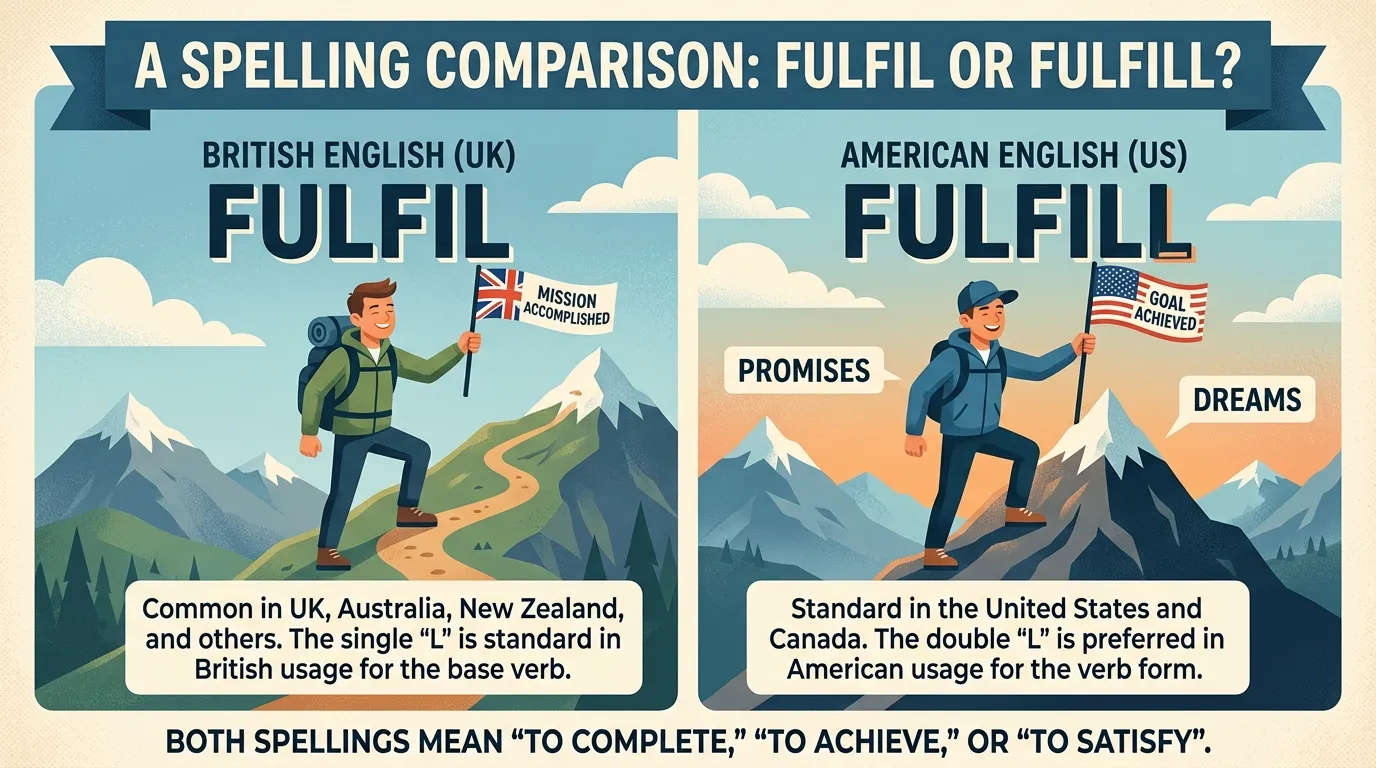
English spelling can change depending on whether you are using British English or American English. A good example is fulfil vs. fulfill. Unlike many spelling pairs where one version is simply wrong, both fulfil and fulfill are correct spellings, but they are generally associated with different varieties of English.
Fulfil is the standard spelling in British English, while fulfill is the standard spelling in American English. Both words have the same meaning: to complete something, satisfy a requirement, achieve a goal, or carry out a promise or duty.
This difference is important for students, writers, businesses, bloggers, and English learners because choosing the spelling that matches your target audience can make your writing more consistent and professional.
In this guide, you’ll learn the difference between fulfil and fulfill, their meanings, grammar, pronunciation, examples, spelling patterns, common mistakes, and when to use each form.
What Is the Correct Spelling?
Both spellings are correct:
✅ Fulfil — British English
✅ Fulfill — American English
Neither spelling is inherently wrong.
British English
We must fulfil our obligations.
American English
We must fulfill our obligations.
Both sentences have exactly the same meaning.
Fulfil vs. Fulfill
| Word | English Variety | Correct? |
|---|---|---|
| Fulfil | British English | ✅ Yes |
| Fulfill | American English | ✅ Yes |
The main difference is the number of L’s.
- British English: fulfil
- American English: fulfill
What Does “Fulfil/Fulfill” Mean?
Fulfil and fulfill are verbs with the same meanings.
They can mean:
- To complete something
- To satisfy a requirement
- To achieve a goal
- To carry out a promise
- To meet an obligation
- To satisfy someone’s expectations
Examples
- She worked hard to fulfil her dream.
- She worked hard to fulfill her dream.
Both sentences are correct.
Why Are There Two Spellings?
The difference comes from British and American spelling conventions.
British English often uses shorter forms with one final l in words such as:
- fulfil
- enrol
- instil
American English commonly doubles the final l:
- fulfill
- enroll
- instill
This is part of a broader difference in spelling conventions between the two varieties.
Fulfil in British English
Use fulfil when writing primarily for readers who use British English.
This includes many countries and regions where British spelling conventions are common.
Examples
- The company must fulfil its legal obligations.
- She hopes to fulfil her ambitions.
- The product failed to fulfil the required standards.
- He fulfilled his promise.
Notice something important: although the base form is fulfil, related forms may contain ll.
Fulfill in American English
Use fulfill when writing for an American English audience.
Examples
- The company must fulfill its legal obligations.
- She hopes to fulfill her ambitions.
- The product must fulfill the required standards.
- He fulfilled his promise.
Fulfill is the preferred spelling in standard American English.
Grammar Guide
Fulfil and fulfill are verbs.
They can be used in several common structures.
Fulfil/Fulfill a Dream
- She wants to fulfill her dream of becoming a doctor.
- He hopes to fulfil his dream of traveling the world.
Fulfil/Fulfill a Promise
- He promised to fulfill his promise.
- She worked hard to fulfil her commitment.
Fulfil/Fulfill a Requirement
- Applicants must fulfill all requirements.
- Students must fulfil the course requirements.
Fulfil/Fulfill an Obligation
- Businesses must fulfill their legal obligations.
- We must fulfil our responsibilities.
Fulfil vs. Fulfill: Past Tense
An interesting point is that the past tense is generally spelled fulfilled in both British and American English.
Present
British:
fulfil
American:
fulfill
Past
Both:
fulfilled
Present Participle
Both:
fulfilling
Noun
Both:
fulfillment / fulfilment
However, the noun also follows regional spelling conventions:
- fulfilment — British English
- fulfillment — American English
Word Forms
| Form | British English | American English |
|---|---|---|
| Base verb | fulfil | fulfill |
| Past tense | fulfilled | fulfilled |
| -ing form | fulfilling | fulfilling |
| Noun | fulfilment | fulfillment |
Examples
British:
She is fulfilling her responsibilities.
American:
She is fulfilling her responsibilities.
The -ing form is spelled the same in both varieties.
Common Meanings of Fulfil/Fulfill
1. Achieve a Dream
She finally fulfilled her dream of becoming a writer.
2. Keep a Promise
He fulfilled his promise to help.
3. Meet a Requirement
The application must fulfill all requirements.
4. Complete a Duty
Employees must fulfil their responsibilities.
5. Satisfy a Need
The service helps fulfill customer needs.
Fulfil vs. Fulfill in Business
Both spellings are common in business English, depending on the company’s preferred variety.
British English
The company aims to fulfil customer expectations.
American English
The company aims to fulfill customer expectations.
If your company uses American English throughout its website, choose fulfill. If it follows British English, choose fulfil.
Consistency is more important than choosing one variety as universally “correct.”
Fulfil vs. Fulfill in Academic Writing
Students should follow the spelling system required by their school, university, style guide, or instructor.
British English
The study aims to fulfil three major objectives.
American English
The study aims to fulfill three major objectives.
Do not randomly switch between British and American spelling within the same document.
Fulfil vs. Fulfill in Digital Communication
On websites, blogs, social media, and online articles, the appropriate spelling depends on your target audience.
For an American audience:
fulfill
For a British audience:
fulfil
For international content, either may be understood, but maintaining consistent spelling throughout your content is recommended.
Common Mistakes
Mistake 1: Thinking “Fulfil” Is Always Wrong
❌ This is not true.
Fulfil is correct British English.
Mistake 2: Thinking “Fulfill” Is Always Wrong
❌ This is also not true.
Fulfill is correct American English.
Mistake 3: Mixing Spelling Styles
For example:
The company will fulfil its goals and enroll new employees.
This mixes British fulfil with American enroll.
For consistent British English:
The company will fulfil its goals and enrol new employees.
For consistent American English:
The company will fulfill its goals and enroll new employees.
Memory Trick
Use this simple rule:
British English
One L: fulfil
American English
Two L’s: fulfill
Think:
UK = one L
US = two L’s
This can help you remember the difference quickly.
Pronunciation
Both fulfil and fulfill are pronounced essentially the same.
The spelling difference does not create a major difference in pronunciation.
Approximate pronunciation:
ful-FIL
Is “Fulfil” More Formal Than “Fulfill”?
No.
Neither spelling is more formal than the other.
The difference is primarily regional spelling.
- fulfil = British spelling
- fulfill = American spelling
Both are standard and appropriate in formal writing when used consistently.
Real-World Examples
Everyday English
British:
I hope you fulfil your dreams.
American:
I hope you fulfill your dreams.
Workplace
British:
We must fulfil our responsibilities.
American:
We must fulfill our responsibilities.
Academic
British:
The research aims to fulfil the study objectives.
American:
The research aims to fulfill the study objectives.
Customer Service
British:
We aim to fulfil all customer requests.
American:
We aim to fulfill all customer requests.
Practice Exercises
Fill in the Blanks
Choose fulfil or fulfill according to the variety of English requested.
British English
- She hopes to ________ her dreams.
- We must ________ our obligations.
Answers: fulfil, fulfil
American English
- She hopes to ________ her dreams.
- We must ________ our obligations.
Answers: fulfill, fulfill
Multiple-Choice Questions
Which spelling is standard in American English?
A. Fulfil
B. Fulfill
✅ Answer: B. Fulfill
Which spelling is standard in British English?
A. Fulfil
B. Fulfill
✅ Answer: A. Fulfil
Are both spellings correct?
A. Yes
B. No
✅ Answer: A. Yes
Sentence Rewriting Practice
British English
American:
The company will fulfill its obligations.
British:
The company will fulfil its obligations.
American English
British:
The company will fulfil its obligations.
American:
The company will fulfill its obligations.
Frequently Asked Questions
Is “fulfil” correct?
Yes. Fulfil is the standard British English spelling.
Is “fulfill” correct?
Yes. Fulfill is the standard American English spelling.
Which spelling should I use in the USA?
Use fulfill.
Which spelling should I use in the UK?
Use fulfil.
Do fulfil and fulfill have different meanings?
No. They have the same meaning.
Is “fulfilled” spelled with one L or two?
Fulfilled is spelled with two L’s in both British and American English.
Is “fulfilment” British English?
Yes. Fulfilment is the British spelling.
Is “fulfillment” American English?
Yes. Fulfillment is the American spelling.
Quick Summary
| Feature | British English | American English |
|---|---|---|
| Correct spelling | Fulfil | Fulfill |
| Meaning | Complete, achieve, satisfy | Complete, achieve, satisfy |
| Past tense | Fulfilled | Fulfilled |
| -ing form | Fulfilling | Fulfilling |
| Noun | Fulfilment | Fulfillment |
| Pronunciation | Essentially the same | Essentially the same |
Conclusion
The good news is that both fulfil and fulfill are correct. The difference is based mainly on the variety of English you are using. Fulfil is the standard spelling in British English, while fulfill is the standard spelling in American English.
Both words mean to complete something, achieve a goal, satisfy a requirement, keep a promise, or meet an obligation. They can be used in everyday conversation, academic writing, business communication, professional documents, and online content.
The most important rule is to remain consistent. If you are writing in American English, use fulfill. If you are writing in British English, use fulfil. Avoid mixing spelling conventions within the same document unless you are discussing the differences between the two varieties.
A simple memory trick can help: British English uses one L in fulfil, while American English uses two L’s in fulfill. Once you remember this regional difference, choosing the correct spelling becomes easy.
Whether you are writing about fulfilling a dream, fulfilling an obligation, fulfilling a requirement, or fulfilling a promise, both forms communicate the same idea. The right choice simply depends on your audience and the English spelling style you follow.


