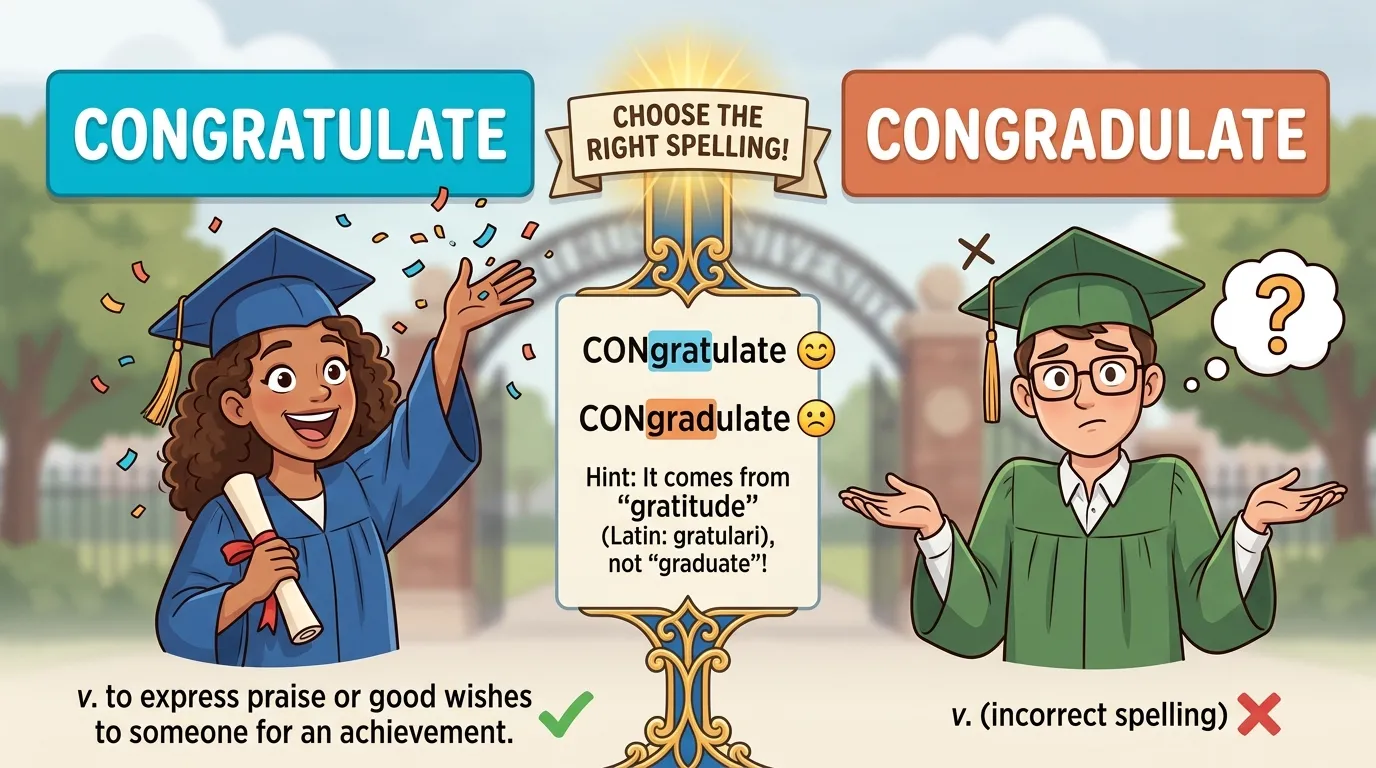
English spelling can be tricky, especially when words contain sounds that are easy to confuse. A common example is congratulate vs. congradulate. Many people accidentally write congradulate because the “d” sound can seem natural when pronouncing the word.
The correct spelling is congratulate. Congradulate is an incorrect spelling and should not be used in standard English.
The word congratulate is very common in everyday conversations, workplace communication, academic writing, social media, and messages. We use it when we want to express happiness or praise someone for an achievement, success, or special event.
For example:
I want to congratulate you on your graduation.
Learning the correct spelling is important because congratulate is frequently used in professional emails, cards, speeches, social media posts, and personal messages.
What Is the Correct Spelling?
✅ Correct: Congratulate
❌ Incorrect: Congradulate
The correct spelling is:
C-O-N-G-R-A-T-U-L-A-T-E
There is no D after the R.
Correct Example
We would like to congratulate you on your success.
Incorrect Example
❌ We would like to congradulate you on your success.
What Does “Congratulate” Mean?
Congratulate is a verb that means to express pleasure, praise, or happiness because of someone’s achievement or good news.
You can congratulate someone for:
- Graduating
- Getting a new job
- Winning an award
- Getting married
- Reaching a goal
- Receiving a promotion
- Winning a competition
- Achieving an important milestone
Examples
- I want to congratulate you on your promotion.
- We congratulated her on graduating.
- Please congratulate the winners.
- Everyone congratulated him on his achievement.
Congratulate vs. Congradulate
| Word | Correct? | Meaning |
|---|---|---|
| Congratulate | ✅ Yes | To praise or express happiness about someone’s success |
| Congradulate | ❌ No | Incorrect spelling |
There is only one standard spelling: congratulate.
Why Do People Spell It “Congradulate”?
The mistake usually happens because of pronunciation.
When people say congratulate quickly, the middle sounds can be difficult to distinguish. Some speakers may hear or produce a sound that resembles “d”, which can lead to the incorrect spelling congradulate.
However, pronunciation should not be used to change the spelling.
Remember:
congratulate = GRAT
Not:
congradulate = GRAD
The Easy Spelling Trick
A simple way to remember the spelling is to connect congratulate with congratulations.
Correct family
- Congratulate
- Congratulations
- Congratulated
- Congratulating
They all begin with:
CONGRAT-
So remember:
Congratulations → Congratulate
If you can spell congratulations, you can use the same congrat- pattern in congratulate.
Congratulate as a Verb
Congratulate is a verb because it describes an action.
Present
I congratulate you on your achievement.
Past
We congratulated her yesterday.
Present participle
They are congratulating the winners.
Third-person singular
She congratulates her students.
Common Grammar Pattern
The most common structure is:
Congratulate + someone + on + something
Examples
- I congratulated her on her promotion.
- We congratulated him on winning the competition.
- She congratulated me on my graduation.
- They congratulated us on our success.
Another Pattern
You can also simply say:
Congratulations!
This is especially common in casual communication.
Congratulate vs. Congratulations
These words are related but have different grammatical roles.
Congratulate
Congratulate is a verb.
I want to congratulate you.
Congratulations
Congratulations is an expression used to praise someone for an achievement.
Congratulations on your new job!
Both are correct, but they are used differently.
Congratulated
Congratulated is the past tense of congratulate.
Examples:
- I congratulated him on his promotion.
- She congratulated her brother.
- The teacher congratulated the students.
Remember that the correct spelling remains based on congratulate.
Congratulating
Congratulating is the present participle or gerund form.
Examples:
- We are congratulating the winners.
- She is congratulating her friend.
- The company released a message congratulating its employees.
Congratulate in Everyday Communication
The word is commonly used when someone achieves something important.
Examples:
- I want to congratulate you!
- We should congratulate her on her success.
- Please congratulate your brother for me.
- I congratulate you on this wonderful achievement.
Congratulate in Workplace Communication
Congratulate is frequently used in professional communication.
Examples
I would like to congratulate you on your promotion.
We would like to congratulate our team for reaching this milestone.
Please join us in congratulating Sarah on her new position.
These sentences are appropriate for professional emails, announcements, newsletters, and company posts.
Congratulate in Academic Writing
Students and teachers also use this word when discussing academic achievements.
Examples
- The principal congratulated the students on their excellent results.
- We would like to congratulate the graduates.
- The professor congratulated the student on completing the research project.
Congratulate in Social Media
Social media is full of congratulatory messages.
Examples:
- Congratulations on your graduation! 🎓
- I want to congratulate you on this amazing achievement!
- Congrats on your new job!
- Please join me in congratulating the winners!
Congrats is an informal shortened form of congratulations.
Common Mistakes
Mistake 1: Congradulate
❌ congradulate
✅ congratulate
There is no d in the correct spelling.
Mistake 2: Congratuldate
❌ congratuldate
✅ congratulate
Be careful not to insert a d before the final part of the word.
Mistake 3: Congratulation
Congratulation can sometimes be grammatically correct when referring to a single act of congratulating, but the common expression is:
Congratulations!
For example:
Congratulations on your graduation!
Congratulate vs. Praise
These words are related but not identical.
Congratulate
Used to express happiness about an achievement.
I congratulated her on winning the award.
Praise
Used to express approval or admiration for someone’s actions or qualities.
The manager praised her for her hard work.
You can praise someone without congratulating them, and you can congratulate someone without giving detailed praise.
Memory Trick
Remember:
CONGRATULATE = CONGRATULATIONS
Both start with:
CONGRAT-
So when you’re unsure, think of the word:
Congratulations
Then remember:
Congratulate ✅
Congradulate ❌
Practice Exercises
Fill in the Blanks
- I want to ________ you on your graduation.
- We ________ her on her promotion.
- Please join us in ________ the winners.
Answers
- congratulate
- congratulated
- congratulating
Multiple-Choice Questions
Which spelling is correct?
A. Congradulate
B. Congratulate
C. Congradulatte
D. Congratulade
✅ Answer: B. Congratulate
Which sentence is correct?
A. I want to congradulate you on your success.
B. I want to congratulate you on your success.
✅ Answer: B
Sentence Rewriting Practice
Incorrect
I want to congradulate you on your achievement.
Correct
I want to congratulate you on your achievement.
Incorrect
We congradulated her on winning the award.
Correct
We congratulated her on winning the award.
Frequently Asked Questions
Is “congratulate” the correct spelling?
Yes. Congratulate is the correct spelling.
Is “congradulate” a word?
No. Congradulate is a common misspelling of congratulate.
Why do people spell congratulate as congradulate?
The mistake usually comes from pronunciation. The word can sound as though there is a d in the middle, especially when spoken quickly.
What does congratulate mean?
It means to express happiness or praise someone because of an achievement or success.
What is the noun form of congratulate?
The related noun is congratulation, while the common expression is congratulations.
What preposition is used after congratulate?
The most common pattern is:
congratulate someone on something
Example:
I congratulated her on her promotion.
Is “congratulate” formal or informal?
Congratulate is neutral and can be used in both formal and informal communication.
Quick Summary
| Feature | Answer |
|---|---|
| Correct spelling | Congratulate |
| Incorrect spelling | Congradulate |
| Part of speech | Verb |
| Meaning | To express happiness or praise for an achievement |
| Common pattern | Congratulate someone on something |
| Related expression | Congratulations |
| Spelling tip | Remember CONGRAT- |
Conclusion
The correct spelling is congratulate, not congradulate. This is a common spelling mistake because the pronunciation of the word can make the middle sound seem as though it contains a d. However, the correct spelling contains “grat”, not “grad.”
The easiest way to remember the spelling is to connect congratulate with congratulations. Both words begin with CONGRAT-. Once you remember this pattern, it becomes much easier to avoid the incorrect spelling congradulate.
Congratulate is a useful and versatile verb. You can use it when someone graduates, gets a new job, receives a promotion, wins an award, reaches a goal, or achieves something important. The most common grammar pattern is congratulate someone on something, such as, “I congratulate you on your success.”
Correct spelling is especially important when writing professional emails, academic assignments, greeting cards, social media posts, and public announcements. A small spelling error can make otherwise excellent writing look less polished.
So, whenever you are unsure, remember:
Congratulate = CONGRAT-
Congradulate = Incorrect
With this simple memory trick and regular practice, you can confidently use congratulate correctly in your everyday English.


