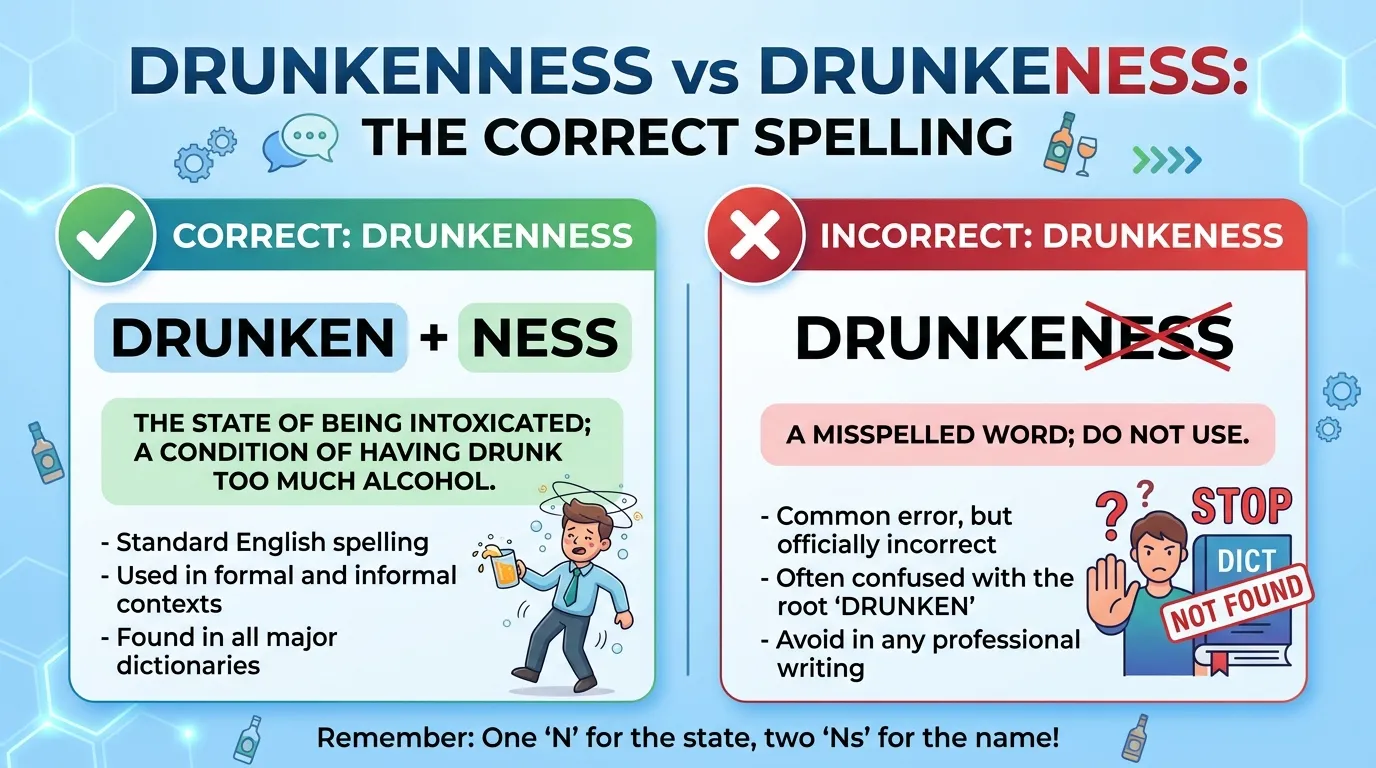
The confusion is understandable because drunkenness contains several consonants close together, and English spelling does not always make it obvious when a suffix such as -ness is added to a word. The correct form is built from drunken + ness, giving drunkenness.
In this guide, you will learn the meaning of drunkenness, why drunkeness is incorrect, how to pronounce the word, how it differs from related terms such as drunk, intoxication, and inebriation, and how to use it naturally in American and British English. You will also see common mistakes, practical examples, synonyms, antonyms, collocations, formal alternatives, and answers to common spelling questions.
Quick Answer
Drunkenness is the correct spelling.
Drunkeness is incorrect and should not be used in standard English.
| Spelling | Correct? | Meaning |
|---|---|---|
| drunkenness | ✅ Yes | The state or condition of being drunk |
| drunkeness | ❌ No | Misspelling of drunkenness |
Example
Correct: His drunkenness caused problems at work.
Incorrect: His drunkeness caused problems at work.
The word drunkenness is a noun. It refers to the state, condition, or behavior associated with being drunk, especially when alcohol has caused noticeable impairment.
Drunkenness vs Drunkeness: The Main Difference
There is only one important spelling difference between the two forms:
- Drunkenness has two n’s after the e: drunkenness.
- Drunkeness drops one of those n’s and is therefore misspelled.
The correct construction is:
drunken + ness = drunkenness
The base word drunken already ends in n, and the suffix -ness begins with n. Both letters remain.
Correct spelling breakdown
drunken + ness → drunkenness
Not:
drunken + ess → drunkeness
This is the key spelling rule to remember.
What Does Drunkenness Mean?
Drunkenness means the condition of being drunk or intoxicated, usually because of consuming too much alcohol.
It can describe both the physical condition and the behavior connected with intoxication.
For example:
The officer noticed signs of drunkenness.
Here, drunkenness refers to the person’s state of intoxication.
It can also describe repeated or noticeable behavior:
His drunkenness was becoming a serious concern for his family.
In this sentence, the word refers not simply to being drunk once but to a pattern or condition that is causing concern.
Dictionary-style definition
Drunkenness
Part of speech: Noun
Definition: The state or condition of being drunk, especially as a result of excessive alcohol consumption.
Simple meaning
If someone is drunk, their condition can be described as drunkenness.
For example:
- He was drunk.
- His drunkenness was obvious.
The first sentence describes the person.
The second sentence names the condition.
Why Is Drunkeness a Common Spelling Mistake?
People often write drunkeness because the pronunciation can make the spelling difficult to remember.
The word looks as if it might be formed by simply adding a shortened version of -ness to drunken. However, the suffix is -ness, so the final n in drunken and the initial n in -ness remain together.
This creates:
drunken + ness
→ drunkenness
Similar spelling patterns occur in many English words.
Compare these examples
- kind + ness = kindness
- dark + ness = darkness
- weak + ness = weakness
- happy + ness = happiness
- drunken + ness = drunkenness
The last example is unusual because the base word already ends in n, producing the sequence nn.
That double n is what writers often forget.
Drunkenness vs Drunkeness: Spelling Rule
A useful way to understand the spelling is to identify the suffix.
The suffix -ness turns an adjective into a noun expressing a state, quality, or condition.
Examples include:
- kind → kindness
- sad → sadness
- dark → darkness
- ill → illness
- aware → awareness
- drunken → drunkenness
Because the suffix is spelled n-e-s-s, the final n of drunken remains.
Therefore:
drunken + ness = drunkenness
The spelling drunkeness does not follow this construction.
Is Drunkenness a Word?
Yes. Drunkenness is a standard English word.
It is a noun formed from the adjective drunken with the suffix -ness.
It appears in formal writing, journalism, legal discussions, literature, historical writing, and everyday English.
However, it can sound somewhat formal depending on the context. In casual conversation, speakers often use being drunk, intoxication, or being intoxicated instead.
Examples
Formal:
The report described the effects of chronic drunkenness.
Everyday:
His being drunk caused an argument.
Medical or professional:
The symptoms were consistent with alcohol intoxication.
All three can refer to related ideas, but their tone and context differ.
Is Drunkeness Ever Correct?
No.
Drunkeness is not the standard spelling of the noun.
If you are writing an essay, article, report, email, academic paper, business document, or professional publication, use drunkenness.
Incorrect
The consequences of drunkeness can be serious.
Correct
The consequences of drunkenness can be serious.
If a spelling checker marks drunkeness as an error, it is identifying a genuine spelling mistake.
Drunkenness vs Drunk
Although drunkenness and drunk are related, they do not serve the same grammatical function.
Drunk can function as an adjective or noun.
Drunkenness is a noun.
| Word | Part of speech | Basic meaning |
|---|---|---|
| drunk | Adjective | Intoxicated |
| drunken | Adjective | Characterized by or affected by being drunk |
| drunkenness | Noun | The state or condition of being drunk |
| drink | Verb/Noun | To consume a liquid or an alcoholic beverage |
| intoxication | Noun | The state of being affected by a substance |
| inebriation | Noun | Formal term for intoxication |
Compare
He was drunk.
This describes his condition.
His drunkenness was obvious.
This names the condition.
The incident involved alcohol intoxication.
This uses a more formal or professional expression.
Drunken vs Drunkenness
These two words are closely connected but have different grammatical roles.
Drunken
Drunken is an adjective.
It describes a person, action, state, or behavior associated with being drunk.
Examples:
- drunken behavior
- drunken argument
- drunken driver
- drunken celebration
- drunken mistake
- drunken speech
Drunkenness
Drunkenness is a noun.
It names the condition or state.
Examples:
- signs of drunkenness
- problems caused by drunkenness
- excessive drunkenness
- public drunkenness
- drunkenness and disorderly behavior
Easy memory trick
Think:
drunken = describes
drunkenness = names the condition
That distinction can help you choose the correct form quickly.
Pronunciation of Drunkenness
Drunkenness is generally pronounced approximately:
DRUNK-en-ness
The pronunciation is straightforward once the word is divided into three parts:
drunk + en + ness
The final -ness sounds like the ending in:
- kindness
- darkness
- sadness
- weakness
The pronunciation does not justify dropping the second n in spelling.
This is a common feature of English: spelling and pronunciation do not always match perfectly.
Is Drunkenness Formal or Informal?
Drunkenness is a standard word, but it can sound more formal or serious than being drunk.
Casual conversation
He got drunk at the party.
Neutral writing
His drunkenness caused problems.
Formal writing
The report examined the social effects of alcohol-related drunkenness.
Professional or technical writing
The patient presented with signs of acute alcohol intoxication.
The best choice depends on the audience and purpose.
American English vs British English
The spelling drunkenness is standard in both American and British English.
There is no major regional spelling difference between American and British English for this word.
Both varieties use:
drunkenness
Not:
drunkeness
The differences are more likely to involve vocabulary and preferred expressions rather than the spelling itself.
For example, American and British writers may use terms such as drunk, intoxicated, alcohol intoxication, or inebriated with different frequencies depending on context.
But the spelling remains drunkenness.
Drunkenness in Formal Writing
In formal writing, drunkenness can be useful when you need a noun describing a state or condition.
Academic writing
Researchers have examined the relationship between alcohol consumption and drunkenness.
Journalistic writing
Police reported several incidents involving public drunkenness.
Legal writing
The law addresses certain forms of public drunkenness and disorderly conduct.
Historical writing
The novel portrays drunkenness as a recurring social problem.
However, writers should choose precise terminology. If the subject is a medical condition, alcohol intoxication may be more appropriate than the broader word drunkenness.
Drunkenness in Casual Writing
In casual communication, drunkenness may sound slightly stiff.
A person might naturally say:
He was really drunk.
rather than:
He was experiencing drunkenness.
Similarly:
She got drunk at the celebration.
sounds more conversational than:
She experienced drunkenness at the celebration.
Neither is necessarily wrong. The difference is primarily one of style, register, and naturalness.
Natural vs Awkward Examples
Understanding how native speakers use the word can make your writing sound more natural.
| Awkward or less natural | More natural |
|---|---|
| He showed drunkenness last night. | He was drunk last night. |
| Her drunkenness was very drunk. | Her drunkenness was obvious. |
| They experienced drunkenness after drinking. | They became intoxicated after drinking. |
| The man’s drunkenness caused an argument. | The man’s drunkenness caused an argument. |
| Drunkeness is dangerous. | Drunkenness can be dangerous. |
The last example demonstrates the spelling issue directly.
Common Collocations With Drunkenness
A collocation is a combination of words that commonly appear together.
Learning common collocations can help you use drunkenness naturally.
Common examples include:
- public drunkenness
- excessive drunkenness
- signs of drunkenness
- effects of drunkenness
- alcohol-related drunkenness
- drunkenness and disorderly conduct
- drunkenness and violence
- chronic drunkenness
- episodes of drunkenness
- consequences of drunkenness
- behavior associated with drunkenness
- problems caused by drunkenness
Example sentences
The police arrested him for public drunkenness.
The article discusses the effects of excessive drunkenness.
The teacher noticed signs of drunkenness during the incident.
The report examined alcohol-related drunkenness among adults.
These combinations sound natural because drunkenness commonly appears in discussions about behavior, alcohol, law, and social consequences.
Common Phrases and Expressions Related to Drunkenness
English has many expressions related to being drunk.
Some are neutral:
- be drunk
- be intoxicated
- be under the influence
- drink too much
- consume too much alcohol
Some are informal:
- get drunk
- get wasted
- be tipsy
- be hammered
- be plastered
Informal expressions should be used carefully because they can sound inappropriate in academic, professional, medical, or legal writing.
Formal alternatives
Instead of:
He was wasted.
A formal report might say:
He appeared to be severely intoxicated.
Instead of:
She got really drunk.
A professional description might say:
She appeared to be significantly affected by alcohol.
Synonyms for Drunkenness
The best synonym depends on context.
Common synonyms
- intoxication
- inebriation
- inebriety
- alcohol intoxication
- being drunk
- drunken behavior
These words are not perfect substitutes in every sentence.
Intoxication
Intoxication is broader and more formal. It can refer to impairment caused by alcohol, drugs, or another substance.
Inebriation
Inebriation is a formal word meaning a state of being drunk.
Inebriety
Inebriety is an older or more formal term associated with habitual drunkenness or intoxication. It is much less common in everyday modern English.
Being drunk
This is simple and natural in conversation.
His being drunk caused the problem.
However, depending on the sentence, rewriting it as his drunkenness may be smoother.
Antonyms and Contrasting Terms
There is no single perfect opposite of drunkenness, but several words describe a contrasting state.
Possible contrasts include:
- sobriety
- soberness
- clear-headedness
- alertness
- temperance
- moderation
Example
The program encouraged sobriety and responsible decision-making.
Sobriety is especially useful as a contrast to drunkenness because it refers to the state of not being intoxicated.
Word History and Etymology
The word drunkenness is built from the older English adjective drunken and the noun-forming suffix -ness.
The word drunken is historically related to drink and the older forms of the verb associated with consuming liquids and becoming intoxicated.
English has long used the suffix -ness to turn adjectives into nouns describing states or qualities.
For example:
- dark → darkness
- kind → kindness
- weak → weakness
- drunken → drunkenness
The spelling therefore reflects its word formation.
Understanding this structure makes drunkenness easier to remember.
The Grammar of Drunkenness
Drunkenness is a common noun.
It can appear as the subject or object of a sentence.
As a subject
Drunkenness can affect judgment.
As an object
The report discussed drunkenness.
After a preposition
The consequences of drunkenness can be serious.
With an adjective
Excessive drunkenness may lead to unsafe behavior.
Because drunkenness is normally treated as an uncountable concept when referring to the condition generally, it usually does not need an article.
For example:
Drunkenness can impair judgment.
However, context can allow different constructions when referring to particular episodes or instances.
Common Mistakes With Drunkenness
Mistake 1: Writing drunkeness
❌ Drunkeness
✅ Drunkenness
The second n is required.
Mistake 2: Writing drunkennesss
❌ Drunkennesss
✅ Drunkenness
The word ends with -ness, which contains only one final s after the preceding s? More precisely, the ending is spelled n-e-s-s, so the word ends in ss, not sss.
Mistake 3: Confusing drunken with drunkenness
❌ His drunkenness behavior was inappropriate.
✅ His drunken behavior was inappropriate.
Or:
✅ His drunkenness was concerning.
Use drunken as an adjective and drunkenness as a noun.
Mistake 4: Using intoxication and drunkenness as exact equivalents
They overlap, but intoxication is broader.
A person can be intoxicated by substances other than alcohol, while drunkenness usually refers specifically to being drunk.
Drunkenness vs Intoxication
These terms are related but not identical.
| Feature | Drunkenness | Intoxication |
|---|---|---|
| Basic meaning | State of being drunk | State of being affected by a substance |
| Usually associated with alcohol | Yes | Not necessarily |
| Formality | Neutral to formal | More formal |
| Medical usage | Less precise | Common |
| Legal usage | Common in some contexts | Common |
| Everyday conversation | Less common | Moderate |
Example
His drunkenness was obvious.
This strongly suggests alcohol.
The patient showed signs of intoxication.
This does not necessarily identify alcohol as the cause.
Drunkenness vs Inebriation
Inebriation is a formal synonym for drunkenness.
Compare:
His drunkenness was apparent.
His inebriation was apparent.
Both can work, but drunkenness is generally easier for a broad audience to understand.
For plain-language writing, choose drunkenness or being drunk.
For formal writing, inebriation may sometimes fit better.
Is Drunkenness a Negative Word?
Usually, drunkenness carries a negative or serious tone.
This is because the word often appears when discussing:
- impaired judgment
- unsafe behavior
- social problems
- alcohol misuse
- legal incidents
- health concerns
- public disorder
- relationship problems
However, the word itself is not inherently insulting.
Its tone depends on context.
Neutral
The study examined patterns of drunkenness among adults.
Negative
His repeated drunkenness damaged his relationships.
Historical
The novel presents drunkenness as a common social issue of the period.
Political, Legal, and Public Usage
The word can appear in discussions of public policy and law, especially in phrases such as public drunkenness.
For example:
The article examined changing laws concerning public drunkenness.
In this context, the word is not slang. It is a formal term describing a particular type of behavior or condition.
Political writing may also discuss alcohol regulation, public safety, addiction policy, and social consequences. In such contexts, more precise terms such as alcohol misuse, alcohol-related harm, or alcohol intoxication may be preferred when the writer wants to avoid broad or judgmental language.
Sports Usage
Drunkenness is not a common technical sports term.
Sports journalism is more likely to use phrases such as:
- drinking
- alcohol consumption
- intoxication
- being under the influence
- alcohol-related incident
For example:
The athlete was suspended following an alcohol-related incident.
This is often more precise than saying:
The athlete was suspended because of drunkenness.
The latter is grammatical but may sound less neutral.
Technical and Medical Usage
In medical and scientific writing, drunkenness is generally less precise than alcohol intoxication.
Medical professionals may need to describe symptoms, blood alcohol concentration, impairment, or the effects of a substance.
Therefore, if you are writing technical content, consider whether intoxication, alcohol-related impairment, or another specific term communicates the meaning more accurately.
For general audiences, however, drunkenness remains understandable and useful.
Business and Professional Writing
In workplace communication, avoid casual expressions such as:
- wasted
- smashed
- hammered
- plastered
If the issue must be described professionally, use precise and neutral language.
Casual
He came to work drunk.
More professional
He appeared to be impaired by alcohol.
Formal
The employee appeared to be under the influence of alcohol.
The word drunkenness may work in a formal discussion, but professional writing should prioritize accuracy and neutral wording.
Academic Writing
In academic writing, drunkenness is acceptable, particularly in studies involving alcohol, sociology, history, literature, public policy, or social behavior.
Examples:
The research examined the relationship between alcohol consumption and episodes of drunkenness.
Historical accounts frequently describe public drunkenness as a social concern.
However, academic writers should define terms when precision matters.
If a study measures a specific clinical condition, alcohol intoxication may be a better technical term.
Journalism and Blogging
For general readers, drunkenness can be useful because it is widely understandable.
However, journalists and bloggers should avoid using it repeatedly.
Instead of writing:
Drunkenness can cause problems. Drunkenness can affect relationships. Drunkenness can create legal problems.
Vary the language naturally:
Excessive alcohol consumption can create serious problems. Intoxication can affect judgment, while repeated alcohol misuse may damage relationships.
This improves readability without resorting to keyword stuffing.
Memory Tricks for Spelling Drunkenness
Here are several simple ways to remember the correct spelling.
Trick 1: Break it into two words
Think:
drunken + ness
That gives:
drunkenness
Trick 2: Remember the double N
The word contains:
…n + n…
So:
drunkenness
not:
drunkeness
Trick 3: Compare it with kindness
You know:
kind + ness = kindness
Apply the same structure:
drunken + ness = drunkenness
Trick 4: Remember that -ness starts with N
The suffix is:
N-E-S-S
Therefore, the final n in drunken meets the first n in -ness.
Everyday Examples of Drunkenness
Here are natural examples across different contexts.
Everyday
His drunkenness became obvious after several drinks.
Family context
The family was concerned about his repeated drunkenness.
Legal context
The case involved allegations of public drunkenness.
Academic context
The paper examines cultural attitudes toward drunkenness.
Historical context
The diary contains several references to drunkenness.
Journalistic context
The incident raised concerns about alcohol-related drunkenness at public events.
Formal context
The organization developed policies addressing alcohol misuse and drunkenness.
Formal vs Informal Alternatives
| Situation | Natural choice |
|---|---|
| Casual conversation | being drunk |
| General writing | drunkenness |
| Formal writing | drunkenness |
| Medical writing | alcohol intoxication |
| Legal writing | intoxication or public drunkenness |
| Academic writing | drunkenness or alcohol intoxication |
| Business writing | alcohol-related impairment |
| Journalism | intoxication, alcohol-related incident |
| Informal slang | wasted, hammered, plastered |
The important lesson is that correct spelling does not automatically mean the word is the best stylistic choice.
Good writing considers both correctness and context.
Frequently Asked Questions
Is drunkenness or drunkeness correct?
Drunkenness is correct. Drunkeness is a misspelling. The correct word contains two consecutive n’s where drunken meets the suffix -ness.
How do you spell drunkenness?
The correct spelling is:
D-R-U-N-K-E-N-N-E-S-S
A useful breakdown is:
drunken + ness = drunkenness
What does drunkenness mean?
Drunkenness means the state or condition of being drunk or intoxicated, usually because of consuming too much alcohol.
Why do people spell drunkenness as drunkeness?
The mistake usually happens because writers forget that -ness begins with n. When it is added to drunken, the two n’s remain: drunken + ness = drunkenness.
Is drunkenness a noun?
Yes. Drunkenness is a noun. It names the condition or state of being drunk.
For example:
His drunkenness caused concern.
What is the difference between drunk and drunkenness?
Drunk usually describes a person’s condition, while drunkenness names the condition itself.
He was drunk.
His drunkenness was obvious.
Is drunkenness formal or informal?
Drunkenness is a standard English word and can be used in formal writing. In casual conversation, being drunk or getting drunk is often more natural.
Is drunkenness used in American English?
Yes. Drunkenness is standard in American English and British English. There is no major regional spelling difference between the two varieties.
What is a synonym for drunkenness?
Common synonyms include intoxication, inebriation, and being drunk. The best choice depends on context and level of formality.
Is drunkeness ever an acceptable spelling?
No. Drunkeness is not the standard spelling. In edited English, use drunkenness.
Final Takeaway: Drunkenness vs Drunkeness
The difference between drunkenness vs drunkeness is simple once you understand how the word is formed.
Drunkenness is the correct spelling. Drunkeness is a spelling error.
The word comes from drunken + -ness, and the final n in drunken combines with the initial n in -ness. That produces the double n in drunkenness.
Remember these key points:
- Drunkenness is correct.
- Drunkeness is incorrect.
- Drunkenness is a noun.
- It means the state or condition of being drunk.
- Drunken is an adjective.
- Drunk commonly describes a person’s condition.
- Intoxication is a broader and more formal term.
- Inebriation is a formal synonym for drunkenness.
- American and British English both use drunkenness.
- For casual writing, being drunk may sound more natural.
- For medical or technical writing, alcohol intoxication may be more precise.
- In every standard context, spell the word drunkenness, with the double n.
If you are ever unsure, use the simple memory formula:
drunken + ness = drunkenness
That one spelling pattern will help you avoid the common drunkeness mistake in essays, articles, reports, professional writing, and everyday communication.


