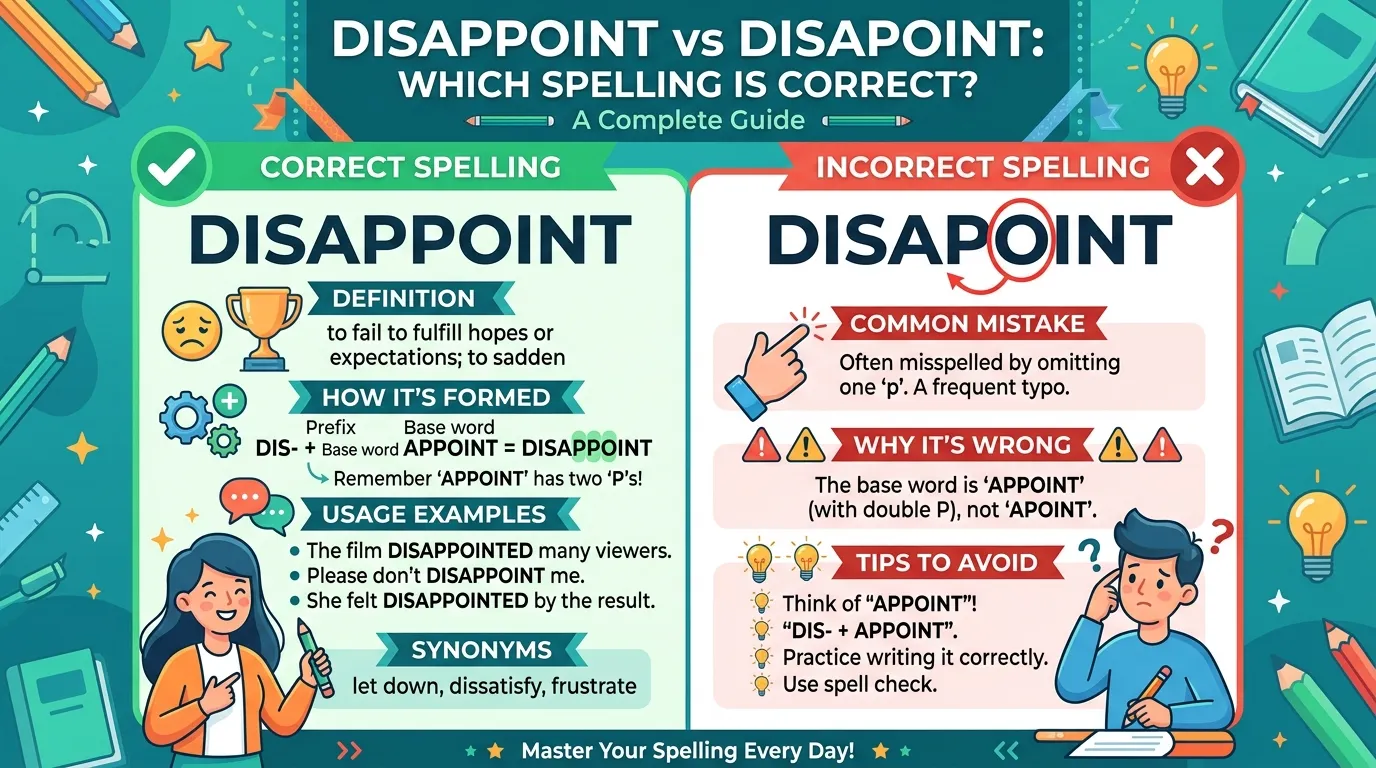
Have you ever typed disapoint and wondered whether it is a correct spelling? You are not alone. The words disappoint and disapoint look almost identical, so it is easy to leave out one of the repeated letters when writing quickly.
The important answer is simple: disappoint is the correct standard English spelling. Disapoint is a misspelling.
The correct verb is disappoint, spelled D-I-S-A-P-P-O-I-N-T. It means to fail to meet someone’s expectations or hopes. For example, you can say, I don’t want to disappoint my parents.
The spelling can be confusing because the pronunciation does not clearly reveal the double p. English also contains many words where repeated consonants are easy to overlook.
In this guide, you will learn the difference between disappoint vs disapoint, the meaning and pronunciation of disappoint, its grammatical forms, word history, common collocations, synonyms and antonyms, examples in everyday and professional English, and easy ways to remember the correct spelling.
Quick Answer: Disappoint or Disapoint?
Disappoint is the correct spelling.
Disapoint is incorrect in standard English.
| Spelling | Correct? | Meaning |
|---|---|---|
| disappoint | ✅ Yes | To fail to meet someone’s expectations |
| disapoint | ❌ No | Misspelling of disappoint |
Correct example
I hope I don’t disappoint you.
Incorrect example
I hope I don’t disapoint you.
The key spelling pattern is:
dis + appoint = disappoint
The word contains two p’s:
D-I-S-A-P-P-O-I-N-T
A useful memory trick is to remember that disappoint contains the complete word appoint after dis:
dis + appoint → disappoint
What Does Disappoint Mean?
Disappoint is a verb meaning to cause someone to feel unhappy because something did not happen as expected, hoped for, or desired.
For example:
- The movie disappointed me.
- I don’t want to disappoint my family.
- The team’s performance disappointed its fans.
- She was disappointed with the result.
- The product failed to meet expectations, so customers were disappointed.
The word usually involves a difference between expectation and reality.
Someone expects one outcome, but the actual result is worse, less exciting, or less satisfying.
Dictionary-style definition
Disappoint (verb): To fail to satisfy someone’s expectations, hopes, wishes, or needs.
It can also mean to let someone down by failing to do what they expected you to do.
Why Is Disapoint Incorrect?
Disapoint is simply a spelling error.
The standard English word contains two p’s:
disappoint
Many writers accidentally remove one of them:
disapoint ❌
This happens because the word is pronounced naturally rather than letter by letter. When people hear disappoint, the repeated p sound is not always obvious.
Another reason is that English spelling does not always make doubled consonants predictable.
Compare:
- disappoint
- appointment
- appoint
- appointed
- disappointing
All of these words retain the double p.
The easiest spelling rule
Think of the word as:
DIS + APPOINT
Since appoint already contains two p’s, disappoint keeps them.
- appoint ✅
- disappoint ✅
- appointment ✅
- disappointing ✅
- disappointed ✅
- disapoint ❌
Disappoint vs Disapoint: The Main Difference
There is no difference in meaning between the two spellings because disapoint is not a standard English word.
The real distinction is:
Disappoint = correct spelling
Disapoint = incorrect spelling
If you are writing an email, school assignment, article, report, resume, business document, or social media post, use disappoint.
How Do You Spell Disappoint?
The correct spelling is:
D-I-S-A-P-P-O-I-N-T
Break it into two parts:
DIS + APPOINT
This gives you:
DISAPPOINT
Notice the double P in the middle.
Related forms
| Word | Correct spelling |
|---|---|
| Base verb | disappoint |
| Third-person singular | disappoints |
| Past tense | disappointed |
| Past participle | disappointed |
| Present participle | disappointing |
| Noun | disappointment |
Examples:
- I don’t want to disappoint you.
- He often disappoints his supporters.
- The result disappointed everyone.
- She was disappointed by the decision.
- The ending was disappointing.
- His disappointment was obvious.
What Is the Pronunciation of Disappoint?
In American English, disappoint is commonly pronounced approximately:
/ˌdɪsəˈpɔɪnt/
It sounds roughly like:
dis-uh-POINT
The main stress falls on point.
The pronunciation can contribute to spelling mistakes because the double p is not pronounced as two separate sounds.
You do not say:
dis-ap-p-p-point
Instead, the word flows naturally as:
disappoint
Pronunciation breakdown
- dis → /dɪs/
- appoint → /əˈpɔɪnt/
- disappoint → /ˌdɪsəˈpɔɪnt/
The spelling contains two p’s, even though the pronunciation does not make them sound like two separate consonants.
Is Disappoint a Verb?
Yes. Disappoint is a verb.
It describes an action or effect involving unmet expectations.
Examples
- Don’t disappoint your team.
- The low score disappointed him.
- The concert disappointed many fans.
- We don’t want to disappoint our customers.
- Her decision disappointed her friends.
The verb can be used with a direct object:
disappoint + person
For example:
The news disappointed Sarah.
It can also appear in passive constructions:
Sarah was disappointed by the news.
Disappoint, Disappointed, and Disappointing
These three forms are closely related but do not function in exactly the same way.
Disappoint
Disappoint is the base verb.
I don’t want to disappoint you.
Disappointed
Disappointed usually describes how a person feels after expectations are not met.
I was disappointed with the result.
It can also describe someone affected by an event:
The disappointed fans left the stadium.
Disappointing
Disappointing describes something that causes disappointment.
The result was disappointing.
A useful distinction is:
People feel disappointed.
Things are disappointing.
For example:
I was disappointed by the movie.
The movie was disappointing.
This is not an absolute rule in every grammatical construction, but it is an excellent guideline for everyday English.
Disappoint vs Disappointed
These words are sometimes confused because they are related.
| Word | Part of speech | Example |
|---|---|---|
| disappoint | Verb | I don’t want to disappoint you. |
| disappointed | Adjective/past participle | She felt disappointed. |
Compare:
The news disappointed me.
and:
I was disappointed by the news.
The first sentence focuses on what caused the emotional reaction. The second focuses on the person’s emotional state.
Disappoint vs Disappointing
The difference is similar.
Disappoint is a verb.
Disappointing describes something that causes disappointment.
Examples:
The team may disappoint its fans.
The team’s performance was disappointing.
I don’t want to disappoint my teacher.
The final grade was disappointing.
Disappoint vs Disappointment
These words have different grammatical roles.
Disappoint is a verb.
Disappointment is a noun.
Examples:
I don’t want to disappoint you.
The result was a disappointment.
She didn’t want to disappoint her parents.
His disappointment was easy to see.
The noun disappointment refers to the feeling or experience resulting from unmet expectations.
Common Collocations With Disappoint
A collocation is a combination of words that commonly appear together.
Common expressions include:
- disappoint someone
- disappoint your parents
- disappoint your family
- disappoint your friends
- disappoint your fans
- disappoint customers
- disappoint supporters
- disappoint the public
- disappoint expectations
- disappoint someone greatly
- deeply disappoint someone
- seriously disappoint someone
- never disappoint
- don’t disappoint me
Examples in natural English
I don’t want to disappoint my parents.
The restaurant rarely disappoints its customers.
The player did not disappoint his fans.
The final episode disappointed many viewers.
We hope the new product doesn’t disappoint customers.
Does Disappoint Mean Let Someone Down?
Often, yes.
Let someone down is a common informal expression that can mean to disappoint someone.
Compare:
I don’t want to disappoint you.
I don’t want to let you down.
Both can communicate a similar idea.
However, let someone down can sound more personal and conversational, while disappoint works comfortably in both everyday and formal writing.
Example
Casual:
I promised to help, and I don’t want to let you down.
Neutral:
I promised to help, and I don’t want to disappoint you.
Formal:
I do not wish to disappoint you or fail to meet your expectations.
Disappoint vs Fail
These words overlap, but they are not identical.
Fail generally means not succeeding or not achieving a desired result.
Disappoint emphasizes the emotional effect of an unmet expectation.
For example:
I failed the exam.
This tells us that the person did not pass.
I disappointed my parents by failing the exam.
This tells us about the effect of the failure on the parents.
Something can also fail without disappointing anyone.
For example:
The experiment failed, but the researchers expected that possibility.
In this situation, the failure may not have been disappointing because nobody expected success.
Synonyms for Disappoint
Depending on the context, useful synonyms include:
- let down
- dishearten
- discourage
- upset
- frustrate
- displease
- dissatisfy
- disillusion
- underwhelm
- fail
- frustrate expectations
However, these words are not always interchangeable.
Disappoint vs Dishearten
Dishearten emphasizes loss of confidence, hope, or courage.
The defeat disheartened the players.
Disappoint vs Frustrate
Frustrate often means preventing someone from achieving a goal.
The delay frustrated the travelers.
Disappoint vs Underwhelm
Underwhelm means to fail to impress someone because something is less impressive than expected.
The new restaurant underwhelmed us.
Disappoint vs Dissatisfy
Dissatisfy focuses on failing to provide the level of satisfaction someone expects.
The service failed to satisfy the customer.
Antonyms of Disappoint
Common opposites include:
- satisfy
- please
- impress
- delight
- encourage
- fulfill
- exceed expectations
- reassure
For example:
The performance disappointed the audience.
Opposite:
The performance delighted the audience.
Another example:
The product disappointed customers.
Opposite:
The product exceeded customer expectations.
Formal and Informal Alternatives
The best alternative depends on context.
| Context | Natural wording |
|---|---|
| Casual conversation | let down |
| General writing | disappoint |
| Business | fail to meet expectations |
| Academic | fail to satisfy expectations |
| Journalism | fall short of expectations |
| Customer service | fail to meet customer expectations |
| Personal message | let you down |
| Formal statement | fail to meet the anticipated standard |
Business example
Instead of:
We are sorry to disappoint our customers.
You might write:
We apologize for failing to meet our customers’ expectations.
Both are correct, but the second sounds more formal.
Disappoint in Business Writing
Disappoint is perfectly acceptable in professional English.
Examples:
We understand that this delay may disappoint our customers.
The company does not want to disappoint its investors.
The latest results disappointed analysts.
The new service failed to meet expectations.
In business journalism, disappoint is especially common when discussing financial results.
For example:
The company’s quarterly earnings disappointed investors.
This means the earnings were lower or weaker than investors expected.
Disappoint in Academic Writing
The word is grammatically correct in academic writing, but the best choice depends on the subject.
Academic writers often use more precise phrases such as:
- fail to meet expectations
- produce an unexpected result
- fall short of expectations
- fail to satisfy the criteria
- produce a less favorable outcome
For example:
The results disappointed researchers.
This is understandable and grammatical.
A more formal version could be:
The results fell short of the researchers’ expectations.
The second version is often more precise in formal academic prose.
Disappoint in Journalism
Journalists frequently use disappoint when describing results that were weaker than expected.
Examples:
The latest sales figures disappointed investors.
The team’s performance disappointed supporters.
The film disappointed audiences despite strong early reviews.
In journalism, the word is useful because it efficiently communicates a gap between expectations and actual results.
Disappoint in Sports
Sports writing often uses disappoint to describe a poor performance or an unexpected loss.
Examples:
The team disappointed its home crowd.
The striker disappointed fans with his performance.
The defending champions disappointed supporters after an early exit.
The players did not disappoint their coach.
Another common expression is:
fall short of expectations
For example:
The team fell short of expectations this season.
This has a similar meaning but sounds slightly more analytical.
Disappoint in Casual Conversation
In everyday speech, disappoint is very common.
Examples:
I hope I don’t disappoint you.
Don’t disappoint me!
The movie really disappointed me.
I was disappointed with the food.
That answer disappointed me.
For a more casual tone, speakers may use:
You let me down.
That was a letdown.
I expected more.
These expressions can sound more conversational.
Common Spelling Mistakes With Disappoint
Here are some frequent errors.
Mistake: disapoint
❌ The result will disapoint many people.
✅ The result will disappoint many people.
Mistake: dissapoint
❌ I don’t want to dissapoint my family.
✅ I don’t want to disappoint my family.
Notice that the correct word begins with dis-, not diss-.
Mistake: dissappoint
❌ The movie might dissappoint viewers.
✅ The movie might disappoint viewers.
The correct spelling has one s and two p’s.
Correct spelling pattern
D I S A P P O I N T
Remember:
one S + two P’s
Disappoint vs Dissapoint
Another common misspelling is dissapoint.
The correct spelling is still:
disappoint
Not:
- disapoint ❌
- dissapoint ❌
- dissappoint ❌
The word contains:
DIS + APPOINT
That gives you:
DISAPPOINT
How to Remember the Spelling of Disappoint
Several memory tricks can help.
Remember the word appoint
The easiest method is:
dis + appoint = disappoint
Since appoint has two p’s, disappoint has two p’s.
Remember “one S, two P’s”
Write:
DIS + APPOINT
Think:
1 S + 2 P’s
Connect it with appointment
If you know how to spell appointment, you already know the difficult part of disappoint.
- appoint
- appointment
- disappoint
- disappointment
All retain the double p.
Word History and Etymology of Disappoint
The history of disappoint helps explain why the word looks the way it does.
The word developed in English from dis-, a prefix often expressing reversal, removal, or negation, combined with appoint.
The verb appoint historically relates to setting, arranging, deciding, or assigning something.
Over time, disappoint developed the sense of frustrating an expectation or preventing an anticipated outcome.
This historical connection is another reason the spelling disappoint is logical:
dis- + appoint
The double p is inherited from appoint.
Literal and Figurative Uses of Disappoint
The most common modern meaning is emotional or figurative: failing to satisfy expectations.
For example:
The restaurant disappointed us.
A restaurant cannot literally experience disappointment. Instead, the sentence means that the restaurant’s food, service, or overall experience failed to meet expectations.
Similarly:
The weather disappointed the organizers.
This means the weather was worse than expected and caused problems.
The verb is therefore commonly used in situations involving results, experiences, people, products, performances, and events.
Can a Thing Disappoint Someone?
Yes.
English frequently uses disappoint with things that cannot have intentions.
For example:
The movie disappointed me.
The weather disappointed us.
The results disappointed investors.
The product disappointed customers.
The meaning is that the thing failed to produce the expected result.
Awkward vs Natural Examples
Awkward
The movie was disappoint me.
Natural
The movie disappointed me.
Awkward
I am disappoint about the result.
Natural
I am disappointed about the result.
Awkward
The game was disappoint.
Natural
The game was disappointing.
Awkward
She doesn’t want to disapoint her parents.
Natural
She doesn’t want to disappoint her parents.
Awkward
His performance was very disappoint.
Natural
His performance was very disappointing.
American vs British English
There is no major American-British spelling difference between disappoint and disappoint.
Both American English and British English use:
disappoint
Both also use:
- disappointed
- disappointing
- disappointment
For example:
American English:
The result disappointed the fans.
British English:
The result disappointed the fans.
The spelling remains the same.
This is different from words such as color/colour or center/centre, where regional spelling conventions differ.
Is Disappoint Appropriate for International English?
Yes.
Disappoint is widely understood in international English and is safe for:
- websites
- business emails
- academic writing
- journalism
- educational content
- customer service
- professional communication
- social media
- everyday conversation
There is no reason to replace it simply because your audience includes speakers from different English-speaking regions.
Is Disappoint Appropriate in Technical Writing?
Yes, but precision may matter.
Technical writing often benefits from describing exactly what failed.
Instead of:
The system disappointed users.
A technical report might say:
The system failed to meet the required performance criteria.
Or:
The system did not meet the specified response-time target.
Disappoint is not wrong, but technical writing often favors measurable language over emotional wording.
Disappoint vs Fall Short
These expressions are closely related.
Disappoint emphasizes the effect of an unmet expectation.
Fall short emphasizes failing to reach a standard, goal, or expectation.
Compare:
The product disappointed customers.
The product fell short of customer expectations.
Both are natural.
The second may sound more analytical or professional.
Disappoint vs Underperform
Underperform is especially useful for business, sports, finance, and technical contexts.
The team disappointed its supporters.
The team underperformed this season.
The first focuses on people’s expectations and emotions.
The second focuses on performance relative to an expected standard.
Common Phrases With Disappoint
Some useful expressions include:
Don’t disappoint me
This can be encouraging, serious, or playful depending on tone.
You have worked hard. Don’t disappoint me now.
I don’t want to disappoint you
A polite way to express concern about failing to satisfy someone’s expectations.
I don’t want to disappoint you, but I can’t attend the event.
Never disappoints
This means something consistently produces a satisfying result.
This restaurant never disappoints.
Her performances never disappoint.
A disappointing result
A result that is worse than expected.
The team suffered a disappointing result.
Deeply disappointed
A stronger expression of disappointment.
The coach was deeply disappointed by the loss.
Frequently Asked Questions
Is “disapoint” a correct spelling?
No. Disapoint is a misspelling. The correct spelling is disappoint, with one s and two p’s.
How do you spell disappoint correctly?
Spell it:
D-I-S-A-P-P-O-I-N-T
A helpful way to remember it is dis + appoint.
What is the meaning of disappoint?
Disappoint means to fail to meet someone’s expectations, hopes, wishes, or needs.
For example:
I don’t want to disappoint my parents.
Is disappoint a verb?
Yes. Disappoint is a verb.
Example:
The poor result disappointed the team.
Its related forms include disappointed, disappointing, and disappointment.
What is the difference between disappoint and disappointed?
Disappoint is the verb, while disappointed usually describes a person’s emotional state.
The news disappointed me.
I was disappointed by the news.
What is the difference between disappoint and disappointing?
Disappoint is a verb, while disappointing describes something that causes disappointment.
The movie disappointed me.
The movie was disappointing.
Is disappoint spelled the same in American and British English?
Yes. Both American and British English use disappoint with the same spelling.
Why do people spell disappoint as disapoint?
People often omit the second p because the repeated consonant is not obvious in pronunciation. The correct spelling comes from dis + appoint, so the double p must remain.
What are synonyms for disappoint?
Common synonyms include let down, discourage, dishearten, frustrate, displease, dissatisfy, underwhelm, and fall short of expectations, although the exact meaning and tone can differ.
Final Verdict: Disappoint vs Disapoint
When choosing between disappoint vs disapoint, there is a clear winner:
Disappoint is correct.
Disapoint is incorrect.
The standard spelling is:
D-I-S-A-P-P-O-I-N-T
The best way to remember it is to break the word into:
DIS + APPOINT
Because appoint contains two p’s, disappoint does too.
The word is a common English verb meaning to fail to meet someone’s expectations or hopes. Its related forms are disappointed, disappointing, and disappointment.
There is no American-British spelling difference here. Disappoint is appropriate in both varieties of English and works in casual, professional, academic, journalistic, business, and general writing.
If you are writing an email, article, school assignment, report, social media post, or professional document, use disappoint rather than disapoint.
When in doubt, remember the simple formula:
DIS + APPOINT = DISAPPOINT
One S, two P’s—and you have the correct spelling.


