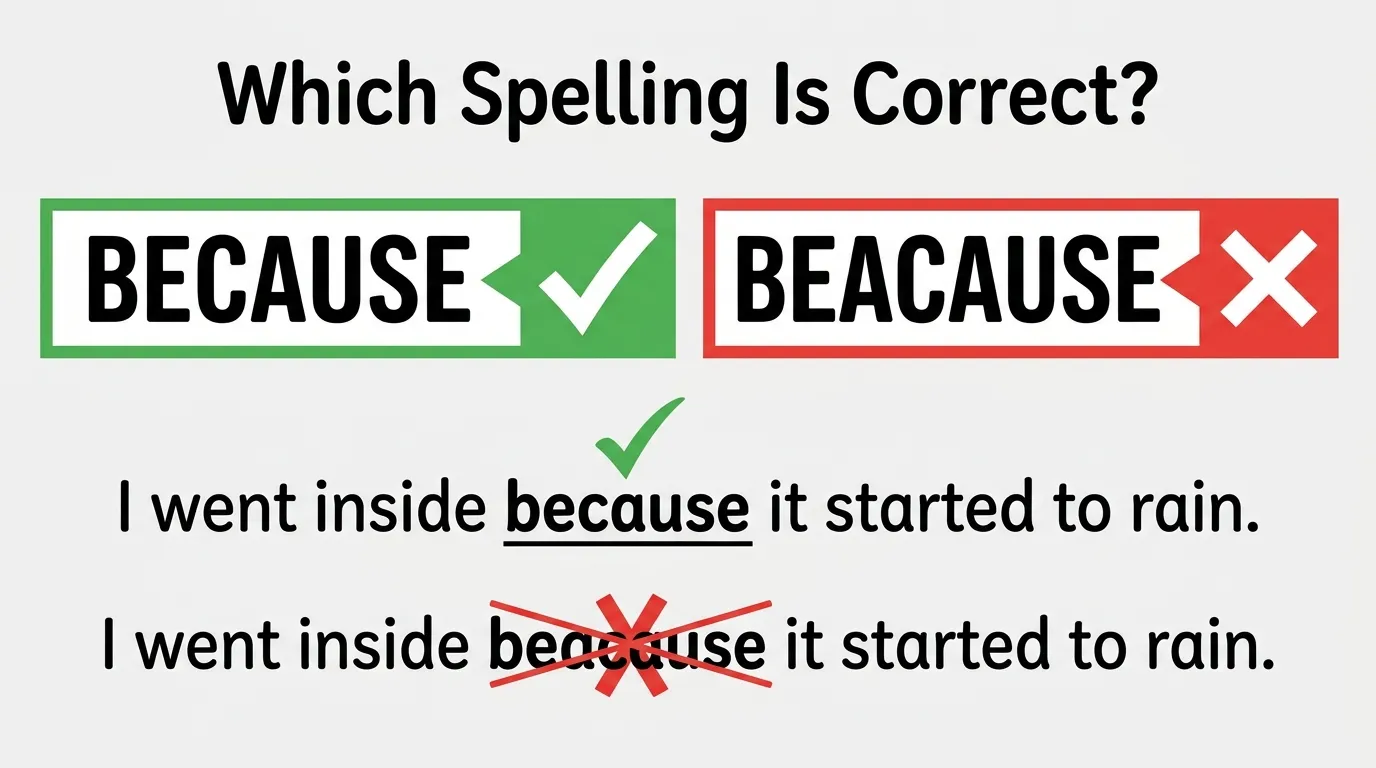
If you’ve ever typed beacause instead of because, you’re not alone. It’s one of the most common spelling mistakes in English. The simple answer is that because is the only correct spelling, while beacause is a misspelling.
Many people accidentally write beacause because English spelling is not always predictable. Fast typing, autocorrect errors, and confusion about vowel placement can all lead to this mistake.
In this guide, you’ll learn:
- The correct spelling and pronunciation
- Why people confuse because and beacause
- The meaning and grammar of because
- Easy memory tricks
- Common mistakes and corrections
- Real-life examples
- Formal and informal alternatives
- Tips for academic, business, and everyday writing
- Frequently asked questions
By the end, you’ll know exactly when and how to use because with confidence.
Quick Answer
| Word | Correct? | Meaning |
|---|---|---|
| Because | ✅ Yes | A conjunction used to give a reason or explanation. |
| Beacause | ❌ No | Incorrect spelling of because. |
Correct: I stayed home because it was raining.
Incorrect: I stayed home beacause it was raining.
Is It Because or Beacause?
The answer is simple.
The only correct spelling is because.
The word beacause does not appear in any standard English dictionary. It is simply a spelling error.
Whether you’re writing:
- school assignments
- emails
- blog posts
- business reports
- research papers
- text messages
you should always write because.
Dictionary Definition of Because
Because (conjunction)
Definition:
Used to introduce the reason why something happens or why something is true.
Examples
- We canceled the picnic because it started raining.
- She smiled because she got good news.
- I left early because I wasn’t feeling well.
Why Do People Spell It Beacause?
There are several reasons.
English Spelling Can Be Confusing
Many English words contain unexpected vowel combinations.
People often guess the spelling based on pronunciation.
For example:
- beautiful
- reason
- season
- speak
These words contain ea, so some writers mistakenly assume because should also include ea after the b.
Fast Typing
Typing quickly often causes letters to switch places.
Instead of:
because
people accidentally type:
beacause
This is one of the most common keyboard mistakes.
Pronunciation Confusion
Most native speakers pronounce because something like:
bih-KAWZ
or
bih-KUZ
Since the first syllable is reduced, people sometimes struggle to remember the exact spelling.
Pronunciation
Because
IPA (American English):
/bɪˈkɔz/
or
/bɪˈkʌz/
Pronunciation Breakdown
be + cause
Sounds approximately like:
bih-KAWZ
The spelling stays the same regardless of pronunciation.
Meaning of Because
The word because introduces a reason.
It answers the question:
Why?
Example:
Why did she leave?
Because she was tired.
Sentence:
She left because she was tired.
Grammatical Role of Because
Because is a subordinating conjunction.
It connects a dependent clause to an independent clause.
Example:
I stayed home because I felt sick.
Independent clause:
I stayed home.
Dependent clause:
because I felt sick.
Because vs Beacause Comparison Table
| Feature | Because | Beacause |
|---|---|---|
| Correct spelling | ✅ Yes | ❌ No |
| Dictionary word | Yes | No |
| Standard English | Yes | No |
| Academic writing | Yes | No |
| Business writing | Yes | No |
| Everyday writing | Yes | No |
| Formal English | Yes | No |
| Accepted worldwide | Yes | No |
Examples of Because in Everyday Sentences
Here are some natural examples.
- I smiled because you called.
- We arrived early because traffic was light.
- She studied hard because the exam was difficult.
- He laughed because the joke was funny.
- They canceled the trip because of bad weather.
- I exercise because it keeps me healthy.
- We ordered pizza because everyone was hungry.
- The game ended early because it started snowing.
- She apologized because she was late.
- I bought a new laptop because my old one stopped working.
Because in Different Types of Writing
Academic Writing
Because is commonly used to explain reasons.
Example:
Students performed better because they practiced consistently.
Business Writing
Example:
The meeting was postponed because several team members were unavailable.
Journalism
Example:
Roads were closed because flooding created dangerous conditions.
Technical Writing
Example:
The device overheated because the cooling system failed.
Blogging
Example:
I love this recipe because it’s simple and delicious.
Casual Conversation
Example:
I’m staying inside because it’s too hot.
Formal vs Informal Alternatives
Although because works almost everywhere, there are alternatives.
| Formal | Informal |
|---|---|
| Since | Because |
| As | Because |
| Due to the fact that | Because |
| Owing to | Because |
| Given that | Because |
Formal Example
The event was canceled owing to severe weather.
Natural Version
The event was canceled because of severe weather.
Usually, the second version sounds clearer.
Because vs Since
Many writers compare these words.
Because
Usually emphasizes the reason.
Example:
I left because I was tired.
Since
May indicate either time or reason.
Example:
Since it was raining, we stayed inside.
Because is usually clearer when expressing cause.
Because vs As
Both can introduce reasons.
Because
Because she practiced, she improved.
As
As she practiced regularly, she improved.
Because places stronger emphasis on the reason.
Because vs Due To
These expressions work differently.
Because
Because it rained, the game ended.
Due To
The cancellation was due to rain.
Although they express similar ideas, they follow different grammar rules.
Common Collocations with Because
These combinations appear frequently.
- because of
- because I said so
- because of this
- because of that
- because they wanted to
- simply because
- just because
- only because
- mainly because
- partly because
Common Expressions
Because of
Example:
The flight was delayed because of fog.
Just Because
Example:
Don’t buy something just because it’s on sale.
Because I Said So
Parents often use this expression.
Example:
Why can’t I stay up?
Because I said so.
Meaning of Because Of
Because of is a preposition.
It comes before a noun or noun phrase.
Examples:
because of traffic
because of rain
because of illness
Compare:
Correct:
We stayed home because it rained.
Correct:
We stayed home because of the rain.
Word History
The word because comes from Middle English.
It developed from the phrase:
by cause
Over time, these words merged into the modern spelling:
because
The spelling has remained stable for centuries.
Synonyms of Because
Depending on context:
- since
- as
- given that
- seeing that
- considering that
- for
- inasmuch as
Not every synonym fits every sentence, so choose carefully.
Antonyms
There is no perfect opposite of because, but opposite ideas include:
- despite
- although
- even though
- regardless of
- nevertheless
Example:
Because it rained, we stayed home.
Although it rained, we went hiking.
Related Words
- cause
- causal
- causation
- reason
- explanation
- therefore
- consequently
- thus
- hence
- accordingly
Common Mistakes
Mistake 1
❌ Beacause
✅ Because
Mistake 2
❌ Becuase
✅ Because
Mistake 3
❌ Becase
✅ Because
Mistake 4
❌ Beacuse
✅ Because
Mistake 5
❌ Becouse
✅ Because
Awkward vs Natural Examples
| Awkward or Incorrect | Natural Version |
|---|---|
| I left beacause I was tired. | I left because I was tired. |
| We stayed because of it was raining. | We stayed because it was raining. |
| Because of she was sick, she missed class. | Because she was sick, she missed class. |
| The event ended because of rain. | The event ended because of the rain. |
| I smiled because of you called. | I smiled because you called. |
Memory Tricks
Here are some easy ways to remember the correct spelling.
Think of the Word Cause
Notice that because ends with:
cause
be + cause
If you remember cause, you’ll spell because correctly.
Remember the School Rhyme
Many students learn:
Big Elephants Can Always Understand Small Elephants
The first letters spell:
B-E-C-A-U-S-E
This classic memory trick still works.
Practice Typing It
The more often you write because, the more natural it becomes.
Tips for Better Spelling
- Slow down while typing.
- Proofread before sending important documents.
- Use spell check as a backup, not a replacement.
- Read regularly to reinforce correct spelling.
- Practice difficult words repeatedly.
American vs British English
Good news:
There is no spelling difference between American English and British English.
Both varieties use:
✅ because
Never:
❌ beacause
Is Because Formal or Informal?
Because works in both formal and informal English.
Examples include:
- university essays
- newspapers
- legal documents
- scientific reports
- business emails
- blogs
- conversations
- social media
It is one of the most versatile conjunctions in English.
Can Because Start a Sentence?
Yes.
Many people incorrectly believe it cannot.
Starting a sentence with because is perfectly acceptable when the sentence is complete.
Correct:
Because the weather improved, we went hiking.
Incorrect:
Because the weather improved.
The second example is only a sentence fragment.
Real-World Usage Examples
At School
I earned a better grade because I studied every evening.
At Work
The project finished early because everyone met the deadlines.
At Home
We’re eating indoors because it’s too windy outside.
During Travel
Our flight was delayed because of heavy snowfall.
In Sports
The team won because its defense stayed strong throughout the game.
Online
People liked the video because it explained the topic clearly.
Best Choice for Different Writing Styles
| Writing Type | Recommended Word |
|---|---|
| Academic papers | Because |
| Business communication | Because |
| Journalism | Because |
| Technical documentation | Because |
| Sports writing | Because |
| Blogging | Because |
| Social media | Because |
| Text messages | Because |
There is never a situation where beacause is considered correct.
Common Search Questions
Many users search for:
- because or beacause
- beacause meaning
- is beacause a word
- correct spelling of because
- how do you spell because
- because grammar
- because vs since
- because vs due to
- because examples
- because pronunciation
The answer remains consistent:
Because is correct.
Practical Recommendations
If you’re unsure which spelling to use, follow these guidelines:
- Always choose because in every type of writing.
- Let spell check catch accidental typos, but don’t rely on it exclusively.
- Remember that because ends with the correctly spelled word cause.
- Use because to introduce a reason, and because of before a noun or noun phrase.
- Proofread carefully, especially in academic and professional documents where spelling errors can affect credibility.
Frequently Asked Questions
Is beacause a real English word?
No. Beacause is not recognized by English dictionaries. It is simply a misspelling of because.
Which spelling is correct: because or beacause?
The correct spelling is because.
Why do people write beacause?
Most often because of typing mistakes, confusion about vowel order, or guessing the spelling based on pronunciation.
Is because used in formal writing?
Yes. Because is appropriate for formal, academic, business, legal, and technical writing, as well as everyday communication.
Can I start a sentence with because?
Yes. You can begin a sentence with because as long as it forms a complete sentence with an independent clause.
Example:
Because we prepared early, the event ran smoothly.
What part of speech is because?
Because is a subordinating conjunction. It introduces a dependent clause that explains the reason for something.
What is the difference between because and because of?
Because is followed by a clause.
- She stayed home because she was sick.
Because of is followed by a noun or noun phrase.
- She stayed home because of her illness.
Is because the same in American and British English?
Yes. Both American English and British English use the same spelling: because.
What is the easiest way to remember how to spell because?
A popular mnemonic is Big Elephants Can Always Understand Small Elephants, which matches the letters B-E-C-A-U-S-E. Another tip is to remember that the word ends with cause.
Conclusion
When comparing because vs beacause, the choice is straightforward. Because is the only correct spelling in standard English, while beacause is simply a common typo or misspelling. Whether you’re writing an essay, business email, blog post, social media update, or text message, always use because to introduce a reason or explanation.
To avoid mistakes, remember that because ends with the correctly spelled word cause, practice common usage patterns, and proofread your work before publishing or sending it. Mastering this simple spelling not only improves your grammar but also makes your writing look more polished, professional, and trustworthy. Once you remember the correct letter order, you’ll never have to wonder about because vs beacause again.


